The Three Fishes
Your child and the Fishermen's Whisper
Your child and the Fishermen's Whisper
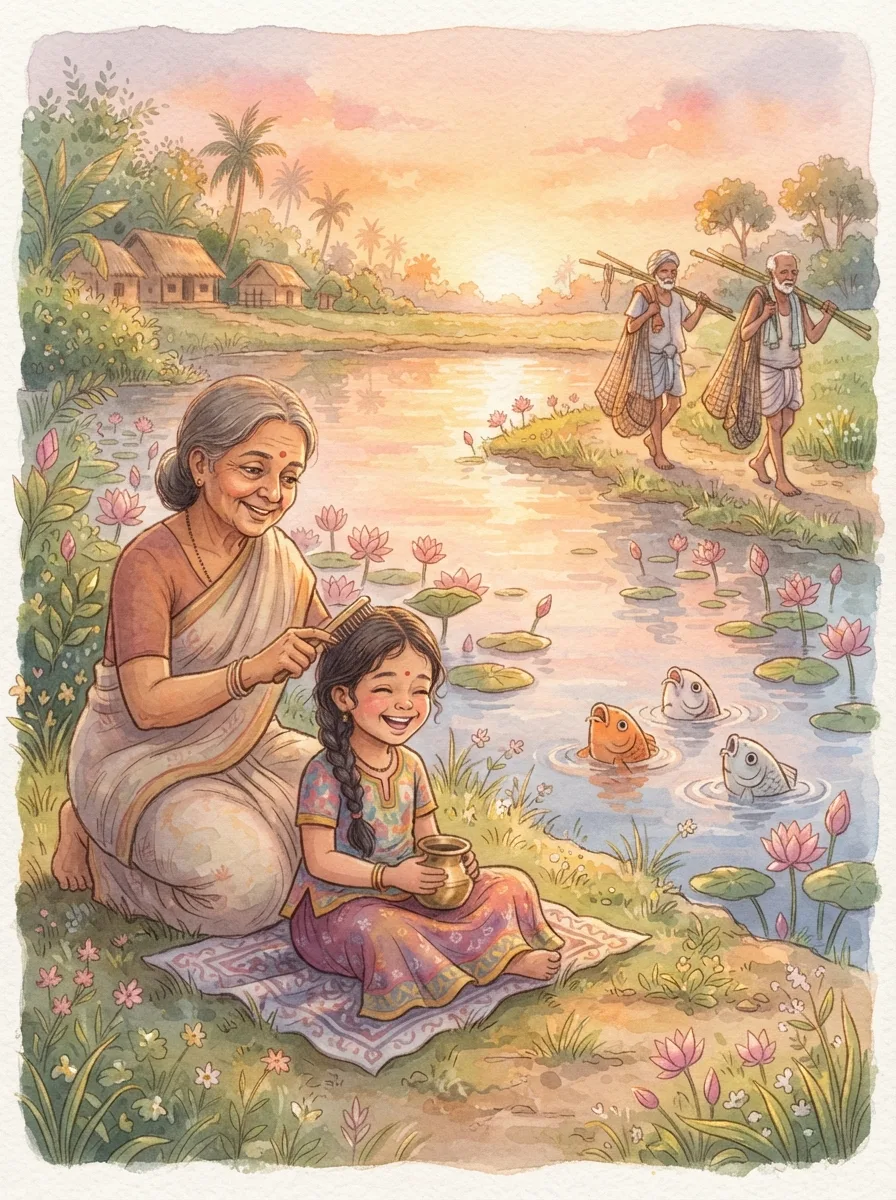
Dadi tells the tale while combing Your child's hair. Three fish friends live in a lotus pond. One evening, in Dadi's telling, Your child is filling a pot at the bank and hears two fishermen say, 'This pond is full of fish. We will bring our nets tomorrow morning.' Your child runs to the water and whispers it to the fish. The first fish gasps, the second fish blinks slowly, and the third fish yawns.
Lesson: Good news and bad news are both worth passing on quickly
The Three Fishes
Your child and the Fish Who Packed Early
Your child and the Fish Who Packed Early
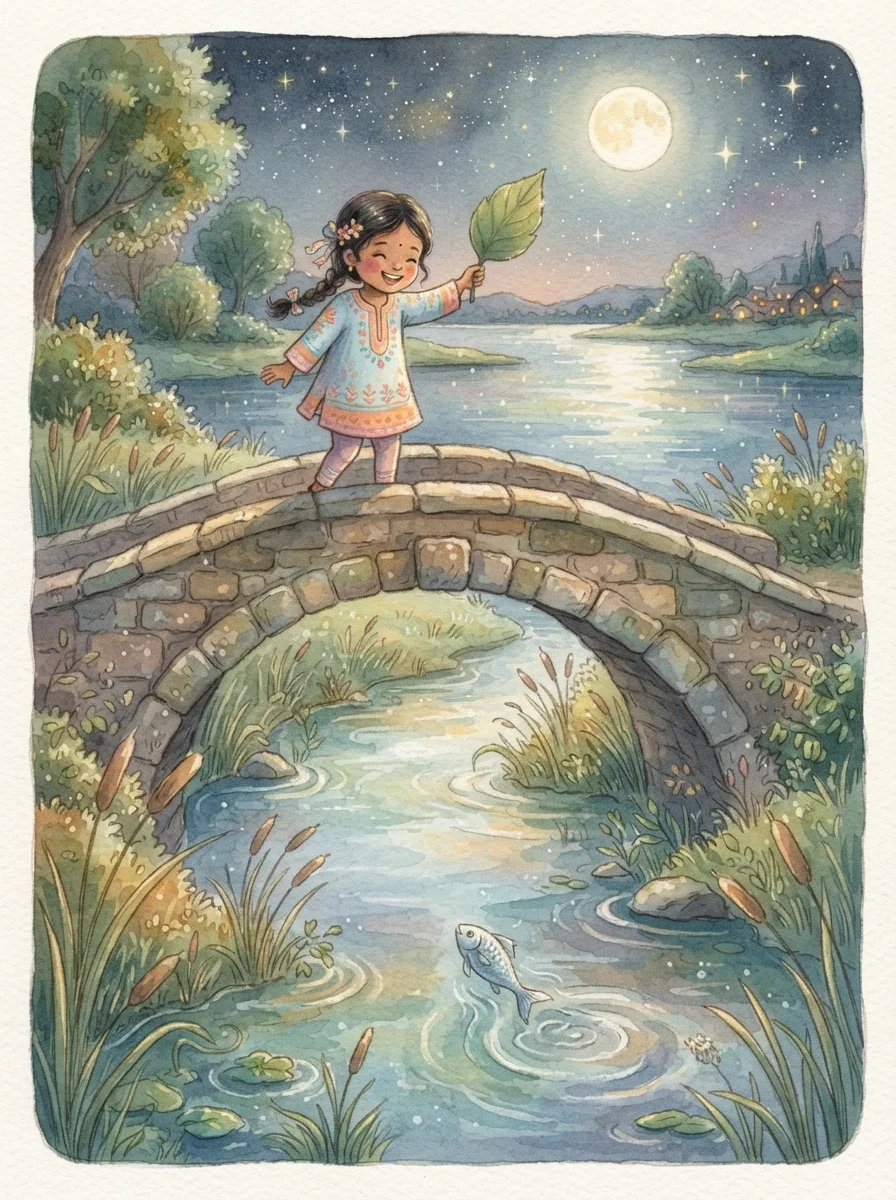
The first fish is called Anagatavidhata, which means the one who plans ahead. She says, 'If the nets come in the morning, I will leave tonight.' She asks Your child where the pond joins the river. Your child walks along the bank and finds the little stream under the bridge. That very night the first fish swims out through the stream to the wide safe river. Your child waves a leaf goodbye from the bridge.
Lesson: If you know trouble is coming, get ready today
The Three Fishes
Your child and the Two Fish Who Stayed
Your child and the Two Fish Who Stayed
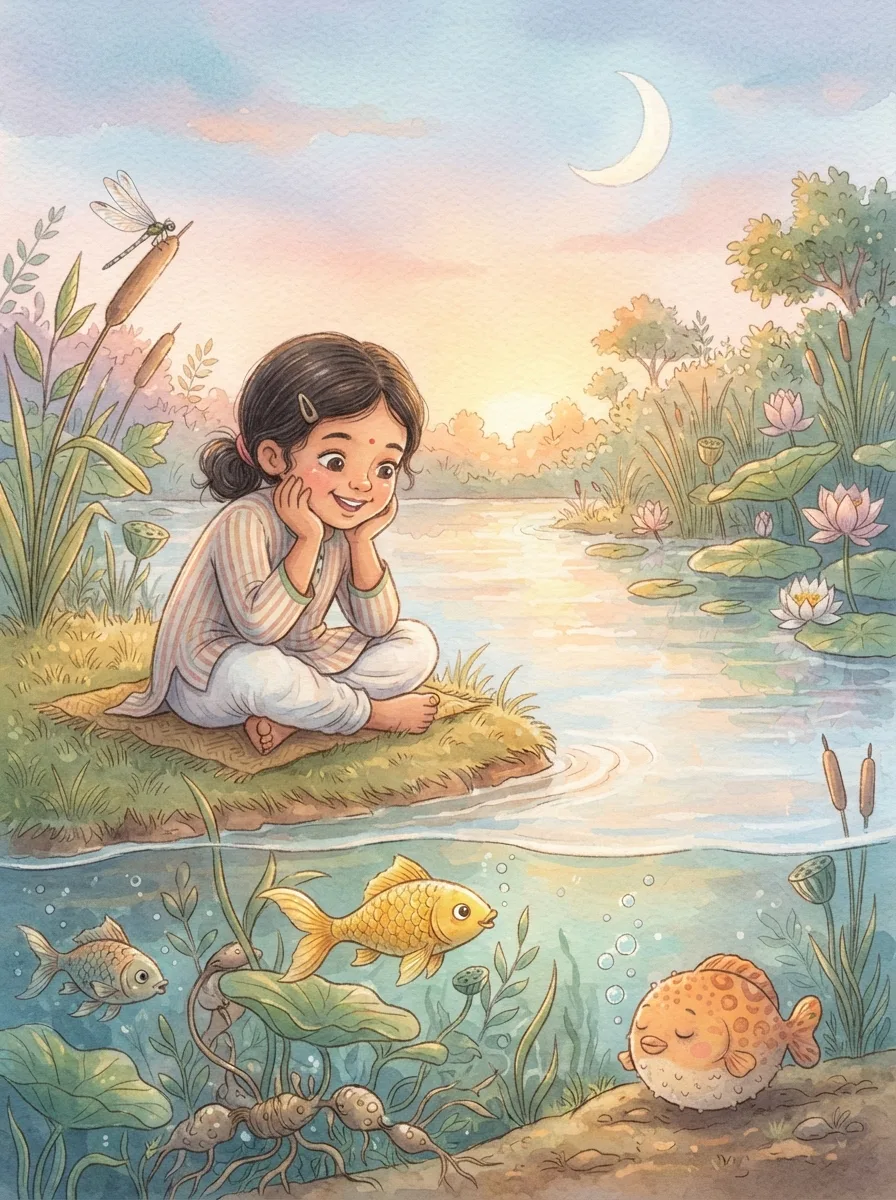
The second fish, Pratyutpannamati, means the one who thinks quickly. She says, 'I will stay, and if the net comes I will think of something on the spot.' The third fish, Yadbhavishya, means whatever will be will be. He says, 'Luck will look after me,' and goes back to sleep in the mud. Your child sits on the bank worrying and says, 'Please at least stay near the lotus roots so you can hide.'
Lesson: Thinking fast helps, but waiting for luck is not a plan
The Three Fishes
Your child and the Quick Thinker's Trick
Your child and the Quick Thinker's Trick
Morning comes and the fishermen throw their net. The quick fish is caught. She thinks fast, goes stiff, rolls over and floats on her back like a fish who is not well. Your child, helping sort the net, holds her up and says, 'Uncle, this one looks poorly, it should go back.' The fisherman nods and tosses her in. The moment she touches the water she flicks her tail and zips under the lotus leaves. Your child grins.
Lesson: A quick idea at the right moment can save the day
The Three Fishes
Your child and the Fish Who Trusted Luck
Your child and the Fish Who Trusted Luck
The third fish is still asleep when the net scoops him up. He wakes in the basket, very surprised. 'Luck?' he squeaks. 'Luck, where are you?' Your child kneels beside the basket and says to the fisherman, 'Uncle, this one is very small. Could he grow bigger for next year?' The fisherman laughs and says, 'Fair enough, little one,' and lets Your child carry him back to the pond. The third fish promises never to just wait again.
Lesson: Luck is nice, but do not leave everything to it
The Three Fishes
Your child and the Three Fishes Rule
Your child and the Three Fishes Rule
When the fishermen leave, the first fish swims back through the stream to check on her friends. All three are safe. Your child sits on the lotus root and says, 'Let us make a pond rule.' The rule is: get ready when you can, think fast when you must, and never only wait. The fish swish their tails yes. In Dadi's telling, the pond paints the rule on a flat stone, and Your child draws three little fish beside it.
Lesson: Get ready, think fast, never only wait
The Three Fishes
Your child and the Lunchbox Plan
Your child and the Lunchbox Plan
Every morning the lunchbox is a rush. Amma is hunting for the lid, Your child is hunting for socks, and the school bus honks. Your child remembers the fish who packed early. That night Your child puts the lunchbox, the bottle and the socks by the door before bed. In the morning there is time for a whole extra paratha. Amma calls Your child her first fish, and the bus driver says, 'Early today, good.'
Lesson: Get things ready the night before and mornings smile at you
The Three Fishes
Your child and the Rain at the Cricket Match
Your child and the Rain at the Cricket Match
Big grey clouds roll over the colony cricket ground. Your child says, 'Rain is coming, let us pack the bats now.' Rohan says, 'I will think of something when it starts.' Vikram says, 'It might not even rain.' It pours. Your child's bat is dry in the bag. Rohan dives under the bench and stays half dry. Vikram gets soaked and laughs. Your child shares a towel and tells them about the three fishes on the walk home.
Lesson: Look at the sky and pack your bat before the rain
The Three Fishes
Your child and the Power Cut
Your child and the Power Cut
The lights go out during dinner. Dadi is not worried, because Your child had put a candle and matches on the shelf that afternoon when the electricity uncle said the lines needed fixing. Papa uses his phone torch to find it. Bhaiya just sits in the dark and says, 'It will come back.' The candle glows, dinner goes on, and Dadi says, 'One planned, one thought fast, one waited. Just like the fish.' Your child beams.
Lesson: A candle kept ready is worth more than waiting in the dark
The Three Fishes
Your child and the Monsoon Puddle Shoes
Your child and the Monsoon Puddle Shoes
School is over and the lane outside is one big puddle. Your child had packed rubber chappals in the bag that morning after seeing the clouds, so Your child changes and splashes across happily. Meera quickly takes off her shoes and carries them, thinking fast. Aarav waits for the puddle to dry, which it does not, and finally paddles through in his school shoes. On the bus Your child tells the three fishes story, and Aarav asks for chappals for his birthday.
Lesson: Look at the clouds in the morning and pack for the afternoon
The Three Fishes
Your child and the Diwali Diyas
Your child and the Diwali Diyas
Two weeks before Diwali, Your child tells Nani, 'Let us buy the diyas now, before the market gets too full.' They buy fifty little clay lamps and paint them at home over many quiet evenings. On Diwali day, cousin Rohan runs to the market in a crowd and finds only three left. He looks sad, so Your child gives him twenty painted ones. Nani says the first fish has just lit the whole building.
Lesson: Do the big things early and there is enough to share
The Three Fishes
Your child and the Lost Water Bottle
Your child and the Lost Water Bottle
On the school picnic, Meera forgets her water bottle on the bus and the bus has gone. She is about to cry. Your child thinks fast like the second fish. Your child asks the teacher for the paper cups from the snack box and fills one from Your child's own bottle. Then Your child pours a little for Meera every time, all day long. On the way home Your child says, 'Next time, we both pack two bottles,' and they shake on it.
Lesson: Think fast for today and plan better for tomorrow
The Three Fishes
Your child and Nani's Pickle Jars
Your child and Nani's Pickle Jars
In summer Nani buys baskets of raw mangoes, and Your child helps cut them into small pieces on the terrace. 'Why so many, Nani, it is so hot,' Your child says. Nani says, 'In winter there are no mangoes, and everyone will want pickle with their parathas.' She is the first fish, Your child realises. When the cold comes, every jar is opened with a cheer, and Your child gets the first spoonful for being the helper.
Lesson: Work done in summer tastes sweetest in winter
The Three Fishes
Your child and the Fish Who Changed
Your child and the Fish Who Changed
Nani's ending is gentle. The third fish, Yadbhavishya, who once waited for luck, is now the first to notice things. When Your child visits the pond next year and says the fishermen are coming again, it is he who leads everyone through the stream to the river before dawn. 'What happened to waiting for luck?' asks Your child. 'I made my own luck,' says the fish, and splashes Your child's nose. Nani says that is the whole story.
Lesson: You can always change from the waiting fish into the ready one
The Three Fishes
Your child and the Fish Lullaby
Your child and the Fish Lullaby
After the tale, Your child cannot sleep and asks which fish is the best one. Dadi says, 'The pond needs all three. One to plan, one to think fast, and one to remind the others that nobody is perfect.' She sings a little song, plan a bit, think a bit, sleep a bit, and Your child hums along. Your child falls asleep and dreams of swimming with three friends in a pond full of lotus.
Lesson: Plan a bit, think a bit, and then rest a bit
The Three Fishes
The Clever Crow’s Pitcher
The Clever Crow’s Pitcher
In a Panchatantra-style village, a thirsty crow cannot reach the water at the bottom of a pitcher. Your child helps gather pebbles one by one, learning that patience and clever thinking can solve problems strength cannot. The story should stay respectful and child-safe, using the epic or fable as inspiration rather than a heavy retelling. Your child faces a small choice connected to courage, dharma, wisdom, or friendship, then helps the scene resolve through kindness. The ending should carry the value clearly without sounding preachy.
Lesson: Small smart steps can solve big problems.
The Three Fishes
The Lion and the Tiny Mouse
The Lion and the Tiny Mouse
A proud lion laughs when a tiny mouse offers help, until a net teaches both of them a lesson. With Your childs kindness, the mouse proves that no friend is too small to make a big difference. The story should stay respectful and child-safe, using the epic or fable as inspiration rather than a heavy retelling. Your child faces a small choice connected to courage, dharma, wisdom, or friendship, then helps the scene resolve through kindness. The ending should carry the value clearly without sounding preachy.
Lesson: Kindness to the small can return in big ways.
The Three Fishes
The Monkey and the Mango Bridge
The Monkey and the Mango Bridge
A playful monkey wants every mango first, but the branch bridge shakes whenever anyone grabs too much. Your child helps the animals share fairly, learning that greed can wobble a bridge while fairness keeps it strong. The story should stay respectful and child-safe, using the epic or fable as inspiration rather than a heavy retelling. Your child faces a small choice connected to courage, dharma, wisdom, or friendship, then helps the scene resolve through kindness. The ending should carry the value clearly without sounding preachy.
Lesson: Fair sharing keeps friendships strong.
The Three Fishes
The Wise Tortoise’s Quiet Plan
The Wise Tortoise’s Quiet Plan
When noisy animals rush toward a muddy shortcut, a wise tortoise asks Your child to wait and watch. The patient path turns out safer, teaching everyone that slow thinking can sometimes be the fastest way home. The story should stay respectful and child-safe, using the epic or fable as inspiration rather than a heavy retelling. Your child faces a small choice connected to courage, dharma, wisdom, or friendship, then helps the scene resolve through kindness. The ending should carry the value clearly without sounding preachy.
Lesson: Patience and observation can prevent avoidable mistakes.
The Three Fishes
The Jackal’s Honest Echo
A clever jackal discovers a cave that echoes every untruth louder than thunder. With Your childs help, the animals learn that cleverness is best when it walks beside honesty. The story should stay respectful and child-safe, using the epic or fable as inspiration rather than a heavy retelling. Your child faces a small choice connected to courage, dharma, wisdom, or friendship, then helps the scene resolve through kindness. The ending should carry the value clearly without sounding preachy.
Lesson: Cleverness should be guided by honesty and care.
The Three Fishes
The Blue Jackal Learns Humility
The Blue Jackal Learns Humility
In a Panchatantra-style forest, a jackal painted blue pretends to be greater than everyone else. Your child helps the animals uncover the truth kindly, learning that pretending feels heavy but honesty feels free. The story should stay respectful and child-safe, using the epic or fable as inspiration rather than a heavy retelling. Your child faces a small choice connected to courage, dharma, wisdom, or friendship, then helps the scene resolve through kindness. The ending should carry the value clearly without sounding preachy.
Lesson: Honesty and humility build better friendships than pretending.
The Three Fishes
The Talkative Turtle’s Promise
The Talkative Turtle’s Promise
A turtle promises two swans to stay quiet while flying across the sky, but words keep tickling the tongue. Your child helps the turtle practice listening, learning that some promises are kept by pausing first. The story should stay respectful and child-safe, using the epic or fable as inspiration rather than a heavy retelling. Your child faces a small choice connected to courage, dharma, wisdom, or friendship, then helps the scene resolve through kindness. The ending should carry the value clearly without sounding preachy.
Lesson: Listening and self-control help us keep promises.
The Three Fishes
The Four Friends of the Forest
The Four Friends of the Forest
A deer, crow, mouse, and turtle each has one small talent. When trouble arrives, Your child helps them combine their strengths and learns that friendship works best when everyone brings what they can. The story should stay respectful and child-safe, using the epic or fable as inspiration rather than a heavy retelling. Your child faces a small choice connected to courage, dharma, wisdom, or friendship, then helps the scene resolve through kindness. The ending should carry the value clearly without sounding preachy.
Lesson: Friends become stronger when they value each other’s different gifts.
The Three Fishes
The Wise Rabbit and the Moon Pond
The Wise Rabbit and the Moon Pond
A small rabbit must protect the pond from a boastful elephant herd without fighting. With Your childs clever plan and moonlit reflection, the animals learn that wisdom can be stronger than size. The story should stay respectful and child-safe, using the epic or fable as inspiration rather than a heavy retelling. Your child faces a small choice connected to courage, dharma, wisdom, or friendship, then helps the scene resolve through kindness. The ending should carry the value clearly without sounding preachy.
Lesson: Wisdom and calm thinking can solve problems without force.