The Mice That Ate Iron
Your child and the Iron Tarazu
Your child and the Iron Tarazu
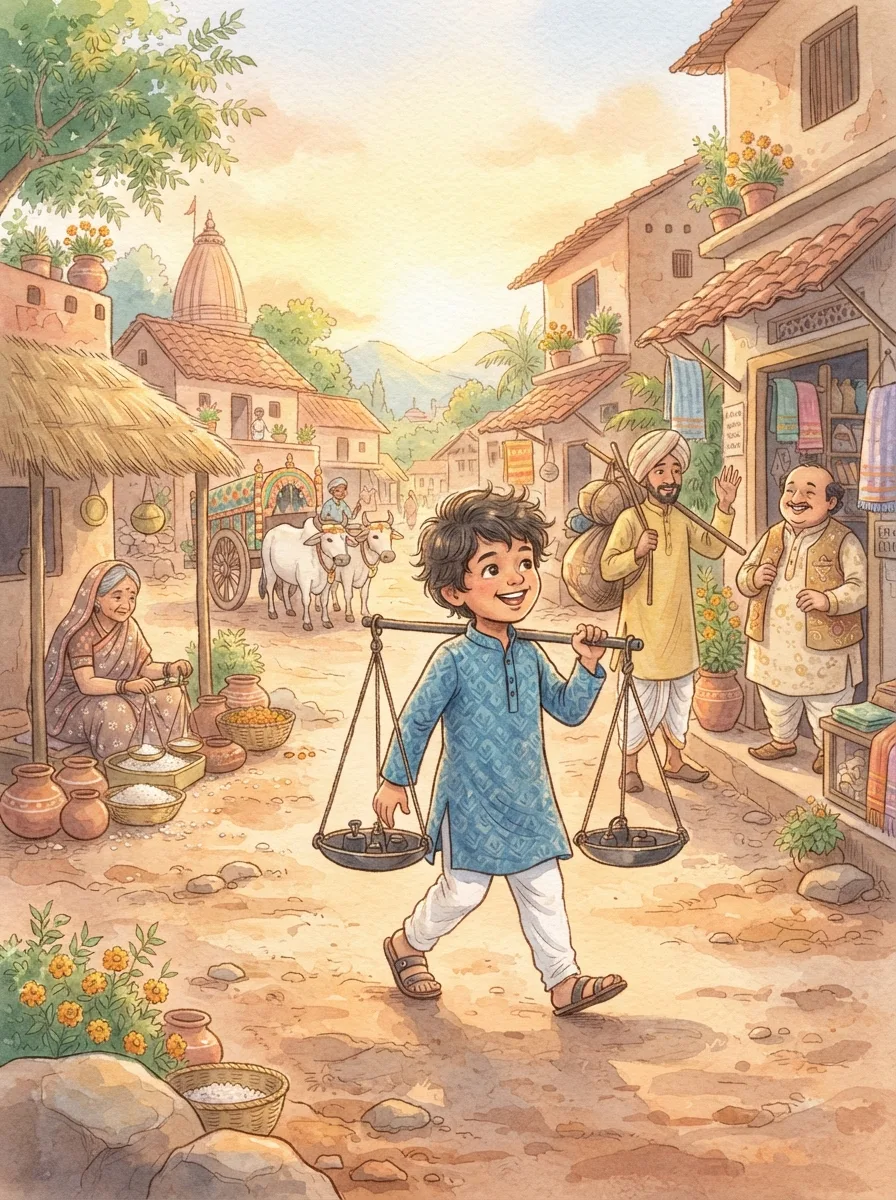
Dadi tells the tale while weighing rice on her little scale. A merchant called Jeernadhana is going on a long journey. His only treasure is a heavy iron balance, a tarazu, and he asks his friend Sethji to keep it safe. In Dadi's telling, Your child is the merchant's helper and carries the tarazu across the lane. It is so heavy Your child has to stop twice. 'Keep it well, uncle,' says Your child. Sethji promises.
Lesson: A promise to keep something safe is a real promise
The Mice That Ate Iron
Your child and the Friend Who Said Mice
Your child and the Friend Who Said Mice
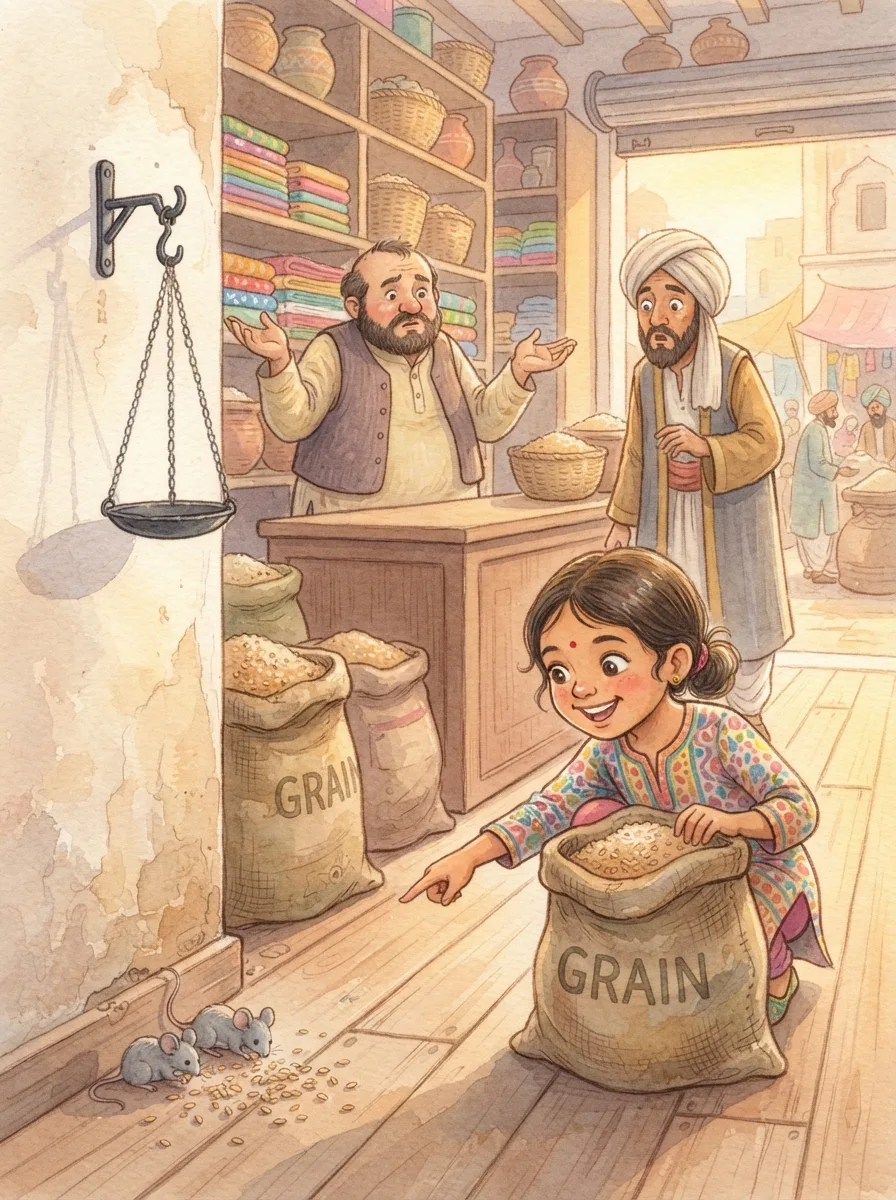
Many months later the merchant comes home. He and Your child go to fetch the tarazu. Sethji scratches his head and says, 'Oh dear, the mice ate it.' The merchant's mouth falls open. Your child peeps behind the sacks in the shop and sees two little mice nibbling grains of wheat, not iron. One mouse whispers, 'We never touched it, we cannot even bite a spoon.' Your child winks at the mouse and says nothing yet.
Lesson: When a story sounds too strange, look a little closer
The Mice That Ate Iron
Your child and the Hawk Idea
Your child and the Hawk Idea
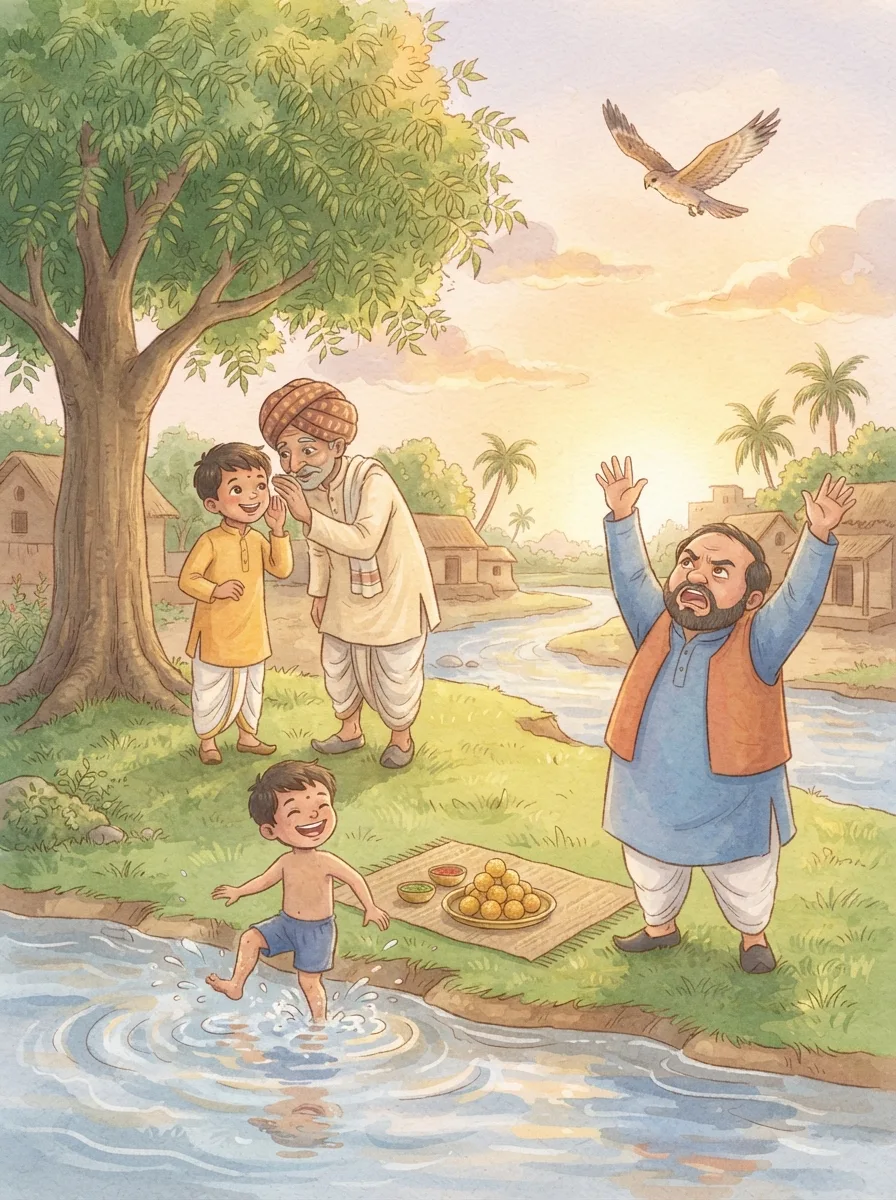
Walking home the merchant sighs. Your child has an idea and whispers it. The next day the merchant asks Sethji if his little boy Gopu can come to the river for a bath and a laddoo. Sethji agrees. Gopu has a lovely time and then stays at the merchant's house eating laddoos with Your child. When Sethji comes asking, the merchant says, 'A hawk flew down and carried him off.' Sethji shouts, 'A hawk cannot carry a boy!'
Lesson: A silly story can be answered with a sillier one
The Mice That Ate Iron
Your child and the Judge Under the Peepal
Your child and the Judge Under the Peepal
Sethji drags the merchant to the village judge under the big peepal tree. 'He says a hawk took my son!' The judge turns to the merchant. Before he can speak, Your child steps forward and says in a clear voice, 'Judge sahib, in a village where mice can eat an iron tarazu, surely a hawk can carry a boy.' The judge's moustache twitches. The whole crowd goes quiet, then bursts out laughing. Sethji goes red as a chilli.
Lesson: One clever true sentence beats a hundred tall tales
The Mice That Ate Iron
Your child and the Balance Comes Home
Your child and the Balance Comes Home
Sethji looks at his feet and says, 'The mice did not eat it. I sold it and I am sorry.' He runs and buys it back from the ironsmith. The merchant runs and fetches Gopu, who is fast asleep with a laddoo in his hand. Your child helps carry the tarazu home, and this time it feels lighter. The two friends hug. Dadi says a friendship with the truth inside it weighs just right.
Lesson: Say sorry and give it back, and friends can be friends again
The Mice That Ate Iron
Your child and the Borrowed Crayons
Your child and the Borrowed Crayons
Aarav borrowed Your child's new crayon box on Monday. On Wednesday he says the crayons melted in the sun into one big blob. Your child thinks of the mice and iron and says gently, 'If crayons melted in the classroom, the chalk would have melted too.' Aarav looks at the whole, unmelted chalk. He goes quiet and pulls the crayon box from his bag. He had just wanted to keep it one more day. Your child lets him keep the blue one.
Lesson: The truth is easier to carry than a tall story
The Mice That Ate Iron
Your child and the Cricket Ball That Vanished
Your child and the Cricket Ball That Vanished
Rohan took the colony cricket ball home yesterday. Today he says, 'A cow ate it.' Your child laughs and says, 'Then the cow must also have eaten the stumps, because those are gone too.' Rohan grins because he has the stumps under his bed as well. He runs up, brings everything down, and says he only wanted to practise alone. Your child says he can borrow them any time he asks. They play till dark.
Lesson: Ask to borrow and you never need a cow story
The Mice That Ate Iron
Your child and the Lunchbox Laddoo
Your child and the Lunchbox Laddoo
At lunch, the laddoo in Your child's lunchbox is gone. Meera says a crow flew in and took it. Your child looks at the shut window, then at the little yellow crumbs on Meera's chin, and says, 'That was a very neat crow. It closed the window on the way out.' Meera giggles and confesses. Your child says, 'Next time just ask, Amma always packs two.' The next day there are two laddoos, one with Meera's name.
Lesson: Just ask and there is usually enough for both
The Mice That Ate Iron
Your child and the Library Book
Your child and the Library Book
Vikram has had the class library book for a month. When Your child asks for it, he says his puppy ate it. Your child knows Vikram's puppy is a tiny thing that only chews socks, and says, 'That puppy would need a whole week for one page.' Vikram laughs and admits he lost it under his bed. They go to his house and find it, only a little dusty. Your child helps him return it and say sorry to Ma'am.
Lesson: A lost thing found is better than a made-up puppy
The Mice That Ate Iron
Your child and the Monsoon Umbrella
Your child and the Monsoon Umbrella
Didi borrowed Your child's frog umbrella and says the wind blew it all the way to the moon. Your child thinks of the merchant and says, 'Then the wind would have taken your hair clips too, and they are still on your head.' Didi laughs so hard she snorts, then pulls the umbrella from behind the door. One rib is bent. Together they fix it with tape, and Didi buys Your child a chocolate for being a good judge.
Lesson: A bent umbrella is easy to fix, a bent story is not
The Mice That Ate Iron
Your child and the Sabzi Wala's Scale
Your child and the Sabzi Wala's Scale
At the vegetable cart, Amma always feels the tomatoes weigh less than they should. Your child brings the one kilo weight from Nani's kitchen in a cloth bag and asks the sabzi wala, 'Uncle, can we check your scale, just for fun?' He laughs and agrees. The pan is a little bit off, so he fixes the string. From that day he calls Your child the little inspector and adds a free coriander bunch to every bag.
Lesson: A fair scale makes both the buyer and the seller happy
The Mice That Ate Iron
Your child and the Mice Who Spoke Up
Your child and the Mice Who Spoke Up
In Nani's version the mice are not quiet at all. When Sethji says they ate the iron, the two mice march out from behind the sacks and stand on Your child's shoe. 'We eat wheat and a little bit of jaggery,' squeaks the first. 'Iron gives us tummy ache,' squeaks the second. Your child lifts them onto the counter so the judge can hear. The whole village laughs, and Sethji brings the tarazu back before lunch.
Lesson: Do not blame someone small who cannot speak for themselves
The Mice That Ate Iron
Your child and the Honest Friend
Your child and the Honest Friend
Dadi tells another ending some nights. In this one, Sethji never tells a tall tale. When the merchant returns, Sethji brings out the tarazu, polished till it shines, and says, 'I oiled it every month so it would not rust.' The merchant is so happy he gives Sethji a bag of dates. Your child, who carried it across the lane, says it is now the shiniest tarazu in the whole district. Dadi says a promise kept shines like that.
Lesson: A promise kept shines brighter than iron
The Mice That Ate Iron
Your child and the Hawk Who Laughed
Your child and the Hawk Who Laughed
After the judge's laugh, a real hawk lands on the peepal branch. Everyone looks up. 'Did you hear I carried off a boy?' she says. 'I carry twigs for my nest and sometimes a small fish. Boys are much too heavy and wriggly.' Your child climbs the low wall and tells her the whole story. The hawk laughs a hawk laugh, which sounds like a whistle, and says Your child is welcome to visit her nest and see the twigs.
Lesson: Ask the one you blamed and the truth flies in
The Mice That Ate Iron
Your child and the Tarazu Drawing
Your child and the Tarazu Drawing
Art teacher asks the class to draw the story. Your child draws a big tarazu. On one pan sits a laddoo, on the other a small note that says the truth. The pans are level. 'Why are they level?' asks Ma'am. Your child says, 'Because when you tell the truth, everything feels balanced.' Ma'am pins it up beside the door so everyone sees it on the way out. Vikram whispers, 'Also, I would eat the laddoo.'
Lesson: Telling the truth keeps everything in balance
The Mice That Ate Iron
Screen Time Balance Quest
Screen Time Balance Quest
A tablet dragon keeps asking for one more minute, so Your child follows a balance map through play, rest, reading, and outdoor time. The dragon learns too: screens are most fun when they have healthy boundaries. The story should turn technology into a helpful tool that needs wise choices. Your child faces a playful digital problem, sets a boundary, and uses curiosity without losing kindness or balance. The ending should show that the smartest hero is not controlled by screens, gadgets, or shortcuts.
Lesson: Healthy boundaries help technology stay useful, fun, and balanced.
The Mice That Ate Iron
The Clever Crow’s Pitcher
The Clever Crow’s Pitcher
In a Panchatantra-style village, a thirsty crow cannot reach the water at the bottom of a pitcher. Your child helps gather pebbles one by one, learning that patience and clever thinking can solve problems strength cannot. The story should stay respectful and child-safe, using the epic or fable as inspiration rather than a heavy retelling. Your child faces a small choice connected to courage, dharma, wisdom, or friendship, then helps the scene resolve through kindness. The ending should carry the value clearly without sounding preachy.
Lesson: Small smart steps can solve big problems.
The Mice That Ate Iron
The Lion and the Tiny Mouse
The Lion and the Tiny Mouse
A proud lion laughs when a tiny mouse offers help, until a net teaches both of them a lesson. With Your childs kindness, the mouse proves that no friend is too small to make a big difference. The story should stay respectful and child-safe, using the epic or fable as inspiration rather than a heavy retelling. Your child faces a small choice connected to courage, dharma, wisdom, or friendship, then helps the scene resolve through kindness. The ending should carry the value clearly without sounding preachy.
Lesson: Kindness to the small can return in big ways.
The Mice That Ate Iron
The Monkey and the Mango Bridge
The Monkey and the Mango Bridge
A playful monkey wants every mango first, but the branch bridge shakes whenever anyone grabs too much. Your child helps the animals share fairly, learning that greed can wobble a bridge while fairness keeps it strong. The story should stay respectful and child-safe, using the epic or fable as inspiration rather than a heavy retelling. Your child faces a small choice connected to courage, dharma, wisdom, or friendship, then helps the scene resolve through kindness. The ending should carry the value clearly without sounding preachy.
Lesson: Fair sharing keeps friendships strong.
The Mice That Ate Iron
The Wise Tortoise’s Quiet Plan
The Wise Tortoise’s Quiet Plan
When noisy animals rush toward a muddy shortcut, a wise tortoise asks Your child to wait and watch. The patient path turns out safer, teaching everyone that slow thinking can sometimes be the fastest way home. The story should stay respectful and child-safe, using the epic or fable as inspiration rather than a heavy retelling. Your child faces a small choice connected to courage, dharma, wisdom, or friendship, then helps the scene resolve through kindness. The ending should carry the value clearly without sounding preachy.
Lesson: Patience and observation can prevent avoidable mistakes.
The Mice That Ate Iron
The Jackal’s Honest Echo
A clever jackal discovers a cave that echoes every untruth louder than thunder. With Your childs help, the animals learn that cleverness is best when it walks beside honesty. The story should stay respectful and child-safe, using the epic or fable as inspiration rather than a heavy retelling. Your child faces a small choice connected to courage, dharma, wisdom, or friendship, then helps the scene resolve through kindness. The ending should carry the value clearly without sounding preachy.
Lesson: Cleverness should be guided by honesty and care.
The Mice That Ate Iron
The Blue Jackal Learns Humility
The Blue Jackal Learns Humility
In a Panchatantra-style forest, a jackal painted blue pretends to be greater than everyone else. Your child helps the animals uncover the truth kindly, learning that pretending feels heavy but honesty feels free. The story should stay respectful and child-safe, using the epic or fable as inspiration rather than a heavy retelling. Your child faces a small choice connected to courage, dharma, wisdom, or friendship, then helps the scene resolve through kindness. The ending should carry the value clearly without sounding preachy.
Lesson: Honesty and humility build better friendships than pretending.
The Mice That Ate Iron
The Talkative Turtle’s Promise
The Talkative Turtle’s Promise
A turtle promises two swans to stay quiet while flying across the sky, but words keep tickling the tongue. Your child helps the turtle practice listening, learning that some promises are kept by pausing first. The story should stay respectful and child-safe, using the epic or fable as inspiration rather than a heavy retelling. Your child faces a small choice connected to courage, dharma, wisdom, or friendship, then helps the scene resolve through kindness. The ending should carry the value clearly without sounding preachy.
Lesson: Listening and self-control help us keep promises.
The Mice That Ate Iron
The Four Friends of the Forest
The Four Friends of the Forest
A deer, crow, mouse, and turtle each has one small talent. When trouble arrives, Your child helps them combine their strengths and learns that friendship works best when everyone brings what they can. The story should stay respectful and child-safe, using the epic or fable as inspiration rather than a heavy retelling. Your child faces a small choice connected to courage, dharma, wisdom, or friendship, then helps the scene resolve through kindness. The ending should carry the value clearly without sounding preachy.
Lesson: Friends become stronger when they value each other’s different gifts.
The Mice That Ate Iron
The Wise Rabbit and the Moon Pond
The Wise Rabbit and the Moon Pond
A small rabbit must protect the pond from a boastful elephant herd without fighting. With Your childs clever plan and moonlit reflection, the animals learn that wisdom can be stronger than size. The story should stay respectful and child-safe, using the epic or fable as inspiration rather than a heavy retelling. Your child faces a small choice connected to courage, dharma, wisdom, or friendship, then helps the scene resolve through kindness. The ending should carry the value clearly without sounding preachy.
Lesson: Wisdom and calm thinking can solve problems without force.