The Monkey and the Wedge
Your child and the Carpenter's Log
Your child and the Carpenter's Log
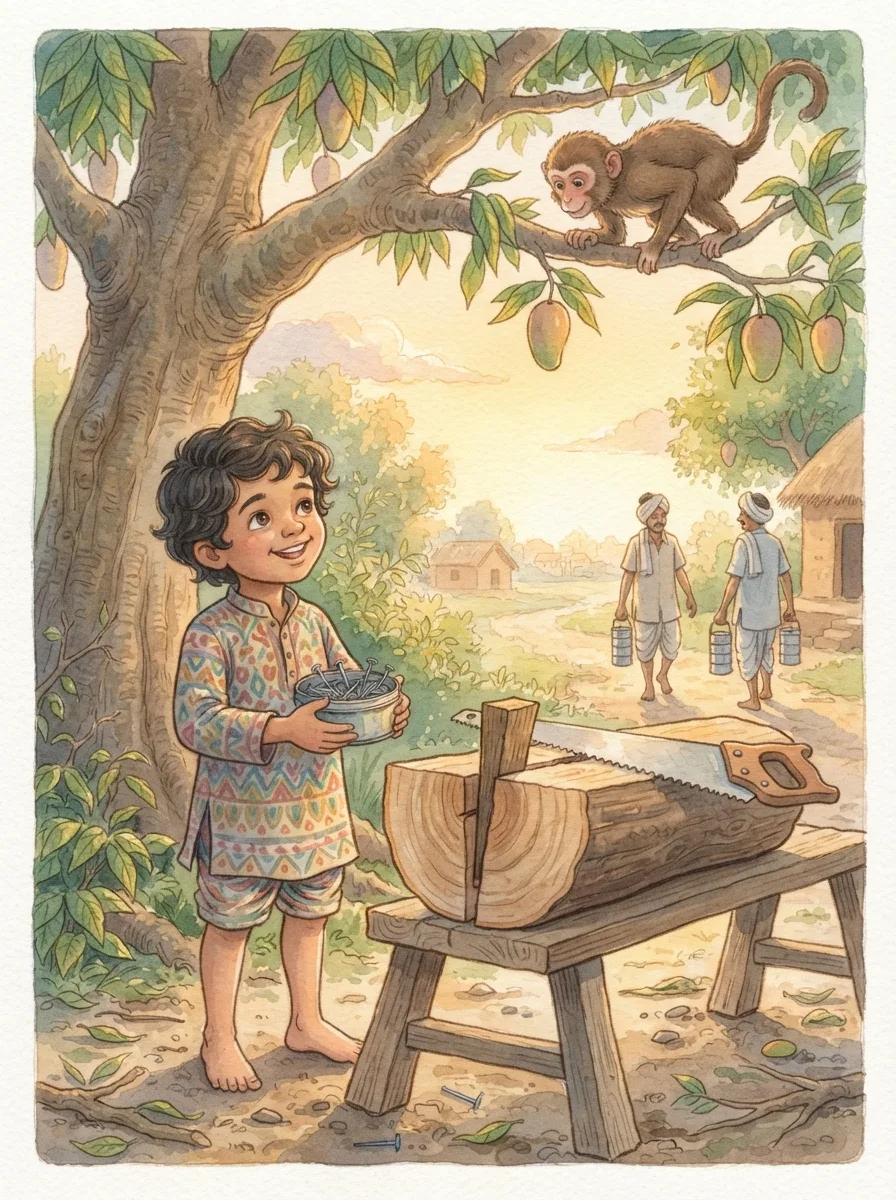
Dadi tells the tale while oiling the door hinge. Two carpenters are sawing a big log under a mango tree. They push a wooden wedge into the cut and go home for lunch. In Dadi's telling, Your child is their little helper, handing them nails from a tin. A monkey on a branch watches the wedge with shiny eyes. Your child whispers, 'That wedge is holding the log open. It is not a toy.' The monkey pretends not to hear.
Lesson: Look at what a thing is for before you touch it
The Monkey and the Wedge
Your child and the Wobbly Wedge
Your child and the Wobbly Wedge
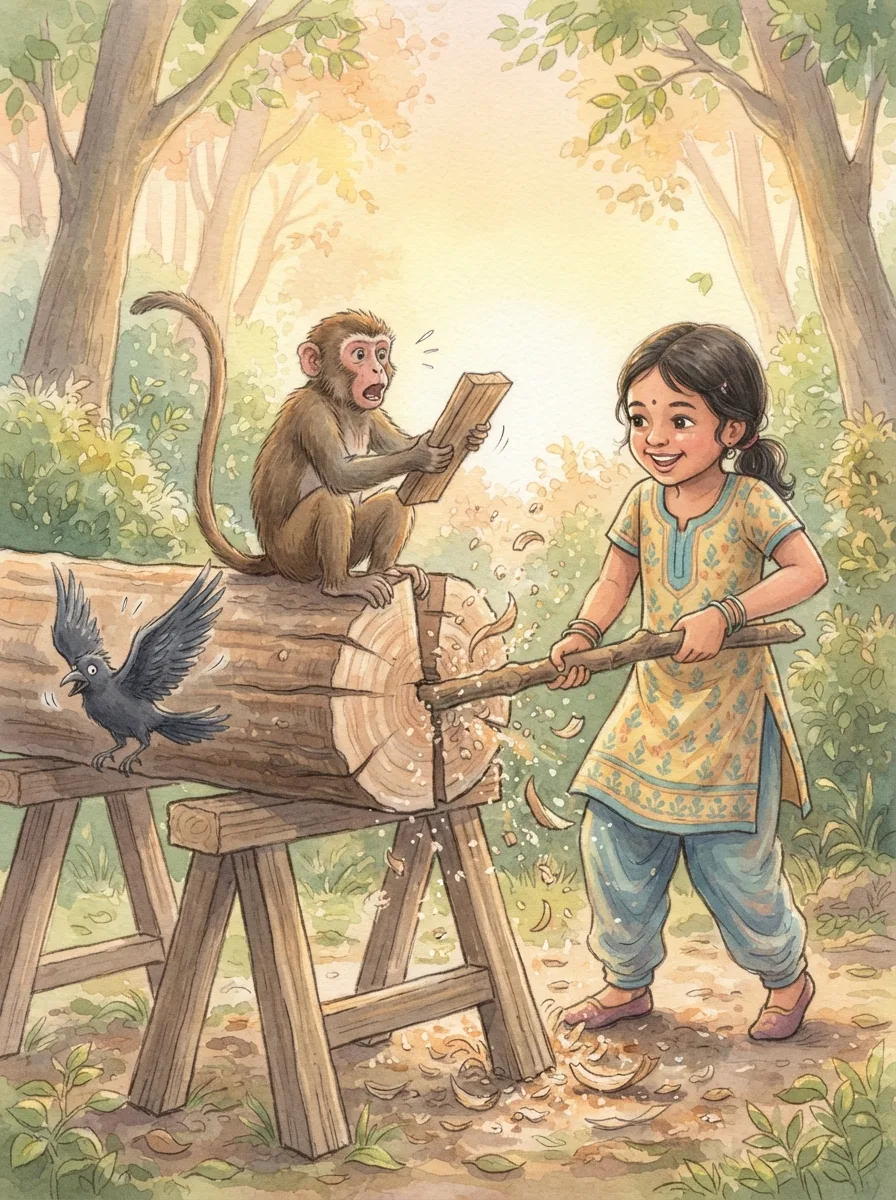
The moment the carpenters are gone, the monkey jumps onto the log. He wiggles the wedge. He tugs it. Your child runs up shouting, 'Wait, your tail is in the cut!' Too late, the wedge pops out and the log closes gently on the monkey's tail. He squeals. Your child grabs a thick stick, pushes it into the crack, and the monkey slides his tail free. It is only pinched, a little red, and very sorry.
Lesson: A quick tug can pinch harder than you think
The Monkey and the Wedge
Your child and the Monkey's Sore Tail
Your child and the Monkey's Sore Tail
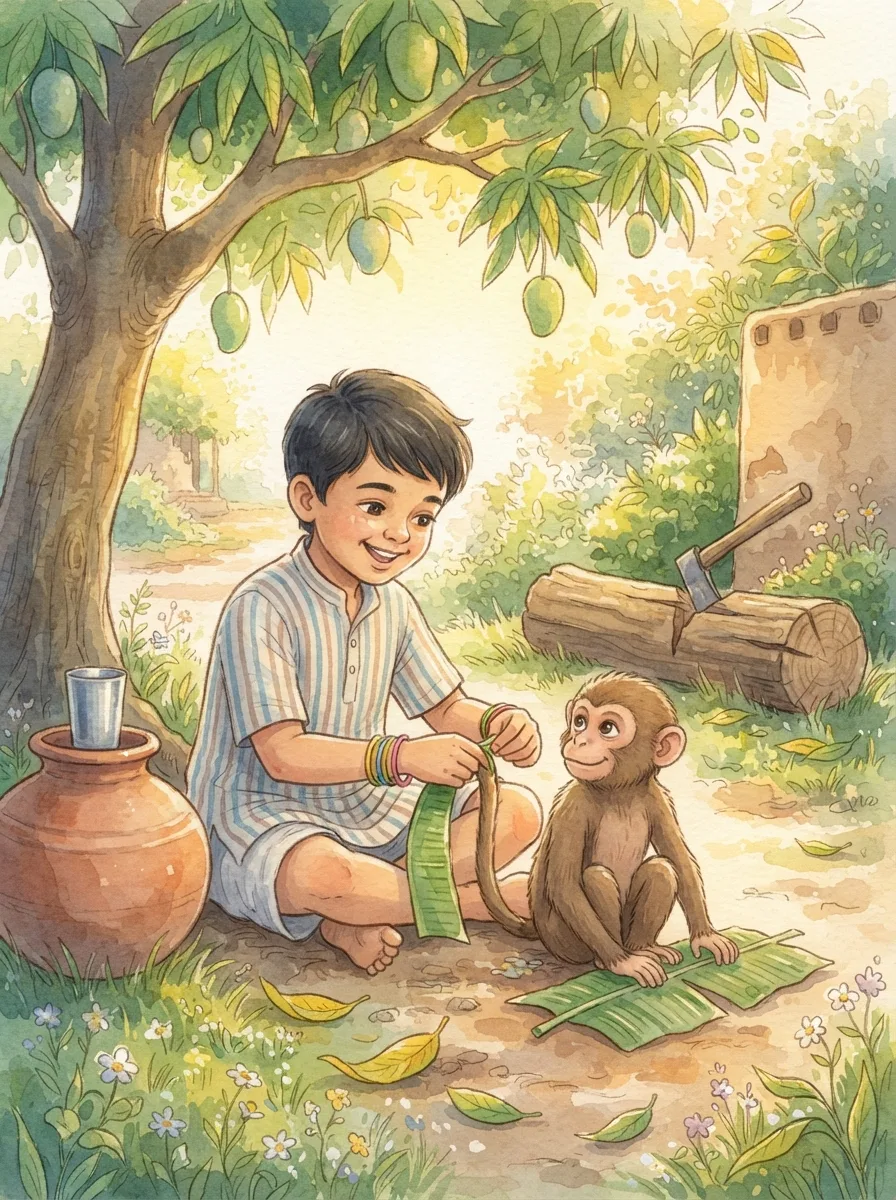
The monkey sits under the tree holding his tail and sniffing. Your child dips a banana leaf in the cool water pot and wraps it round the sore bit. 'Why did you pull it?' asks Your child. The monkey says, 'I just wanted to see what would happen.' Your child nods, because Your child also likes to see what happens. 'Next time,' says Your child, 'let us find out a way that does not pinch.' The monkey agrees, rubbing his tail.
Lesson: Wanting to know is good, getting pinched is not the only way
The Monkey and the Wedge
Your child and the Safer Way to Look
Your child and the Safer Way to Look
When the carpenters come back, Your child tells them everything. Instead of scolding, the older carpenter laughs and picks up a small offcut of wood. He cuts a tiny slit in it and gives the monkey a little wedge of his own. 'Pull this one as much as you like,' he says. The monkey pulls and pushes it a hundred times and nothing pinches. Your child claps. Now the monkey knows the safe way to be curious.
Lesson: Ask a grown-up and curiosity gets a safe place to play
The Monkey and the Wedge
Your child and the Monkey Who Asked First
Your child and the Monkey Who Asked First
Nani tells it differently at bedtime. In her version, the monkey climbs down and asks Your child, 'What is that wooden thing in the log?' Your child explains that it keeps the cut open for the saw. The monkey asks, 'Can I hold it?' Your child says, 'Not that one, but the carpenter has spare ones in his bag.' They look together, and the monkey holds a spare wedge all afternoon. Nobody gets pinched, and Nani says that is the best kind of story.
Lesson: One question saves a whole lot of ouch
The Monkey and the Wedge
Your child and Papa's Toolbox
Your child and Papa's Toolbox
Papa's red toolbox sits open on the floor while he fixes the fan. Your child sees a shiny screwdriver and reaches for it, then remembers the monkey's tail. Your child pulls the hand back and asks, 'Papa, can I hold one?' Papa smiles and hands over the measuring tape instead. It clicks and zips and is the best toy in the world. Your child measures the sofa, the dog and Papa's foot while Papa finishes the fan.
Lesson: Ask first and you might get something even better
The Monkey and the Wedge
Your child and the Pressure Cooker
Your child and the Pressure Cooker
The cooker on the stove whistles and jumps, and Your child wants to lift the little weight on top to see the steam. Amma is in the next room. Your child thinks of the monkey and the wedge and calls out, 'Amma, can I see how it works?' Amma comes, switches off the gas, and later shows the weight when the cooker is cool and quiet. Your child holds it and says, 'So this one is a wedge for steam.' Amma laughs.
Lesson: Some things you look at only when a grown-up says the time is right
The Monkey and the Wedge
Your child and the Fish Tank Filter
Your child and the Fish Tank Filter
The class fish tank has a humming box with a tube. Aarav wants to pull the tube out to see where the bubbles come from. Your child tells him about the monkey who pulled the wedge. 'It might pinch,' Aarav says. 'Or the fish might lose their bubbles,' says Your child. They ask Ma'am instead. She lifts the lid and shows them the little pump, and lets each of them drop in one pinch of fish food.
Lesson: Pulling things apart can hurt someone smaller than you
The Monkey and the Wedge
Your child and the Cricket Ball in the Drain
Your child and the Cricket Ball in the Drain
The cricket ball rolls into the colony drain grate. Rohan wants to lift the heavy iron grate himself. Your child says, 'Remember the monkey? Heavy things can slip and pinch.' They run to the watchman, Bahadur uncle, who brings a long hook and fishes the ball out in one go. He shows them how the grate is lifted only by two grown-ups together. Your child bowls the next ball extra carefully, away from the drain.
Lesson: Heavy things need a helper, not a hero
The Monkey and the Wedge
Your child and the Monsoon Gate
Your child and the Monsoon Gate
After the rain, the colony gate's spring latch is stiff and springy. Little cousin Pihu wants to pull it hard to see it snap back. Your child remembers the monkey's tail and holds Pihu's hand. 'Let us ask Bahadur uncle to show us,' says Your child. The watchman opens the latch slowly and shows the spring inside. He lets them push the gate together. Pihu jumps in a puddle instead, which is a much better thing to snap.
Lesson: Springy things bite fingers, puddles do not
The Monkey and the Wedge
Your child and Nani's Sewing Machine
Your child and Nani's Sewing Machine
Nani's old sewing machine has a big black wheel that goes round and round. Your child wants to spin it fast when Nani goes to get tea. Your child puts one finger on it, then stops and thinks of the monkey. When Nani returns, Your child asks, 'Can we make it go together?' Nani puts Your child's hand under hers on the wheel and they stitch a tiny handkerchief. Nani says, 'Now you know its secret the safe way.'
Lesson: Turning a wheel with Nani is better than alone
The Monkey and the Wedge
Your child and Didi's Paint Box
Your child and Didi's Paint Box
Didi's new paint box sits on her desk with the lid shut tight. Your child wants to open every little pot. Then Your child remembers the monkey who touched what was not his. So Your child waits by the door until Didi comes home and asks, 'May I see?' Didi is so happy Your child asked that she opens it herself, and they paint a monkey with a bandaged tail together. It goes on the fridge.
Lesson: Things that are not yours open best when you ask
The Monkey and the Wedge
Your child and the Monkey at the Temple
Your child and the Monkey at the Temple
At the hill temple, a real monkey grabs a lady's shiny spectacles and climbs a pillar. Everyone shouts. Your child thinks of the story and stays calm. Your child holds up a banana from the prasad basket and says softly, 'Swap?' The monkey looks at the spectacles, looks at the banana, and drops the spectacles right into Your child's hands. The lady laughs and says Your child must have read the Panchatantra.
Lesson: A calm voice and a banana work better than shouting
The Monkey and the Wedge
Your child and the Wedge Drawing
Your child and the Wedge Drawing
Art teacher asks the class to draw the monkey and the wedge. Most children draw the pinched tail. Your child draws the monkey standing beside the log with his hands behind his back, looking very hard with big round eyes. 'He is looking without touching,' Your child explains. Teacher pins it on the board and says, 'This monkey learnt the lesson before the story even started.' The class laughs, and Your child draws a small smile on the monkey.
Lesson: Looking hard with your eyes is also a way of exploring
The Monkey and the Wedge
Your child and the Monkey Who Became a Helper
Your child and the Monkey Who Became a Helper
Dadi ends the tale with a twist. The monkey's tail heals, and the next morning he is waiting under the mango tree. Your child gives him a job: carrying the spare wedges in a cloth bag and handing them to the carpenters when they call. The monkey is so proud he polishes each wedge with his tail. In the story, Your child and the monkey become the carpenters' two best helpers. Dadi says the log got cut in half by teatime.
Lesson: Curiosity turned into helping is the happiest ending
The Monkey and the Wedge
The Clever Crow’s Pitcher
The Clever Crow’s Pitcher
In a Panchatantra-style village, a thirsty crow cannot reach the water at the bottom of a pitcher. Your child helps gather pebbles one by one, learning that patience and clever thinking can solve problems strength cannot. The story should stay respectful and child-safe, using the epic or fable as inspiration rather than a heavy retelling. Your child faces a small choice connected to courage, dharma, wisdom, or friendship, then helps the scene resolve through kindness. The ending should carry the value clearly without sounding preachy.
Lesson: Small smart steps can solve big problems.
The Monkey and the Wedge
The Lion and the Tiny Mouse
The Lion and the Tiny Mouse
A proud lion laughs when a tiny mouse offers help, until a net teaches both of them a lesson. With Your childs kindness, the mouse proves that no friend is too small to make a big difference. The story should stay respectful and child-safe, using the epic or fable as inspiration rather than a heavy retelling. Your child faces a small choice connected to courage, dharma, wisdom, or friendship, then helps the scene resolve through kindness. The ending should carry the value clearly without sounding preachy.
Lesson: Kindness to the small can return in big ways.
The Monkey and the Wedge
The Monkey and the Mango Bridge
The Monkey and the Mango Bridge
A playful monkey wants every mango first, but the branch bridge shakes whenever anyone grabs too much. Your child helps the animals share fairly, learning that greed can wobble a bridge while fairness keeps it strong. The story should stay respectful and child-safe, using the epic or fable as inspiration rather than a heavy retelling. Your child faces a small choice connected to courage, dharma, wisdom, or friendship, then helps the scene resolve through kindness. The ending should carry the value clearly without sounding preachy.
Lesson: Fair sharing keeps friendships strong.
The Monkey and the Wedge
The Wise Tortoise’s Quiet Plan
The Wise Tortoise’s Quiet Plan
When noisy animals rush toward a muddy shortcut, a wise tortoise asks Your child to wait and watch. The patient path turns out safer, teaching everyone that slow thinking can sometimes be the fastest way home. The story should stay respectful and child-safe, using the epic or fable as inspiration rather than a heavy retelling. Your child faces a small choice connected to courage, dharma, wisdom, or friendship, then helps the scene resolve through kindness. The ending should carry the value clearly without sounding preachy.
Lesson: Patience and observation can prevent avoidable mistakes.
The Monkey and the Wedge
The Jackal’s Honest Echo
A clever jackal discovers a cave that echoes every untruth louder than thunder. With Your childs help, the animals learn that cleverness is best when it walks beside honesty. The story should stay respectful and child-safe, using the epic or fable as inspiration rather than a heavy retelling. Your child faces a small choice connected to courage, dharma, wisdom, or friendship, then helps the scene resolve through kindness. The ending should carry the value clearly without sounding preachy.
Lesson: Cleverness should be guided by honesty and care.
The Monkey and the Wedge
The Blue Jackal Learns Humility
The Blue Jackal Learns Humility
In a Panchatantra-style forest, a jackal painted blue pretends to be greater than everyone else. Your child helps the animals uncover the truth kindly, learning that pretending feels heavy but honesty feels free. The story should stay respectful and child-safe, using the epic or fable as inspiration rather than a heavy retelling. Your child faces a small choice connected to courage, dharma, wisdom, or friendship, then helps the scene resolve through kindness. The ending should carry the value clearly without sounding preachy.
Lesson: Honesty and humility build better friendships than pretending.
The Monkey and the Wedge
The Talkative Turtle’s Promise
The Talkative Turtle’s Promise
A turtle promises two swans to stay quiet while flying across the sky, but words keep tickling the tongue. Your child helps the turtle practice listening, learning that some promises are kept by pausing first. The story should stay respectful and child-safe, using the epic or fable as inspiration rather than a heavy retelling. Your child faces a small choice connected to courage, dharma, wisdom, or friendship, then helps the scene resolve through kindness. The ending should carry the value clearly without sounding preachy.
Lesson: Listening and self-control help us keep promises.
The Monkey and the Wedge
The Four Friends of the Forest
The Four Friends of the Forest
A deer, crow, mouse, and turtle each has one small talent. When trouble arrives, Your child helps them combine their strengths and learns that friendship works best when everyone brings what they can. The story should stay respectful and child-safe, using the epic or fable as inspiration rather than a heavy retelling. Your child faces a small choice connected to courage, dharma, wisdom, or friendship, then helps the scene resolve through kindness. The ending should carry the value clearly without sounding preachy.
Lesson: Friends become stronger when they value each other’s different gifts.
The Monkey and the Wedge
The Wise Rabbit and the Moon Pond
The Wise Rabbit and the Moon Pond
A small rabbit must protect the pond from a boastful elephant herd without fighting. With Your childs clever plan and moonlit reflection, the animals learn that wisdom can be stronger than size. The story should stay respectful and child-safe, using the epic or fable as inspiration rather than a heavy retelling. Your child faces a small choice connected to courage, dharma, wisdom, or friendship, then helps the scene resolve through kindness. The ending should carry the value clearly without sounding preachy.
Lesson: Wisdom and calm thinking can solve problems without force.