The Heron and the Crab
Your child and the Heron Who Stopped Fishing
Your child and the Heron Who Stopped Fishing
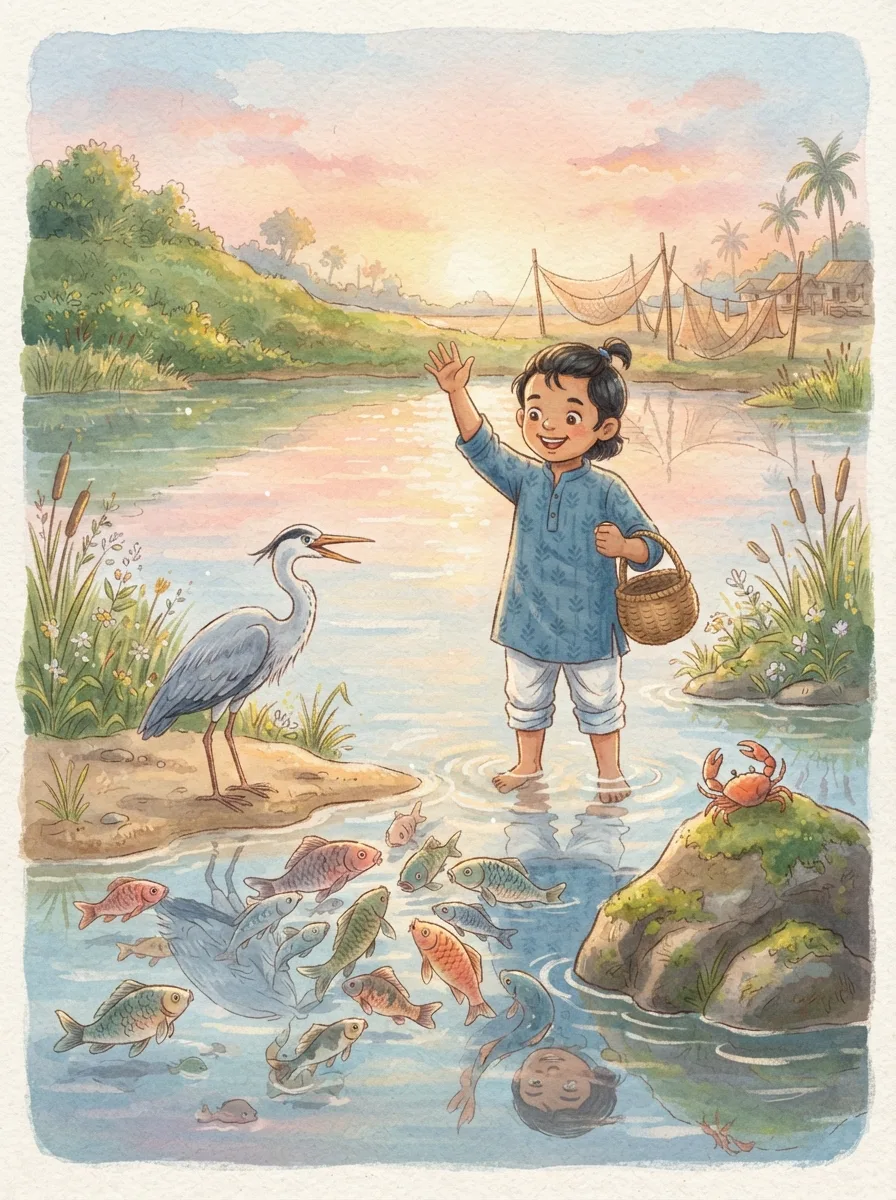
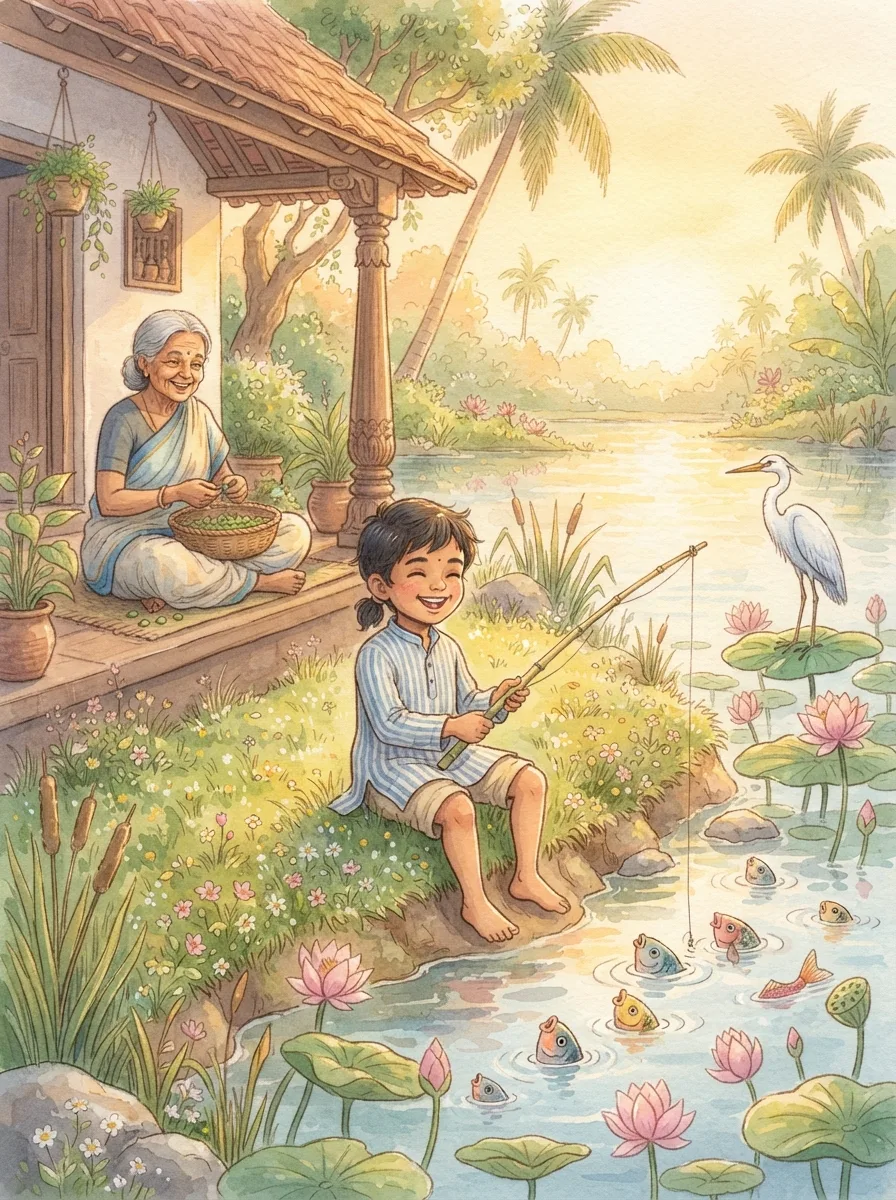
Nani tells the tale while shelling peas. An old heron stands at the edge of a lotus pond, sighing that he has given up fish forever. The fish are amazed. In Nani's telling, Your child is fishing with a bamboo rod nearby and notices the heron's eyes keep flicking to the water. Your child whispers to the fish, 'Sad eyes do not usually watch dinner.' The fish decide to listen a little more carefully.
Lesson: Sweet words are worth checking against watchful eyes
The Heron and the Crab
Your child and the Safer Pond
Your child and the Safer Pond
The heron tells the fish that fishermen are coming with nets, and offers to carry them one by one to a deeper pond over the hill. The fish cheer. Your child, in Dadaji's story, asks a simple question: 'Which hill, and can we see it?' The heron flaps and mumbles. Your child suggests that the crab go first and come back to tell everyone. The heron says the crab is too heavy. The fish begin to wonder.
Lesson: Ask to see the safe place before you agree to go there
The Heron and the Crab
Your child and the Pile of Bones
Your child and the Pile of Bones
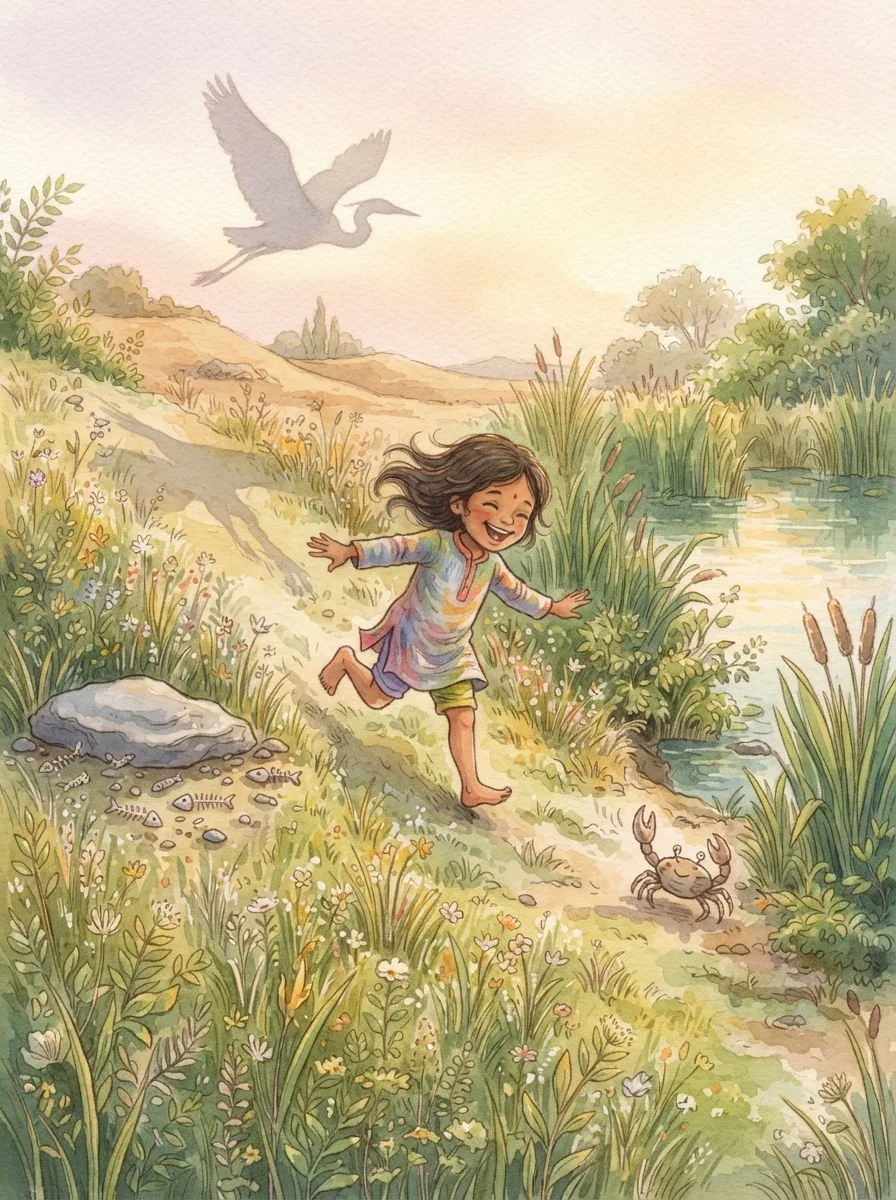
The heron has already carried away three fish. Your child, in the tale, follows his shadow over the hill and finds a flat rock with little fish bones scattered around it, and no pond anywhere. Instead of shouting, Your child runs back and tells the crab quietly. The crab says, 'Then I shall ask for a ride and keep my claws ready.' Your child hides in the reeds to watch, heart thumping.
Lesson: Check the facts yourself, then tell someone brave
The Heron and the Crab
Your child and the Crab's Clever Ride
Your child and the Crab's Clever Ride
The heron agrees to carry the crab and flies towards the rock. Halfway, the crab sees the bones and gently but firmly grips the heron's neck. 'Take me back to the pond, please,' the crab says, 'or I hold tighter.' In the story, Your child waves from the bank to guide them home. The heron lands, drops the crab, and flies off ashamed. Nobody is hurt, and the pond has learnt to look before it leaps.
Lesson: Cleverness saves you when strength cannot
The Heron and the Crab
Your child Warns the Fish
Your child Warns the Fish
After the crab returns, the fish are still arguing about whether the heron meant well. Your child gathers them at the lotus root and tells them what the bones looked like. Then Your child suggests a pond rule: nobody leaves with a stranger, however kind, unless two friends have seen the place first. The fish swish their tails in agreement. When a new heron arrives next spring, every fish knows the rule by heart.
Lesson: One warning shared saves a whole pond
The Heron and the Crab
Your child and the Free Tuition Uncle
Your child and the Free Tuition Uncle
A man in a shiny kurta comes to the colony offering free tuition, but first every child must hand him their school report for 'admission'. The mothers are delighted. Your child remembers the heron and asks where the classroom is. The man points vaguely towards the highway. Your child tells Papa, who calls the school, which has never heard of him. The man leaves quickly. The colony sets up its own study circle instead.
Lesson: Don't trust sweet talk that cannot show you a real place
The Heron and the Crab
Your child and the Mango Seller
Your child and the Mango Seller
A mango seller at the station calls out that his mangoes are the sweetest in Ratnagiri, sweeter than sugar, and Amma reaches for her purse. Your child asks to cut one first. The seller grumbles but agrees, and the mango is sour. Your child doesn't laugh at him; instead they walk to the next cart, where the seller cuts a slice before anyone asks. Amma buys a dozen and lets Your child carry the basket.
Lesson: Taste one before you buy the whole basket
The Heron and the Crab
Your child's Online Prize
Your child's Online Prize
A message pops up on Didi's tablet saying she has won a bicycle and only needs to type in Papa's card number to collect it. Didi is excited. Your child thinks of the heron's safer pond and says, 'Did you enter any contest?' She hadn't. Together they show Papa, who explains how such tricks work. Didi is a little sad about the bicycle, so Your child lends the old one until Diwali, when there might be a real one.
Lesson: A prize you never entered for is usually bait
The Heron and the Crab
Your child and the Fisherman of Vembanad
Your child and the Fisherman of Vembanad
Visiting cousins in Kerala, Your child rides in a canoe with Chettan, the fisherman, who says the heron on the paddy bund is his best friend because it warns him of fish. Your child watches and sees the heron only ever warns when the fish are near its own feet. Your child laughs and tells Chettan the Panchatantra tale. Chettan laughs too, and for the rest of the day they read the water themselves.
Lesson: Friends who only help themselves are not really helping you
The Heron and the Crab
Your child and the Crab in the Classroom
Your child and the Crab in the Classroom
Science teacher brings a live crab in a tub for the class to observe. The bully Vikram tells the smaller kids the crab can jump and bite, so they should give him their seats in front. Your child reads the chart on the board: crabs walk sideways and cannot jump. Your child says so, calmly, and the little ones return to their seats. Vikram sulks, then asks if he can hold the crab too, and Your child shows him how.
Lesson: Check the facts and fear loses its grip
The Heron and the Crab
Your child and the Empty Hill
Your child and the Empty Hill
In the retelling Papa gives on the road to Nainital, the fish never get carried away at all. Your child, in the tale, climbs the hill the very first evening the heron talks of a deeper pond, and finds only dry grass and a rock. Your child comes back and does not accuse the heron; instead Your child invites him to show everyone the pond tomorrow. The heron does not turn up. The fish understand without a single bone.
Lesson: The easiest way to test a promise is to ask to see it
The Heron and the Crab
Your child's Neighbourhood Watch
Your child's Neighbourhood Watch
Someone rings the doorbell claiming to be from the water board and asks to be let in to check the tank while Amma is out. Dadi hesitates. Your child, remembering how the crab checked before trusting, asks for an identity card and calls the number on the water bill. The office has sent nobody. The man leaves. Dadi hugs Your child and telephones every flat in the building so the neighbours know too.
Lesson: Check who is at the door before you open it
The Heron and the Crab
Your child and the Heron Who Said Sorry
Your child and the Heron Who Said Sorry
Nani's version has an ending nobody expects. The heron, exposed and hungry, sits alone in the reeds. Your child in the tale brings him a handful of snails and asks why he lied. He says he was too old to catch fish honestly. Your child suggests he guard the pond from the kingfisher instead, in exchange for the fish's leftover weeds and snails. The heron agrees, and becomes the pond's watchman.
Lesson: Even a trickster can choose a better job
The Heron and the Crab
Your child and the Village Well Rumour
Your child and the Village Well Rumour
A rumour runs through the village that the well water has gone bad and everyone should buy water from a new tanker uncle instead. Grandmothers are worried. Your child takes a cup of well water to the primary health centre, where the nurse tests it and finds it clean. Your child reads the report out loud at the panchayat tree. The tanker leaves. The sarpanch gives Your child the job of ringing the bell for real announcements.
Lesson: A rumour cannot survive one honest test
The Heron and the Crab
Your child and the Fish Who Asked Questions
Your child and the Fish Who Asked Questions
In the last bit of the tale, the youngest fish, Chhoti, is embarrassed that she believed the heron. Your child tells her that the crab believed him too, at first; the difference was that the crab kept looking. Chhoti asks so many questions afterwards that the pond calls her the little judge. Your child smiles at Nani and promises to be a Chhoti too, asking one more question than seems polite.
Lesson: Ask one more question than seems polite
The Heron and the Crab
The Clever Crow’s Pitcher
The Clever Crow’s Pitcher
In a Panchatantra-style village, a thirsty crow cannot reach the water at the bottom of a pitcher. Your child helps gather pebbles one by one, learning that patience and clever thinking can solve problems strength cannot. The story should stay respectful and child-safe, using the epic or fable as inspiration rather than a heavy retelling. Your child faces a small choice connected to courage, dharma, wisdom, or friendship, then helps the scene resolve through kindness. The ending should carry the value clearly without sounding preachy.
Lesson: Small smart steps can solve big problems.
The Heron and the Crab
The Lion and the Tiny Mouse
The Lion and the Tiny Mouse
A proud lion laughs when a tiny mouse offers help, until a net teaches both of them a lesson. With Your childs kindness, the mouse proves that no friend is too small to make a big difference. The story should stay respectful and child-safe, using the epic or fable as inspiration rather than a heavy retelling. Your child faces a small choice connected to courage, dharma, wisdom, or friendship, then helps the scene resolve through kindness. The ending should carry the value clearly without sounding preachy.
Lesson: Kindness to the small can return in big ways.
The Heron and the Crab
The Monkey and the Mango Bridge
The Monkey and the Mango Bridge
A playful monkey wants every mango first, but the branch bridge shakes whenever anyone grabs too much. Your child helps the animals share fairly, learning that greed can wobble a bridge while fairness keeps it strong. The story should stay respectful and child-safe, using the epic or fable as inspiration rather than a heavy retelling. Your child faces a small choice connected to courage, dharma, wisdom, or friendship, then helps the scene resolve through kindness. The ending should carry the value clearly without sounding preachy.
Lesson: Fair sharing keeps friendships strong.
The Heron and the Crab
The Wise Tortoise’s Quiet Plan
The Wise Tortoise’s Quiet Plan
When noisy animals rush toward a muddy shortcut, a wise tortoise asks Your child to wait and watch. The patient path turns out safer, teaching everyone that slow thinking can sometimes be the fastest way home. The story should stay respectful and child-safe, using the epic or fable as inspiration rather than a heavy retelling. Your child faces a small choice connected to courage, dharma, wisdom, or friendship, then helps the scene resolve through kindness. The ending should carry the value clearly without sounding preachy.
Lesson: Patience and observation can prevent avoidable mistakes.
The Heron and the Crab
The Jackal’s Honest Echo
A clever jackal discovers a cave that echoes every untruth louder than thunder. With Your childs help, the animals learn that cleverness is best when it walks beside honesty. The story should stay respectful and child-safe, using the epic or fable as inspiration rather than a heavy retelling. Your child faces a small choice connected to courage, dharma, wisdom, or friendship, then helps the scene resolve through kindness. The ending should carry the value clearly without sounding preachy.
Lesson: Cleverness should be guided by honesty and care.
The Heron and the Crab
The Blue Jackal Learns Humility
The Blue Jackal Learns Humility
In a Panchatantra-style forest, a jackal painted blue pretends to be greater than everyone else. Your child helps the animals uncover the truth kindly, learning that pretending feels heavy but honesty feels free. The story should stay respectful and child-safe, using the epic or fable as inspiration rather than a heavy retelling. Your child faces a small choice connected to courage, dharma, wisdom, or friendship, then helps the scene resolve through kindness. The ending should carry the value clearly without sounding preachy.
Lesson: Honesty and humility build better friendships than pretending.
The Heron and the Crab
The Talkative Turtle’s Promise
The Talkative Turtle’s Promise
A turtle promises two swans to stay quiet while flying across the sky, but words keep tickling the tongue. Your child helps the turtle practice listening, learning that some promises are kept by pausing first. The story should stay respectful and child-safe, using the epic or fable as inspiration rather than a heavy retelling. Your child faces a small choice connected to courage, dharma, wisdom, or friendship, then helps the scene resolve through kindness. The ending should carry the value clearly without sounding preachy.
Lesson: Listening and self-control help us keep promises.
The Heron and the Crab
The Four Friends of the Forest
The Four Friends of the Forest
A deer, crow, mouse, and turtle each has one small talent. When trouble arrives, Your child helps them combine their strengths and learns that friendship works best when everyone brings what they can. The story should stay respectful and child-safe, using the epic or fable as inspiration rather than a heavy retelling. Your child faces a small choice connected to courage, dharma, wisdom, or friendship, then helps the scene resolve through kindness. The ending should carry the value clearly without sounding preachy.
Lesson: Friends become stronger when they value each other’s different gifts.
The Heron and the Crab
The Wise Rabbit and the Moon Pond
The Wise Rabbit and the Moon Pond
A small rabbit must protect the pond from a boastful elephant herd without fighting. With Your childs clever plan and moonlit reflection, the animals learn that wisdom can be stronger than size. The story should stay respectful and child-safe, using the epic or fable as inspiration rather than a heavy retelling. Your child faces a small choice connected to courage, dharma, wisdom, or friendship, then helps the scene resolve through kindness. The ending should carry the value clearly without sounding preachy.
Lesson: Wisdom and calm thinking can solve problems without force.