The Hermit and the Mouse
Your child and the Mouse in the Hermit's Hut
Your child and the Mouse in the Hermit's Hut
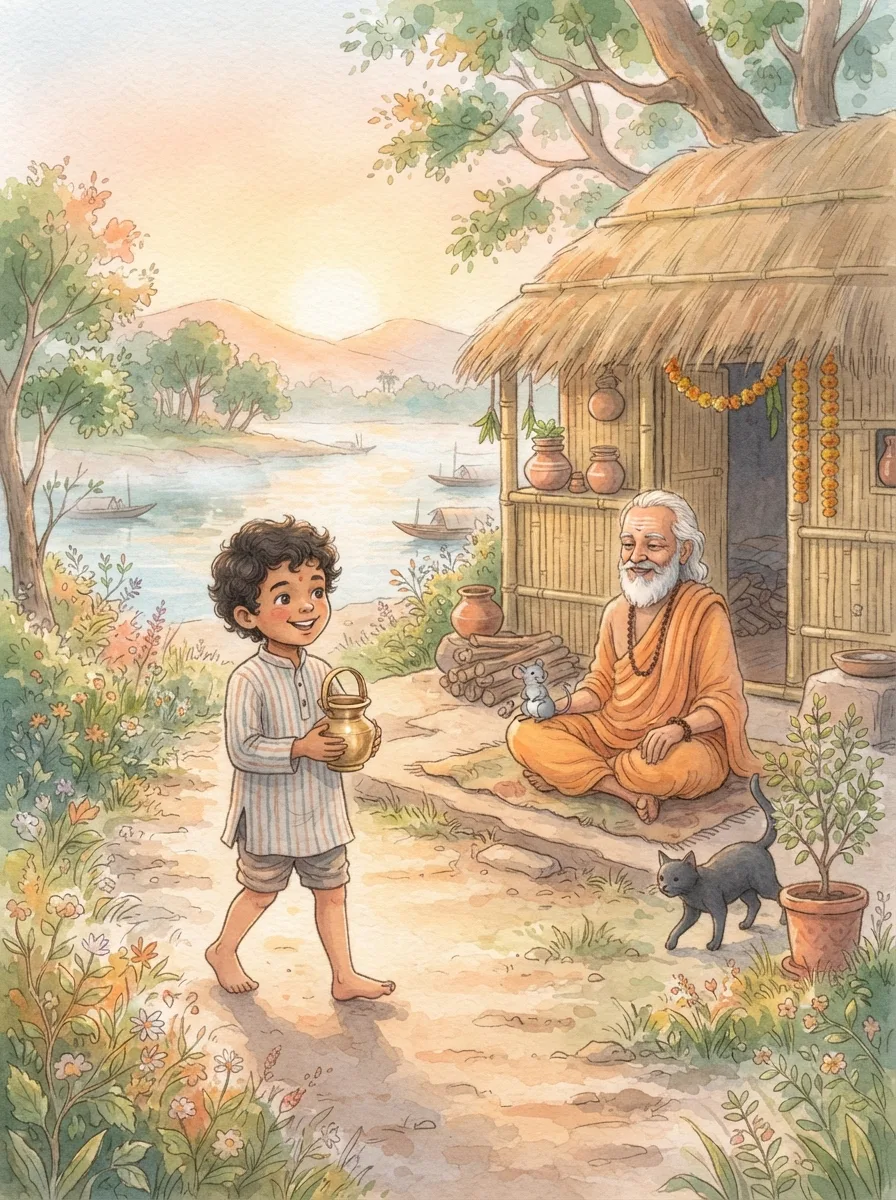
Dadaji tells the tale by the winter fire. A hermit by the Ganga finds a tiny mouse dropped by a crow and nurses it with rice grains. In the story, Your child carries water to the hut every morning and watches the mouse grow bold enough to sit on the hermit's knee. When the mouse trembles at a passing cat, Your child says, 'Sadhu ji, can you help him?' The hermit smiles and closes his eyes to chant.
Lesson: Small kindness at the start makes the biggest stories
The Hermit and the Mouse
Your child and the Mouse Who Became a Cat
Your child and the Mouse Who Became a Cat
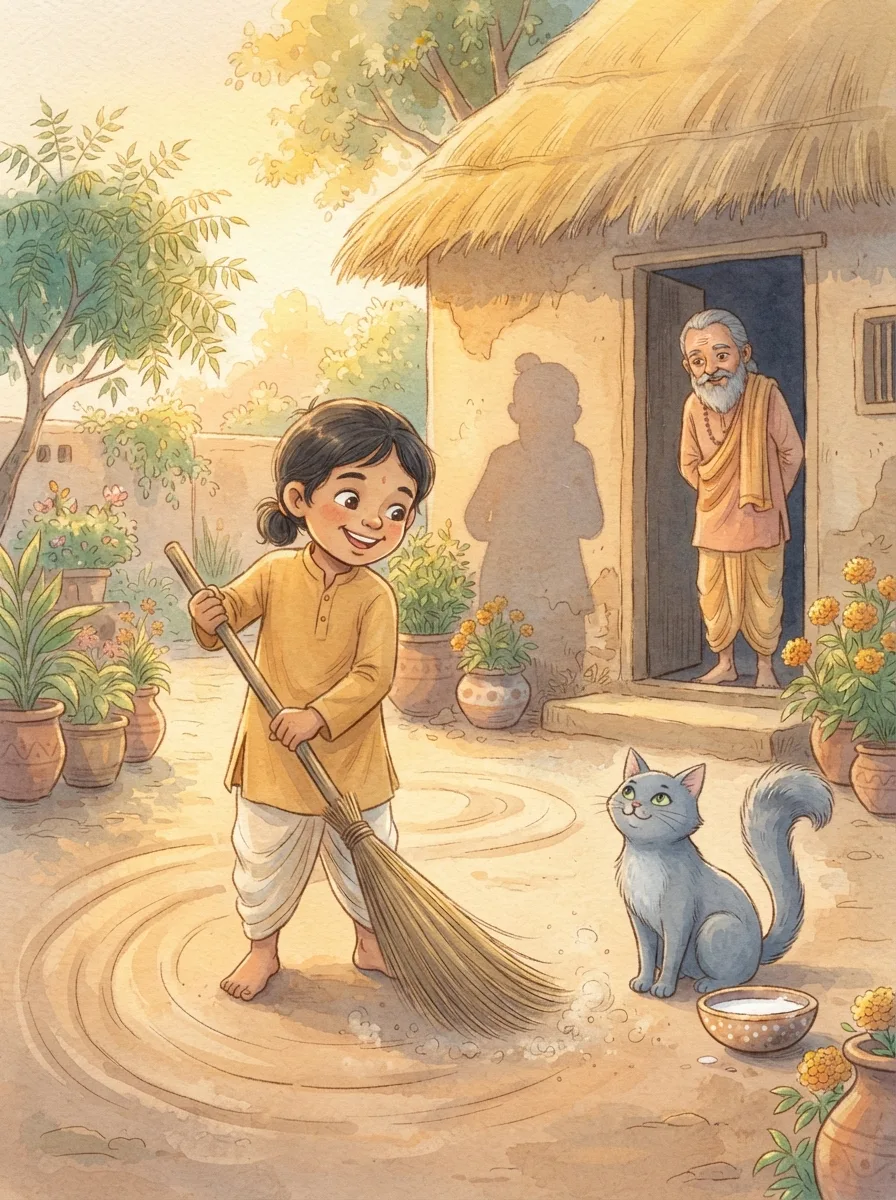
With a chant, the hermit turns the mouse into a cat, and the cat struts round the hut chasing its own shadow. Your child, sweeping the courtyard in the tale, notices the cat no longer says thank you for its milk and just stares at the bowl until it is filled. Your child gently says, 'A bigger body needs a bigger heart, not a smaller one.' The cat blinks, licks Your child's hand, and purrs a thank you.
Lesson: Growing bigger should never make your thank you smaller
The Hermit and the Mouse
Your child and the Dog That Barked at the Ganga
Your child and the Dog That Barked at the Ganga
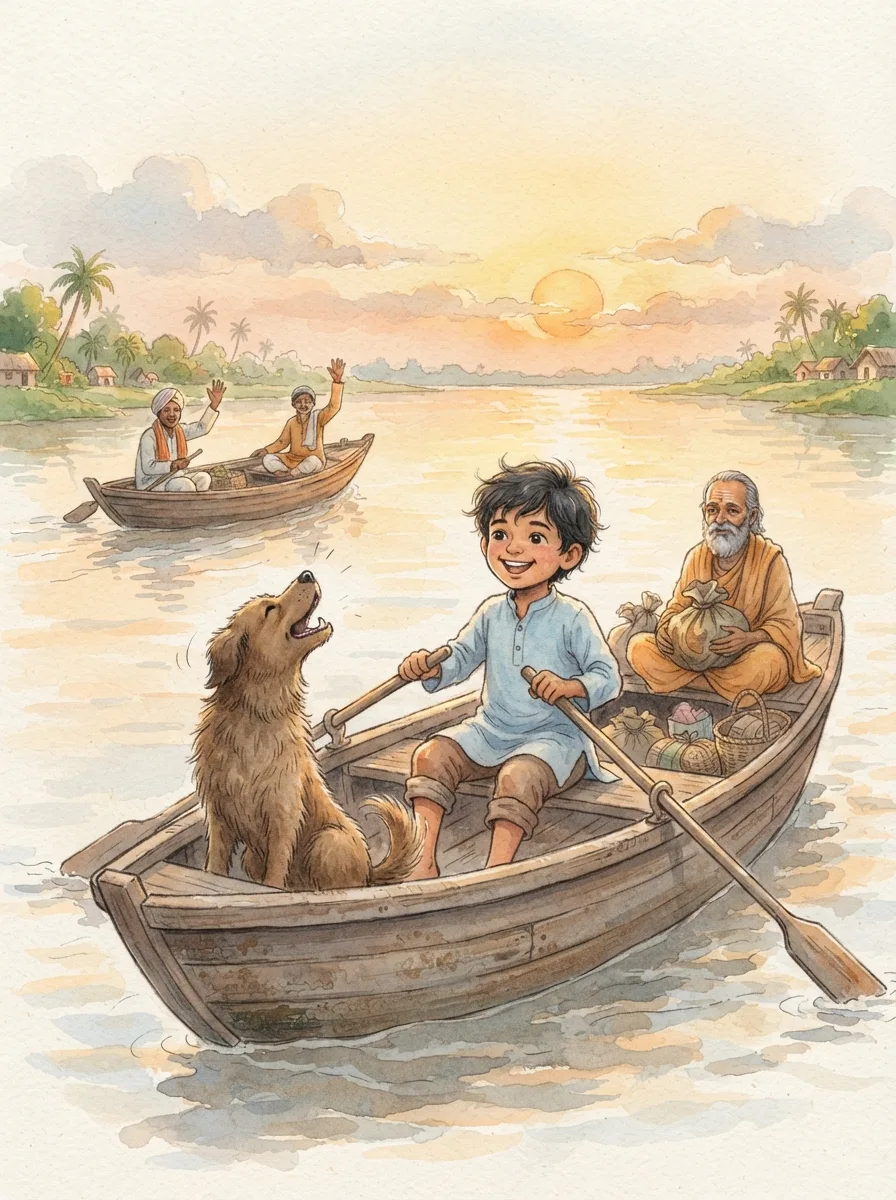
Now a dog, the hermit's friend barks at the river, at the boatmen, at the sun. He is scared of the village dogs, so the hermit makes him bigger still. Your child in the story rows the hermit's little boat and asks the dog, 'Who feeds you?' The dog goes quiet, remembering the rice grains. That afternoon he carries the hermit's bundle instead of barking, and the boatmen wave for the first time.
Lesson: Remember who feeds you and the barking stops on its own
The Hermit and the Mouse
Your child and the Tiger in the Doorway
Your child and the Tiger in the Doorway
The mouse is a tiger now, and the whole village whispers, 'That is only the hermit's mouse.' The tiger hates the whisper. In Nani's telling, Your child finds him sulking in the hut doorway and says, 'They are not laughing at you, they are amazed at how far you have come.' The tiger's ears go up. He walks to the market with his head high and lets the children touch his stripes.
Lesson: Where you came from is a story to be proud of
The Hermit and the Mouse
Your child and the Tiger's Terrible Plan
Your child and the Tiger's Terrible Plan
The proud tiger decides that if the hermit is gone, nobody will remember he was a mouse. He creeps to the hut at night. Your child, sleeping on the veranda in the story, wakes and steps in front of the door with a lamp. 'Before you do anything, look in the water,' says Your child, pointing at the bucket. In the ripples the tiger sees a tiny mouse. Ashamed, he sits down and cries. The hermit wakes and forgives him.
Lesson: Look at who you truly are before you hurt the one who helped you
The Hermit and the Mouse
Your child and the Mouse Once More
Your child and the Mouse Once More
The hermit turns the tiger back into a mouse, and the mouse hides under the rice pot, too embarrassed to come out. Every morning Your child leaves one grain nearer the door. In Dadaji's tale, on the tenth day the mouse takes the grain from Your child's palm and squeaks, 'Thank you.' Your child says that thank you was worth more than all the roaring. The hermit nods and pours the tea.
Lesson: A humble thank you is worth more than a mighty roar
The Hermit and the Mouse
Your child's Cricket Captain
Your child's Cricket Captain
Arjun was the worst batter in the mohalla until Your child spent a whole monsoon teaching him in the parking lot. Now Arjun is captain and tells Your child to fetch the balls. On the walk home, Your child remembers the mouse who forgot the hermit and says so, gently, without anger. Arjun stops. The next match he hands Your child the new bat and says, 'You taught me, you go first.'
Lesson: Never forget the friend who taught you your first shot
The Hermit and the Mouse
Your child and the Shopkeeper's First Customer
Your child and the Shopkeeper's First Customer
Sharma uncle's kirana shop is big now, with a fridge and a glass counter. Old Kaki, who lent him money when he had only a cart, comes to buy sugar and he makes her wait. Your child, buying toffees, tells the hermit and the mouse story loudly enough for Sharma uncle to hear. He goes red, comes round the counter, pulls up a stool for Kaki, and refuses to take her coins.
Lesson: Success that forgets its helpers is only half a success
The Hermit and the Mouse
Your child and the Tiger Mask
Your child and the Tiger Mask
For the school play Your child is the tiger and little Meera is the mouse. Backstage, Your child starts ordering everyone about because the tiger mask is the biggest. Meera's lip wobbles. Your child catches sight of the mirror, a big papier-mache tiger with a small worried face inside, and laughs. Your child takes the mask off, helps Meera with her whiskers, and lets her take the final bow first.
Lesson: The biggest mask should never hide the smallest kindness
The Hermit and the Mouse
Your child and Nani's Photograph
Your child and Nani's Photograph
Mama has a new car and a new flat in Gurugram and is too busy to call Nani, who paid for his engineering books by selling her bangles. Your child finds the old black and white photo of Nani with the bangles and puts it on the dashboard without a word. Next Sunday, Mama drives four hours to the village with a box of sweets. Your child sits in the back, quietly proud, thinking about the mouse and the hermit.
Lesson: Gratitude is the road that always leads back home
The Hermit and the Mouse
Your child and the Roaring Cousin
Your child and the Roaring Cousin
Cousin Rohan won a state chess medal and now roars about it at every meal, correcting everyone's moves. At the family lunch in Lucknow, Your child sets up the board and asks Rohan who taught him to play. Rohan remembers Bade Papa on the veranda, patient for years. He goes quiet, then walks over and touches Bade Papa's feet. Your child slides the medal across the table so Bade Papa can hold it too.
Lesson: Every champion stands on somebody's patient shoulders
The Hermit and the Mouse
Your child at the Sadhu's Ashram
Your child at the Sadhu's Ashram
On a trip to Rishikesh, Your child visits an ashram where a real sadhu feeds the mice with rice from his own plate. A tourist laughs and calls it foolish. Your child tells the sadhu the Panchatantra tale, and he laughs and says, 'Yes, but that mouse forgot, and these mice remember. Watch.' Sure enough, a mouse drops a marigold petal on his mat every evening. Your child decides to remember every small kindness too.
Lesson: The ones who remember are always richer than the ones who forget
The Hermit and the Mouse
Your child and the Mouse Drawing
Your child and the Mouse Drawing
Art teacher asks the class to draw the hermit's mouse at his proudest. Everyone draws a tiger. Your child draws a tiny mouse carrying a single rice grain to the hermit's bowl. The class laughs, but the teacher pins it in the middle of the board. 'This mouse is proud of the right thing,' she says. Your child gives the drawing to the school peon uncle, who fills the water coolers every day and never gets a thank you.
Lesson: Be proud of what you give, not of how big you look
The Hermit and the Mouse
Your child and the Lift Uncle
Your child and the Lift Uncle
Rakesh uncle in the building got a big promotion and stopped saying good morning to the liftman who has pressed his floor button for eleven years. Your child notices the liftman's hurt face. That evening Your child asks Rakesh uncle if he has heard the story of the hermit's tiger, and tells it in the lift, all seven floors. At the top, Rakesh uncle shakes the liftman's hand and asks his name for the first time. It is Bhola.
Lesson: A big chair is no reason to stop saying good morning
The Hermit and the Mouse
Your child's Humble Tiger
Your child's Humble Tiger
Nani ends her tale differently tonight. In this ending the tiger never creeps to the hut at all. Instead, Your child in the story invites him to help carry the hermit's firewood, and the tiger discovers that being useful feels better than being feared. He stays a tiger, but he sleeps at the hermit's feet, and every morning he brings one rice grain from the field, the way a mouse would. Your child falls asleep smiling.
Lesson: Stay humble and you can be strong without frightening anyone
The Hermit and the Mouse
The Clever Crow’s Pitcher
The Clever Crow’s Pitcher
In a Panchatantra-style village, a thirsty crow cannot reach the water at the bottom of a pitcher. Your child helps gather pebbles one by one, learning that patience and clever thinking can solve problems strength cannot. The story should stay respectful and child-safe, using the epic or fable as inspiration rather than a heavy retelling. Your child faces a small choice connected to courage, dharma, wisdom, or friendship, then helps the scene resolve through kindness. The ending should carry the value clearly without sounding preachy.
Lesson: Small smart steps can solve big problems.
The Hermit and the Mouse
The Lion and the Tiny Mouse
The Lion and the Tiny Mouse
A proud lion laughs when a tiny mouse offers help, until a net teaches both of them a lesson. With Your childs kindness, the mouse proves that no friend is too small to make a big difference. The story should stay respectful and child-safe, using the epic or fable as inspiration rather than a heavy retelling. Your child faces a small choice connected to courage, dharma, wisdom, or friendship, then helps the scene resolve through kindness. The ending should carry the value clearly without sounding preachy.
Lesson: Kindness to the small can return in big ways.
The Hermit and the Mouse
The Monkey and the Mango Bridge
The Monkey and the Mango Bridge
A playful monkey wants every mango first, but the branch bridge shakes whenever anyone grabs too much. Your child helps the animals share fairly, learning that greed can wobble a bridge while fairness keeps it strong. The story should stay respectful and child-safe, using the epic or fable as inspiration rather than a heavy retelling. Your child faces a small choice connected to courage, dharma, wisdom, or friendship, then helps the scene resolve through kindness. The ending should carry the value clearly without sounding preachy.
Lesson: Fair sharing keeps friendships strong.
The Hermit and the Mouse
The Wise Tortoise’s Quiet Plan
The Wise Tortoise’s Quiet Plan
When noisy animals rush toward a muddy shortcut, a wise tortoise asks Your child to wait and watch. The patient path turns out safer, teaching everyone that slow thinking can sometimes be the fastest way home. The story should stay respectful and child-safe, using the epic or fable as inspiration rather than a heavy retelling. Your child faces a small choice connected to courage, dharma, wisdom, or friendship, then helps the scene resolve through kindness. The ending should carry the value clearly without sounding preachy.
Lesson: Patience and observation can prevent avoidable mistakes.
The Hermit and the Mouse
The Jackal’s Honest Echo
A clever jackal discovers a cave that echoes every untruth louder than thunder. With Your childs help, the animals learn that cleverness is best when it walks beside honesty. The story should stay respectful and child-safe, using the epic or fable as inspiration rather than a heavy retelling. Your child faces a small choice connected to courage, dharma, wisdom, or friendship, then helps the scene resolve through kindness. The ending should carry the value clearly without sounding preachy.
Lesson: Cleverness should be guided by honesty and care.
The Hermit and the Mouse
The Blue Jackal Learns Humility
The Blue Jackal Learns Humility
In a Panchatantra-style forest, a jackal painted blue pretends to be greater than everyone else. Your child helps the animals uncover the truth kindly, learning that pretending feels heavy but honesty feels free. The story should stay respectful and child-safe, using the epic or fable as inspiration rather than a heavy retelling. Your child faces a small choice connected to courage, dharma, wisdom, or friendship, then helps the scene resolve through kindness. The ending should carry the value clearly without sounding preachy.
Lesson: Honesty and humility build better friendships than pretending.
The Hermit and the Mouse
The Talkative Turtle’s Promise
The Talkative Turtle’s Promise
A turtle promises two swans to stay quiet while flying across the sky, but words keep tickling the tongue. Your child helps the turtle practice listening, learning that some promises are kept by pausing first. The story should stay respectful and child-safe, using the epic or fable as inspiration rather than a heavy retelling. Your child faces a small choice connected to courage, dharma, wisdom, or friendship, then helps the scene resolve through kindness. The ending should carry the value clearly without sounding preachy.
Lesson: Listening and self-control help us keep promises.
The Hermit and the Mouse
The Four Friends of the Forest
The Four Friends of the Forest
A deer, crow, mouse, and turtle each has one small talent. When trouble arrives, Your child helps them combine their strengths and learns that friendship works best when everyone brings what they can. The story should stay respectful and child-safe, using the epic or fable as inspiration rather than a heavy retelling. Your child faces a small choice connected to courage, dharma, wisdom, or friendship, then helps the scene resolve through kindness. The ending should carry the value clearly without sounding preachy.
Lesson: Friends become stronger when they value each other’s different gifts.
The Hermit and the Mouse
The Wise Rabbit and the Moon Pond
The Wise Rabbit and the Moon Pond
A small rabbit must protect the pond from a boastful elephant herd without fighting. With Your childs clever plan and moonlit reflection, the animals learn that wisdom can be stronger than size. The story should stay respectful and child-safe, using the epic or fable as inspiration rather than a heavy retelling. Your child faces a small choice connected to courage, dharma, wisdom, or friendship, then helps the scene resolve through kindness. The ending should carry the value clearly without sounding preachy.
Lesson: Wisdom and calm thinking can solve problems without force.