The Jackal and the Drum
Your child and the Big Boom in the Forest
Your child and the Big Boom in the Forest
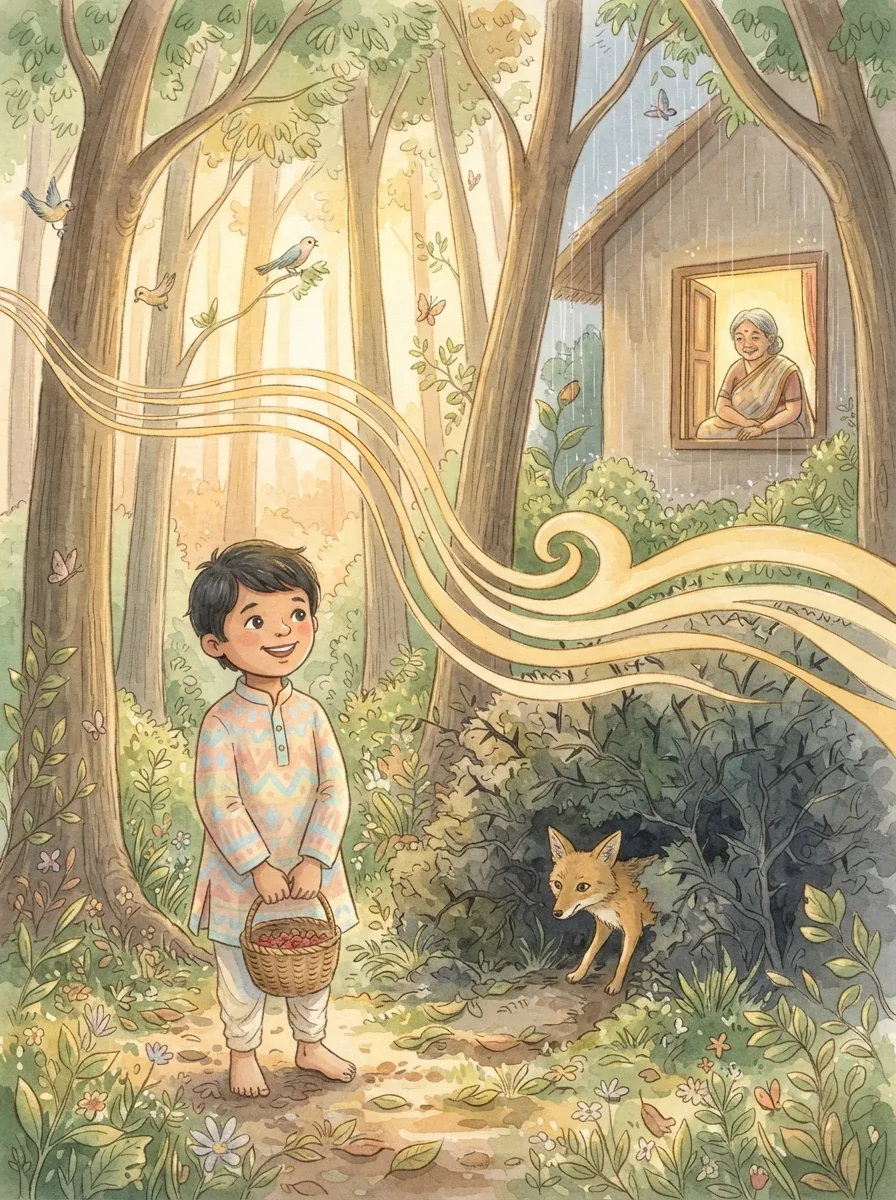
Dadi tells the tale while the rain drums on the tin roof. A thin, hungry jackal is sniffing for food at the edge of the forest when a huge BOOM rolls through the trees. He dives under a bush. In Dadi's telling, Your child is picking ber berries nearby and hears it too. Your child's heart goes thump, but Your child stands still and listens. Boom. Silence. Boom. 'It is very slow for a monster,' Your child thinks.
Lesson: Stand still and listen before you decide to be afraid
The Jackal and the Drum
Your child and the Jackal Who Hid
Your child and the Jackal Who Hid
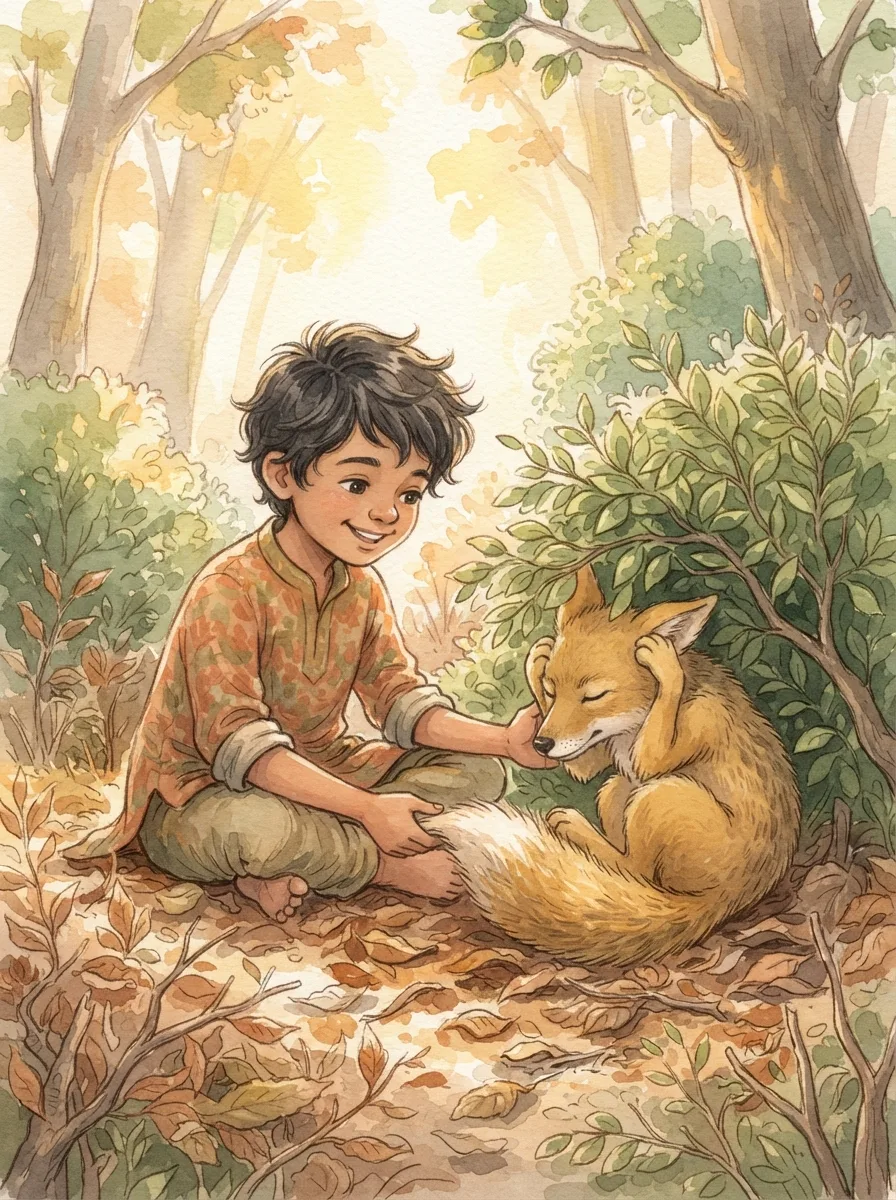
Your child finds the jackal shivering under the bush with his paws over his ears. 'It is a giant,' he whispers. 'It will eat me.' Your child sits down beside him and says, 'Giants do not go boom and then wait so long.' The jackal peeps out. Your child says, 'Let us go and look together. I will hold your tail so you feel brave.' The jackal thinks about it, then nods a tiny nod.
Lesson: Being brave is easier when someone holds your tail
The Jackal and the Drum
Your child and the Drum in the Wind
Your child and the Drum in the Wind
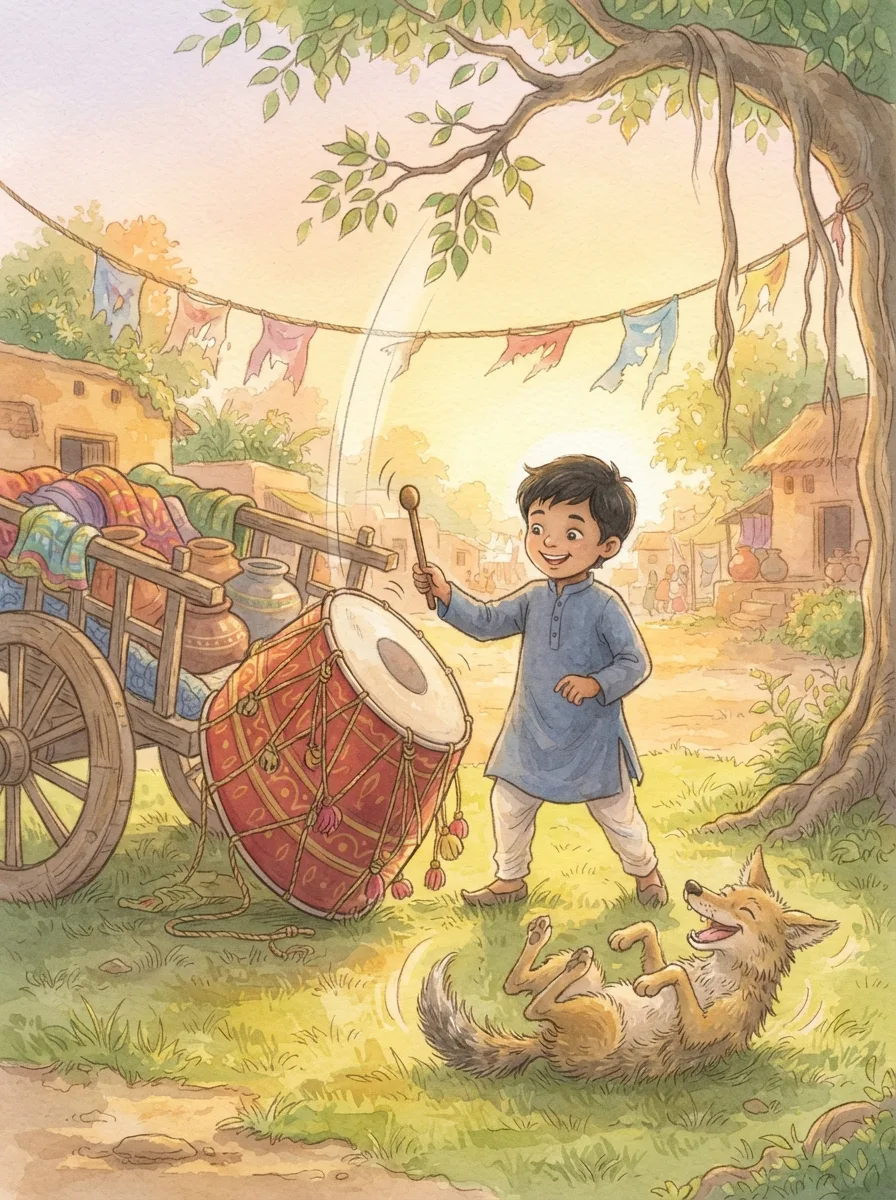
Step by step they creep towards the boom. It gets louder. Behind a big banyan tree they find a clearing where the village mela was held last week. A big dhol has been left leaning on a cart, and every time the wind blows, a hanging branch swings down and thumps it. BOOM. The jackal's mouth falls open. Your child laughs and taps the drum with a stick. Now the jackal laughs too, rolling on the grass.
Lesson: Things are not always what they sound like
The Jackal and the Drum
Your child and the Jackal's Supper
Your child and the Jackal's Supper
The jackal is still hungry. Your child looks inside the cart and finds a cloth bundle the drummer forgot. Inside are four dry rotis and a piece of gur. 'The thing that scared you was hiding your supper,' says Your child. The jackal eats three rotis and gives one to Your child, and they break the gur in half. In Dadi's telling, the jackal says he will never run from a noise again without peeping first.
Lesson: Behind the scary thing there is often something good
The Jackal and the Drum
Your child and the Three Brave Steps
Your child and the Three Brave Steps
Nani's bedtime version has a rule. When the jackal hears the boom, Your child in the tale teaches him three steps. Stop. Listen. Peep. 'First stop your feet,' says Your child. 'Then listen with your big ears. Then peep with one eye.' They practise on the drum and it works. They practise on a rustle and it is a squirrel. Nani says Your child can use the three steps at home too, for any noise in the night.
Lesson: Stop, listen, peep, then decide
The Jackal and the Drum
Your child and the Tapping at the Window
Your child and the Tapping at the Window
At night there is a tap, tap, tap on the bedroom window. Your child pulls the blanket up, then remembers the jackal. Stop. Listen. Peep. Your child calls Papa and they peep together with the torch. It is the clothesline rope that Amma tied to the grill, swinging in the wind and tapping the glass. Papa tucks it away. Your child says, 'That was my drum,' and Papa says, 'Then you were my jackal who looked.'
Lesson: A torch and a peep turn a monster into a rope
The Jackal and the Drum
Your child and the Rumbling Cupboard
Your child and the Rumbling Cupboard
A soft rumble comes from inside the steel cupboard in the hall. Little cousin Pihu says it is a ghost and hides behind Your child. Your child does the jackal's three steps and hears the rumble go purr, purr. Your child opens the door a crack and out pops Billi the cat, who had climbed in behind the winter blankets for a nap. Pihu giggles so much she gets hiccups. Now the cupboard is called the purring cupboard.
Lesson: Most ghosts are just cats having a nap
The Jackal and the Drum
Your child and the Monsoon Thunder
Your child and the Monsoon Thunder
The first monsoon thunder crashes and Your child jumps. Dadi pats the sofa and says, 'Come, let us be the jackal.' They go to the balcony and watch the grey clouds. Dadi says thunder is just big clouds bumping into each other like drums. They count between the flash and the boom, one, two, three, and the numbers get bigger as the storm walks away. By the fifth boom Your child is clapping along with it.
Lesson: Count the boom and it stops being so big
The Jackal and the Drum
Your child and the Noise Behind the School Wall
Your child and the Noise Behind the School Wall
During lunch break a loud clank, clank comes from behind the school wall. Meera says nobody should go near. Your child tells the class about the jackal and the drum, and three of them tiptoe to the corner and peep. It is the goat from the next lane with a bell on its neck, scratching against the tin sheet. Your child feeds it a leaf through the gap. Meera decides to peep too, and names the goat Clanky.
Lesson: The bravest thing at lunch break is one small peep
The Jackal and the Drum
Your child and the Colony Dhol
Your child and the Colony Dhol
A wedding dhol starts up in the colony courtyard and little cousin Pihu bursts into tears at the sound. Your child holds her hand and says, 'Remember the jackal? Let us go and see the boom.' They walk close, and the dholwala smiles and lets Pihu tap the drum once with her tiny hand. Dhum! Pihu laughs. By the end of the evening she is dancing right next to the drum with Your child and does not want to go home.
Lesson: Get close to a loud thing and it becomes a friend
The Jackal and the Drum
Your child and the Rattling School Bag
Your child and the Rattling School Bag
On the school bus something in Aarav's bag goes rattle, rattle every time the bus bumps. Aarav is sure a lizard has got inside. He will not open it. Your child says, 'Let us peep like the jackal.' They open the zip one finger at a time. Inside, a marble is rolling around in the empty lunchbox. Aarav goes pink and laughs. Your child says the marble was a very small drum, and they play with it at recess.
Lesson: A tiny peep beats a big worry
The Jackal and the Drum
Your child and the Shadow on the Wall
Your child and the Shadow on the Wall
The night lamp makes a tall shape with arms on the bedroom wall. Your child freezes under the quilt. Then Your child thinks of the jackal. Stop. Listen. Peep. The shape does not move or breathe. Your child gets up and walks to the wall, and the shape is Papa's raincoat hanging on the hook with its hood sticking up. Your child puts the coat on and makes a bigger monster shadow, giggling, until Amma says it is sleep time.
Lesson: Walk up to a shadow and it turns back into a coat
The Jackal and the Drum
Your child and the Jackal Who Taught the Cubs
Your child and the Jackal Who Taught the Cubs
In Dadi's tale, the jackal becomes famous for his peeping. When the little rabbits and deer fawns hear a strange sound, they run to him. He takes them to Your child and they all practise the three steps together. Stop, listen, peep. The sound is a woodpecker. The next sound is a frog. Soon every small animal in the forest is a brave peeper, and Your child gives each of them a leaf badge for courage.
Lesson: Courage you learn is courage you can teach
The Jackal and the Drum
Your child and the Train Horn
Your child and the Train Horn
At the railway station a train gives a huge long horn and cousin Pihu covers her ears and cries. Your child kneels down and says, 'That is only the train saying hello. Let us look at it.' They walk with Papa to the front and see the driver in the big engine. He waves and gives one short toot just for Pihu. She waves back with both hands. On the train she keeps asking the engine to say hello again.
Lesson: Go and see who is making the noise and say hello
The Jackal and the Drum
Your child and the Jackal's Drum Song
Your child and the Jackal's Drum Song
Nani ends the tale her own way. The drummer never comes back for his dhol, so the jackal keeps it. Every full moon he thumps it in the clearing and all the animals come to dance. In the story, Your child sits on the cart and sings while the jackal plays. The noise that once made him hide is now the noise that makes him happy. Nani hums the drum song, and Your child falls asleep tapping the pillow.
Lesson: The sound that scared you can become your favourite song
The Jackal and the Drum
Being Brave
Your child befriends a tiny lion named Whiskers who has somehow misplaced his roar. Together the two face small everyday fears, the shadowy closet, the very tall slide, and the noisy neighborhood dog. Each time Your child takes a gentle, steady step forward, Whiskers' roar grows a little louder, teaching them both that being brave does not mean having no fear, but facing it anyway.
Lesson: Bravery is not the absence of fear but acting despite it, everyone has courage inside them, facing fears makes them smaller, and supporting others helps everyone be braver.
The Jackal and the Drum
The Clever Crow’s Pitcher
The Clever Crow’s Pitcher
In a Panchatantra-style village, a thirsty crow cannot reach the water at the bottom of a pitcher. Your child helps gather pebbles one by one, learning that patience and clever thinking can solve problems strength cannot. The story should stay respectful and child-safe, using the epic or fable as inspiration rather than a heavy retelling. Your child faces a small choice connected to courage, dharma, wisdom, or friendship, then helps the scene resolve through kindness. The ending should carry the value clearly without sounding preachy.
Lesson: Small smart steps can solve big problems.
The Jackal and the Drum
The Lion and the Tiny Mouse
The Lion and the Tiny Mouse
A proud lion laughs when a tiny mouse offers help, until a net teaches both of them a lesson. With Your childs kindness, the mouse proves that no friend is too small to make a big difference. The story should stay respectful and child-safe, using the epic or fable as inspiration rather than a heavy retelling. Your child faces a small choice connected to courage, dharma, wisdom, or friendship, then helps the scene resolve through kindness. The ending should carry the value clearly without sounding preachy.
Lesson: Kindness to the small can return in big ways.
The Jackal and the Drum
The Monkey and the Mango Bridge
The Monkey and the Mango Bridge
A playful monkey wants every mango first, but the branch bridge shakes whenever anyone grabs too much. Your child helps the animals share fairly, learning that greed can wobble a bridge while fairness keeps it strong. The story should stay respectful and child-safe, using the epic or fable as inspiration rather than a heavy retelling. Your child faces a small choice connected to courage, dharma, wisdom, or friendship, then helps the scene resolve through kindness. The ending should carry the value clearly without sounding preachy.
Lesson: Fair sharing keeps friendships strong.
The Jackal and the Drum
The Wise Tortoise’s Quiet Plan
The Wise Tortoise’s Quiet Plan
When noisy animals rush toward a muddy shortcut, a wise tortoise asks Your child to wait and watch. The patient path turns out safer, teaching everyone that slow thinking can sometimes be the fastest way home. The story should stay respectful and child-safe, using the epic or fable as inspiration rather than a heavy retelling. Your child faces a small choice connected to courage, dharma, wisdom, or friendship, then helps the scene resolve through kindness. The ending should carry the value clearly without sounding preachy.
Lesson: Patience and observation can prevent avoidable mistakes.
The Jackal and the Drum
The Jackal’s Honest Echo
A clever jackal discovers a cave that echoes every untruth louder than thunder. With Your childs help, the animals learn that cleverness is best when it walks beside honesty. The story should stay respectful and child-safe, using the epic or fable as inspiration rather than a heavy retelling. Your child faces a small choice connected to courage, dharma, wisdom, or friendship, then helps the scene resolve through kindness. The ending should carry the value clearly without sounding preachy.
Lesson: Cleverness should be guided by honesty and care.
The Jackal and the Drum
The Tiny Bow of Courage
In a Ramayana-inspired practice grove, Your child finds a tiny bow that grows stronger only when used to protect, not show off. Helping a frightened bird family, Your child learns that real courage is gentle, careful, and kind. The story should stay respectful and child-safe, using the epic or fable as inspiration rather than a heavy retelling. Your child faces a small choice connected to courage, dharma, wisdom, or friendship, then helps the scene resolve through kindness. The ending should carry the value clearly without sounding preachy.
Lesson: Courage should protect others, not impress them.
The Jackal and the Drum
The Blue Jackal Learns Humility
The Blue Jackal Learns Humility
In a Panchatantra-style forest, a jackal painted blue pretends to be greater than everyone else. Your child helps the animals uncover the truth kindly, learning that pretending feels heavy but honesty feels free. The story should stay respectful and child-safe, using the epic or fable as inspiration rather than a heavy retelling. Your child faces a small choice connected to courage, dharma, wisdom, or friendship, then helps the scene resolve through kindness. The ending should carry the value clearly without sounding preachy.
Lesson: Honesty and humility build better friendships than pretending.
The Jackal and the Drum
The Talkative Turtle’s Promise
The Talkative Turtle’s Promise
A turtle promises two swans to stay quiet while flying across the sky, but words keep tickling the tongue. Your child helps the turtle practice listening, learning that some promises are kept by pausing first. The story should stay respectful and child-safe, using the epic or fable as inspiration rather than a heavy retelling. Your child faces a small choice connected to courage, dharma, wisdom, or friendship, then helps the scene resolve through kindness. The ending should carry the value clearly without sounding preachy.
Lesson: Listening and self-control help us keep promises.
The Jackal and the Drum
The Four Friends of the Forest
The Four Friends of the Forest
A deer, crow, mouse, and turtle each has one small talent. When trouble arrives, Your child helps them combine their strengths and learns that friendship works best when everyone brings what they can. The story should stay respectful and child-safe, using the epic or fable as inspiration rather than a heavy retelling. Your child faces a small choice connected to courage, dharma, wisdom, or friendship, then helps the scene resolve through kindness. The ending should carry the value clearly without sounding preachy.
Lesson: Friends become stronger when they value each other’s different gifts.
The Jackal and the Drum
The Wise Rabbit and the Moon Pond
The Wise Rabbit and the Moon Pond
A small rabbit must protect the pond from a boastful elephant herd without fighting. With Your childs clever plan and moonlit reflection, the animals learn that wisdom can be stronger than size. The story should stay respectful and child-safe, using the epic or fable as inspiration rather than a heavy retelling. Your child faces a small choice connected to courage, dharma, wisdom, or friendship, then helps the scene resolve through kindness. The ending should carry the value clearly without sounding preachy.
Lesson: Wisdom and calm thinking can solve problems without force.