The Four Friends
Your child and the Fifth Friend
Your child and the Fifth Friend
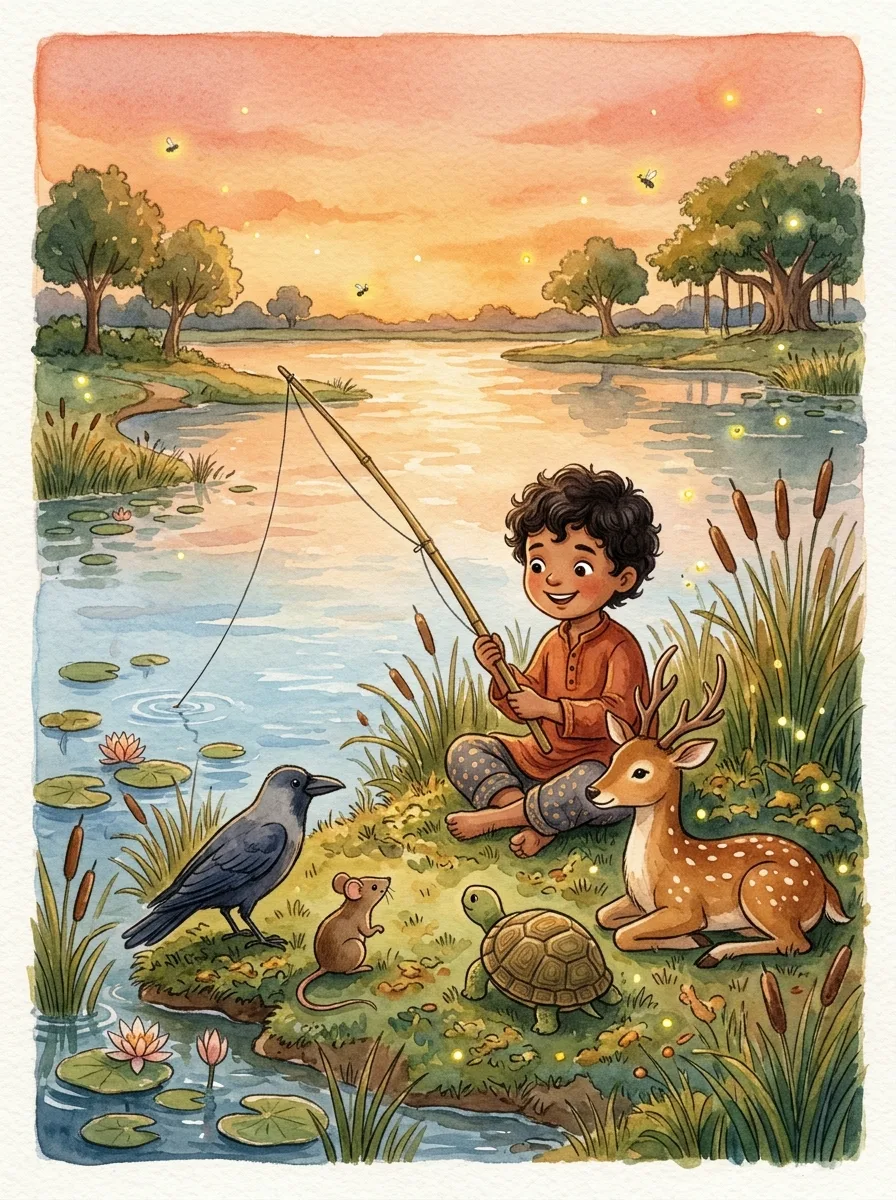
Every evening, a crow, a mouse, a tortoise and a deer meet by the lake to share the day's news. Your child, sitting quietly with a fishing rod, is invited to join them. The crow tells of faraway fields, the mouse of tiny tunnels, the tortoise of slow seasons and the deer of the swift meadow. Your child brings a story from the village, and the circle grows to five.
Lesson: Friends come in every size and every speed
The Four Friends
Your child and the Hunter's Net
Your child and the Hunter's Net
The deer does not come to the lake one evening, and the crow flies off to find her tangled in a hunter's net. Your child runs with the mouse through the tall grass while the tortoise plods behind. The mouse gnaws the knots and Your child pulls the net wide, and the deer springs free. But now the hunter is coming, and the tortoise is still far too slow to run.
Lesson: When a friend is stuck, everyone brings what they can
The Four Friends
Your child and the Tortoise Rescue
Your child and the Tortoise Rescue
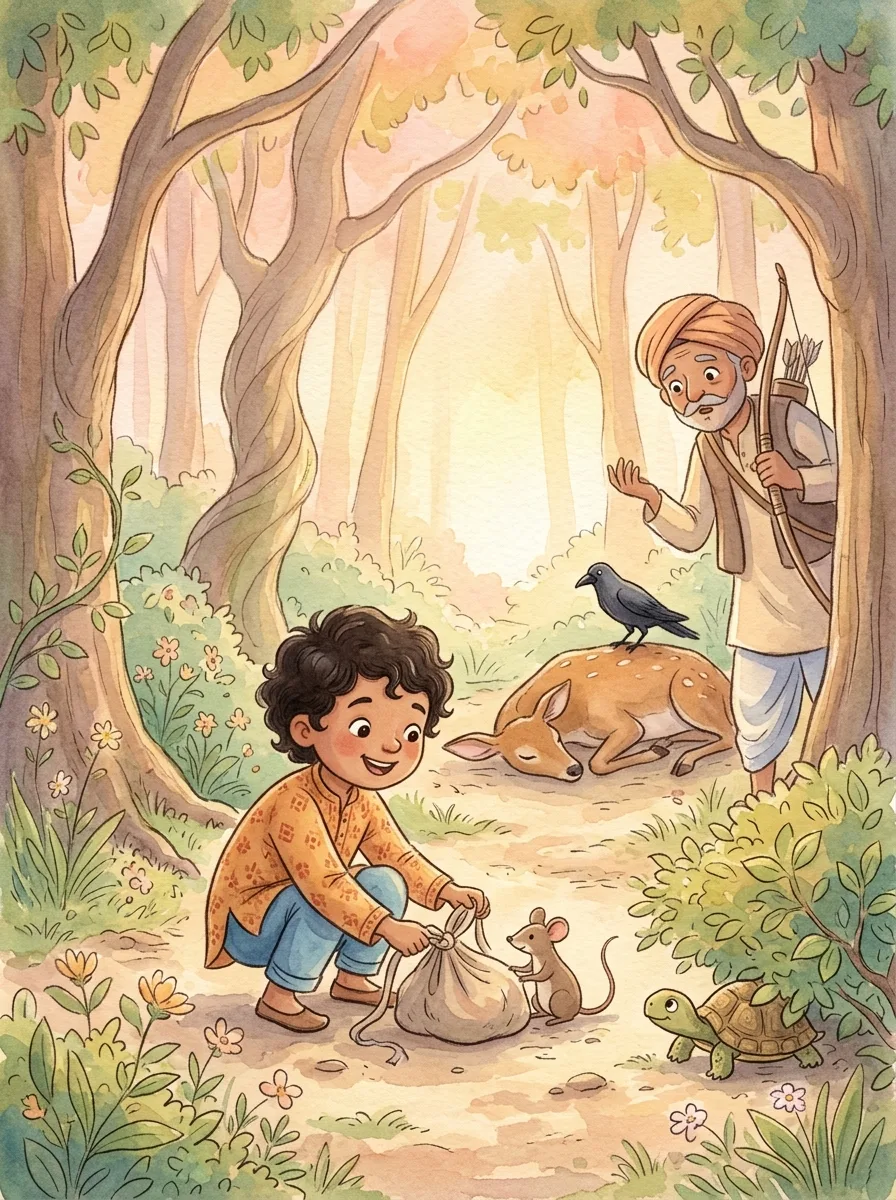
The hunter has scooped up the slow tortoise and is walking home with him in a sack. The friends make a plan: the deer lies down by the path pretending to be hurt, the crow perches on her as if she were a lost cause, and while the hunter sets the sack down to look, the mouse and Your child nibble and untie the string. The tortoise slips out, the deer leaps up, and everyone runs.
Lesson: Four clever friends can outthink any trap
The Four Friends
Your child and the Crow Who Wanted a Friend
Your child and the Crow Who Wanted a Friend
The crow watches a mouse outwit a hunter and wants to be his friend, but the mouse will not trust a bird with a sharp beak. Your child, sitting by the banyan, tells the mouse that the crow has waited three days without trying to peck anyone. The mouse peeks out. Your child suggests they share a grain of rice first, and the crow gently pushes it forward with his beak.
Lesson: Trust grows one small grain at a time
The Four Friends
Your child and the Flight to the Lake
Your child and the Flight to the Lake
The crow wants to move to a peaceful lake where his old friend the tortoise lives, but the mouse cannot fly. Your child weaves a tiny basket from grass for the mouse to sit in, and the crow carries it in his beak. Your child follows on foot, hours behind, and arrives at the lake to find the crow, the mouse and the tortoise already telling jokes on the bank.
Lesson: Find a way to bring everyone along
The Four Friends
Your child and the Frightened Deer
Your child and the Frightened Deer
A deer comes racing to the lake, breathless and trembling, and the mouse and tortoise dive for cover. Your child holds up a hand and asks the deer to breathe. She has escaped a hunter and has nowhere to go. Your child brings water in a leaf and asks the three friends to let her stay. The tortoise says yes, the crow says yes, and the mouse, from behind a stone, says yes too.
Lesson: Calm a frightened stranger before you decide about them
The Four Friends
Your child and the Deer's First Lesson
Your child and the Deer's First Lesson
The deer keeps wandering off alone to eat the sweetest grass, and the friends worry. Your child walks with her and shows how the crow scouts from the sky, the mouse checks the ground for traps and the tortoise knows which paths are safe. The deer learns to call before she goes. The next time she finds sweet grass, all four friends are eating it with her.
Lesson: Tell your friends where you are going
The Four Friends
Your child and the Net in the Grass
Your child and the Net in the Grass
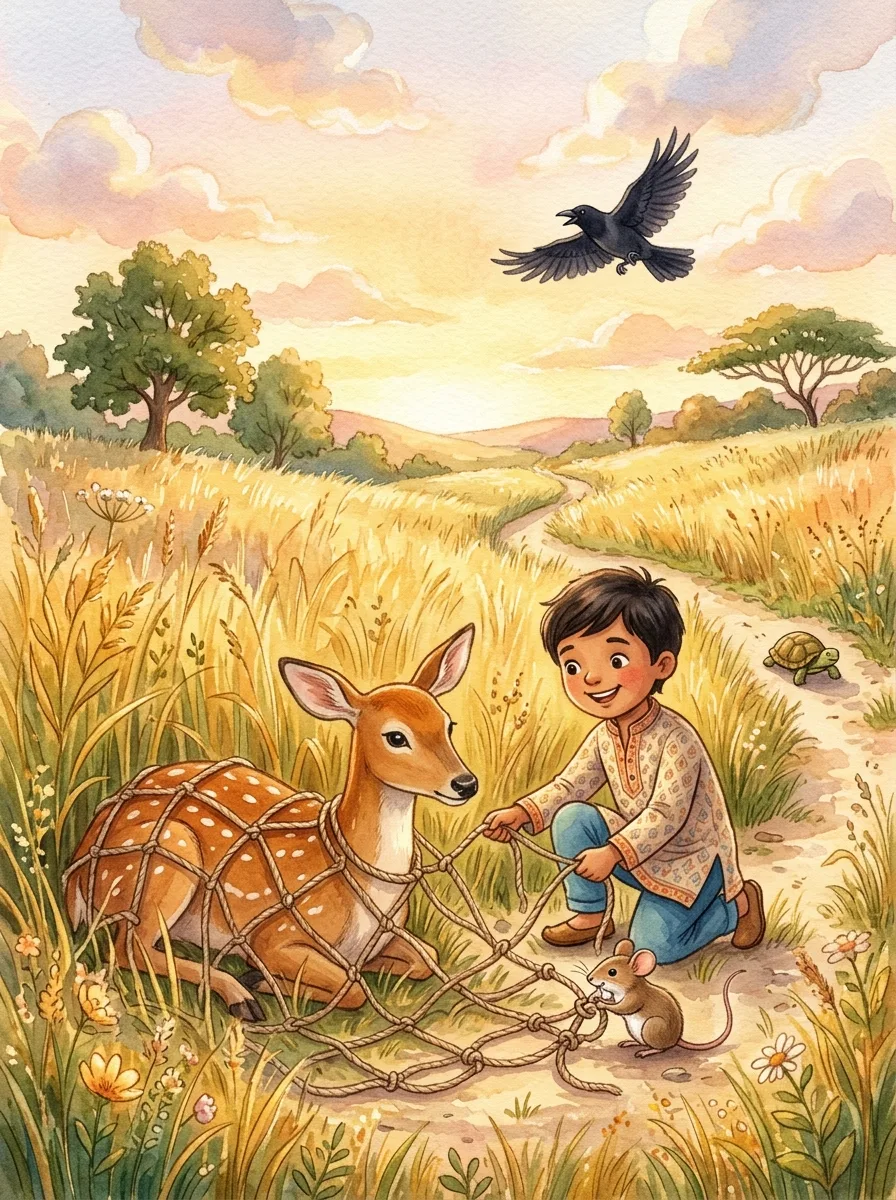
The deer has not come back, and the crow flies out to look. He spots her tangled in a hunter's net in the long grass. Your child is fetched, but the ropes are too thick for small hands. The mouse gnaws through them, one strand after another, while Your child keeps the deer calm by stroking her neck and humming. By the time the hunter's footsteps come near, the deer is free and running.
Lesson: Small teeth and a calm voice can undo a big trap
The Four Friends
Your child and the Slow Tortoise
Your child and the Slow Tortoise
The deer, the mouse and the crow have escaped, but the tortoise, who followed to help, is too slow and the hunter picks him up. The friends are heartbroken. Your child stops them from panicking and asks what each of them does best. The deer can run, the crow can fly, the mouse can gnaw. Together, Your child says, that is enough for a plan. The friends lean in.
Lesson: When one friend is in trouble, every friend has a part
The Four Friends
Your child and the Deer Who Played Dead
Your child and the Deer Who Played Dead
The plan: the deer lies still by the path as if hurt, the crow pecks at her to make it look real, and the hunter sets the tortoise down to grab the bigger prize. Your child hides behind a tree, heart pounding, ready to signal. The hunter bends; Your child whistles; the deer springs up, the crow flies, and the mouse cuts the tortoise's rope. Four friends and one child vanish into the trees.
Lesson: A clever plan needs everyone to play their part
The Four Friends
Your child and the Feast by the Lake
Your child and the Feast by the Lake
Back at the lake, the four friends want to celebrate but each likes different food: grain for the mouse, grass for the deer, fruit for the crow and water plants for the tortoise. Your child spends the morning gathering a little of everything and laying it out on a wide lotus leaf. Nobody has to share a taste they do not like, and everybody shares the same leaf.
Lesson: Friends do not need the same food, only the same table
The Four Friends
Your child and the Mouse's Hidden Treasure
Your child and the Mouse's Hidden Treasure
The mouse tells Your child a secret: he once had a store of gold coins under a temple, and a greedy monk took it. Since then he has felt small. Your child listens, then points to the deer, the crow and the tortoise laughing on the bank, and says the mouse has a treasure nobody can dig up. The mouse looks at his friends for a long time and never mentions the gold again.
Lesson: Friends are a treasure nobody can take
The Four Friends
Your child and the Day the Child Needed Help
Your child and the Day the Child Needed Help
Your child falls into a ditch on the way home from the lake and twists an ankle. Nobody from the village is near. The crow flies for help, the deer runs to the road to stop a cart, the mouse squeaks the way, and the tortoise sits beside Your child so nobody is alone. When the cart comes, Your child understands that four friends had adopted a fifth long ago.
Lesson: Help given comes back when you need it most
The Four Friends
Your child and the Hunter Who Changed
Your child and the Hunter Who Changed
The hunter keeps setting nets around the lake, and the friends live in fear. Your child goes to the hunter's hut with a basket of the lake's fruit and asks why he hunts. He says his children are hungry. Your child shows him where the wild fruit and fish are plentiful and where the village needs a strong hand. The hunter takes down the nets. The lake sleeps easy.
Lesson: Understand why someone does harm and you can help them stop
The Four Friends
Your child and the Knot of Friendship
Your child and the Knot of Friendship
The tortoise says that in the old days, four friends were like four strands: alone, each could snap, but knotted together, no hunter could break them. Your child takes four coloured threads from a pocket, ties them into one thick knot, and hangs it on the banyan by the lake. When Your child returns to the village, a fifth thread has been tied in by a small, sharp beak.
Lesson: Tied together, small friends are stronger than any trap
The Four Friends
The Clever Crow’s Pitcher
The Clever Crow’s Pitcher
In a Panchatantra-style village, a thirsty crow cannot reach the water at the bottom of a pitcher. Your child helps gather pebbles one by one, learning that patience and clever thinking can solve problems strength cannot. The story should stay respectful and child-safe, using the epic or fable as inspiration rather than a heavy retelling. Your child faces a small choice connected to courage, dharma, wisdom, or friendship, then helps the scene resolve through kindness. The ending should carry the value clearly without sounding preachy.
Lesson: Small smart steps can solve big problems.
The Four Friends
The Lion and the Tiny Mouse
The Lion and the Tiny Mouse
A proud lion laughs when a tiny mouse offers help, until a net teaches both of them a lesson. With Your childs kindness, the mouse proves that no friend is too small to make a big difference. The story should stay respectful and child-safe, using the epic or fable as inspiration rather than a heavy retelling. Your child faces a small choice connected to courage, dharma, wisdom, or friendship, then helps the scene resolve through kindness. The ending should carry the value clearly without sounding preachy.
Lesson: Kindness to the small can return in big ways.
The Four Friends
The Monkey and the Mango Bridge
The Monkey and the Mango Bridge
A playful monkey wants every mango first, but the branch bridge shakes whenever anyone grabs too much. Your child helps the animals share fairly, learning that greed can wobble a bridge while fairness keeps it strong. The story should stay respectful and child-safe, using the epic or fable as inspiration rather than a heavy retelling. Your child faces a small choice connected to courage, dharma, wisdom, or friendship, then helps the scene resolve through kindness. The ending should carry the value clearly without sounding preachy.
Lesson: Fair sharing keeps friendships strong.
The Four Friends
The Wise Tortoise’s Quiet Plan
The Wise Tortoise’s Quiet Plan
When noisy animals rush toward a muddy shortcut, a wise tortoise asks Your child to wait and watch. The patient path turns out safer, teaching everyone that slow thinking can sometimes be the fastest way home. The story should stay respectful and child-safe, using the epic or fable as inspiration rather than a heavy retelling. Your child faces a small choice connected to courage, dharma, wisdom, or friendship, then helps the scene resolve through kindness. The ending should carry the value clearly without sounding preachy.
Lesson: Patience and observation can prevent avoidable mistakes.
The Four Friends
The Jackal’s Honest Echo
A clever jackal discovers a cave that echoes every untruth louder than thunder. With Your childs help, the animals learn that cleverness is best when it walks beside honesty. The story should stay respectful and child-safe, using the epic or fable as inspiration rather than a heavy retelling. Your child faces a small choice connected to courage, dharma, wisdom, or friendship, then helps the scene resolve through kindness. The ending should carry the value clearly without sounding preachy.
Lesson: Cleverness should be guided by honesty and care.
The Four Friends
The Blue Jackal Learns Humility
The Blue Jackal Learns Humility
In a Panchatantra-style forest, a jackal painted blue pretends to be greater than everyone else. Your child helps the animals uncover the truth kindly, learning that pretending feels heavy but honesty feels free. The story should stay respectful and child-safe, using the epic or fable as inspiration rather than a heavy retelling. Your child faces a small choice connected to courage, dharma, wisdom, or friendship, then helps the scene resolve through kindness. The ending should carry the value clearly without sounding preachy.
Lesson: Honesty and humility build better friendships than pretending.
The Four Friends
The Talkative Turtle’s Promise
The Talkative Turtle’s Promise
A turtle promises two swans to stay quiet while flying across the sky, but words keep tickling the tongue. Your child helps the turtle practice listening, learning that some promises are kept by pausing first. The story should stay respectful and child-safe, using the epic or fable as inspiration rather than a heavy retelling. Your child faces a small choice connected to courage, dharma, wisdom, or friendship, then helps the scene resolve through kindness. The ending should carry the value clearly without sounding preachy.
Lesson: Listening and self-control help us keep promises.
The Four Friends
The Four Friends of the Forest
The Four Friends of the Forest
A deer, crow, mouse, and turtle each has one small talent. When trouble arrives, Your child helps them combine their strengths and learns that friendship works best when everyone brings what they can. The story should stay respectful and child-safe, using the epic or fable as inspiration rather than a heavy retelling. Your child faces a small choice connected to courage, dharma, wisdom, or friendship, then helps the scene resolve through kindness. The ending should carry the value clearly without sounding preachy.
Lesson: Friends become stronger when they value each other’s different gifts.
The Four Friends
The Wise Rabbit and the Moon Pond
The Wise Rabbit and the Moon Pond
A small rabbit must protect the pond from a boastful elephant herd without fighting. With Your childs clever plan and moonlit reflection, the animals learn that wisdom can be stronger than size. The story should stay respectful and child-safe, using the epic or fable as inspiration rather than a heavy retelling. Your child faces a small choice connected to courage, dharma, wisdom, or friendship, then helps the scene resolve through kindness. The ending should carry the value clearly without sounding preachy.
Lesson: Wisdom and calm thinking can solve problems without force.