The Blue Jackal
Your child and the Pot of Blue
Your child and the Pot of Blue
A jackal running from the village dogs tumbles into a dyer's pot and comes out bright blue from nose to tail. Your child, helping at the dyer's house, is the first to see him. The jackal wants to run back to the forest and pretend to be a magic king, but Your child laughs and says the colour will wash off in the first rain, so he had better think of a plan that lasts.
Lesson: A disguise never lasts as long as the truth
The Blue Jackal
Your child and the King of the Forest
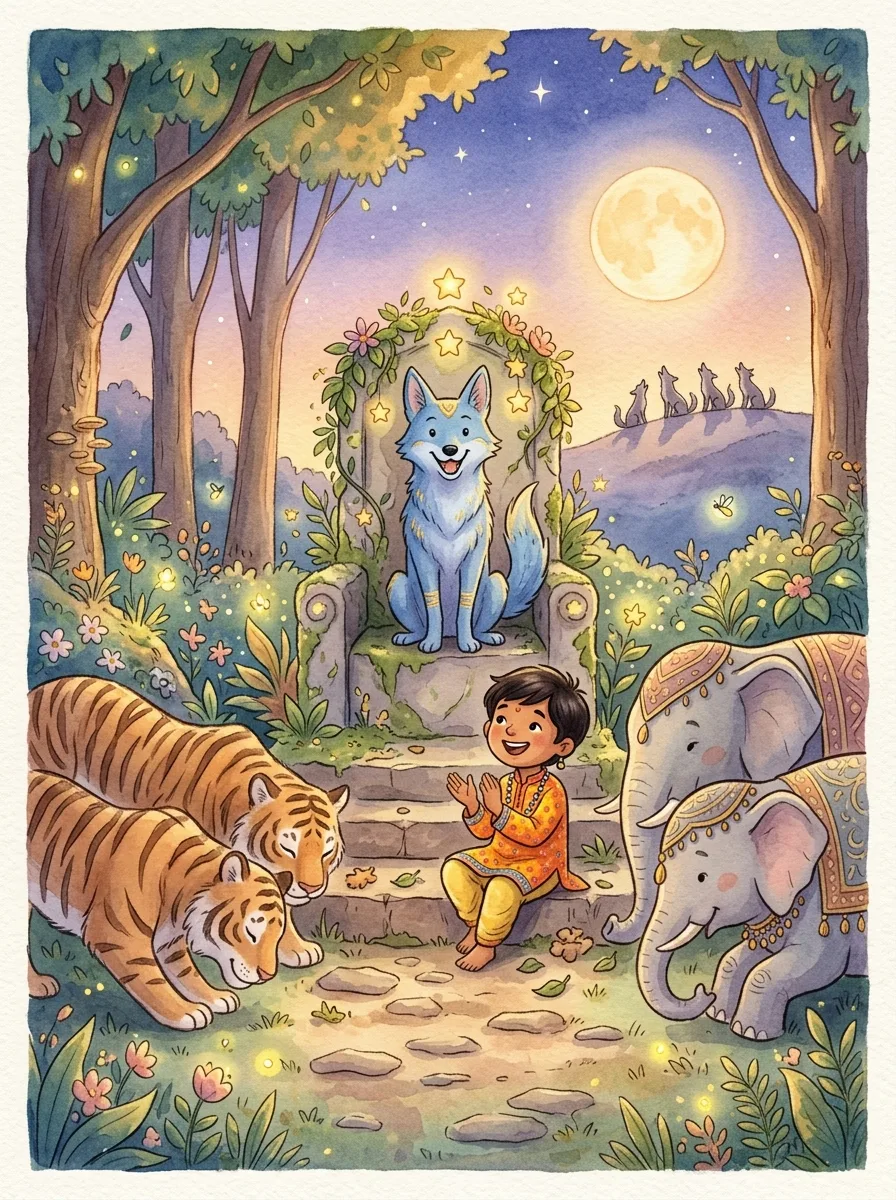
Your child and the King of the Forest
The blue jackal has told every animal that he is a rare king sent to rule the forest, and the tigers and elephants are bowing to him. Your child visits the new palace and finds the jackal lonely on his stone throne, missing his old friends. That night, when the other jackals howl, he howls back, and the animals gasp. Your child is there to hold his paw when the truth comes out.
Lesson: Being yourself is better than being a king
The Blue Jackal
Your child and the First Rain
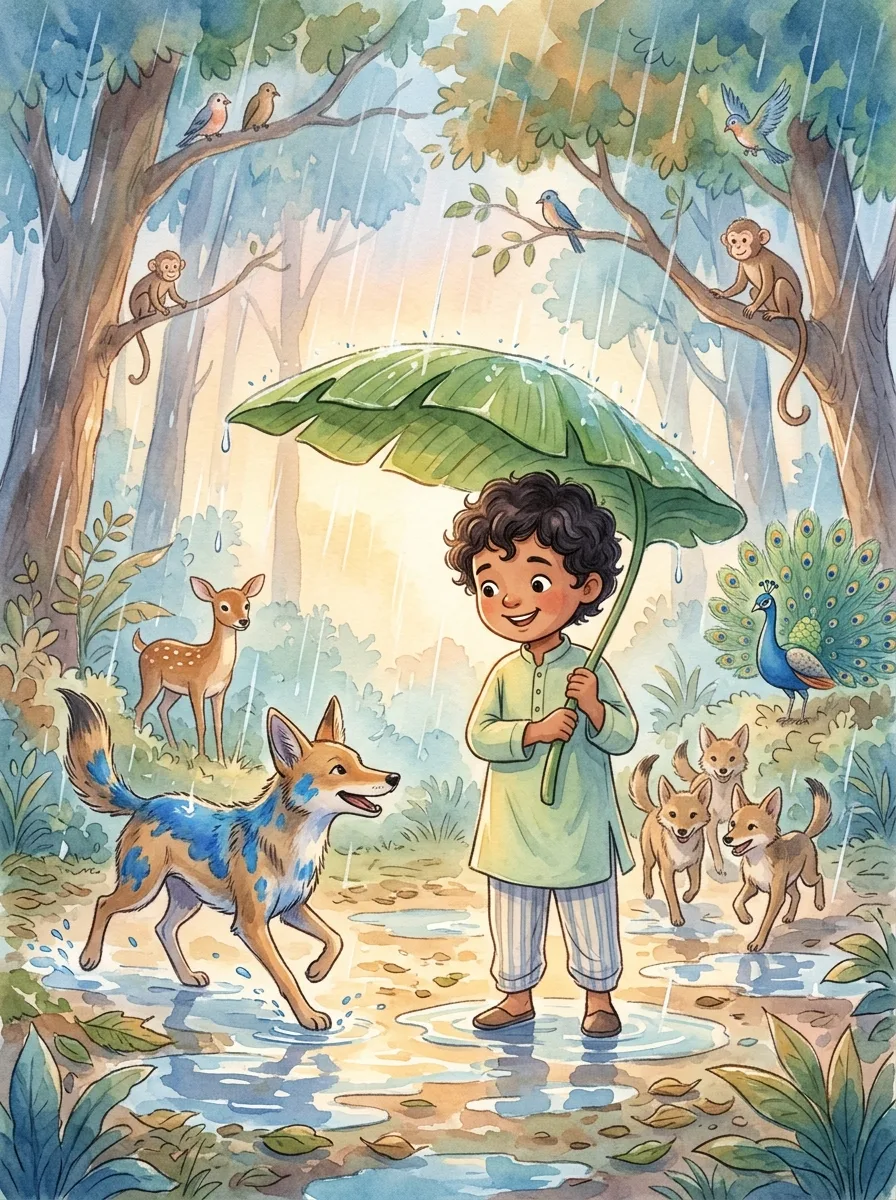
Your child and the First Rain
The monsoon arrives and the blue dye runs off the jackal in streams, leaving a plain grey jackal in the middle of a very surprised forest. Your child steps forward and tells the animals about the jackal's sore heart, his silly plan and how much he missed his family. The other jackals come running, and the animals decide the forest does not need a king after all.
Lesson: Say sorry, come home and start again
The Blue Jackal
Your child and the Dyer's Courtyard
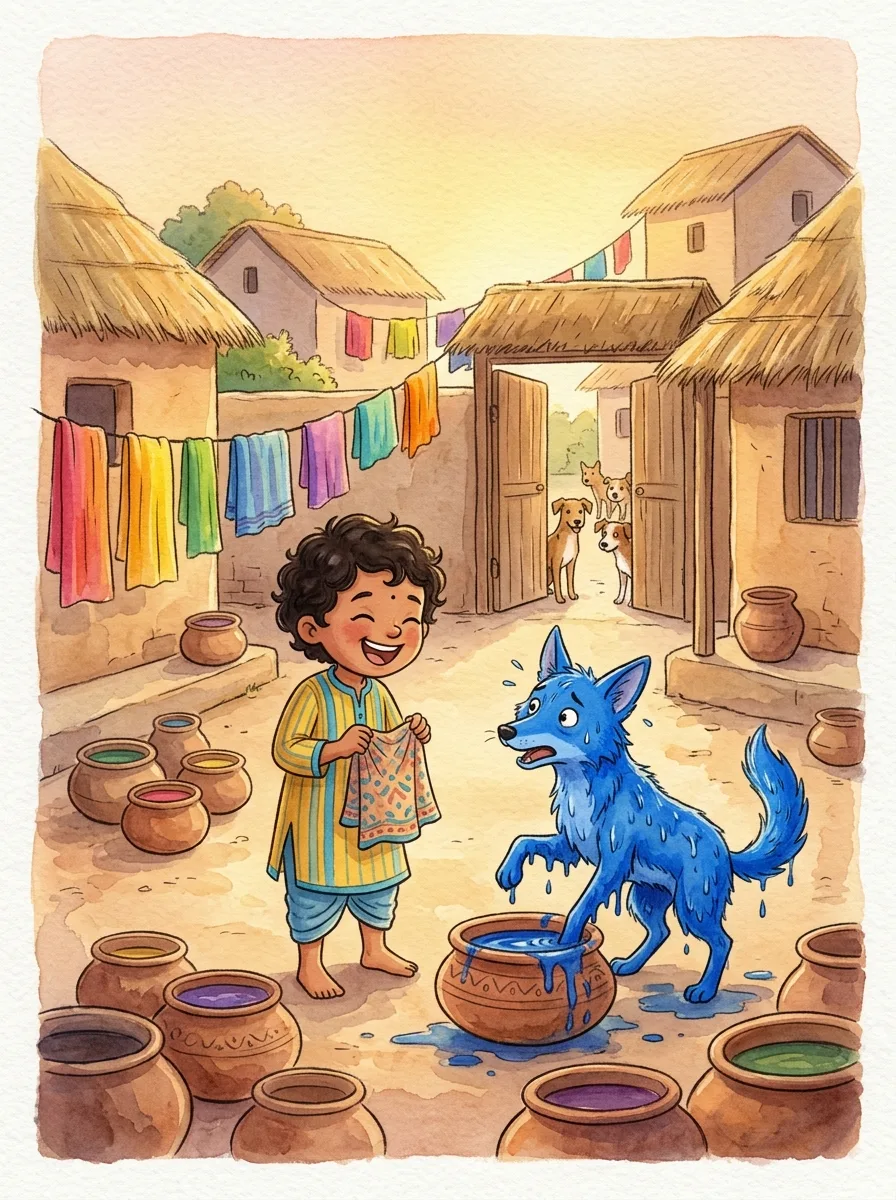
Your child and the Dyer's Courtyard
Your child helps the village dyer stir great vats of indigo, and one evening a hungry jackal creeps in, chased by dogs, and tumbles headfirst into the bluest vat. Your child hauls him out by the tail, dripping and shivering. Before the jackal can run into the forest, Your child tries to rinse him, but the blue will not come off. Neither of them knows yet what trouble a blue jackal can cause.
Lesson: Help first, ask questions after
The Blue Jackal
Your child and the Strange Blue King
Your child and the Strange Blue King
In the forest, the animals gasp at the shining blue creature and bow. The jackal, delighted, announces that he is a king sent by the gods. Your child, visiting to collect honey, recognises the dyer's indigo at once. But the animals are so happy to have a king that Your child decides to wait and watch, and only whispers to the jackal, 'Be careful with a crown that is only paint.'
Lesson: A borrowed colour cannot make a real king
The Blue Jackal
Your child and the Lions Who Carried the Jackal
Your child and the Lions Who Carried the Jackal
The blue king now rides on the lion's back and makes the tigers fan him with leaves. He has sent his own jackal family away because they are not blue. Your child visits the jackals and finds them sad and hungry. Your child brings them food from the village and tells them that a brother who forgets his family has lost more than they have.
Lesson: Do not forget your own people when you rise
The Blue Jackal
Your child and the Howl in the Night
Your child and the Howl in the Night
One moonlit night the jackals begin to howl, and the blue king, who cannot help himself, howls back. Your child, camping by the forest with Dadaji, hears the sound and knows what will happen next. The animals realise the truth and chase the blue king out of the palace. Your child finds him hiding in the reeds and says, 'Now you can just be a jackal again. That was never so bad.'
Lesson: Your true voice always comes out in the end
The Blue Jackal
Your child and the Long Bath
Your child and the Long Bath
The blue jackal is hiding, ashamed, and the dye has still not come off. Your child brings soap-nut from the village and a bucket, and they scrub by the stream for a whole afternoon. Fur by fur, the brown comes back. When the jackal sees his own colour in the water, he cries a little, and Your child says the brown looks much better on him than the crown did.
Lesson: Washing off a lie takes time, but your real self is worth it
The Blue Jackal
Your child and the Jackal Goes Home
Your child and the Jackal Goes Home
The jackal wants to go back to his family but is afraid they will turn him away. Your child walks with him to the den. The other jackals are silent at first. Then Your child says, 'He has come to say sorry, and I think he means it.' The jackal says it himself, and his mother licks his ear. That night the whole family howls together, and nobody is blue.
Lesson: Going home to say sorry takes more courage than being king
The Blue Jackal
Your child and the Lion Who Felt Foolish
Your child and the Lion Who Felt Foolish
The lion is furious that he bowed to a painted jackal and wants to hunt him down. Your child finds the lion sulking at the waterhole and asks him a question: was it the jackal who tricked him, or was it his own wish to have someone to bow to? The lion is quiet for a long time. Then he laughs, a big rumbly laugh, and says he would rather be laughed at than be a fool twice.
Lesson: Ask yourself why you were fooled, and you will not be fooled again
The Blue Jackal
Your child and the Animals Who Bowed
Your child and the Animals Who Bowed
The forest animals are arguing about whose fault it was: the jackal for pretending, or everyone for believing. Your child suggests a new forest rule: before bowing to anyone, ask three questions. Where are you from? Who knows you? What can you do? The animals agree. The next week a peacock arrives claiming to be a prince, and the deer asks all three questions before anyone bows.
Lesson: Ask questions before you bow
The Blue Jackal
Your child and the New Dye Vats
Your child and the New Dye Vats
The dyer's vats are still open to the courtyard, and last week it was a jackal; next time it could be a child. Your child persuades the dyer to build wooden lids and a low fence, and spends a weekend hammering with him. The dyer grumbles about the cost, until his own goat wanders in, bumps a lid and stays perfectly white. The lids stay.
Lesson: Fix the danger before the next accident
The Blue Jackal
Your child and the Jackal Who Wanted to Help
Your child and the Jackal Who Wanted to Help
The jackal, brown again, wants to do something good for the forest that once bowed to him. He is quick and knows every path. Your child suggests he become the forest's messenger, carrying news between the animals. The lion agrees, warily. Within a month the jackal has warned the deer of a fire and led a lost cub home, and the forest calls him something better than king: useful.
Lesson: Being useful lasts longer than being admired
The Blue Jackal
Your child and the Village Fancy Dress
Your child and the Village Fancy Dress
At the village fair there is a fancy dress contest, and Your child wants to go as the blue jackal. Mummy warns the paint may not wash off, but Your child uses turmeric-and-indigo rice paste, the kind Nani uses for kolam, that washes off with water. Your child wins the funniest costume prize and is clean by bedtime. The real jackal, Your child thinks, should have asked Nani.
Lesson: Play at being someone else, but make sure you can come back
The Blue Jackal
Your child and the Painted Elephant
Your child and the Painted Elephant
For the temple festival, the elephant is painted with bright patterns, and the little village children think it has become a different, magical animal. Your child remembers the blue jackal and takes the smallest children to the elephant after the festival, when the paint is being washed off. Underneath is the same gentle grey elephant who takes bananas from their hands, just as always.
Lesson: Paint changes the outside, never the inside
The Blue Jackal
The Clever Crow’s Pitcher
The Clever Crow’s Pitcher
In a Panchatantra-style village, a thirsty crow cannot reach the water at the bottom of a pitcher. Your child helps gather pebbles one by one, learning that patience and clever thinking can solve problems strength cannot. The story should stay respectful and child-safe, using the epic or fable as inspiration rather than a heavy retelling. Your child faces a small choice connected to courage, dharma, wisdom, or friendship, then helps the scene resolve through kindness. The ending should carry the value clearly without sounding preachy.
Lesson: Small smart steps can solve big problems.
The Blue Jackal
The Lion and the Tiny Mouse
The Lion and the Tiny Mouse
A proud lion laughs when a tiny mouse offers help, until a net teaches both of them a lesson. With Your childs kindness, the mouse proves that no friend is too small to make a big difference. The story should stay respectful and child-safe, using the epic or fable as inspiration rather than a heavy retelling. Your child faces a small choice connected to courage, dharma, wisdom, or friendship, then helps the scene resolve through kindness. The ending should carry the value clearly without sounding preachy.
Lesson: Kindness to the small can return in big ways.
The Blue Jackal
The Monkey and the Mango Bridge
The Monkey and the Mango Bridge
A playful monkey wants every mango first, but the branch bridge shakes whenever anyone grabs too much. Your child helps the animals share fairly, learning that greed can wobble a bridge while fairness keeps it strong. The story should stay respectful and child-safe, using the epic or fable as inspiration rather than a heavy retelling. Your child faces a small choice connected to courage, dharma, wisdom, or friendship, then helps the scene resolve through kindness. The ending should carry the value clearly without sounding preachy.
Lesson: Fair sharing keeps friendships strong.
The Blue Jackal
The Wise Tortoise’s Quiet Plan
The Wise Tortoise’s Quiet Plan
When noisy animals rush toward a muddy shortcut, a wise tortoise asks Your child to wait and watch. The patient path turns out safer, teaching everyone that slow thinking can sometimes be the fastest way home. The story should stay respectful and child-safe, using the epic or fable as inspiration rather than a heavy retelling. Your child faces a small choice connected to courage, dharma, wisdom, or friendship, then helps the scene resolve through kindness. The ending should carry the value clearly without sounding preachy.
Lesson: Patience and observation can prevent avoidable mistakes.
The Blue Jackal
The Jackal’s Honest Echo
A clever jackal discovers a cave that echoes every untruth louder than thunder. With Your childs help, the animals learn that cleverness is best when it walks beside honesty. The story should stay respectful and child-safe, using the epic or fable as inspiration rather than a heavy retelling. Your child faces a small choice connected to courage, dharma, wisdom, or friendship, then helps the scene resolve through kindness. The ending should carry the value clearly without sounding preachy.
Lesson: Cleverness should be guided by honesty and care.
The Blue Jackal
The Blue Jackal Learns Humility
The Blue Jackal Learns Humility
In a Panchatantra-style forest, a jackal painted blue pretends to be greater than everyone else. Your child helps the animals uncover the truth kindly, learning that pretending feels heavy but honesty feels free. The story should stay respectful and child-safe, using the epic or fable as inspiration rather than a heavy retelling. Your child faces a small choice connected to courage, dharma, wisdom, or friendship, then helps the scene resolve through kindness. The ending should carry the value clearly without sounding preachy.
Lesson: Honesty and humility build better friendships than pretending.
The Blue Jackal
The Talkative Turtle’s Promise
The Talkative Turtle’s Promise
A turtle promises two swans to stay quiet while flying across the sky, but words keep tickling the tongue. Your child helps the turtle practice listening, learning that some promises are kept by pausing first. The story should stay respectful and child-safe, using the epic or fable as inspiration rather than a heavy retelling. Your child faces a small choice connected to courage, dharma, wisdom, or friendship, then helps the scene resolve through kindness. The ending should carry the value clearly without sounding preachy.
Lesson: Listening and self-control help us keep promises.
The Blue Jackal
The Four Friends of the Forest
The Four Friends of the Forest
A deer, crow, mouse, and turtle each has one small talent. When trouble arrives, Your child helps them combine their strengths and learns that friendship works best when everyone brings what they can. The story should stay respectful and child-safe, using the epic or fable as inspiration rather than a heavy retelling. Your child faces a small choice connected to courage, dharma, wisdom, or friendship, then helps the scene resolve through kindness. The ending should carry the value clearly without sounding preachy.
Lesson: Friends become stronger when they value each other’s different gifts.
The Blue Jackal
The Wise Rabbit and the Moon Pond
The Wise Rabbit and the Moon Pond
A small rabbit must protect the pond from a boastful elephant herd without fighting. With Your childs clever plan and moonlit reflection, the animals learn that wisdom can be stronger than size. The story should stay respectful and child-safe, using the epic or fable as inspiration rather than a heavy retelling. Your child faces a small choice connected to courage, dharma, wisdom, or friendship, then helps the scene resolve through kindness. The ending should carry the value clearly without sounding preachy.
Lesson: Wisdom and calm thinking can solve problems without force.