The Monkey and the Crocodile
Your child and the Jamun Tree
Your child and the Jamun Tree
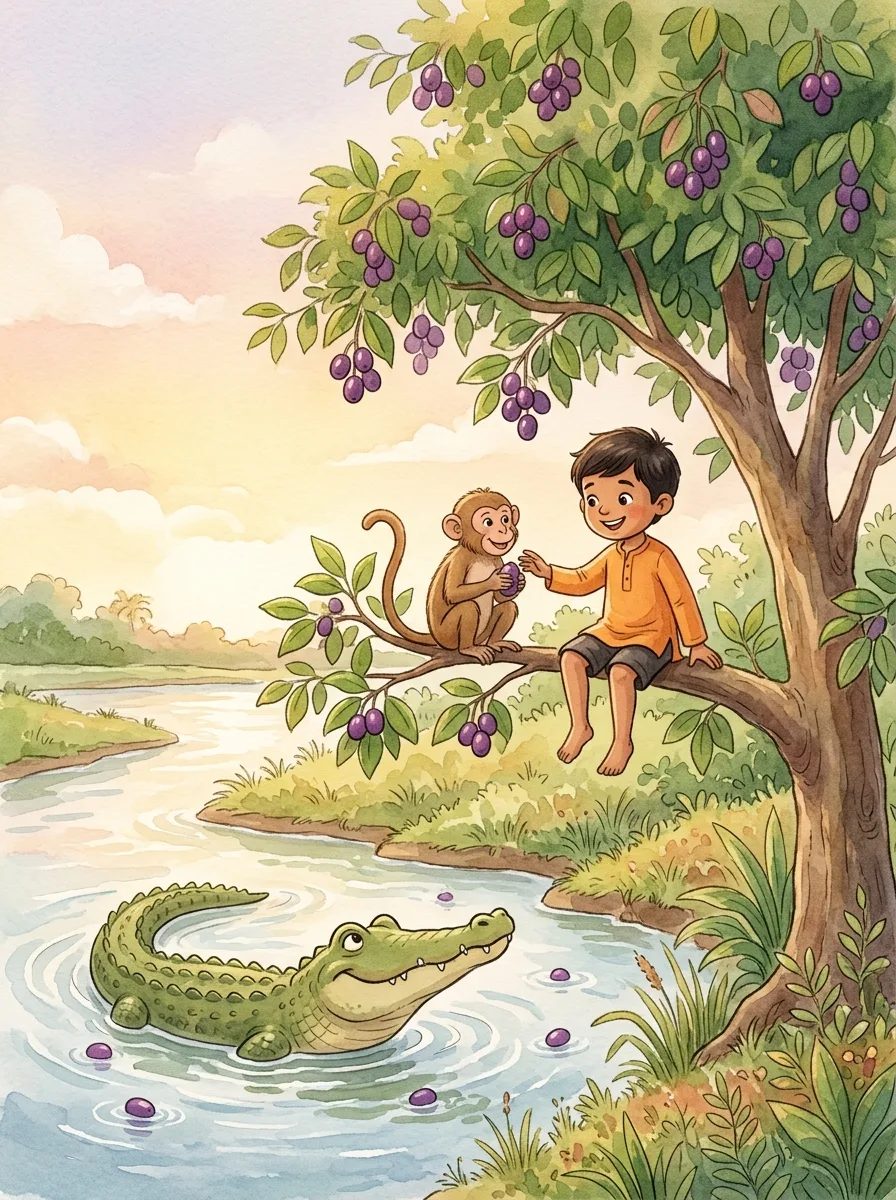
High in the jamun tree by the river, Your child and the monkey are dropping purple fruit to a crocodile who has never tasted anything so sweet. Every day the crocodile comes back, and every day Your child picks the ripest ones. Soon the three of them are telling jokes across the water, and Your child learns that a shared snack can turn a stranger into a friend.
Lesson: Sharing what you have is the quickest way to make a friend
The Monkey and the Crocodile
Your child and the River Ride
Your child and the River Ride
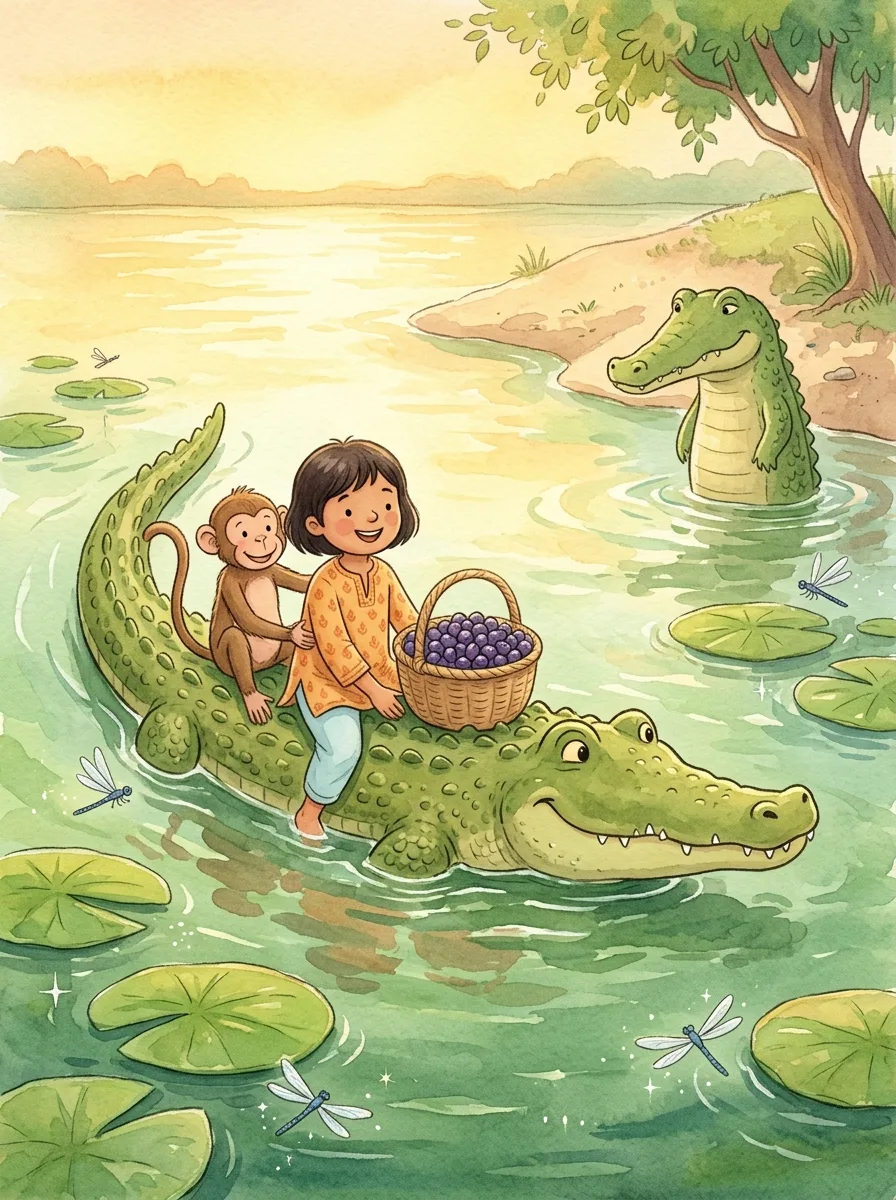
The crocodile offers the monkey and Your child a ride across the river to meet his wife, who has heard so much about the monkey that she wants him to visit. Halfway across, the crocodile looks worried and admits his wife is grumpy about waiting. Your child suggests they turn back for a basket of jamun so nobody arrives empty-handed, and the visit becomes a picnic.
Lesson: A worry shared out loud is half solved already
The Monkey and the Crocodile
Your child and the Heart in the Tree
Your child and the Heart in the Tree
When the crocodile says his wife wants the monkey's heart, the monkey does not panic. He tells the crocodile he left his heart hanging in the jamun tree and they must go back for it. Back on the bank, Your child helps the monkey scramble up and then explains gently to the crocodile that friends do not ask for things that cannot be given. The crocodile blushes and says sorry.
Lesson: Stay calm, think clearly, and be honest with your friends
The Monkey and the Crocodile
Your child and the Crocodile's First Visit
Your child and the Crocodile's First Visit
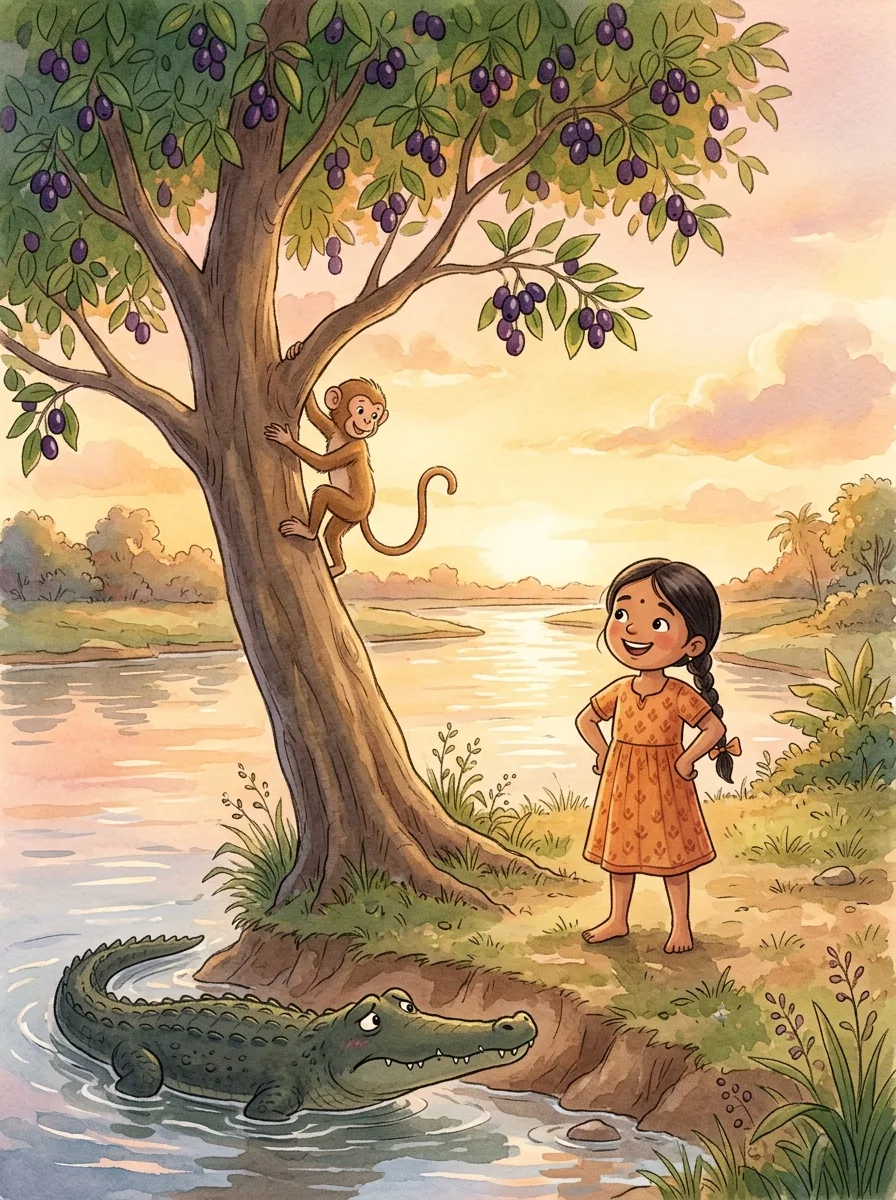
A crocodile has appeared under the jamun tree for the first time, and the monkey is nervous about the big teeth. Your child, sitting on the lowest branch, notices the crocodile is only looking at the fallen fruit, not at anyone's tail. Your child drops one jamun into the water as a test. The crocodile eats it and says thank you, and a strange new friendship begins.
Lesson: Be careful with strangers, but give kindness a small chance
The Monkey and the Crocodile
Your child and the Basket for the Crocodile's Wife
Your child and the Basket for the Crocodile's Wife
The crocodile keeps eating all the jamun himself, and his wife at home has never tasted one. Your child weaves a little basket from river reeds, fills it with the ripest fruit, and asks the crocodile to carry it home on his back without eating a single one. He wobbles all the way across, and returns the next day saying his wife has asked to meet the child who thinks of others.
Lesson: Remember the people at home who cannot come to the feast
The Monkey and the Crocodile
Your child and the Wife's Strange Wish
Your child and the Wife's Strange Wish
The crocodile's wife has decided that if jamun make the monkey so sweet, his heart must be sweeter still, and she wants it. The crocodile is miserable and tells Your child on the riverbank. Your child does not shout at him; instead Your child asks what would happen to the friendship, and to the jamun, if the monkey were gone. The crocodile thinks for a long time and goes home to talk to his wife.
Lesson: A good question can stop a bad plan before it starts
The Monkey and the Crocodile
Your child and the Monkey's Quick Thinking
Your child and the Monkey's Quick Thinking
In the middle of the river, the crocodile confesses what his wife wants, and the monkey calmly says he left his heart in the tree. Your child, swimming alongside on a log, understands the trick at once and keeps a straight face. Back at the bank, when the monkey is safely up the tree, Your child tells the crocodile that friends do not carry friends into danger. He hangs his head and agrees.
Lesson: Keep calm in danger and think before you act
The Monkey and the Crocodile
Your child and the Heart That Stays Inside
Your child and the Heart That Stays Inside
After the river ride, the little forest animals are confused: can a monkey really leave his heart in a tree? Your child gathers them under the jamun and explains gently that the monkey said a clever thing to stay safe, and that hearts always stay inside where they belong. Then Your child shows them how to check a story by asking, 'Does that make sense?' The rabbits ask it about everything after that.
Lesson: Ask 'does that make sense?' before you believe a story
The Monkey and the Crocodile
Your child and the Sorry That Took a Week
Your child and the Sorry That Took a Week
The crocodile wants to say sorry to the monkey but the monkey will not come down from the tree. Every day the crocodile brings a lotus and leaves it on the bank, and every day Your child carries the flower up. On the seventh day, the monkey comes down to the lowest branch. The crocodile says sorry, properly, and the three of them share jamun, this time with the monkey staying on land.
Lesson: A real sorry takes patience and keeps coming back
The Monkey and the Crocodile
Your child and the Jamun Harvest
Your child and the Jamun Harvest
The jamun tree is so heavy with fruit that the branches are bending into the river. The monkey wants to eat them all, and the crocodile says the fish deserve some. Your child climbs up with a cloth sling and divides the harvest: a pile for the monkey, a pile for the crocodile's family, a scatter for the fish, and a basket for the village children on the far bank.
Lesson: A big harvest is for sharing all the way round
The Monkey and the Crocodile
Your child and the Flood on the River
Your child and the Flood on the River
The rains have swollen the river and the jamun tree is surrounded by rushing water, with the monkey stranded. Your child cannot swim across, but the crocodile can. Your child persuades him to carry a rope to the tree and ties it firmly to a stump, so the monkey can hand-over-hand to safety. Once the friend who was nearly a danger, the crocodile becomes the friend who saved the day.
Lesson: Old mistakes can be mended with a new brave act
The Monkey and the Crocodile
Your child and the Fisherman with the Net
Your child and the Fisherman with the Net
A fisherman has set a net in the river and the crocodile is caught in it, thrashing and frightened. The monkey says serves him right and stays in the tree. Your child wades in with a small knife, cuts the ropes one by one, and tells the monkey that a friend in trouble is still a friend. The crocodile swims free and never forgets who came into the water for him.
Lesson: Help a friend in trouble, even if you are still a little cross
The Monkey and the Crocodile
Your child and the Story Told to the Hatchlings
Your child and the Story Told to the Hatchlings
The crocodile's eggs have hatched, and the tiny crocodiles want to know why their father visits a tree every day. Your child sits on the sand and tells them the whole story: the jamun, the ride, the heart in the tree and the sorry that took a week. The hatchlings decide they want a monkey friend too. The monkey, listening from above, drops a jamun for each of them.
Lesson: Stories about mistakes teach the next ones to do better
The Monkey and the Crocodile
Your child and the Sweetest Jamun
Your child and the Sweetest Jamun
The monkey and the crocodile argue about who gets the single darkest, ripest jamun at the very top of the tree. Your child climbs up, picks it, and instead of choosing a winner, splits it in three. Each gets a third, and Your child declares it the sweetest jamun ever, because it was shared. The two friends agree, and the argument turns into a picnic.
Lesson: Shared fruit tastes sweeter than fruit fought over
The Monkey and the Crocodile
Your child and the Rope Bridge to the Island
Your child and the Rope Bridge to the Island
The crocodile's wife wants to visit the jamun tree but cannot climb, and the monkey will not ride on a crocodile again. Your child suggests a rope bridge from the island to the low branch, so everyone can meet in the middle without anyone carrying anyone. It takes three days to build, with the crocodile towing the ropes. On the fourth day, the whole river family has a jamun feast on the bridge.
Lesson: When trust is thin, build a way that is safe for everyone
The Monkey and the Crocodile
The Clever Crow’s Pitcher
The Clever Crow’s Pitcher
In a Panchatantra-style village, a thirsty crow cannot reach the water at the bottom of a pitcher. Your child helps gather pebbles one by one, learning that patience and clever thinking can solve problems strength cannot. The story should stay respectful and child-safe, using the epic or fable as inspiration rather than a heavy retelling. Your child faces a small choice connected to courage, dharma, wisdom, or friendship, then helps the scene resolve through kindness. The ending should carry the value clearly without sounding preachy.
Lesson: Small smart steps can solve big problems.
The Monkey and the Crocodile
The Lion and the Tiny Mouse
The Lion and the Tiny Mouse
A proud lion laughs when a tiny mouse offers help, until a net teaches both of them a lesson. With Your childs kindness, the mouse proves that no friend is too small to make a big difference. The story should stay respectful and child-safe, using the epic or fable as inspiration rather than a heavy retelling. Your child faces a small choice connected to courage, dharma, wisdom, or friendship, then helps the scene resolve through kindness. The ending should carry the value clearly without sounding preachy.
Lesson: Kindness to the small can return in big ways.
The Monkey and the Crocodile
The Monkey and the Mango Bridge
The Monkey and the Mango Bridge
A playful monkey wants every mango first, but the branch bridge shakes whenever anyone grabs too much. Your child helps the animals share fairly, learning that greed can wobble a bridge while fairness keeps it strong. The story should stay respectful and child-safe, using the epic or fable as inspiration rather than a heavy retelling. Your child faces a small choice connected to courage, dharma, wisdom, or friendship, then helps the scene resolve through kindness. The ending should carry the value clearly without sounding preachy.
Lesson: Fair sharing keeps friendships strong.
The Monkey and the Crocodile
The Wise Tortoise’s Quiet Plan
The Wise Tortoise’s Quiet Plan
When noisy animals rush toward a muddy shortcut, a wise tortoise asks Your child to wait and watch. The patient path turns out safer, teaching everyone that slow thinking can sometimes be the fastest way home. The story should stay respectful and child-safe, using the epic or fable as inspiration rather than a heavy retelling. Your child faces a small choice connected to courage, dharma, wisdom, or friendship, then helps the scene resolve through kindness. The ending should carry the value clearly without sounding preachy.
Lesson: Patience and observation can prevent avoidable mistakes.
The Monkey and the Crocodile
The Jackal’s Honest Echo
A clever jackal discovers a cave that echoes every untruth louder than thunder. With Your childs help, the animals learn that cleverness is best when it walks beside honesty. The story should stay respectful and child-safe, using the epic or fable as inspiration rather than a heavy retelling. Your child faces a small choice connected to courage, dharma, wisdom, or friendship, then helps the scene resolve through kindness. The ending should carry the value clearly without sounding preachy.
Lesson: Cleverness should be guided by honesty and care.
The Monkey and the Crocodile
The Blue Jackal Learns Humility
The Blue Jackal Learns Humility
In a Panchatantra-style forest, a jackal painted blue pretends to be greater than everyone else. Your child helps the animals uncover the truth kindly, learning that pretending feels heavy but honesty feels free. The story should stay respectful and child-safe, using the epic or fable as inspiration rather than a heavy retelling. Your child faces a small choice connected to courage, dharma, wisdom, or friendship, then helps the scene resolve through kindness. The ending should carry the value clearly without sounding preachy.
Lesson: Honesty and humility build better friendships than pretending.
The Monkey and the Crocodile
The Talkative Turtle’s Promise
The Talkative Turtle’s Promise
A turtle promises two swans to stay quiet while flying across the sky, but words keep tickling the tongue. Your child helps the turtle practice listening, learning that some promises are kept by pausing first. The story should stay respectful and child-safe, using the epic or fable as inspiration rather than a heavy retelling. Your child faces a small choice connected to courage, dharma, wisdom, or friendship, then helps the scene resolve through kindness. The ending should carry the value clearly without sounding preachy.
Lesson: Listening and self-control help us keep promises.
The Monkey and the Crocodile
The Four Friends of the Forest
The Four Friends of the Forest
A deer, crow, mouse, and turtle each has one small talent. When trouble arrives, Your child helps them combine their strengths and learns that friendship works best when everyone brings what they can. The story should stay respectful and child-safe, using the epic or fable as inspiration rather than a heavy retelling. Your child faces a small choice connected to courage, dharma, wisdom, or friendship, then helps the scene resolve through kindness. The ending should carry the value clearly without sounding preachy.
Lesson: Friends become stronger when they value each other’s different gifts.
The Monkey and the Crocodile
The Wise Rabbit and the Moon Pond
The Wise Rabbit and the Moon Pond
A small rabbit must protect the pond from a boastful elephant herd without fighting. With Your childs clever plan and moonlit reflection, the animals learn that wisdom can be stronger than size. The story should stay respectful and child-safe, using the epic or fable as inspiration rather than a heavy retelling. Your child faces a small choice connected to courage, dharma, wisdom, or friendship, then helps the scene resolve through kindness. The ending should carry the value clearly without sounding preachy.
Lesson: Wisdom and calm thinking can solve problems without force.