The Tortoise and the Geese
Your child and the Drying Lake
Your child and the Drying Lake
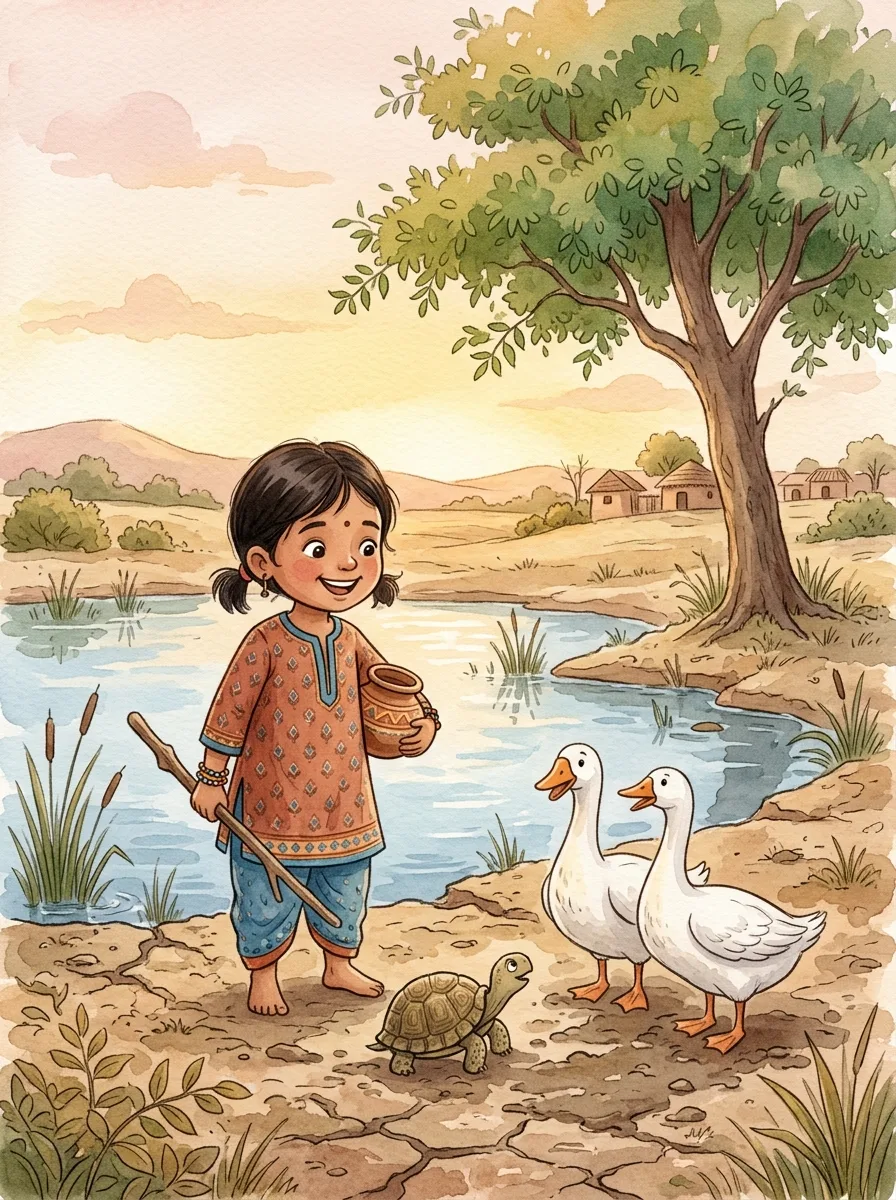
The summer is long and the lake is shrinking day by day. Your child, fetching water in a clay pot, finds a tortoise worried about his two goose friends who plan to fly to a bigger lake far away. The geese offer to carry the tortoise if he grips a stick in his mouth, and Your child finds the perfect stick, straight and strong, from under the neem tree.
Lesson: A good plan starts with good preparation
The Tortoise and the Geese
Your child and the Flight over the Village
Your child and the Flight over the Village
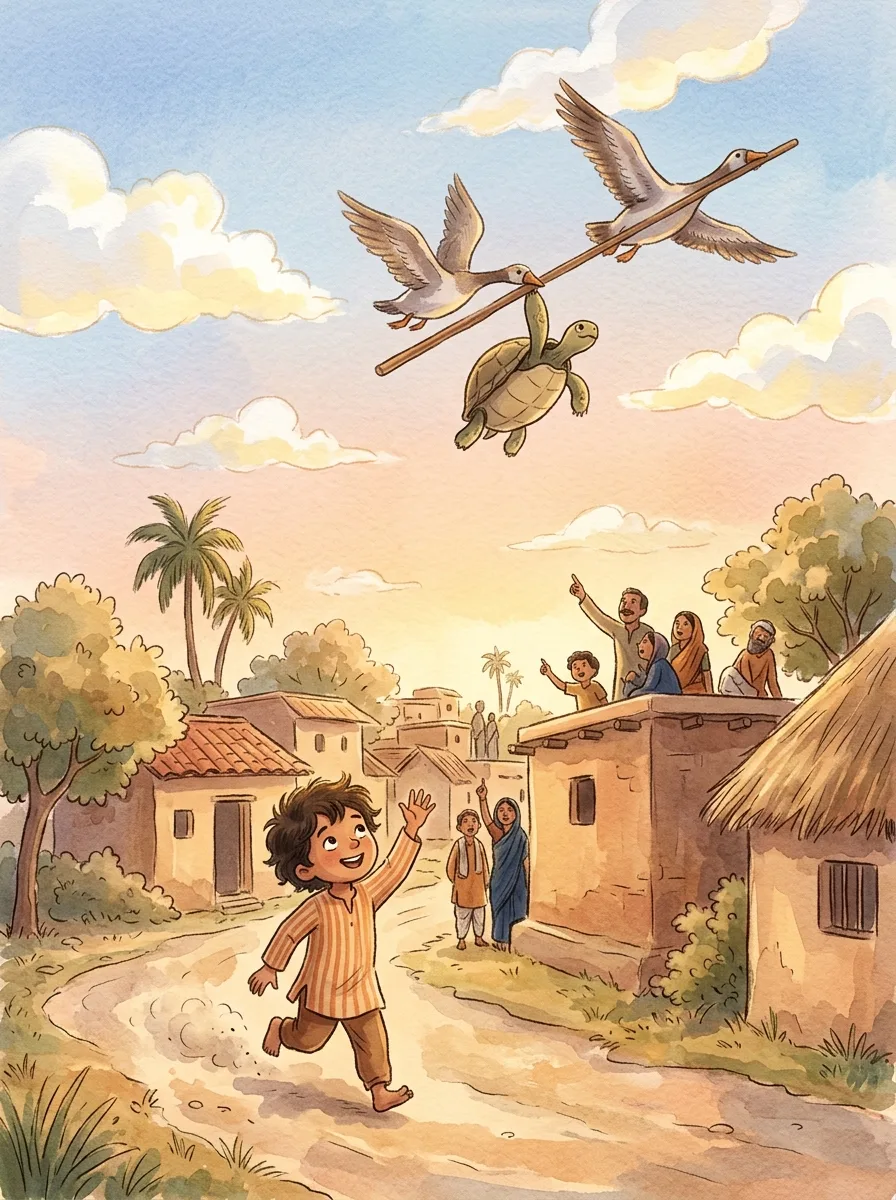
The geese take off with the stick between them and the tortoise dangling in the middle. Your child runs along below, waving and shouting to keep him quiet as the villagers point and laugh. The tortoise's mouth twitches, he so badly wants to answer, but he hears Your child calling do not talk, and he grips the stick even tighter until the village is far behind.
Lesson: Sometimes the wisest thing to say is nothing at all
The Tortoise and the Geese
Your child and the Soft Landing
Your child and the Soft Landing
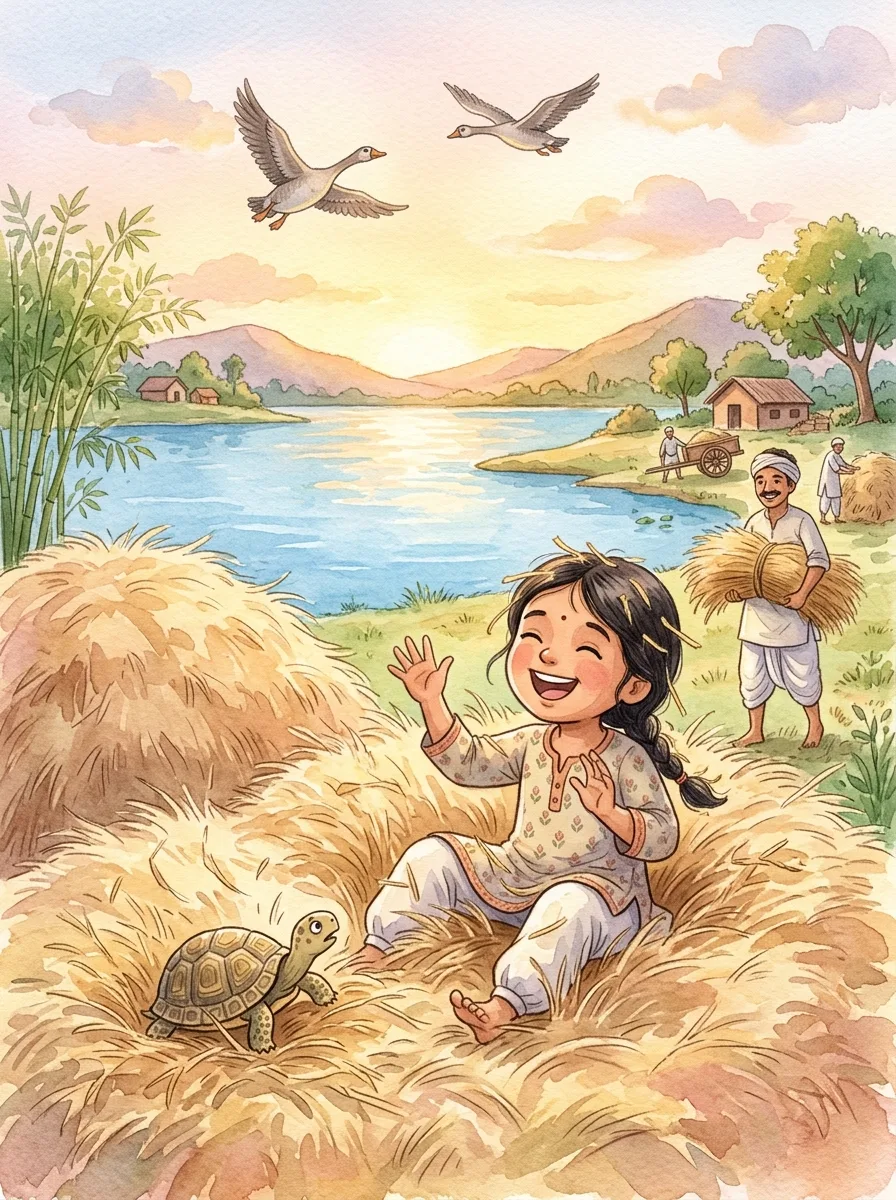
Just before the new lake, a boy on the ground shouts a silly joke and the tortoise opens his mouth to laugh. Down he tumbles, straight into the haystack Your child had raced ahead to pile up, just in case. The geese circle back, the tortoise climbs out covered in straw, and all four of them agree that next time he will laugh only after landing.
Lesson: Learn from a slip and try again more carefully
The Tortoise and the Geese
Your child and the Tortoise Who Talked Too Much
Your child and the Tortoise Who Talked Too Much
By the village lake lives a tortoise named Kambugriva who talks to everyone about everything and never stops. The geese are his best friends, but even they need a rest. Your child, who comes to the lake to fill pots, notices the geese sighing. Your child suggests a game: the tortoise listens for as long as the sun takes to cross one reed. He manages it, just, and learns that listening is a game too.
Lesson: Listening is as much a part of friendship as talking
The Tortoise and the Geese
Your child and the Lake That Shrank
Your child and the Lake That Shrank
No rain has fallen for months and the lake is shrinking to mud. The geese can fly to a far lake, but the tortoise cannot. Your child, who has been watching the water line drop against the stone steps, marks it every day with chalk and warns the tortoise before the last pool dries. Together they call the geese for a serious talk about how to move a tortoise.
Lesson: Watch closely and warn early
The Tortoise and the Geese
Your child and the Stick Idea
Your child and the Stick Idea
The geese and the tortoise cannot think how to get him to the far lake. Your child watches two boys carrying a water pot on a pole between them and has an idea: a strong stick, a goose at each end, and the tortoise holding the middle in his mouth. The tortoise cheers so loudly the geese remind him that the plan only works if his mouth stays closed. He promises, twice.
Lesson: Look around you and ideas are everywhere
The Tortoise and the Geese
Your child and the Practice Flight
Your child and the Practice Flight
Before the real journey, Your child insists on a practice flight, just across the courtyard, close to the ground. The tortoise bites the stick, the geese lift, and halfway across he opens his mouth to say 'this is wonderful' and lands on a pile of hay Your child had spread just in case. Nobody is hurt. The tortoise agrees that practice was a very good idea, and practises keeping quiet all afternoon.
Lesson: Practise the hard thing before it matters
The Tortoise and the Geese
Your child and the Village That Pointed
Your child and the Village That Pointed
The real flight begins, and as the geese pass over the village, people run out pointing and shouting at the flying tortoise. Your child can see the tortoise's mouth twitching to answer. Running below, Your child shouts up the one thing that works: 'Do not say a word, I will tell them for you!' Then Your child tells the crowd the whole story so the tortoise does not have to.
Lesson: A friend can speak for you so you do not have to
The Tortoise and the Geese
Your child and the Shut-Mouth Landing
Your child and the Shut-Mouth Landing
The far lake is in sight, and the tortoise's jaws are aching. One goose wobbles in a gust and the tortoise nearly gasps. Your child, who ran the whole way, reaches the lake first and stands on the bank holding both arms straight up, a signal that means 'almost there, hold on'. The tortoise holds on. They land in the reeds with a splash and a cheer, and the tortoise finally speaks: 'I did it!'
Lesson: Hold on a little longer; the finish is closer than you think
The Tortoise and the Geese
Your child and the Story at the New Lake
Your child and the Story at the New Lake
At the new lake the fish and frogs ask how a tortoise arrived from the sky. The tortoise is bursting to tell. Your child suggests he tell it in ten words, then twenty, then the whole thing, and the frogs count. He gets it down to ten: 'Two geese, one stick, my mouth shut, here I am.' The frogs clap, and he tells the long version anyway, but only after dinner.
Lesson: A good story is worth waiting for and telling well
The Tortoise and the Geese
Your child and the Return Journey
Your child and the Return Journey
The rains come and the old lake is full again, and the tortoise misses his home. This time Your child asks him to plan the flight himself: the stick, the route, the signal, the hay. The tortoise makes a list on a leaf and, most importantly, plans a stop halfway on a haystack where talking is allowed. He flies home without a single word in the air, and talks for a week afterwards.
Lesson: Plan for your own weakness and it stops being one
The Tortoise and the Geese
Your child and the Geese Who Were Tired
Your child and the Geese Who Were Tired
The geese are exhausted from carrying the tortoise and have caught a chill. The tortoise wants to thank them but does not know how. Your child shows him how to gather soft reeds for a warm nest and pick the best water snails from the lake bottom, where geese cannot reach. The geese rest for three days in the softest nest by the lake, fed by a grateful tortoise.
Lesson: Thank the ones who carried you by carrying them a while
The Tortoise and the Geese
Your child and the Boy Who Could Not Keep a Secret
Your child and the Boy Who Could Not Keep a Secret
In the village, Your child's friend Chintu cannot keep his mouth shut, and has just spoiled a surprise for Nani's birthday. Chintu is sad. Your child tells him about the tortoise who had to hold a stick for a whole flight, and gives him a smooth pebble to hold in his hand whenever a secret wants to escape. At the next surprise, Chintu squeezes the pebble so hard it is warm, and says nothing.
Lesson: Give your hands something to hold when your mouth wants to talk
The Tortoise and the Geese
Your child and the Crane Who Laughed
Your child and the Crane Who Laughed
A crane has heard about the flying tortoise and laughs that tortoises belong in mud. The tortoise's feelings are hurt. Your child does not scold the crane. Instead Your child asks the crane if he could hold a stick in his beak for an hour without a single word. The crane tries, lasts a minute, and drops it to complain. Everyone laughs, including the crane, who apologises.
Lesson: Before you laugh at someone, try what they did
The Tortoise and the Geese
Your child and the Flying Tortoise Festival
Your child and the Flying Tortoise Festival
The village decides to remember the flying tortoise with a festival: paper tortoises hung from bamboo poles and a stick-carrying race for children. Your child organises it and adds a rule: every racer must carry a stick in their teeth and cannot speak until the finish. The whole village learns how hard it was, and the tortoise is carried around on a cushion, talking the entire time.
Lesson: Honour someone by understanding what they went through
The Tortoise and the Geese
The Clever Crow’s Pitcher
The Clever Crow’s Pitcher
In a Panchatantra-style village, a thirsty crow cannot reach the water at the bottom of a pitcher. Your child helps gather pebbles one by one, learning that patience and clever thinking can solve problems strength cannot. The story should stay respectful and child-safe, using the epic or fable as inspiration rather than a heavy retelling. Your child faces a small choice connected to courage, dharma, wisdom, or friendship, then helps the scene resolve through kindness. The ending should carry the value clearly without sounding preachy.
Lesson: Small smart steps can solve big problems.
The Tortoise and the Geese
The Lion and the Tiny Mouse
The Lion and the Tiny Mouse
A proud lion laughs when a tiny mouse offers help, until a net teaches both of them a lesson. With Your childs kindness, the mouse proves that no friend is too small to make a big difference. The story should stay respectful and child-safe, using the epic or fable as inspiration rather than a heavy retelling. Your child faces a small choice connected to courage, dharma, wisdom, or friendship, then helps the scene resolve through kindness. The ending should carry the value clearly without sounding preachy.
Lesson: Kindness to the small can return in big ways.
The Tortoise and the Geese
The Monkey and the Mango Bridge
The Monkey and the Mango Bridge
A playful monkey wants every mango first, but the branch bridge shakes whenever anyone grabs too much. Your child helps the animals share fairly, learning that greed can wobble a bridge while fairness keeps it strong. The story should stay respectful and child-safe, using the epic or fable as inspiration rather than a heavy retelling. Your child faces a small choice connected to courage, dharma, wisdom, or friendship, then helps the scene resolve through kindness. The ending should carry the value clearly without sounding preachy.
Lesson: Fair sharing keeps friendships strong.
The Tortoise and the Geese
The Wise Tortoise’s Quiet Plan
The Wise Tortoise’s Quiet Plan
When noisy animals rush toward a muddy shortcut, a wise tortoise asks Your child to wait and watch. The patient path turns out safer, teaching everyone that slow thinking can sometimes be the fastest way home. The story should stay respectful and child-safe, using the epic or fable as inspiration rather than a heavy retelling. Your child faces a small choice connected to courage, dharma, wisdom, or friendship, then helps the scene resolve through kindness. The ending should carry the value clearly without sounding preachy.
Lesson: Patience and observation can prevent avoidable mistakes.
The Tortoise and the Geese
The Jackal’s Honest Echo
A clever jackal discovers a cave that echoes every untruth louder than thunder. With Your childs help, the animals learn that cleverness is best when it walks beside honesty. The story should stay respectful and child-safe, using the epic or fable as inspiration rather than a heavy retelling. Your child faces a small choice connected to courage, dharma, wisdom, or friendship, then helps the scene resolve through kindness. The ending should carry the value clearly without sounding preachy.
Lesson: Cleverness should be guided by honesty and care.
The Tortoise and the Geese
The Blue Jackal Learns Humility
The Blue Jackal Learns Humility
In a Panchatantra-style forest, a jackal painted blue pretends to be greater than everyone else. Your child helps the animals uncover the truth kindly, learning that pretending feels heavy but honesty feels free. The story should stay respectful and child-safe, using the epic or fable as inspiration rather than a heavy retelling. Your child faces a small choice connected to courage, dharma, wisdom, or friendship, then helps the scene resolve through kindness. The ending should carry the value clearly without sounding preachy.
Lesson: Honesty and humility build better friendships than pretending.
The Tortoise and the Geese
The Talkative Turtle’s Promise
The Talkative Turtle’s Promise
A turtle promises two swans to stay quiet while flying across the sky, but words keep tickling the tongue. Your child helps the turtle practice listening, learning that some promises are kept by pausing first. The story should stay respectful and child-safe, using the epic or fable as inspiration rather than a heavy retelling. Your child faces a small choice connected to courage, dharma, wisdom, or friendship, then helps the scene resolve through kindness. The ending should carry the value clearly without sounding preachy.
Lesson: Listening and self-control help us keep promises.
The Tortoise and the Geese
The Four Friends of the Forest
The Four Friends of the Forest
A deer, crow, mouse, and turtle each has one small talent. When trouble arrives, Your child helps them combine their strengths and learns that friendship works best when everyone brings what they can. The story should stay respectful and child-safe, using the epic or fable as inspiration rather than a heavy retelling. Your child faces a small choice connected to courage, dharma, wisdom, or friendship, then helps the scene resolve through kindness. The ending should carry the value clearly without sounding preachy.
Lesson: Friends become stronger when they value each other’s different gifts.
The Tortoise and the Geese
The Wise Rabbit and the Moon Pond
The Wise Rabbit and the Moon Pond
A small rabbit must protect the pond from a boastful elephant herd without fighting. With Your childs clever plan and moonlit reflection, the animals learn that wisdom can be stronger than size. The story should stay respectful and child-safe, using the epic or fable as inspiration rather than a heavy retelling. Your child faces a small choice connected to courage, dharma, wisdom, or friendship, then helps the scene resolve through kindness. The ending should carry the value clearly without sounding preachy.
Lesson: Wisdom and calm thinking can solve problems without force.