Patience
Your child and the Slow Seed
Your child and the Slow Seed
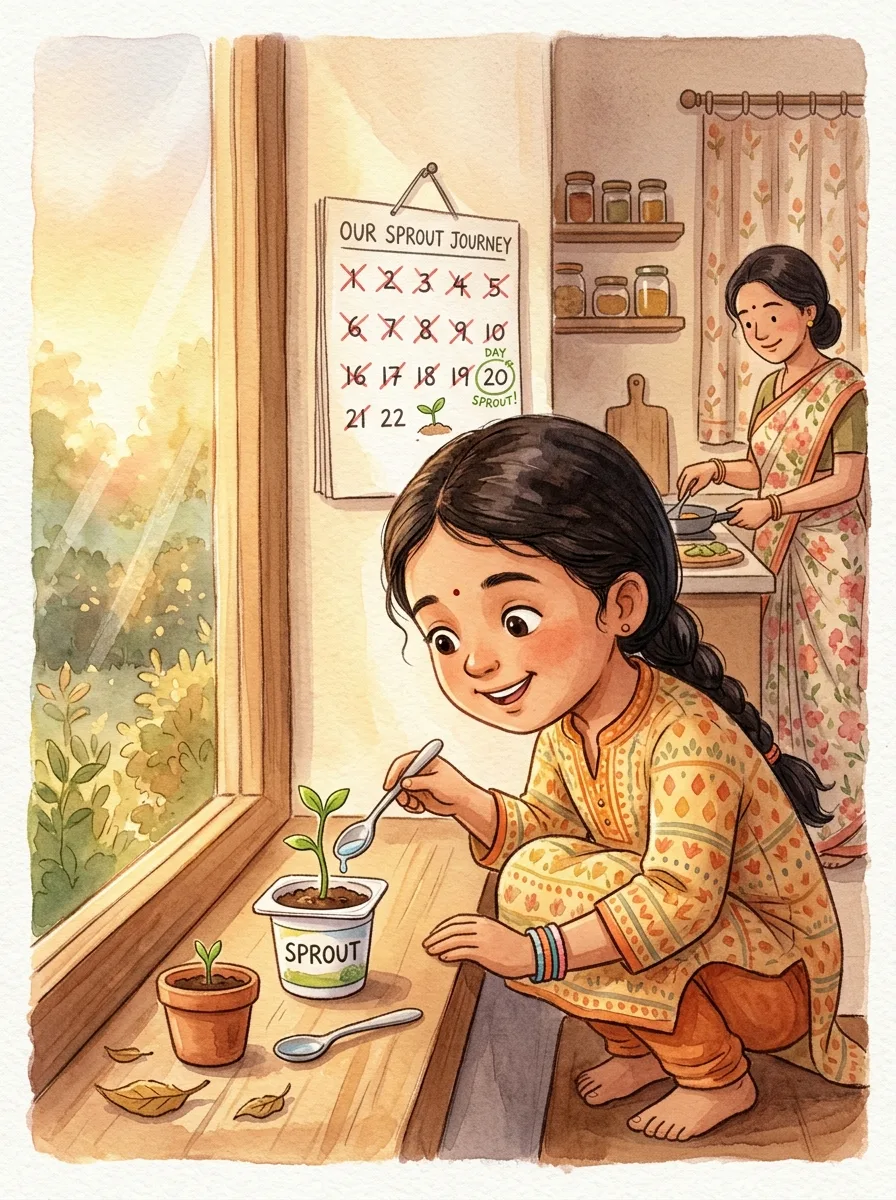
Your child plants a methi seed in a yoghurt cup on the windowsill and checks it every ten minutes. Nothing. By the third day Your child wants to dig it up to see what is wrong, but Mummy says seeds work in the dark. Your child waters it, waits, and on the sixth morning finds a tiny green loop pushing up through the soil, as if it had been listening all along.
Lesson: Some good things grow only when you stop digging them up
Patience
Your child and the Kite That Would Not Fly
Your child and the Kite That Would Not Fly
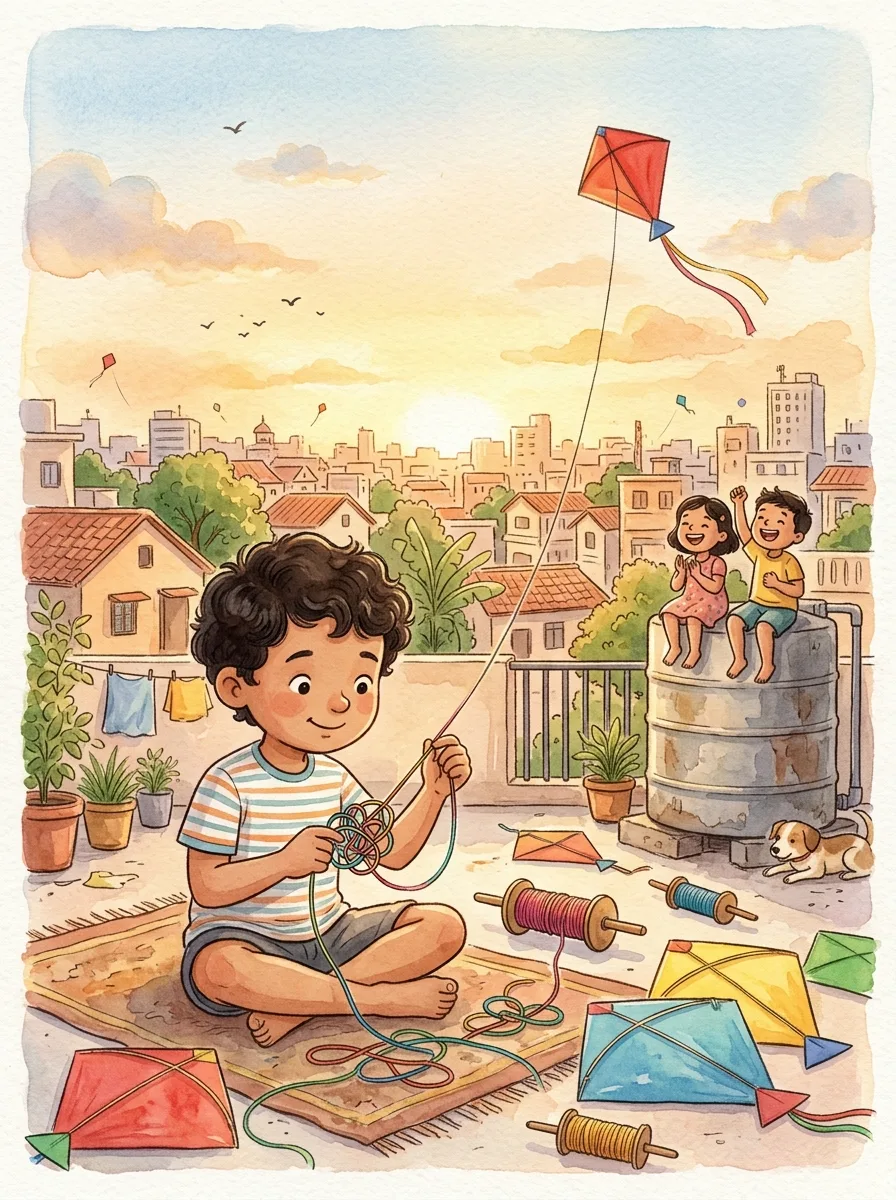
On the terrace, every kite is up except Your child's, which flops into the water tank again and again. The cousins are laughing. Your child wants to throw the kite away, then sits down, untangles the string properly, waits for the wind to turn, and runs once more. This time the kite climbs and climbs until it is the highest one in the whole sky.
Lesson: Wait for the right wind and try once more
Patience
Your child and the Little Brother's Shoelaces
Your child and the Little Brother's Shoelaces
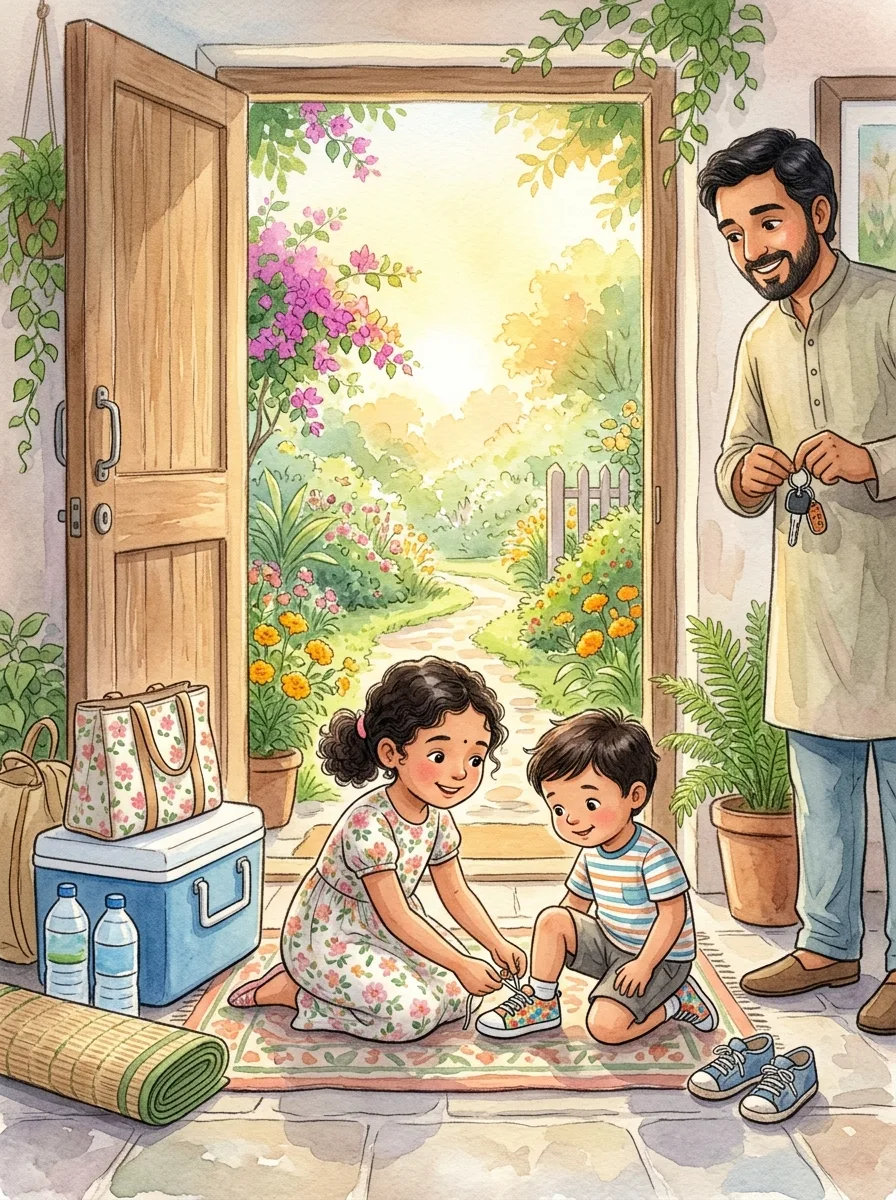
Everyone is ready to leave for the picnic, and Your child's little brother insists on tying his own shoelaces for the first time. It takes forever. Papa reaches to do it, but Your child says wait, kneels down, and shows him the bunny-ears trick one loop at a time. On the fourth try the knot holds, and he walks out to the car like a king.
Lesson: Patience lets someone else grow
Patience
Your child and the Queue at the Temple
Your child and the Queue at the Temple
The temple queue on festival morning stretches around the block, and Your child wants to push forward like the big boys are doing. Nani holds Your child's hand and says the god is not going anywhere. So Your child counts the steps, watches the pigeons, listens to an old man's story about the temple bell. By the time they reach the door, Your child has forgotten about pushing, and the bell sounds sweeter.
Lesson: The wait is part of the visit
Patience
Your child and the Mango That Was Picked Early
Your child and the Mango That Was Picked Early
The first mango on Dadaji's tree is green and small, and Your child cannot wait. Dadaji says three more weeks. Your child picks it anyway, in secret, and it is sour enough to twist the whole face. Dadaji says nothing, just hands over a glass of water. Three weeks later, the next mango is golden and sweet, and Your child eats it slowly, remembering the sour one.
Lesson: Pick too early and you taste the lesson, not the fruit
Patience
Your child and the Jigsaw of a Thousand Pieces
Your child and the Jigsaw of a Thousand Pieces
The thousand-piece jigsaw on the dining table has been abandoned by everyone; too hard, too slow. Your child decides to finish it: ten pieces every evening, no more, no less. Some evenings ten pieces take an hour. The family laughs. On the hundredth evening, Your child presses the last piece in, a picture of a ship in a storm, and the family stops laughing and takes a photograph.
Lesson: Ten pieces a day finishes what a hurry abandons
Patience
Your child and the Slow-Cooked Dal
Your child and the Slow-Cooked Dal
Dadi's special dal takes four hours on a low flame, and Your child wants to turn the gas up to make it faster. Dadi says no; slow is the recipe. Your child sits by the stove, stirring every fifteen minutes, reading between stirs. At the fourth hour the dal is thick and golden and tastes nothing like the quick one. Dadi says patience is the secret ingredient, and it cannot be bought.
Lesson: Some things are only good when they are slow
Patience
Your child and the Sister Who Learned to Walk
Your child and the Sister Who Learned to Walk
The baby sister is learning to walk, and she falls every third step. Your child wants to carry her everywhere so she stops falling. Mummy says every fall is a lesson. So Your child walks backwards in front of her, hands out, ready but not touching, day after day. She falls fifty times. On the fifty-first, she walks the whole length of the corridor into Your child's arms.
Lesson: Be ready to catch, but let them try
Patience
Your child and the Bus That Was Late
Your child and the Bus That Was Late
The school bus is forty minutes late and every child at the stop is complaining, kicking the wall, calling their parents. Your child is annoyed too. Then Your child takes out the storybook, sits on the wall, and starts reading aloud. One by one the others sit down. When the bus finally comes, the conductor finds fifteen children sitting quietly, listening, and asks if he can hear the ending too.
Lesson: Waiting is easier when you fill it with something good
Patience
Your child and the Handwriting That Improved
Your child and the Handwriting That Improved
Your child's handwriting is a mess, and the teacher says it will take a year of daily practice to fix. A year sounds impossible. Nani suggests one line a day, in a special notebook. Some days the line is worse than the day before. Your child keeps going. On page three hundred and sixty-five, the line is neat, and the teacher pins it beside page one so the class can see the year.
Lesson: A year of small tries becomes a big change
Patience
Your child and Nana's Long Story
Your child and Nana's Long Story
Nana tells stories slowly, with long pauses and repeated bits, and the cousins drift away one by one. Your child wants to go too. Instead Your child stays, and asks a question during each pause. Nana's eyes brighten, and the story, once he gets to the end, has a twist nobody expected. The cousins hear about it later and ask Your child to retell it. Your child tells it slowly.
Lesson: Stay for the slow story; the ending is worth it
Patience
Your child and the Bird That Would Not Come
Your child and the Bird That Would Not Come
A shy sunbird visits the hibiscus on the balcony but flies off whenever Your child moves. Your child wants to see it up close. Day after day, Your child sits still on the balcony floor, a little closer each morning, not moving a finger. On the twelfth day, the sunbird hovers a hand's width away, shimmering, and drinks from the flower. Your child does not breathe until it leaves.
Lesson: Stillness brings what chasing scares away
Patience
Your child and the Cast on the Arm
Your child and the Cast on the Arm
Your child has broken an arm and must wear a cast for six weeks, with no cricket, no cycling, no swimming. The first week is misery. Then Your child decides to learn something one-handed: chess from Dadaji. Six weeks of chess, every evening. When the cast comes off, Your child runs straight to the cricket pitch, and that evening beats Dadaji at chess for the first time.
Lesson: A long wait is a chance to learn something new
Patience
Your child and the Rangoli That Took All Day
Your child and the Rangoli That Took All Day
The Diwali rangoli design Mummy chose has a hundred tiny petals, and Your child wants to do it quickly and go play. The first quick petals are lumpy. Mummy says one petal at a time, or none. So Your child does one petal at a time, all afternoon, while the friends play outside. At dusk the diyas are lit around a perfect lotus, and the friends come in to look, and stay.
Lesson: One careful petal at a time makes the whole flower
Patience
Your child and the Turn That Never Seemed to Come
Your child and the Turn That Never Seemed to Come
At the fair, the giant wheel queue is an hour long and Your child's little brother wants to give up. Your child wants to give up too. Instead, they play a game: guess the colour of the next car to pass, count the balloons, spot ten hats. The hour goes. At the top of the wheel, with the whole fair glittering below, the little brother says it was worth every minute, and Your child agrees.
Lesson: The view from the top is worth the wait in the queue
Patience
Breaking the Limits
Your child has one big dream and a mountain of doubts standing in the way. Through early mornings, small setbacks, and the quiet courage to try again, Your child discovers that limits are just lines waiting to be crossed. Step by determined step, Your child learns that real strength grows from showing up, especially on the hard days.
Lesson: The biggest limits exist in our minds, not our abilities; consistent effort creates extraordinary results; the process of pursuing a goal transforms you regardless of the outcome; and proving yourself to yourself is the only validation that truly matters.
Patience
Calm Breathing Balloon
A tiny balloon friend floats beside Your child and grows bigger with every slow breath. When a windy worry tries to blow everyone around, Your child learns to breathe in, breathe out, and guide the balloon safely home. The story should make the feeling visible as a cloud, balloon, volcano, garden, or other child-friendly symbol. Your child does not defeat the feeling by force; instead, they name it, breathe, ask for help, and choose one steady step. The ending should feel safe, hopeful, and practical.
Lesson: Slow breathing can help big feelings become manageable.
Patience
Sita’s Garden of Patience
Sita’s Garden of Patience
In a garden inspired by Sita’s quiet strength, Your child helps flowers bloom even when they are slow. Watering each plant with patience and hope, Your child learns that gentle strength can be as powerful as loud bravery. The story should stay respectful and child-safe, using the epic or fable as inspiration rather than a heavy retelling. Your child faces a small choice connected to courage, dharma, wisdom, or friendship, then helps the scene resolve through kindness. The ending should carry the value clearly without sounding preachy.
Lesson: Patience, dignity, and hope are powerful forms of strength.