Anger
Your child and the Volcano Feeling
Your child and the Volcano Feeling
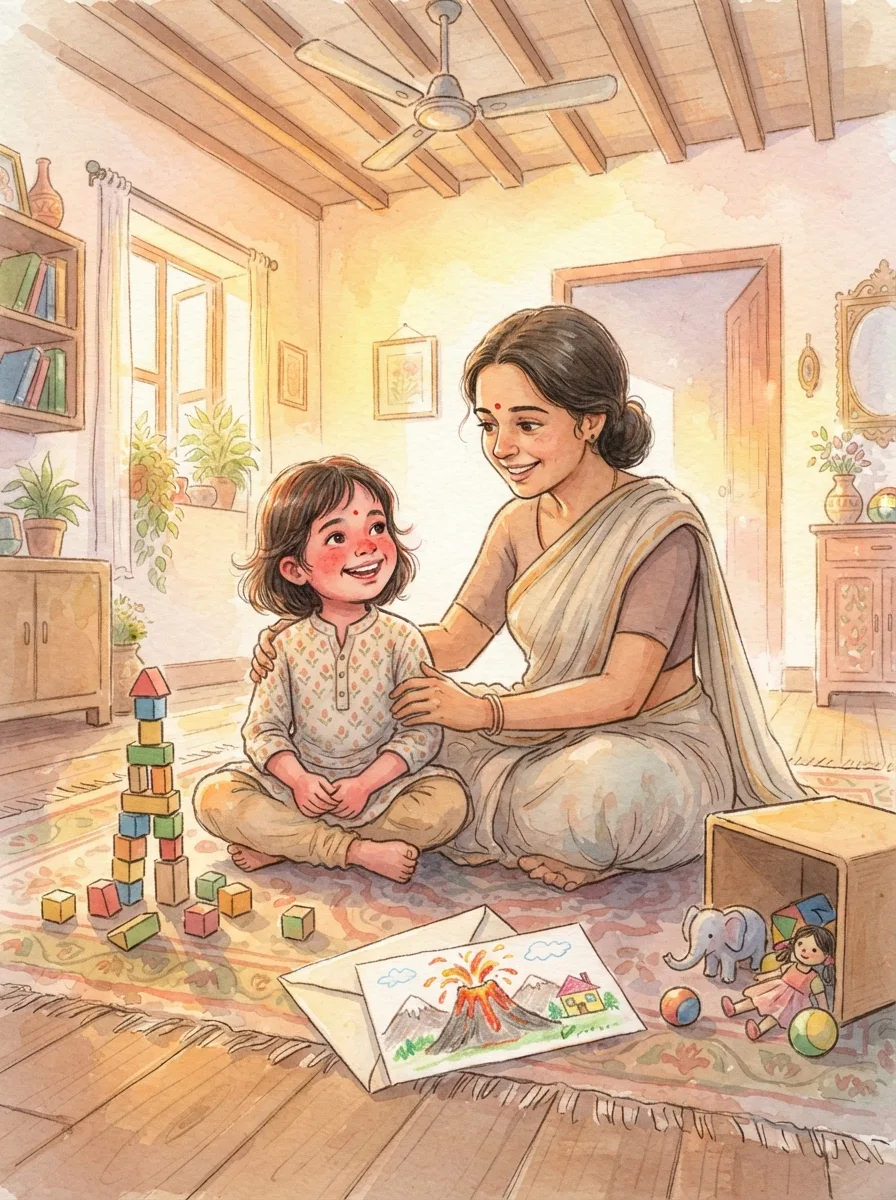
When the tower of blocks falls for the third time, something hot rushes up from Your child's tummy to the top of the head and comes out as a roar. Mumma comes in and does not shout back. She draws a mountain on the back of an envelope with a red top. 'That is your volcano,' she says. 'It warns you before it bursts. Where do you feel it first?' Your child points at the tummy. 'Good. Next time, when it is there, tell me.'
Lesson: Know where your volcano starts and you can catch it early
Anger
Your child and the Last Laddoo
Your child and the Last Laddoo
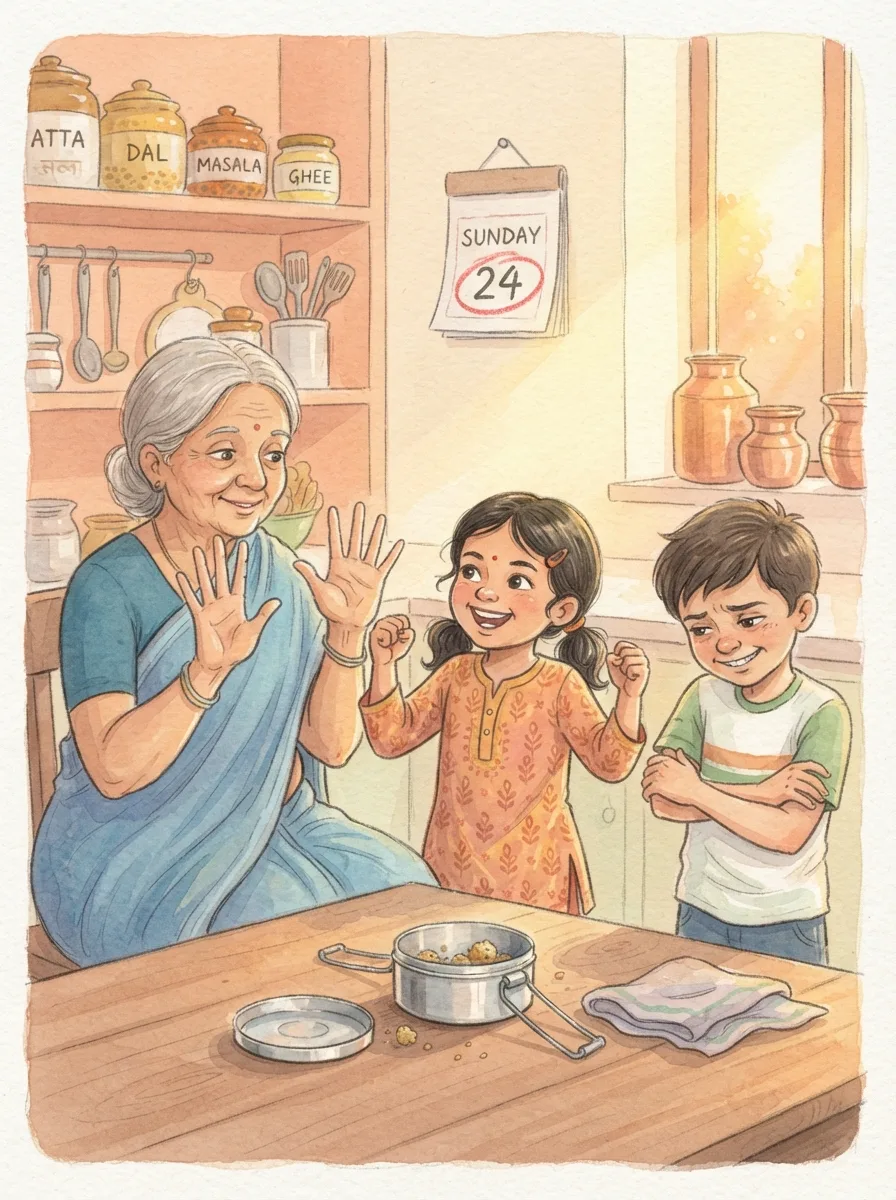
There was one besan laddoo left in the steel dabba and Your child had been saving it since morning. Bhaiya ate it. Your child feels the volcano rising and is about to scream when Dadi catches an eye and holds up ten fingers. They count together, slowly. By seven the scream has gone. By ten Your child can say, 'That was mine and I am angry.' Bhaiya says sorry and Dadi says the kadhai is coming out on Sunday.
Lesson: Ten fingers can hold back a scream
Anger
Your child and the Broken Toy Car
Your child and the Broken Toy Car
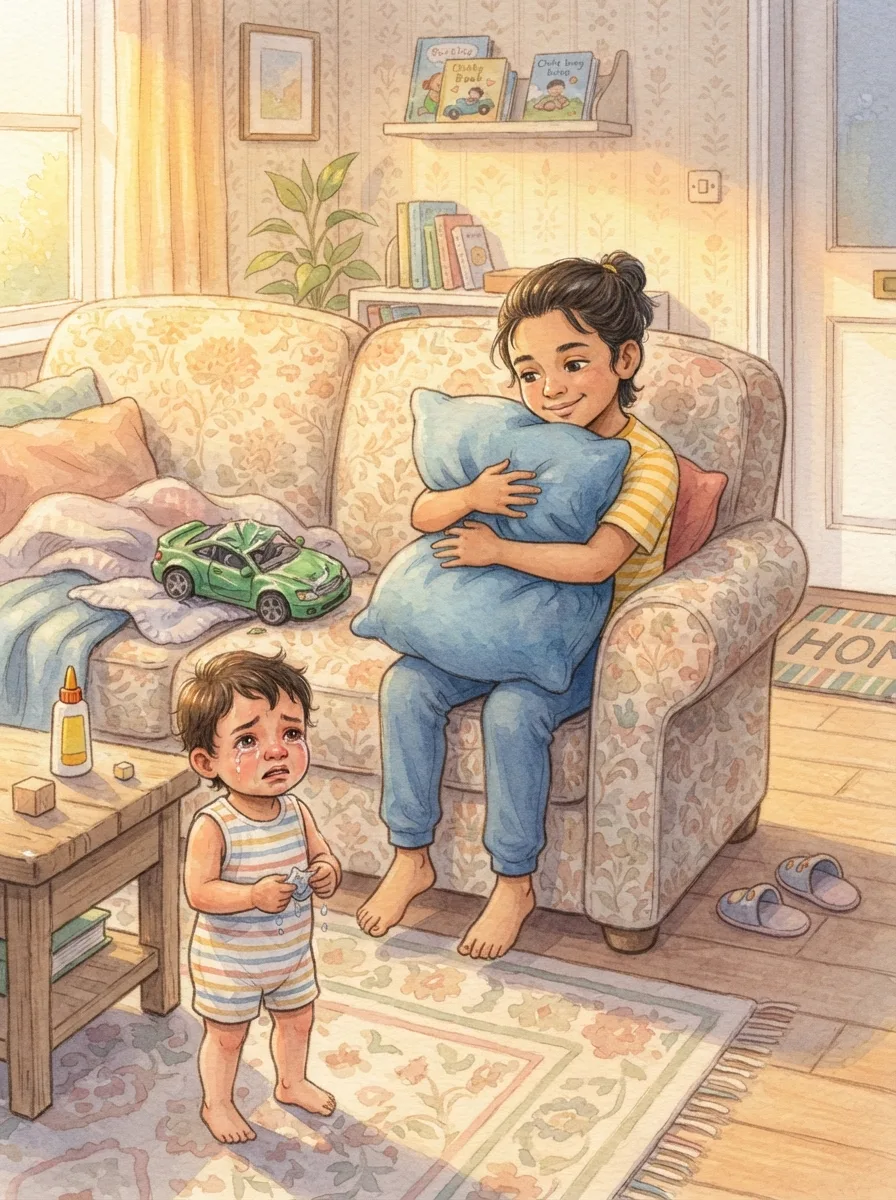
Little Chhotu from next door stands on Your child's green racing car and the roof caves in. Your child wants to push him. Papa has taught a trick for exactly this moment. Your child runs to the sofa, grabs the big cushion and squeezes it as hard as possible, growling into it. The growl gets smaller. When it is gone, Your child comes back. Chhotu is crying. 'It is okay,' Your child says. 'Papa will find glue.'
Lesson: Squeeze the cushion, not the little one
Anger
Your child and the Lost Cricket Final
Your child and the Lost Cricket Final
The colony final is lost by two runs and Your child was the last one out. Team mates are muttering. The volcano is rising and the bat is about to be thrown. Instead Your child remembers Chacha's rule, walk away first, and walks to the boundary wall and sits with a back to everyone. Five minutes. Then Chacha comes and sits too. 'Good walk,' he says. 'Now, come and shake hands.' Your child does, even with the bowler.
Lesson: Walk away first, then shake hands
Anger
Your child Counts to Ten at School
Your child Counts to Ten at School
Kabir takes Your child's new pencil box without asking and breaks the sharpener. In the middle of the classroom the volcano starts. Your child grips the desk and counts in a whisper. One, two, three. By six Ma'am has noticed. By ten Your child can say, 'Kabir, you broke it and did not ask.' Kabir goes red. Ma'am sends both to the corner to talk, and by lunch they have swapped sharpeners.
Lesson: Count first, and the words that come out will be fair ones
Anger
Your child and the Sorry After the Storm
Your child and the Sorry After the Storm
Last night Your child shouted at Didi so loudly that the neighbour banged on the wall. This morning the anger has gone, but a heavy stone is sitting where it was. Nana says, 'That stone is called the after. It only moves when you say sorry.' Your child finds Didi brushing her hair and says it, properly, looking at her. Didi says, 'Okay. Plait my hair?' The stone rolls away while Your child plaits.
Lesson: Anger passes on its own but sorry has to be said
Anger
Your child and the Cushion That Took the Roar
Your child and the Cushion That Took the Roar
Papa comes home to find Your child kicking the door because the tablet time is over. He does not switch the tablet back on. He fetches the old round cushion from the bed, the faded blue one. 'This is the roar cushion,' he says. 'It can take anything.' Your child punches it, squeezes it, shouts into it. The cushion just gets fatter. When the roar is finished, Papa says, 'Now let us go and buy bread.'
Lesson: Give the roar to a cushion and keep your hands kind
Anger
Your child and the Walk Around the Park
Your child and the Walk Around the Park
Aryan pushes in front of Your child at the slide for the fourth time. Your child can feel the shove coming in both hands. Instead Your child walks away, around the whole colony park, past the swings and the gulmohar and the watchman's chair, breathing hard. By the time the circle is finished the hands are ordinary hands again. Aryan is at the top of the slide. 'Aryan,' says Your child, 'my turn next, then yours.' It works.
Lesson: One walk around the park can cool two hot hands
Anger
Your child and the Cold Water at the Hand Pump
Your child and the Cold Water at the Hand Pump
In the village, cousin Munna lets Your child's kite go on purpose and laughs as it sails over the fields. Your child runs at him, furious. Nani steps between them and does not scold. She walks Your child to the hand pump and pumps cold water. 'Wash your face. Then your hands. Then drink.' The water is so cold it makes Your child gasp, and the gasp takes the fury out. Munna, watching, quietly goes to fetch the kite.
Lesson: Cold water on the face is faster than hot words
Anger
Your child and the Angry Scribble
Your child and the Angry Scribble
Bua is visiting when the fight about the colour pencils breaks out. Your child is shouting and nobody is listening. Bua tears a sheet from her sketchbook, hands over a black crayon and says, 'Scribble the whole angry on this. Hard as you like.' Your child scribbles until the crayon snaps and the paper goes shiny black. Bua holds it up. 'Big angry,' she says. Your child looks at it and starts to laugh.
Lesson: Put the anger on paper and it stops being inside you
Anger
Your child and the Window Seat on the Train
Your child and the Window Seat on the Train
On the overnight train to Jaipur, Bhaiya grabs the window seat before Your child can even put the bag down. The volcano rumbles. Mumma sees it and says, 'Stations. You get the window till the next station, then swap.' Your child wants to argue but the next station is only twenty minutes. Bhaiya swaps without a fuss. By the third station they are both leaning out the same window, counting camels together.
Lesson: A fair turn is worth more than a whole window
Anger
Your child and the Torn Kite at the Market
Your child and the Torn Kite at the Market
At the kite market before Makar Sankranti, a passing cycle tears the paper kite Your child just chose. The kite seller shrugs. Your child feels the heat rising and the fists forming. Papa says quietly, 'Breathe out longer than you breathe in. Three times.' Your child does it, watching the strings hanging everywhere. The heat sinks. Then Your child picks a new kite, a purple one, and holds it high so no cycle can reach.
Lesson: A long breath out lets the hot air go
Anger
Your child and the Angry Words Jar
Your child and the Angry Words Jar
After a bad afternoon Your child has called Didi three names that cannot be taken back. Dadi brings out an old jar with a lid. 'When the angry words come, write them and put them here. Then the jar has them, not Didi.' Your child writes six words in wobbly letters, folds them small and screws the lid on tight. That evening the jar sits on the shelf, very full, and Your child finds nicer words to give Didi.
Lesson: Angry words belong in a jar, not in a sister
Anger
Your child and the Volcano That Went to Sleep
Your child and the Volcano That Went to Sleep
It is bedtime and Your child is still angry about the whole day, the lost game, the scolding, the spilled juice. Papa turns off the light and says, 'Let us put the volcano to sleep.' He lays a hand on Your child's tummy. 'Breathe in and the mountain rises. Breathe out and it sinks.' Up, down. Up, down. Somewhere around the tenth breath Your child stops counting, and the volcano, and the child, are both asleep.
Lesson: Even a volcano can be breathed to sleep
Anger
Your child and the Balloon Line at the Mela
Your child and the Balloon Line at the Mela
The balloon man at the mela is slow and the line is long and a big boy pushes in. Your child feels the shove building in the shoulders. Chacha bends down. 'Angry is fine. Pushing is not. What else can you do?' Your child thinks, then says loudly, 'Uncle, the line starts behind me.' The balloon man looks up and points the big boy to the back. Your child gets a yellow balloon and a feeling that is better than a push.
Lesson: Use your voice for the fair thing and keep your hands still
Anger
Anger Volcano Cooldown
A little volcano inside the mountain starts rumbling whenever things feel unfair. Your child helps the volcano cool down with words, space, and safe choices, learning that anger is a signal, not a boss. The story should make the feeling visible as a cloud, balloon, volcano, garden, or other child-friendly symbol. Your child does not defeat the feeling by force; instead, they name it, breathe, ask for help, and choose one steady step. The ending should feel safe, hopeful, and practical.
Lesson: Anger can be handled safely by pausing, naming the feeling, and choosing what helps.