Gratitude
Your child and the Thank You for Bus Uncle
Your child and the Thank You for Bus Uncle
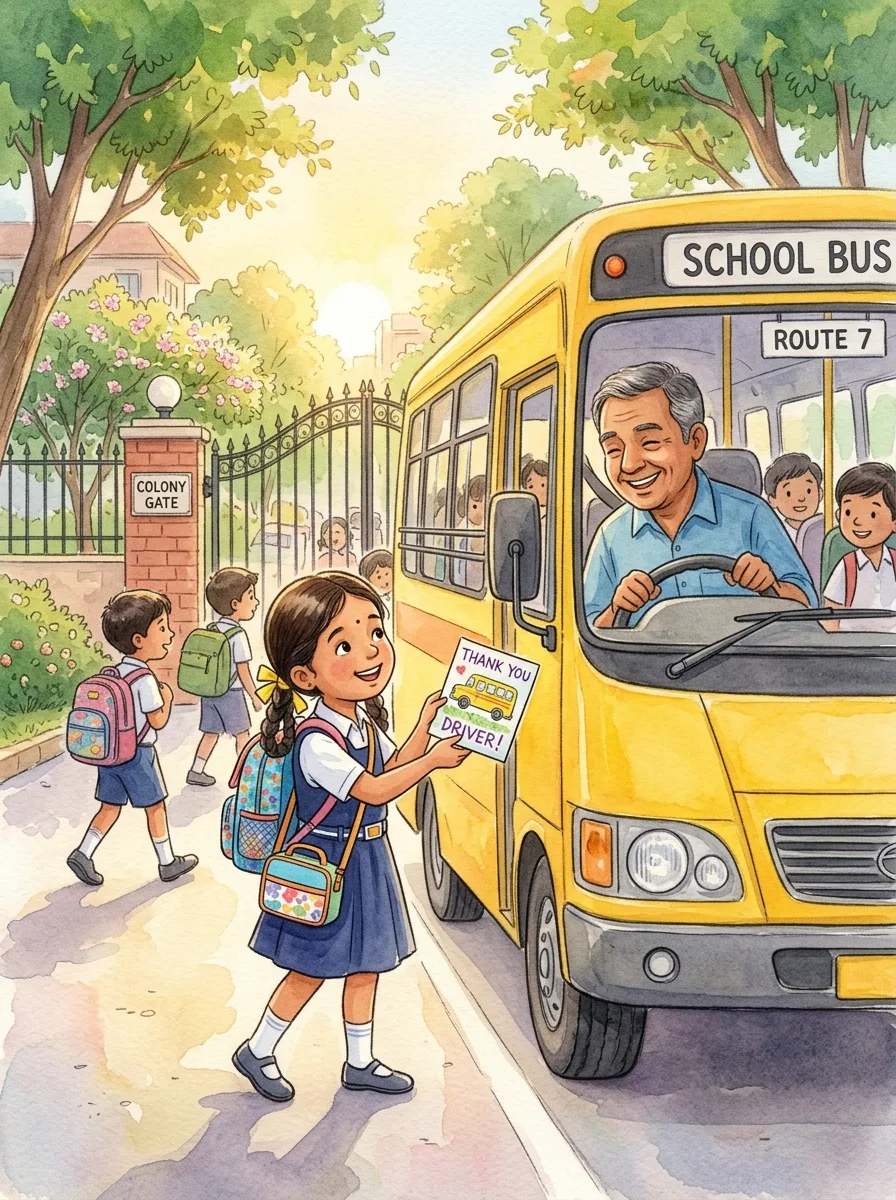
Every day the school bus driver waits an extra minute when Your child is late, and nobody ever says anything about it. On the last day before the holidays, Your child makes a card with a wobbly bus drawn on the front and hands it over at the gate. Bus Uncle reads it twice, tucks it above his mirror, and it is still there when school opens again.
Lesson: Say thank you to the people who quietly make your day work
Gratitude
Your child and the Power-Cut Evening
Your child and the Power-Cut Evening
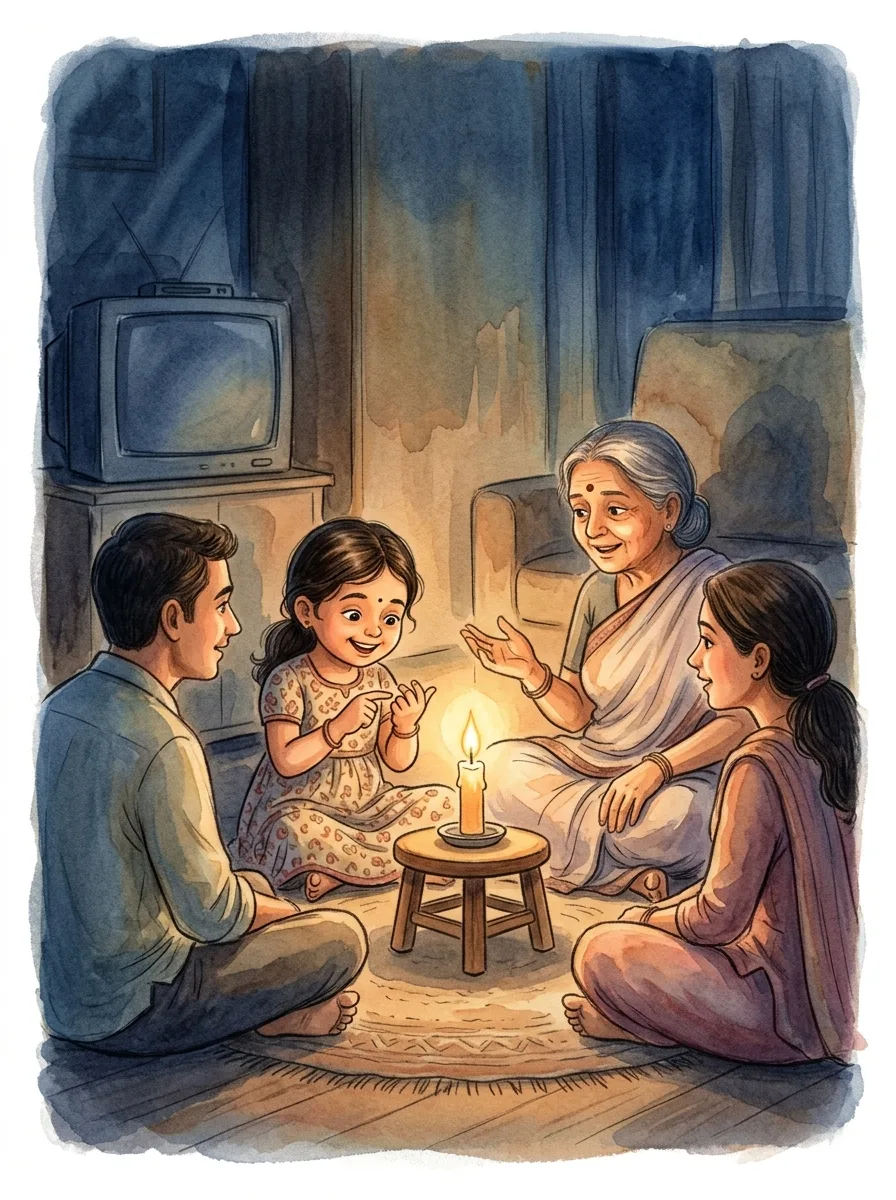
The power goes out during Your child's favourite show and the whole house groans. Papa lights a candle and Nani starts a game: everyone must name one good thing from today. Your child grumbles, then thinks of the mango at lunch, the goal in the park, Nani's hand on the stairs. By the time the lights flicker back on, nobody wants to switch the television on.
Lesson: Counting the good things turns a bad evening around
Gratitude
Your child and the Rain That Came Late
Your child and the Rain That Came Late
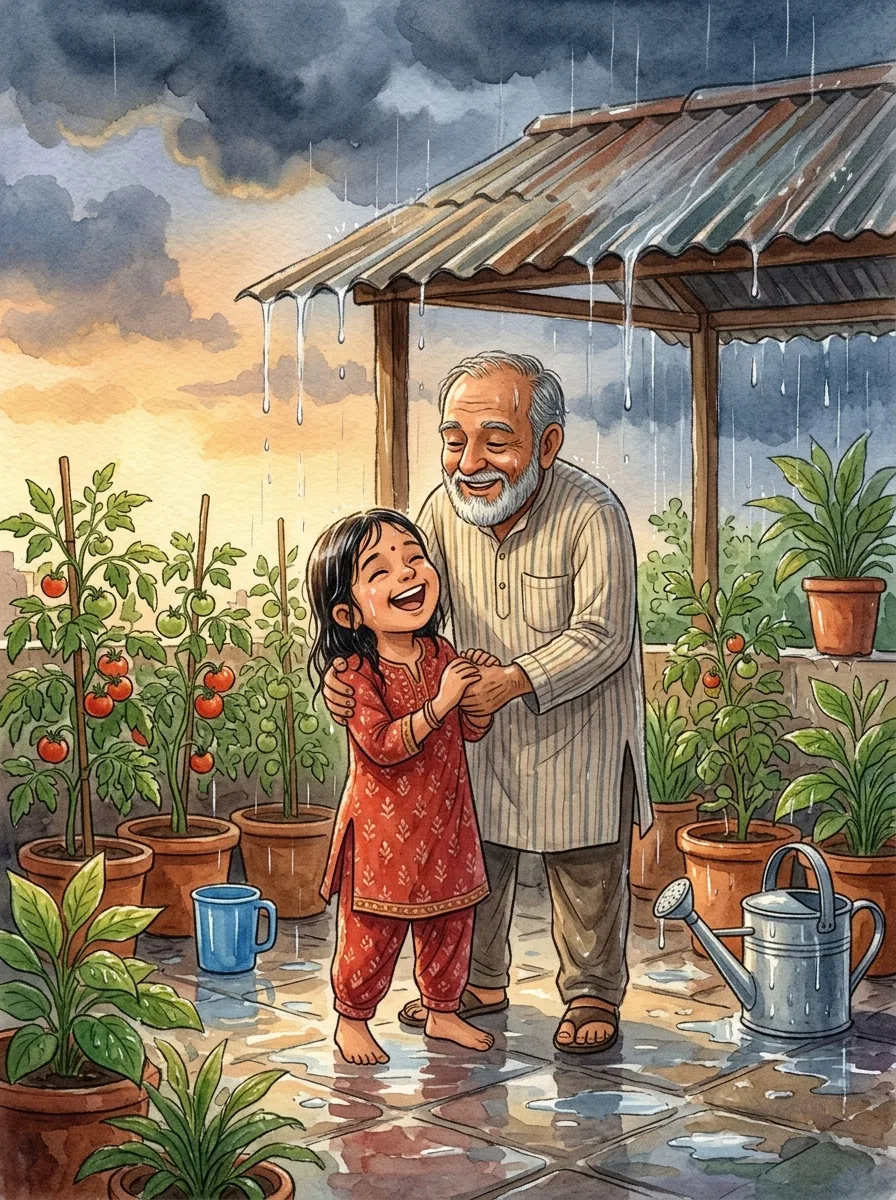
The monsoon is late and Nana's tomato plants on the terrace are drooping. Your child carries mugs of water up the stairs every evening, until finally one night the rain arrives, drumming on the tin roof. Your child runs onto the terrace with Nana, faces up, soaked and laughing, and says thank you to the sky, just in case it is listening.
Lesson: Be thankful for the things you cannot make happen yourself
Gratitude
Your child and the Thank You to the Cook
Your child and the Thank You to the Cook
At the school canteen, Your child has eaten the same dal and rice for three years without ever seeing who makes it. One day the door to the kitchen is open, and an old woman is stirring a pot big enough to bathe in. Your child walks in and says thank you for three years of dal. She stops stirring. The next day there is an extra ladle of dal, and a smile, every single lunch.
Lesson: Thank the hands behind the food
Gratitude
Your child and the List of Good Things
Your child and the List of Good Things
It has been a bad week: a lost match, a scolding, rain every day. Your child is sulking. Dadaji hands over a pencil and says, 'Write ten good things about this week.' Your child cannot think of one. Then: the puppy, the paratha, the friend who lent a pen, the rainbow. By ten, the list is at fifteen and Your child is laughing. Dadaji says the list works every time; he has been making it for seventy years.
Lesson: Count the good things and the bad ones shrink
Gratitude
Your child and the Doctor Who Came at Night
Your child and the Doctor Who Came at Night
The night Your child had the high fever, the lane's old doctor came at two in the morning in his slippers. Your child only remembers it dimly. Months later, Your child passes his small clinic and stops. Inside, Your child says thank you for the night visit. The doctor cannot remember which night; he has done so many. Your child draws it for him, and the drawing goes on the clinic wall.
Lesson: Say thank you even for the things you barely remember
Gratitude
Your child and the Tiffin That Came Every Day
Your child and the Tiffin That Came Every Day
Every day for years, a tiffin has appeared in Your child's bag, and Your child has never thought about it. One morning, awake early, Your child sees Mummy in the kitchen at half past five, rolling parathas in the dark. Your child does not say anything then. But that evening, Your child washes the tiffin, dries it, and leaves a note inside for the morning: 'Thank you for every single one.'
Lesson: Look for the person behind the things that just appear
Gratitude
Your child and the Grumpy Bus Conductor
Your child and the Grumpy Bus Conductor
The school bus conductor never smiles, and the children call him Grumpy Uncle. Then Your child notices that he checks every child's seatbelt, twice, every single day, and waits until each one is through their gate. On the last day of term, Your child gives him a card that says 'Thank you for watching us.' Grumpy Uncle reads it, and for the first time anyone has seen, he smiles.
Lesson: Gratitude can find kindness hidden under a frown
Gratitude
Your child and the Old Tree in the Compound
Your child and the Old Tree in the Compound
The big neem tree in the compound is going to be cut for a parking space, and nobody minds much. Your child thinks about it: the shade at cricket, the swing, the birds, the leaves Nani boils for fevers. Your child writes a letter to the building committee listing everything the tree has given, and reads it at the meeting. The committee moves the parking. The tree stays, and gets a thank-you ribbon.
Lesson: Be grateful for the things that shade you, and speak for them
Gratitude
Your child and the First Teacher
Your child and the First Teacher
Your child's first teacher, who taught the alphabet in the nursery, has retired and lives near the temple. Mummy says teachers like to be remembered. Your child walks there with a drawing of the whole alphabet, each letter as an animal. The teacher remembers Your child holding the pencil wrong. She keeps the drawing on her fridge, and says it is the first time a student has come back to say thank you.
Lesson: Go back and thank the ones who taught you first
Gratitude
Your child and the Shoes That Were Old
Your child and the Shoes That Were Old
Your child complains that the school shoes are old and scuffed while other children have new ones. That afternoon Your child sees the cobbler's son at the corner, barefoot on the hot road, and stops complaining mid-sentence. At home, Your child polishes the old shoes until they shine, and asks Mummy if the outgrown pair can go to the cobbler's son. The old shoes suddenly feel like enough.
Lesson: Gratitude arrives when you see what others do without
Gratitude
Your child and the Birthday of the House
Your child and the Birthday of the House
Nani says the house is fifty years old this month and nobody has ever thanked it. Your child thinks that is silly, then thinks again: the roof through the monsoons, the cool floor in summer, the corner where every story was told. Your child organises a birthday for the house, with a cake, a garland on the door and a thank-you from every family member. The house, Nani says, looks pleased.
Lesson: Even walls that keep you safe deserve a thank you
Gratitude
Your child and the Gift That Was Not Liked
Your child and the Gift That Was Not Liked
Bua gives Your child a hand-knitted sweater in a colour Your child hates. Your child's face shows it, and Bua looks hurt. Later, Mummy explains that Bua knitted for three weeks with sore hands. Your child thinks about the three weeks, puts on the sweater, and goes to sit with Bua. Your child wears it to school the next day too. The colour, oddly, grows on Your child.
Lesson: Thank the effort, not just the thing
Gratitude
Your child and the Farmer's Thank You
Your child and the Farmer's Thank You
It has rained for a week and Your child is bored and grumpy about cancelled cricket. Dadaji takes Your child to the edge of town where the fields begin. A farmer is standing in the rain with his face turned up, grinning. He says the rice will live now. Your child stands in the rain beside him and turns a face up too, and from then on rain days feel like somebody else's good luck.
Lesson: What annoys you may be someone else's answered prayer
Gratitude
Your child and the Thank You That Was Late
Your child and the Thank You That Was Late
Two years ago, a neighbour uncle pulled Your child out of the way of a speeding scooter, and Your child was too shocked to say anything. He has since moved to another building. Your child finds his new address, walks there with Papa, and says the thank you that was two years late. The uncle does not remember at first, then does, and hugs Your child for a long time.
Lesson: A thank you is never too late to give
Gratitude
Thank You Note Mission
A mailbox fairy gives Your child three blank cards and a challenge: notice three people who helped today. By writing tiny thank-you notes, Your child learns that gratitude turns ordinary helpers into seen and smiling heroes. The story should place Your child inside a real moral choice, where the easy path and the kind path are not the same. Through a small mistake, a helpful pause, and a brave decision, Your child learns the value by doing it. The ending should feel honest, warm, and earned.
Lesson: Gratitude helps children notice care and respond with kindness.
Gratitude
Gratitude Garden Glow
In a garden where flowers glow only when someone says thank you, Your child discovers many quiet helpers. Watering each flower with gratitude, Your child learns that noticing kindness makes ordinary days shine brighter. The story should make the feeling visible as a cloud, balloon, volcano, garden, or other child-friendly symbol. Your child does not defeat the feeling by force; instead, they name it, breathe, ask for help, and choose one steady step. The ending should feel safe, hopeful, and practical.
Lesson: Gratitude grows when children notice and name the care around them.