Sharing
Your child and the Last Paratha
Your child and the Last Paratha
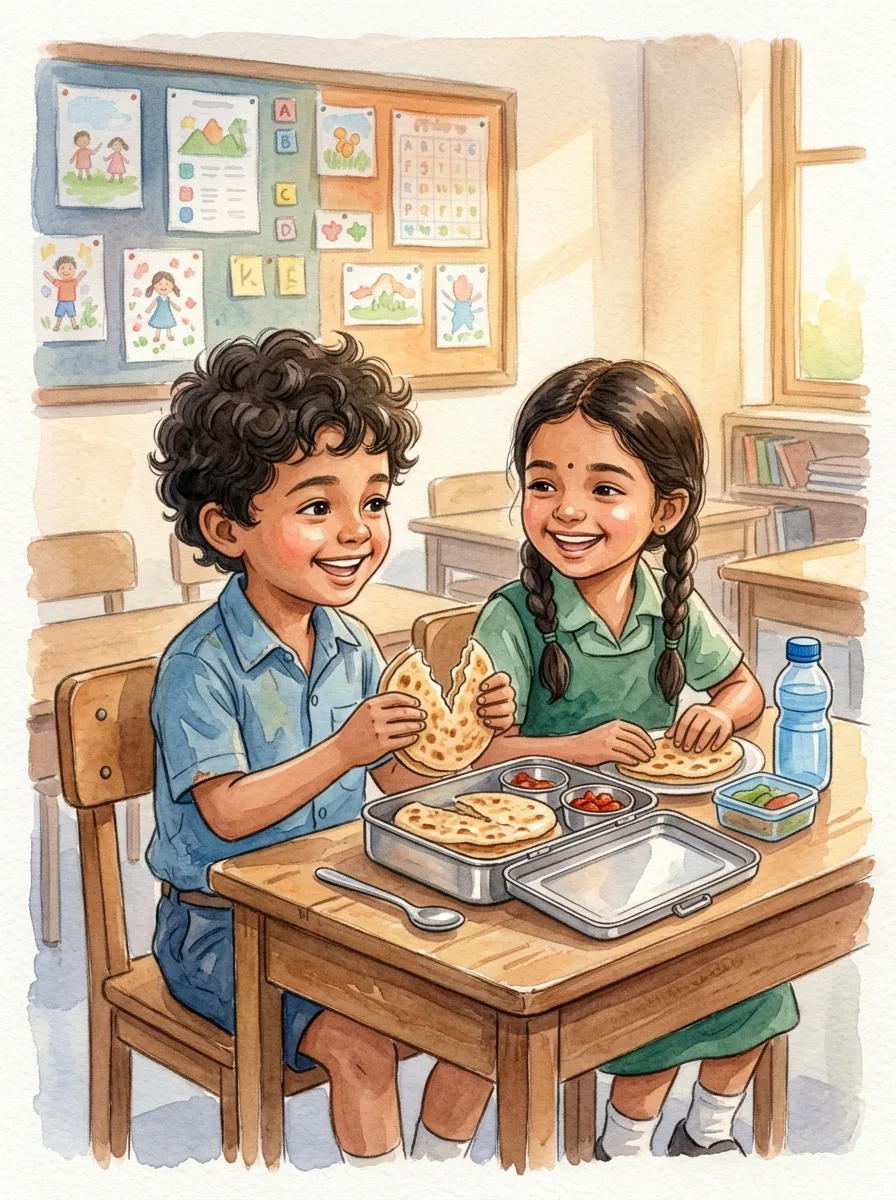
Your child opens the tiffin and finds Mummy has packed only one paratha today because the gas ran out. Next to Your child, Meera has forgotten her lunch altogether and is pretending not to be hungry. Your child tears the paratha down the middle and slides half across the desk. Half a paratha with a friend fills a tummy better than a whole one alone.
Lesson: Half of something shared is more than all of it alone
Sharing
Your child and the Birthday Crayons
Your child and the Birthday Crayons
Your child gets a brand-new box of sixty-four crayons for a birthday and does not want a single one to break. In art class, Arjun's crayons are down to three stubs and his sky is turning out brown. Your child looks at the perfect box, then pushes it into the middle of the table. Two skies come out blue, and a broken crayon still colours just fine.
Lesson: Things are for using together, not for keeping perfect
Sharing
Your child and the One Cricket Bat
Your child and the One Cricket Bat
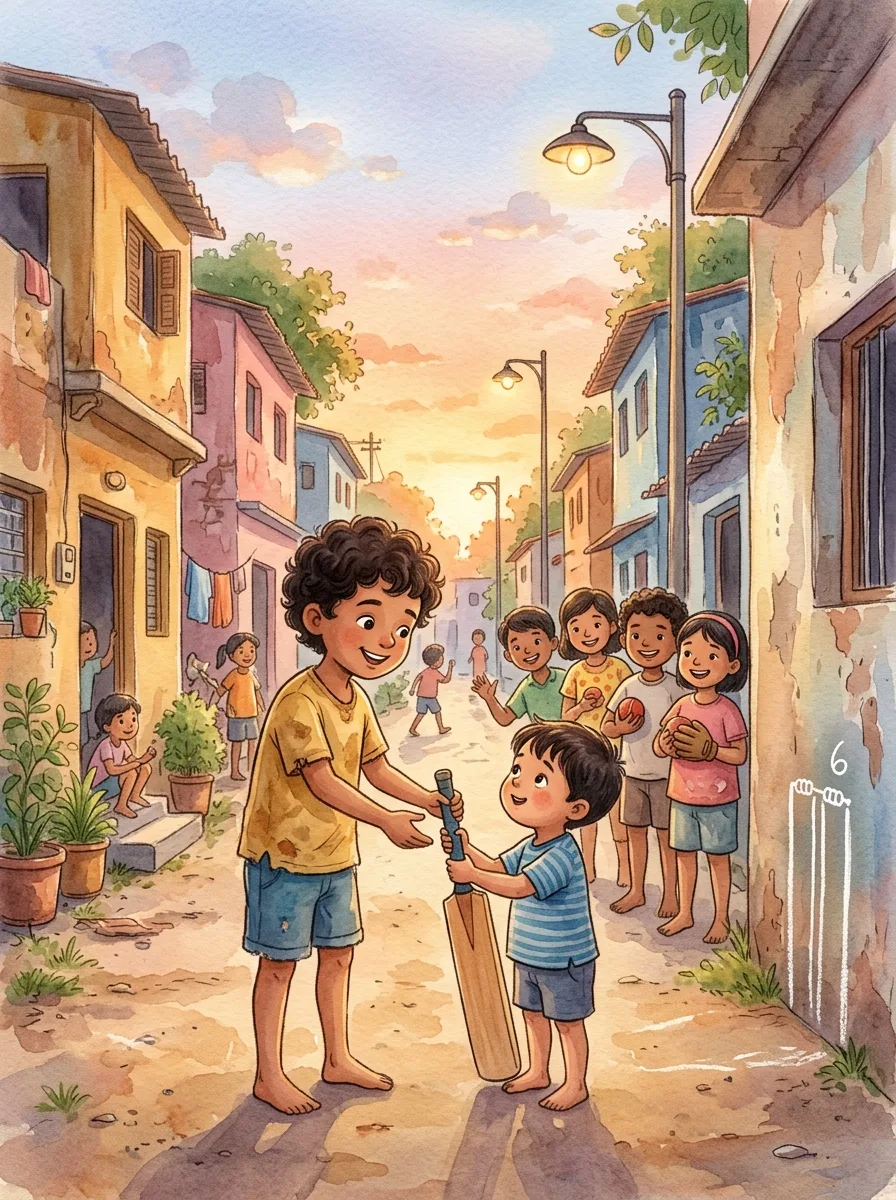
There is only one bat in the whole colony and it belongs to Your child. The bigger children want to play all evening while the little ones wait. Your child makes a rule: five balls each, littlest first, and hands the bat to the smallest boy. The game goes slower, but everyone gets a turn, and when the streetlights come on, nobody is sulking.
Lesson: A fair turn for everyone makes the game worth playing
Sharing
Your child and the One Umbrella
Your child and the One Umbrella
The rain comes down suddenly after school and Your child has the only umbrella at the bus stop. A boy Your child does not know well is getting drenched. Your child holds the umbrella over both of them, which means half of Your child gets wet. By the time the bus comes, they are both half-wet, laughing, and friends. The umbrella becomes a two-person umbrella every rainy day after that.
Lesson: Half an umbrella shared is better than a whole one alone
Sharing
Your child and the Swing in the Park
Your child and the Swing in the Park
There is one swing in the park and Your child got there first. A line of smaller children forms, watching. Your child could swing all evening. Instead Your child invents a rule: twenty swings each, and the person getting off pushes the next one. The line becomes a game, and by dark, Your child has pushed every child in the park and had five turns instead of one long one.
Lesson: Taking turns makes one swing enough for everyone
Sharing
Your child and the Mango Cut in Five
Your child and the Mango Cut in Five
There is one mango left in the house, the last of the season, and five people at the table. Papa says Your child can have it, being the smallest. Your child takes the knife, asks Mummy to help, and cuts the mango into five pieces, giving the biggest to Nani, whose teeth are weak. Everyone eats the last mango of the year together, and Nani says it tastes of next summer.
Lesson: The last of anything is sweetest when everyone gets a taste
Sharing
Your child and the Shared Textbook
Your child and the Shared Textbook
The new science textbook is out of stock and half the class has none, including the friend who sits behind. Your child has one. The exam is in a week. Instead of guarding it, Your child moves the desk sideways so both can read, and after school they study together at Your child's house. Both pass. The friend says the book was better with two people reading it.
Lesson: A book read by two teaches twice as much
Sharing
Your child and the Sweets for the Lane
Your child and the Sweets for the Lane
A big box of sweets arrives from an uncle abroad, forty pieces, all for Your child. Your child eats two, then looks at the box and at the lane outside. With Mummy's help, Your child wraps the rest in little paper parcels, and goes door to door: the guard, the tailor, the girl upstairs, the old man who never smiles. He smiles. The two pieces Your child ate were enough.
Lesson: Forty sweets shared taste better than forty eaten
Sharing
Your child and the Team with No Bat
Your child and the Team with No Bat
The lane's second cricket team has no bat, only a plank, and always loses. Your child's team has three bats. The captain says it is not their problem. Your child argues that a match against a plank is no fun, and lends the second team the best bat. They lose anyway, but by fewer runs, and the next match is close. By the end of the summer, the lane has one team of twenty-two.
Lesson: A fair game is more fun than an easy win
Sharing
Your child and the Cousins Who Came to Stay
Your child and the Cousins Who Came to Stay
Three cousins arrive for a month because of floods in their town, and Your child must share the bedroom and every toy. The first night is terrible. Your child thinks about the cousins' home under water, and in the morning divides the shelf into four, draws name labels, and puts the best toy in the middle for everyone. The month ends with four children crying at the door because it is over.
Lesson: Sharing space is hard at first and wonderful after
Sharing
Your child and the Water Bottle on Sports Day
Your child and the Water Bottle on Sports Day
Sports day is hot and Your child has one bottle of water. After the race, the boy who came last is sitting on the grass, red-faced and empty-handed. Your child is thirsty too. Your child hands him the bottle first, and he drinks half. Later, the teacher sees the shared bottle and brings a whole jug for both of them. The boy who came last carries Your child's bag home.
Lesson: Offer the first sip and there is always more
Sharing
Your child and the Crayons for the Whole Table
Your child and the Crayons for the Whole Table
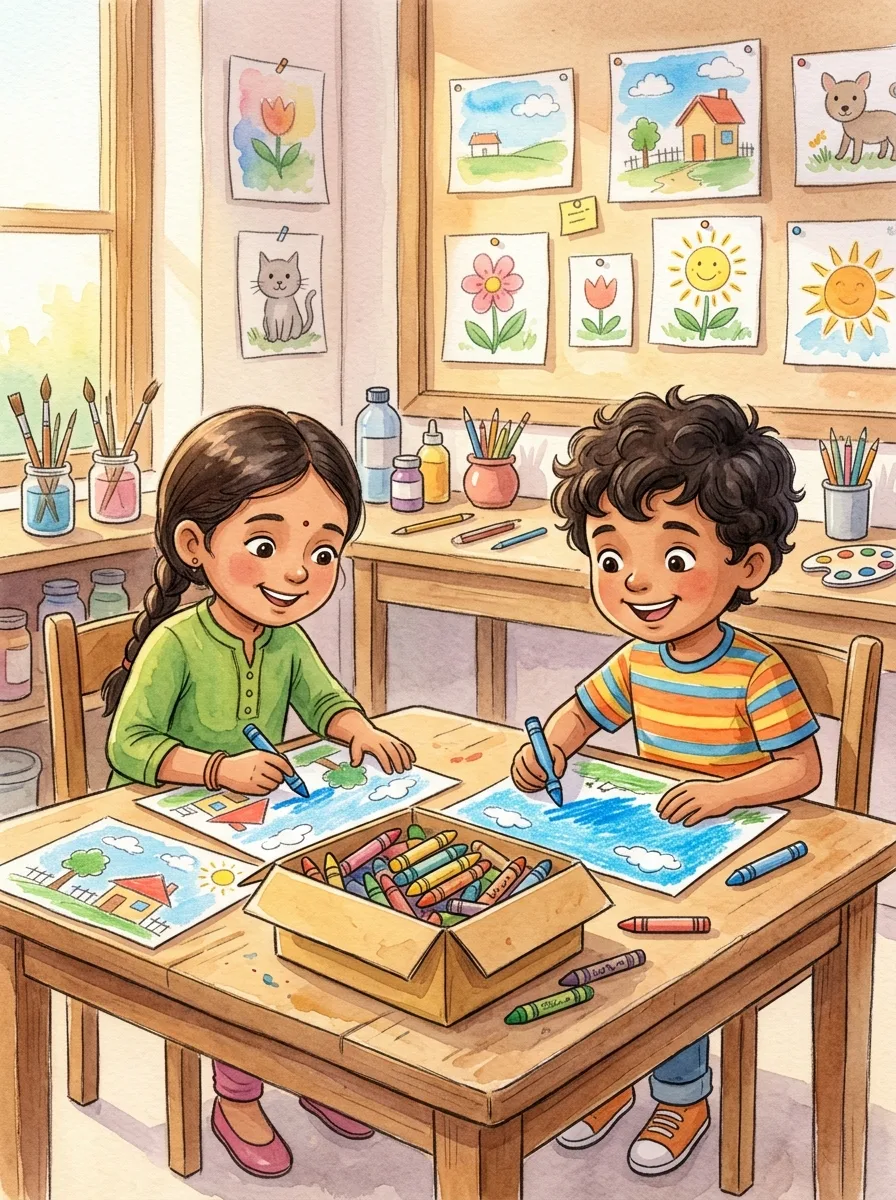
Your child has a new box of twenty-four crayons, and the rest of the art table has stubs. Everyone is drawing a garden, and only Your child has green. Your child tips the box into the middle of the table. Twenty-four crayons, six children, four each, and then everybody swaps as they need. The gardens are the best the class has made, and one crayon goes missing, which is fine.
Lesson: Colours in the middle of the table make better pictures
Sharing
Your child and the Bicycle Ride for Two
Your child and the Bicycle Ride for Two
Your child has a bicycle and the friend next door does not, and every evening the friend watches from the step. Your child tries carrying the friend on the back, and it wobbles. So Your child makes a rule: two laps of the compound each, then swap. The friend learns to ride on Your child's bicycle within a week, and the evenings become races instead of watching.
Lesson: A shared bicycle teaches two people to ride
Sharing
Your child and the Pocket Money for the Puppy
Your child and the Pocket Money for the Puppy
The lane's stray puppy is limping, and the vet costs more than any one child has. Your child has been saving pocket money for a football. Your child puts it all on the table, and asks every child in the lane to add what they can: two rupees, five, a ten. Together it is enough. The puppy limps for a week and then races again. The football comes three months later, and the puppy chases it.
Lesson: Pooled together, small savings fix big problems
Sharing
Your child and the Story That Was Shared
Your child and the Story That Was Shared
Nani tells Your child a wonderful story at bedtime, and Your child wants to keep it, like a secret. The next day at school, the little cousin is sad and will not eat. Your child tells the story, and the cousin laughs. Then the cousin tells it to another child, and by Friday the whole class knows Nani's story. Nani says stories are the one thing that grows bigger when shared.
Lesson: A story shared is a story that grows
Sharing
Sharing Toys Treasure
When two favorite toys are wanted at the same time, Your child finds a treasure map that only opens after fair turns. With timers, choices, and a little patience, Your child learns that sharing keeps playtime happy for everyone. The story should turn the everyday skill into a playful mission with a real choice to practice. Your child can make a mistake, try again, and discover a simple tool like counting, waiting, asking, or planning. The ending should celebrate progress, not perfection, so the lesson feels encouraging.
Lesson: Sharing is easier when children know their turn will come too.
Sharing
The Sharing Sweet Shop
At a magical sweet shop, sweets multiply only when they are shared fairly. Your child helps friends divide treats, wait for turns, and discover that sharing makes the last bite taste happiest. The story should place Your child inside a real moral choice, where the easy path and the kind path are not the same. Through a small mistake, a helpful pause, and a brave decision, Your child learns the value by doing it. The ending should feel honest, warm, and earned.
Lesson: Sharing fairly makes joy grow for everyone.