Sibling Squabbles
Your child and the Line Down the Middle
Your child and the Line Down the Middle
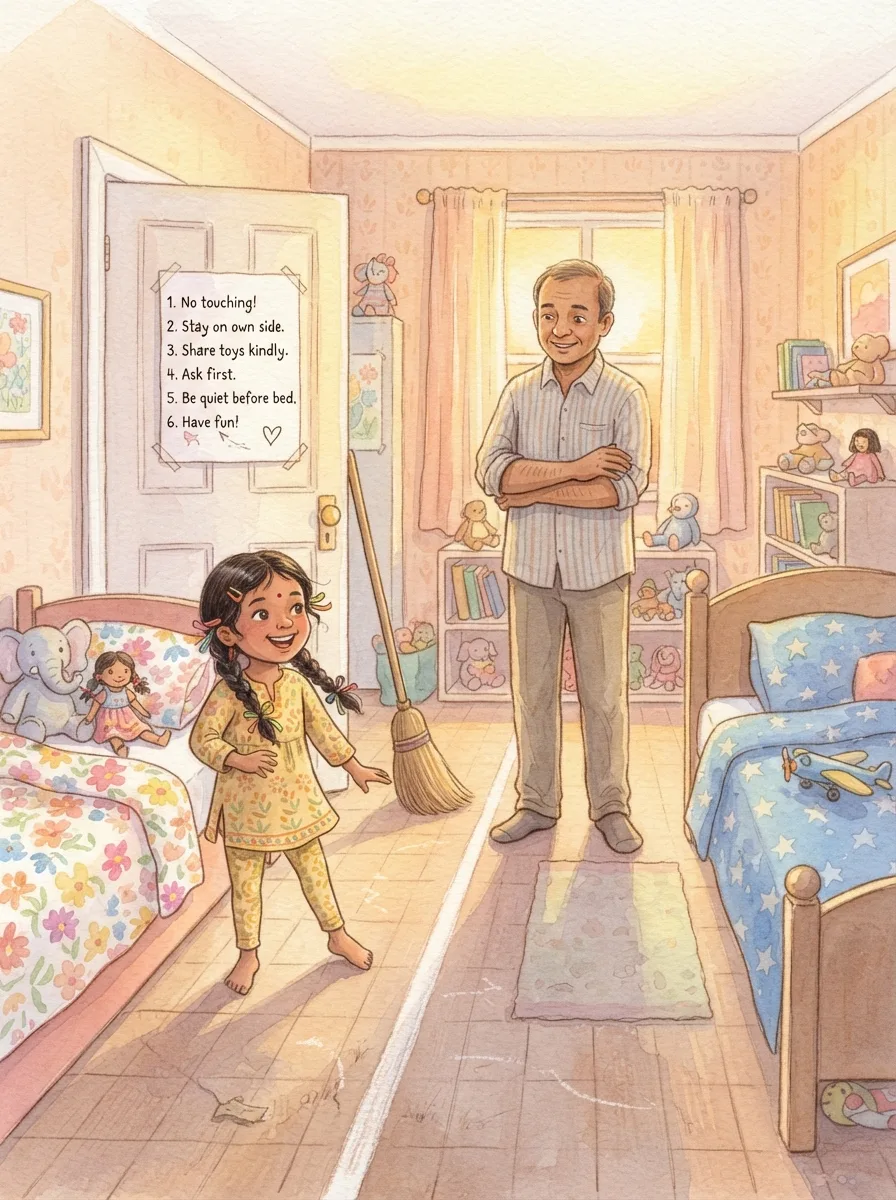
Your child and Didi share one room and the fighting has reached the stage of a chalk line drawn down the middle of the floor. Papa looks at it and says nothing for a whole day. Then he asks them each to write three rules they want. Six rules go up on the door. No touching the other one's shelf. Lights out by ten. The chalk line is swept away by Thursday and nobody misses it.
Lesson: Rules you both wrote work better than a line on the floor
Sibling Squabbles
Your child and the Remote War
Your child and the Remote War
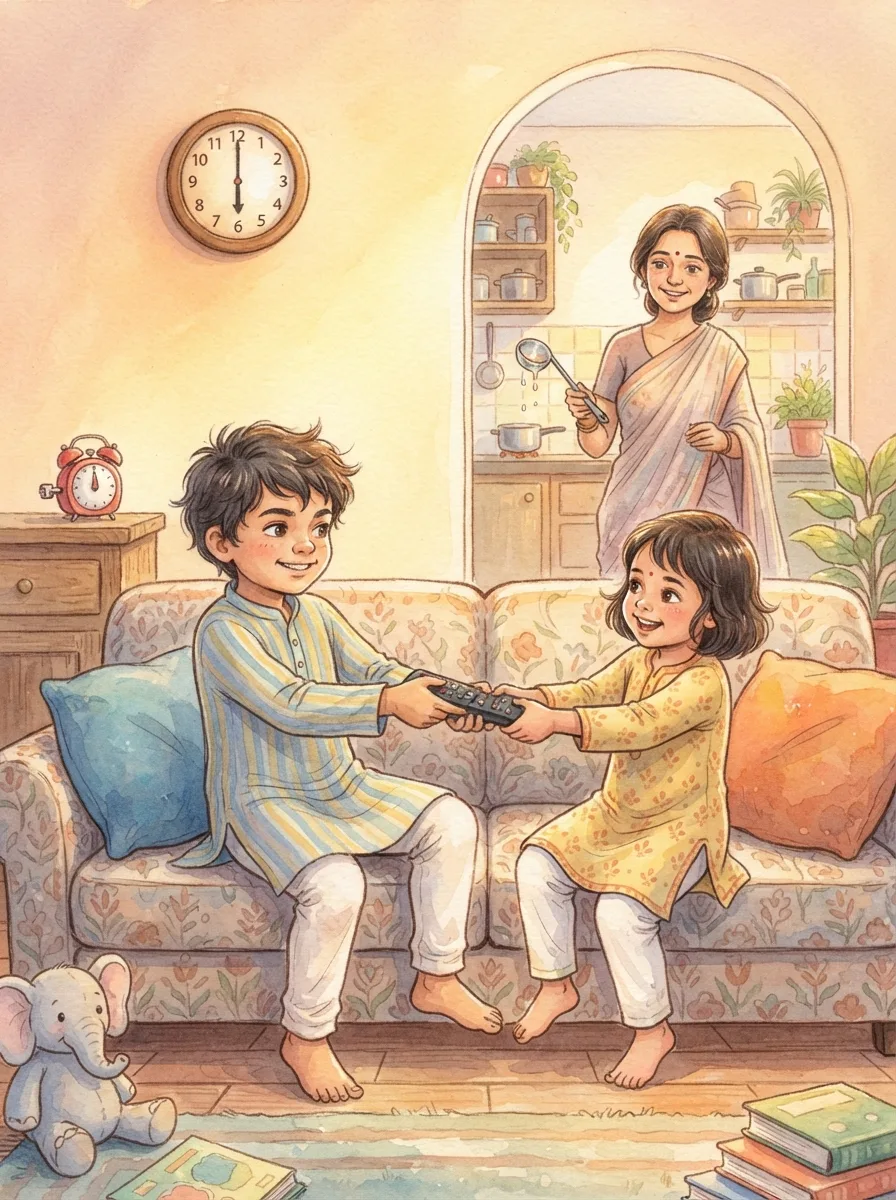
There is one television, one remote and two very different opinions about what happens at six o'clock. The shouting brings Mumma out of the kitchen holding a dripping ladle. She sets the kitchen timer instead of scolding. 'Twenty minutes each. Whoever grabs, loses the next turn.' The first evening is agony for Your child and for Bhaiya. By the third, Bhaiya hands the remote over the moment the timer rings.
Lesson: A timer is fairer than the fastest hand
Sibling Squabbles
Your child and the Last Piece of Cake
Your child and the Last Piece of Cake
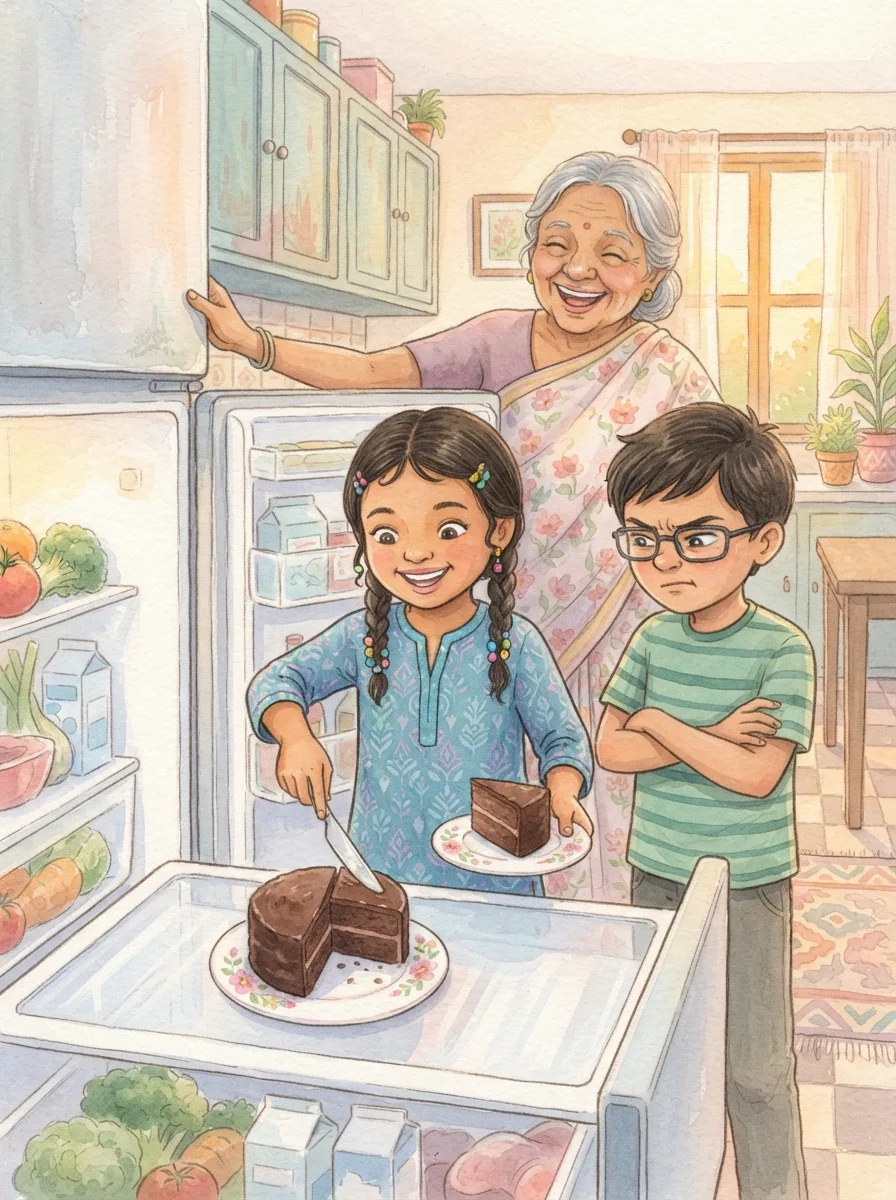
There is one slice of birthday cake left in the fridge and two children who both want it very much. Dadi fetches a knife and a plate and announces the old rule. 'One of you cuts. The other one chooses.' Your child cuts, and it has never been done so carefully in the whole history of cake. Bhaiya chooses. The halves are so equal that Dadi laughs all the way to the kitchen.
Lesson: One cuts and the other chooses and nobody can complain
Sibling Squabbles
Your child and the Turn Taking Chart
Your child and the Turn Taking Chart
The new cricket bat is shared and every single evening it starts a fight in the lane. Dadi tears a page out of an old diary and rules a chart with the days on it. Monday Your child, Tuesday Bhaiya, and so on, with Sunday for both. It is taped up beside the door. The fighting stops, not because the chart is fair, but because it is on the wall and cannot be argued with.
Lesson: A chart on the wall settles what shouting cannot
Sibling Squabbles
Your child and the Ball on the Terrace
Your child and the Ball on the Terrace
In the middle of an enormous fight the ball sails over the wall onto the neighbour's terrace, and neither of them can reach the latch alone. They stop shouting to look at the wall. Your child holds the stool steady. Bhaiya climbs and passes the ball down. It takes four minutes and both of them, and by the time the ball is back nobody remembers what the fight was about.
Lesson: A problem you can only solve together makes you a team
Sibling Squabbles
Your child and the Rakhi Promise
Your child and the Rakhi Promise
On Raksha Bandhan, Didi ties the thread on Your child's wrist and the whole family claps, and there is a hundred rupees and a laddoo. Later, alone on the stairs, Didi says, 'The thread is not about the money. It means you will stand up for me.' Two weeks later a boy in the lane calls Didi a name, and Your child remembers the thread, and stands up.
Lesson: A rakhi is a promise you keep on an ordinary day
Sibling Squabbles
Your child Teaches Chhoti to Tie Her Laces
Your child Teaches Chhoti to Tie Her Laces
Chhoti has new school shoes with laces and is crying because everybody else can already do it. Your child, who learned last year and remembers exactly how hard it was, sits down on the floor and does it slowly four times, saying the bunny ears part out loud. Chhoti manages it on the seventh try and runs off without a thank you, which is fine, because Your child feels enormous anyway.
Lesson: Being older is best used for teaching not for winning
Sibling Squabbles
Your child and the Sorry That Took Two Days
Your child and the Sorry That Took Two Days
The fight was about a broken toy but the words went a long way past that, and now Your child and Bhaiya have not spoken for two days. It is the loudest silence the house has ever had. Mumma refuses to carry messages. On the second evening Your child leaves a drawing on Bhaiya's pillow with sorry written along the bottom. Bhaiya arrives at the door with two glasses of Rooh Afza and no speech.
Lesson: Sorry can be delivered on paper when the mouth will not work
Sibling Squabbles
Your child and the One Cycle
Your child and the One Cycle
There is one cycle for Your child and Didi and a whole colony full of evening. The obvious answer is a fight, and they have it twice. Then Chacha shows them the double ride, one pedalling and one sitting on the carrier, and how to swap at the end of every round. Two rounds each. It turns out that the carrier, with all the wind and none of the work, is the better seat anyway.
Lesson: Two on one cycle beats one on the ground
Sibling Squabbles
Your child and the Borrowed Colour Pencils
Your child and the Borrowed Colour Pencils
Your child takes Didi's new colour pencils without asking and the aqua green comes back as a stub. Didi is furious and she is right to be. Papa does not shout. He asks a question instead. 'What would have made this fine?' Your child thinks and says, 'Asking.' So a rule is made for the whole house. Ask first and return the same day. Your child also buys one aqua green pencil from pocket money.
Lesson: Ask first and return the same day
Sibling Squabbles
Your child and the Back Seat to Nani's
Your child and the Back Seat to Nani's
It is a five hour drive to Nani's house and both children want the window with the good view. Mumma divides the road by landmarks instead of by minutes. Till the toll, Your child. Toll to the dhaba, Bhaiya. Dhaba to the canal, Your child again. The swapping becomes the game. By the canal they are both hanging out of the same window counting the names painted on the backs of trucks.
Lesson: Share by landmarks and the journey becomes the game
Sibling Squabbles
Your child and the Broken Flower Pot
Your child and the Broken Flower Pot
The football hits Mumma's favourite money plant pot and it breaks into three pieces, and both Your child and Bhaiya were playing. The first instinct is to blame the other one. They look at each other in the middle of the wreckage. Then Bhaiya says, 'Together?' They sweep it up, repot the plant in an old paint bucket and tell Mumma at the door. She is cross for four minutes and proud for far longer.
Lesson: Owning it together costs less than blaming each other
Sibling Squabbles
Your child and the Quiet Hour
Your child and the Quiet Hour
Didi has board exams and needs quiet, and Your child has a new whistle and needs an audience. After three days of shouting Mumma writes a deal on a piece of paper. Six to eight, complete silence, and afterwards Your child gets the whole terrace with Didi as the audience. Both of them sign it. At eight sharp on the first day Didi climbs up and claps at every single whistle.
Lesson: A deal you both sign beats a rule handed down
Sibling Squabbles
Your child and the Birthday That Was Not Mine
Your child and the Birthday That Was Not Mine
It is Bhaiya's birthday and the cake, the guests, the songs and every single present belong to him. Your child smiles all evening and feels awful inside. Bua notices and takes Your child into the kitchen. 'Jealous on your brother's birthday is normal. It does not make you bad.' Then she asks for help with the candles, and being the one who carries the cake in turns out to be a job worth having.
Lesson: Jealous does not make you bad and a job makes it smaller
Sibling Squabbles
Your child and Bhaiya Against the World
Your child and Bhaiya Against the World
At Nana's village the older boys tease Bhaiya about his city shoes, and Your child, who has spent the whole year fighting with him, is astonished to find both fists clenching. Your child announces loudly that Bhaiya bowls better than any of them, which is possibly untrue but works. Walking back through the fields Bhaiya says nothing about it, and carries Your child's bag the entire way home.
Lesson: You can fight at home and still stand together outside
Sibling Squabbles
Sharing Toys Treasure
When two favorite toys are wanted at the same time, Your child finds a treasure map that only opens after fair turns. With timers, choices, and a little patience, Your child learns that sharing keeps playtime happy for everyone. The story should turn the everyday skill into a playful mission with a real choice to practice. Your child can make a mistake, try again, and discover a simple tool like counting, waiting, asking, or planning. The ending should celebrate progress, not perfection, so the lesson feels encouraging.
Lesson: Sharing is easier when children know their turn will come too.
Sibling Squabbles
The Sharing Sweet Shop
At a magical sweet shop, sweets multiply only when they are shared fairly. Your child helps friends divide treats, wait for turns, and discover that sharing makes the last bite taste happiest. The story should place Your child inside a real moral choice, where the easy path and the kind path are not the same. Through a small mistake, a helpful pause, and a brave decision, Your child learns the value by doing it. The ending should feel honest, warm, and earned.
Lesson: Sharing fairly makes joy grow for everyone.