Ramayana
Your child and the Squirrel's Bridge
Your child and the Squirrel's Bridge
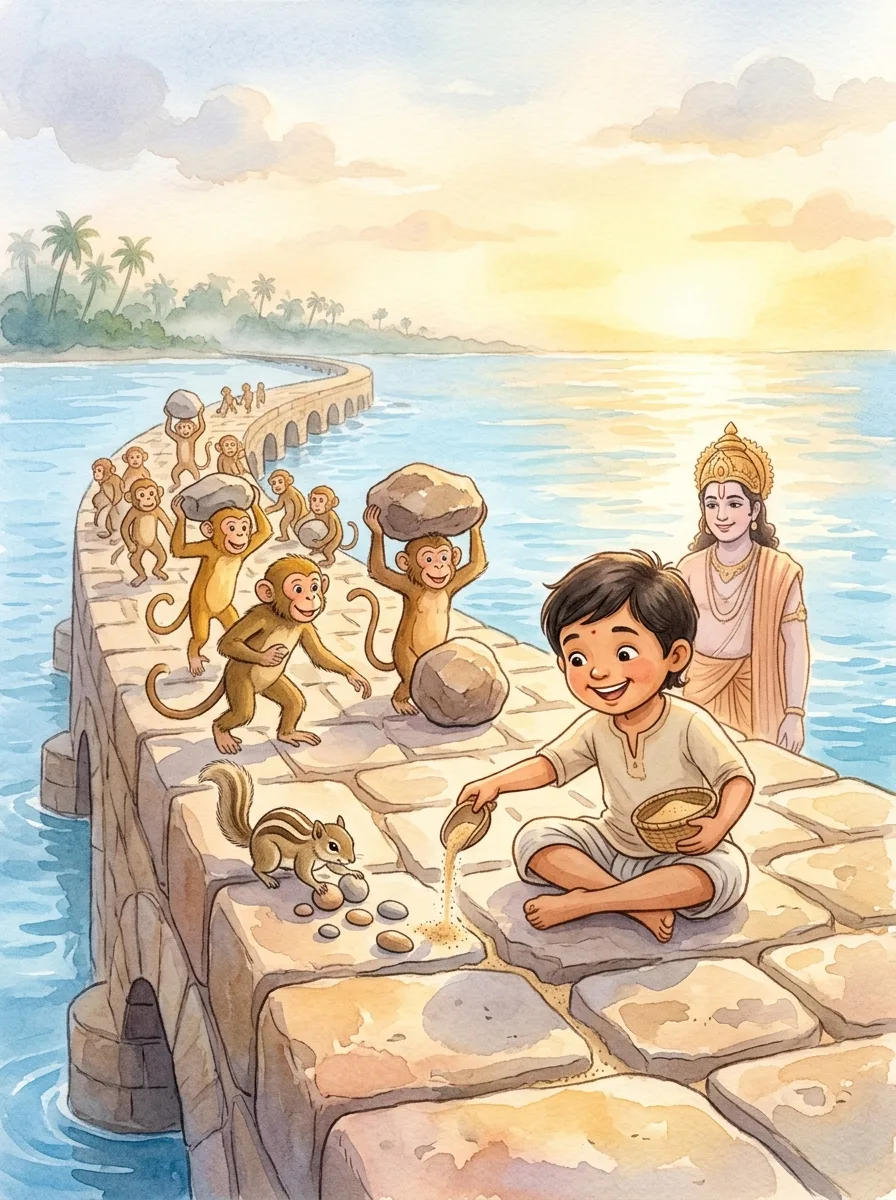
The monkey army is heaving boulders into the sea to build a bridge to Lanka, and Your child is too small to lift even one. A little squirrel rolling pebbles into the gaps gives Your child an idea: fill the cracks with sand so the stones stop wobbling. Rama kneels, thanks them both, and strokes three soft lines down the squirrel's back.
Lesson: No help is too small when it is given with your whole heart
Ramayana
Your child and the Forest Years
Your child and the Forest Years
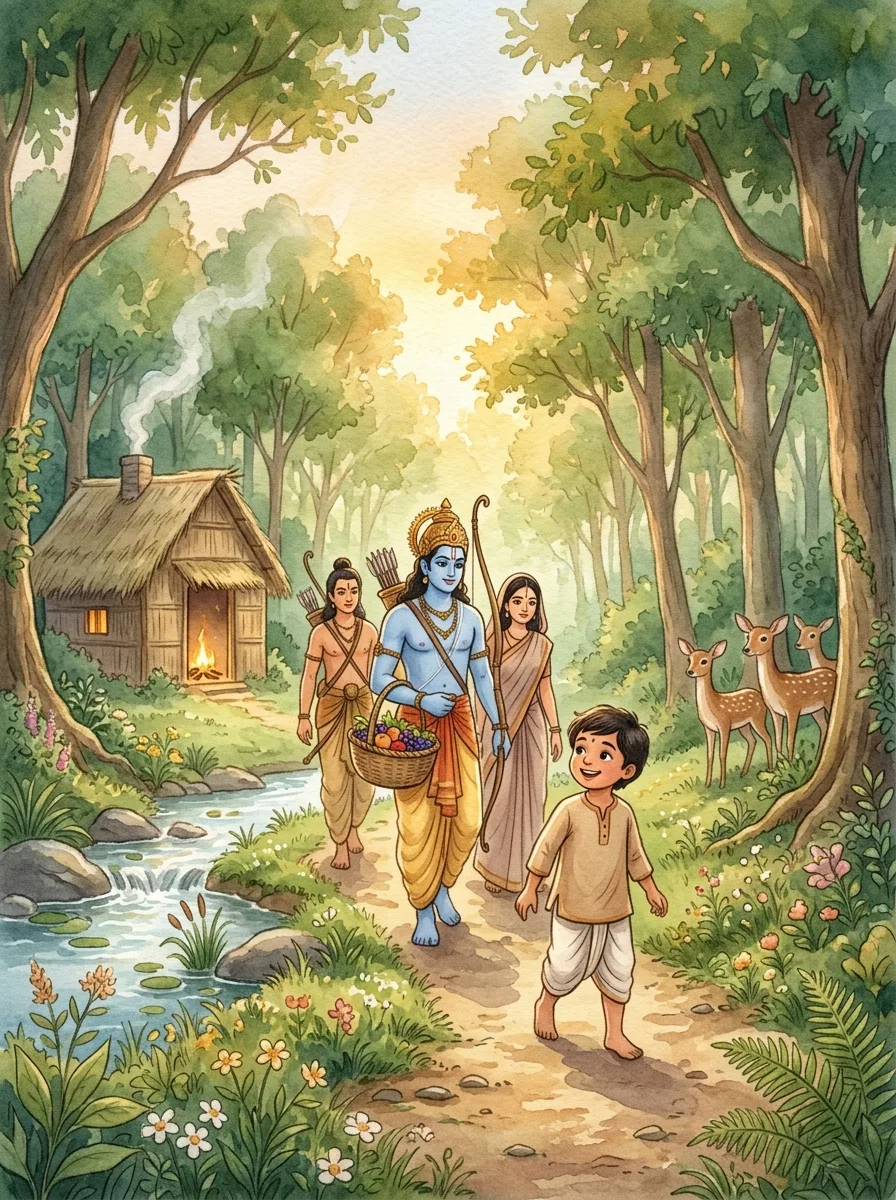
Rama, Sita and Lakshman have just arrived in the forest, and Your child, a child from the nearby village, offers to show them where the sweet berries grow and which stream is safe to drink from. Lakshman is grumpy about the mud until Your child shows him how to weave a leaf umbrella. By evening the hut has a roof and the forest feels like home.
Lesson: A good guide shares what they know without being asked twice
Ramayana
Your child and the Lamps of Ayodhya
Your child and the Lamps of Ayodhya
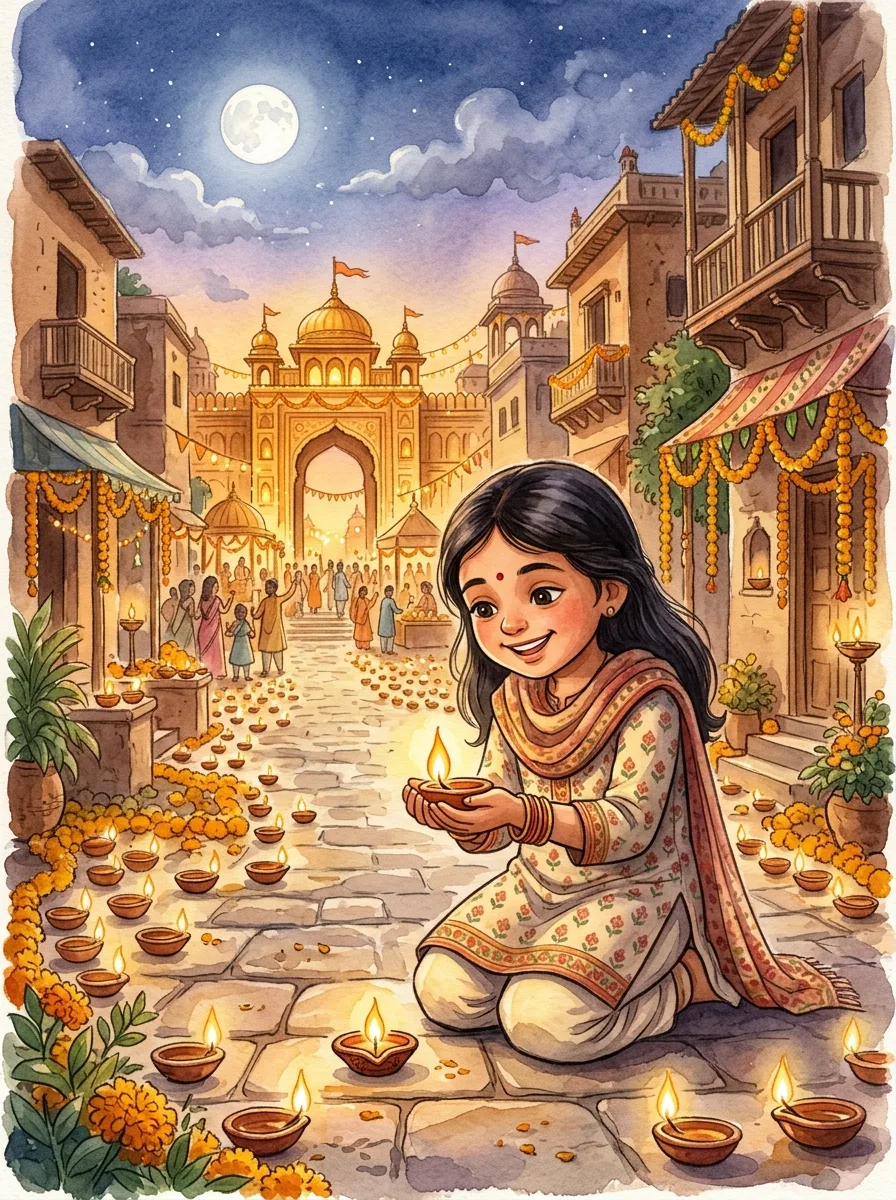
Rama is coming home after fourteen years and every doorstep in Ayodhya needs a lamp. Your child is given one clay diya and a tiny bottle of oil, but the wind keeps blowing it out. Instead of giving up, Your child cups the flame with both hands and walks it, step by careful step, to the palace gate, where a thousand lamps light up at once.
Lesson: Protect a small light and it becomes part of a great one
Ramayana
Your child and the Golden Deer of Panchavati
Your child and the Golden Deer of Panchavati
A deer glittering like gold trots past the hut at Panchavati, and Sita longs for it. Your child, who herds goats nearby, has never seen a deer with golden fur and says so out loud: real deer are brown, and this one leaves no hoofprints. Rama pauses and looks closer. The deer is watched but not chased that day, and Your child learns that noticing what is odd can protect a whole family.
Lesson: Look closely at what seems too good to be true
Ramayana
Your child and Jatayu's Feather
Your child and Jatayu's Feather
Rama and Lakshman are searching the forest for Sita, and old Jatayu the vulture lies exhausted after trying to stop Ravana's chariot. Your child finds him first, fetches water in a leaf cup, and sits with him until the brothers arrive. Jatayu tells them which way the chariot went, and gives Your child one great feather for staying when others would have run.
Lesson: Staying beside someone who is hurt is a brave thing to do
Ramayana
Your child and Sugriva's Garland
Your child and Sugriva's Garland
Rama must tell the two monkey kings apart, Sugriva and his brother Vali, but they look exactly alike. Your child, a child of the monkey kingdom, weaves a garland of forest flowers and hangs it around Sugriva's neck so there can be no mistake. Rama smiles at the simple solution, and from that day the garland becomes Sugriva's crown.
Lesson: A simple idea can solve a big confusion
Ramayana
Your child and the Search for Sita
Your child and the Search for Sita
The monkey army is splitting up to search north, south, east and west for Sita, and everyone wants to go with Hanuman. Your child is sent north with the slow, grumbling group nobody chose. Instead of sulking, Your child draws maps in the dust of every village they pass and asks every bird for news. The north team returns with the best map of all, and Rama keeps it.
Lesson: Do the job you are given as well as the one you wanted
Ramayana
Your child and Sita's Jewels in the Forest
Your child and Sita's Jewels in the Forest
As Ravana's chariot flew over the forest, Sita dropped her jewels so someone could follow the trail. Your child, gathering firewood, finds a single anklet in the grass and thinks about keeping it. Instead Your child runs all the way to the monkey camp to give it to Rama. He holds it and knows Sita is alive. The anklet, he says, is worth more than a kingdom because of the child who returned it.
Lesson: Returning what is not yours can change someone's whole story
Ramayana
Your child and the Message in the Ashoka Garden
Your child and the Message in the Ashoka Garden
Hanuman has found Sita in the Ashoka garden of Lanka, but she does not believe he comes from Rama. Your child, hidden in the branches beside Hanuman, remembers the ring Rama gave him and whispers to hold it out first, gently, before speaking. The ring falls into Sita's palm, she weeps with joy, and gives Hanuman her hair jewel to carry back. Your child carries the hope.
Lesson: Proof offered gently opens a frightened heart
Ramayana
Your child and the Floating Stones
Your child and the Floating Stones
Nala and Nila are building the bridge to Lanka, and the stones only float when Rama's name is written on them. Your child is given a piece of chalk and the job of writing the name on every boulder, hundreds of them, in the sun. Halfway through, Your child's hand is aching and the letters go wobbly. A wobbly stone still floats, Nala says kindly, and the bridge reaches Lanka by sunset.
Lesson: Keep going, even when your work stops looking perfect
Ramayana
Your child and Vibhishana's Lamp
Your child and Vibhishana's Lamp
Vibhishana, Ravana's own brother, has crossed the sea to join Rama because he believes it is right, and the monkeys do not trust him. Your child is asked to bring him food and notices he has given away his own blanket to a shivering monkey. Your child tells Rama what was seen, and Rama welcomes him. The one who chooses the right side, Your child learns, deserves a chance.
Lesson: Judge people by what they do, not by where they come from
Ramayana
Your child and the Flying Chariot Home
Your child and the Flying Chariot Home
The exile is over and Rama, Sita and Lakshman are flying home to Ayodhya in the Pushpaka chariot. Your child is invited aboard and spends the whole journey looking down, pointing out the hut, the river, the bridge and every place where a friend helped. Sita asks Your child to remember them all, so that when they reach the palace, no helper is forgotten in the thanks.
Lesson: Remember everyone who helped you on the way
Ramayana
Your child and Bharata's Sandals
Your child and Bharata's Sandals
While Rama is away, Bharata refuses to sit on the throne and places Rama's sandals there instead, ruling as their servant. Your child is the palace child who dusts the sandals every morning. One day a visiting prince laughs at a kingdom ruled by shoes. Your child explains, politely, that the sandals stand for a promise, and the prince stops laughing and bows to them.
Lesson: Keeping someone's place for them is a kind of loyalty
Ramayana
Your child and the Boatman Kevat
Your child and the Boatman Kevat
Rama, Sita and Lakshman need to cross the Ganga, and Kevat the boatman insists on washing Rama's feet first. Your child, Kevat's helper, thinks it is silly to make a prince wait, until Kevat explains he simply wants to serve properly. Your child fetches the cleanest water from midstream and holds the boat steady. Rama offers a ring, but Kevat and Your child ask only for a blessing.
Lesson: Do your work properly and ask for nothing in return
Ramayana
Your child and the Song of Luv and Kush
Your child and the Song of Luv and Kush
In Valmiki's ashram, the twins Luv and Kush are learning to sing the whole story of Rama, and Your child is learning beside them. Your child keeps forgetting the verse about the squirrel. Instead of skipping it, Your child practises that one verse under the mango tree for a week. When the three sing before the king, the squirrel's verse is the one that makes him smile.
Lesson: Practise the part you find hardest until it becomes your best
Ramayana
The Kindly Forest Quest
Deep in a friendly, sunlit forest, Your child joins noble Rama, gentle Sita, and loyal Lakshmana on a caring quest to help woodland creatures find their way home. Wise squirrels build tiny bridges, and singing birds light the path. Together they share kindness with every animal they meet. Rama teaches Your child that loyalty, honesty, and helping others make any journey brave and bright.
Lesson: Loyalty, honesty, and helping others make any journey worthwhile.
Ramayana
Rama and the Forest Promise
Rama and the Forest Promise
In a quiet forest inspired by the Ramayana, Your child finds a promise leaf that glows only when words and actions match. Helping forest friends keep small promises, Your child learns that truthfulness makes courage steady. The story should stay respectful and child-safe, using the epic or fable as inspiration rather than a heavy retelling. Your child faces a small choice connected to courage, dharma, wisdom, or friendship, then helps the scene resolve through kindness. The ending should carry the value clearly without sounding preachy.
Lesson: Keeping promises builds trust, courage, and inner strength.
Ramayana
Sita’s Garden of Patience
Sita’s Garden of Patience
In a garden inspired by Sita’s quiet strength, Your child helps flowers bloom even when they are slow. Watering each plant with patience and hope, Your child learns that gentle strength can be as powerful as loud bravery. The story should stay respectful and child-safe, using the epic or fable as inspiration rather than a heavy retelling. Your child faces a small choice connected to courage, dharma, wisdom, or friendship, then helps the scene resolve through kindness. The ending should carry the value clearly without sounding preachy.
Lesson: Patience, dignity, and hope are powerful forms of strength.
Ramayana
The Bridge of Teamwork
Inspired by the great bridge-building spirit of the Ramayana, Your child helps squirrels, birds, and bears carry tiny stones across a stream. No helper is too small, and together they learn that teamwork can cross big distances. The story should stay respectful and child-safe, using the epic or fable as inspiration rather than a heavy retelling. Your child faces a small choice connected to courage, dharma, wisdom, or friendship, then helps the scene resolve through kindness. The ending should carry the value clearly without sounding preachy.
Lesson: Every contribution matters when a team works with trust.
Ramayana
Lakshman’s Listening Line
Lakshman’s Listening Line
On an enchanted forest path, Your child must draw a listening line before rushing into action. Inspired by Lakshman’s alert care, the line glows when Your child pauses, listens, and chooses safely. The story should stay respectful and child-safe, using the epic or fable as inspiration rather than a heavy retelling. Your child faces a small choice connected to courage, dharma, wisdom, or friendship, then helps the scene resolve through kindness. The ending should carry the value clearly without sounding preachy.
Lesson: Careful listening and boundaries help keep everyone safe.
Ramayana
The Tiny Bow of Courage
In a Ramayana-inspired practice grove, Your child finds a tiny bow that grows stronger only when used to protect, not show off. Helping a frightened bird family, Your child learns that real courage is gentle, careful, and kind. The story should stay respectful and child-safe, using the epic or fable as inspiration rather than a heavy retelling. Your child faces a small choice connected to courage, dharma, wisdom, or friendship, then helps the scene resolve through kindness. The ending should carry the value clearly without sounding preachy.
Lesson: Courage should protect others, not impress them.
Ramayana
The Squirrel Stone Helper
The Squirrel Stone Helper
Inspired by the bridge helpers of the Ramayana, Your child meets a tiny squirrel carrying one pebble at a time. When bigger animals laugh, Your child helps everyone see that small hands can do sacred work too. The story should stay respectful and child-safe, using the epic or fable as inspiration rather than a heavy retelling. Your child faces a small choice connected to courage, dharma, wisdom, or friendship, then helps the scene resolve through kindness. The ending should carry the value clearly without sounding preachy.
Lesson: Every sincere contribution matters, no matter how small.
Ramayana
The Golden Deer of Wise Choices
The Golden Deer of Wise Choices
A shining deer races through a Ramayana-inspired forest, tempting everyone to chase without thinking. Your child pauses, asks careful questions, and learns that wisdom means not every glittering thing must be followed. The story should stay respectful and child-safe, using the epic or fable as inspiration rather than a heavy retelling. Your child faces a small choice connected to courage, dharma, wisdom, or friendship, then helps the scene resolve through kindness. The ending should carry the value clearly without sounding preachy.
Lesson: Wise children pause before chasing distractions.
Ramayana
The Lanterns of Ayodhya
In a city inspired by Ayodhya, the welcome lanterns have gone dim before a joyful homecoming. Your child helps neighbors light them with kindness, forgiveness, and hope, learning that a true celebration welcomes every heart home. The story should stay respectful and child-safe, using the epic or fable as inspiration rather than a heavy retelling. Your child faces a small choice connected to courage, dharma, wisdom, or friendship, then helps the scene resolve through kindness. The ending should carry the value clearly without sounding preachy.
Lesson: Homecoming feels joyful when people choose forgiveness, hope, and welcome.