Bhagavad Gita
Your child and the Worried Archer
Your child and the Worried Archer
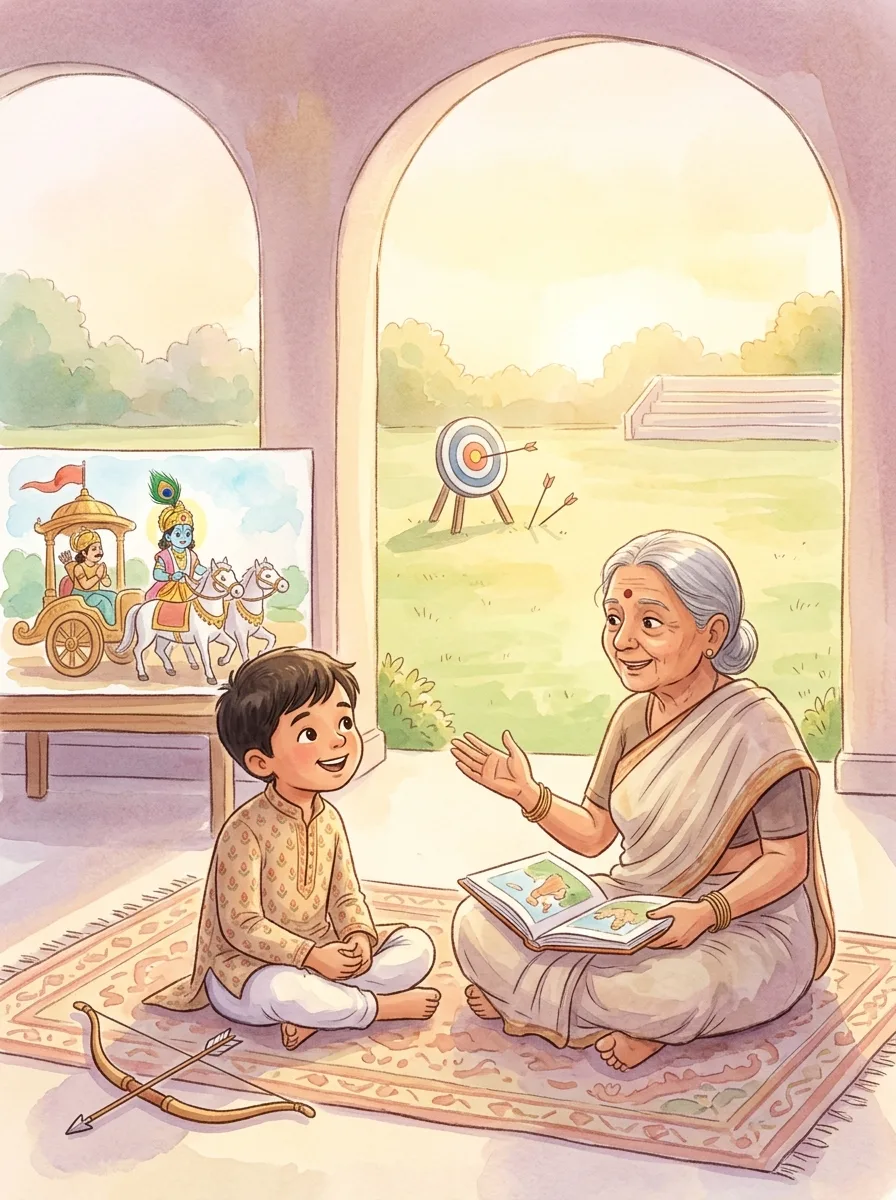
On the morning of the big match, Your child cannot stop thinking about losing, and the bow feels heavier than ever. Nani tells the story of Arjuna, who was so worried he sat down in his chariot, and of Krishna, who said: give the arrow your best, the rest is not yours to carry. Your child breathes out, aims, and, whatever happens, lets go.
Lesson: Do your part with all your heart and let the result be
Bhagavad Gita
Your child and the Two Paths
Your child and the Two Paths
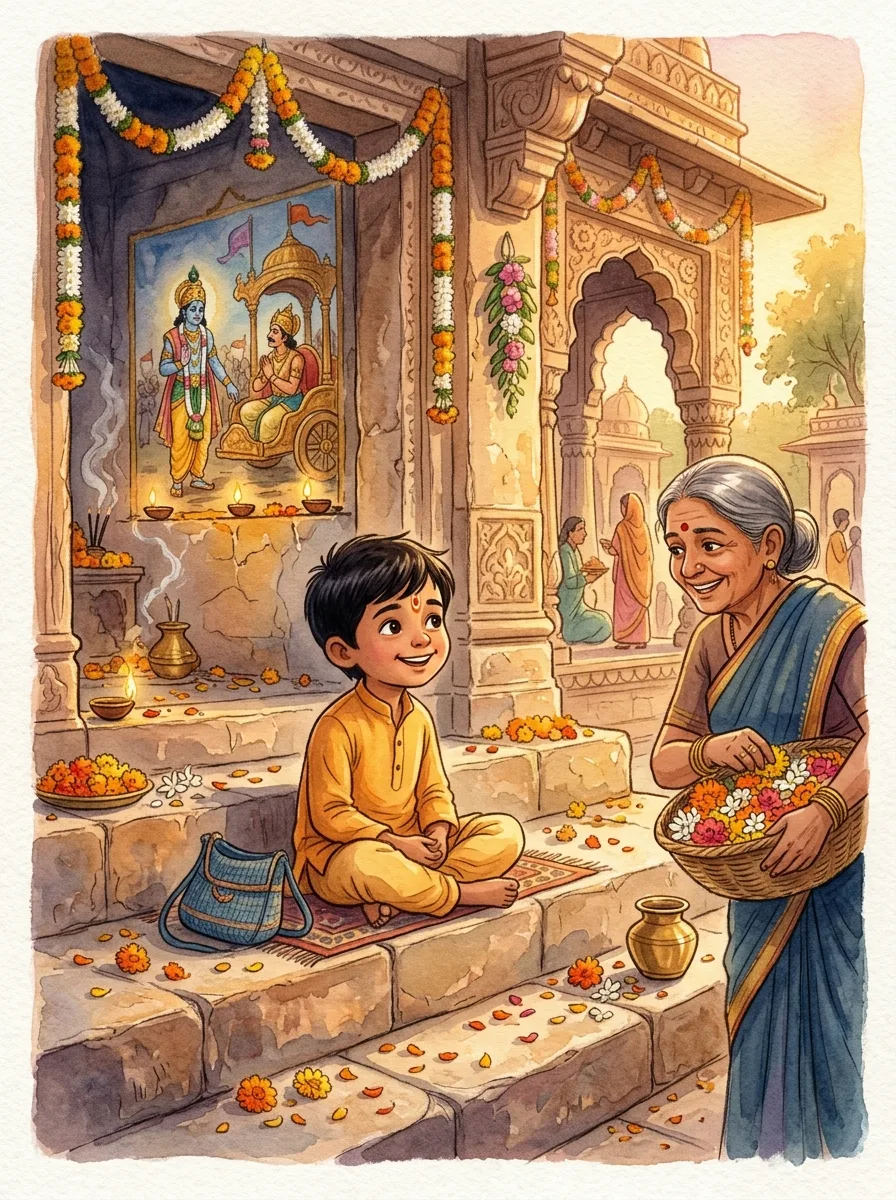
Your child finds a purse full of coins on the temple steps and hears two voices: one says keep it, one says find who lost it. At the shrine, a painting shows Krishna talking to Arjuna, and Dadaji explains that the Gita is really about choosing the harder right path. Your child waits by the steps until a crying flower-seller comes looking, and hands it back.
Lesson: The right thing to do is often the harder thing to do
Bhagavad Gita
Your child and the Steady Lamp
Your child and the Steady Lamp
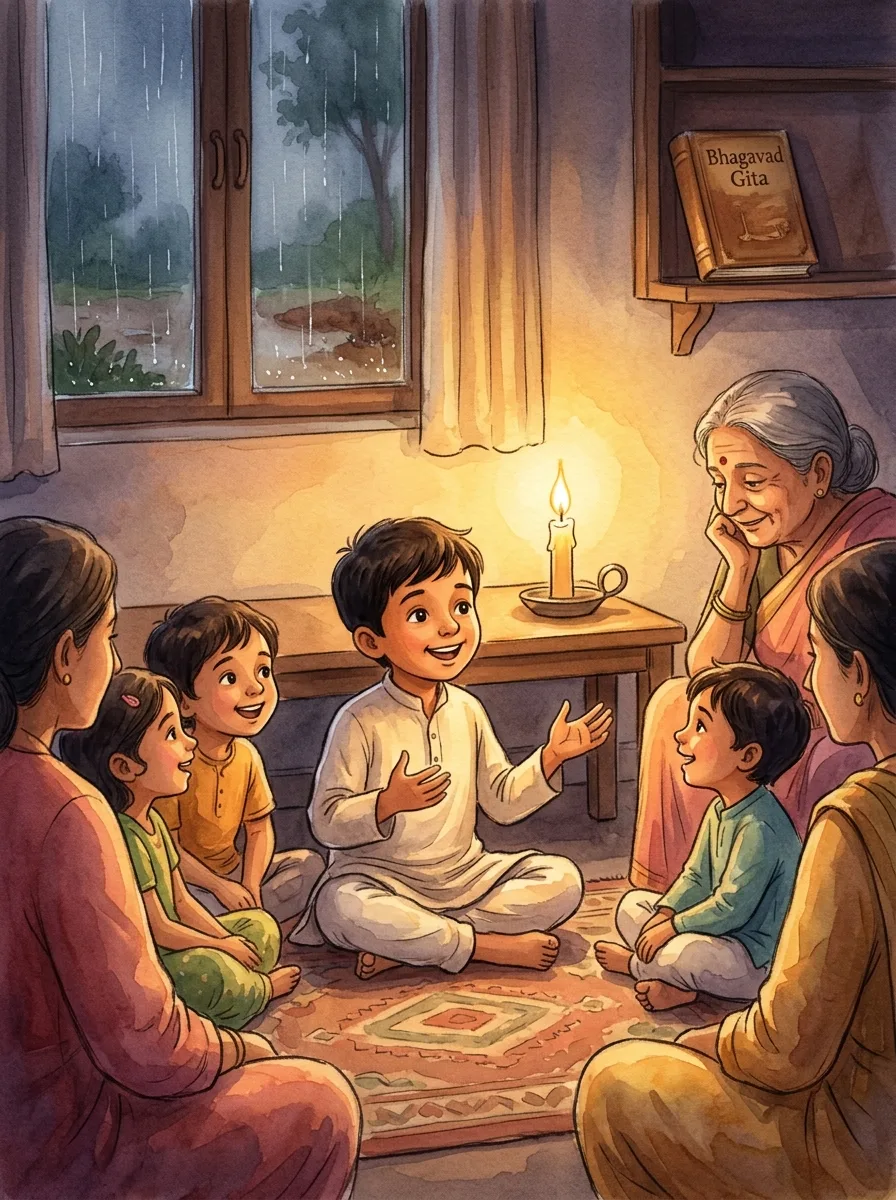
Everyone at home is upset: the power is out, the exam is tomorrow, and the little cousins are crying. Your child remembers a line Mummy loves from the Gita, about a mind as steady as a lamp in a windless place, and quietly lights a candle, hands out snacks, and starts a story. One by one the family calms down around the small, steady flame.
Lesson: A calm mind is a light everyone can gather around
Bhagavad Gita
Your child and the Charioteer
Your child and the Charioteer
Papa explains that in the Gita, Krishna does not fight; he only steers Arjuna's chariot and helps him think clearly. On the day of the school debate, Your child's best friend is shaking with nerves. Your child decides to be the charioteer: carrying the notes, whispering 'breathe', and steering the friend to the stage. The friend wins, and Your child finds that helping someone shine feels wonderful.
Lesson: You can be the one who steers, not the one who shines
Bhagavad Gita
Your child and the Lotus Leaf
Your child and the Lotus Leaf
At the village pond, Nani shows Your child how water rolls right off a lotus leaf without wetting it, and says the Gita asks us to be like that: do everything, but do not let praise or scolding stick. That week Your child is teased for a wrong answer in class. Instead of sulking for days, Your child pictures the lotus leaf, shrugs off the drops, and raises a hand again the next day.
Lesson: Let praise and teasing roll off like water on a lotus leaf
Bhagavad Gita
Your child and the Three Kinds of Food
Your child and the Three Kinds of Food
Dadaji reads that the Gita sorts food into calm food, fiery food and stale food, and that what we eat shapes our mood. Your child has been eating chips and getting cranky all week. As an experiment, Your child eats Dadi's fresh khichdi and fruit for three days and keeps a mood chart on the fridge. The chart says calm, and Your child decides the Gita might be onto something.
Lesson: Eat calm food and you feel calm inside
Bhagavad Gita
Your child and the Gift with No Strings
Your child and the Gift with No Strings
The Gita says the best gift is one given at the right time, to the right person, without expecting anything back. Your child has saved a chocolate for the friend who always shares. Then Your child sees the quiet boy who never gets anything at lunch. It is hard, but Your child gives it to him instead, and walks away before he can say thank you.
Lesson: Give without waiting for a thank you
Bhagavad Gita
Your child and the Mind Like a Monkey
Your child and the Mind Like a Monkey
Arjuna complained that the mind jumps around like a restless monkey, and Krishna said practice and patience can tame it. Your child cannot sit through five minutes of homework without looking out of the window. Nani suggests a game: every time the mind jumps, Your child draws a small monkey on a page and goes back. By the end of the week the monkey drawings are fewer, and the homework is done early.
Lesson: Bring your mind back gently, again and again
Bhagavad Gita
Your child and the Friend in Everyone
Your child and the Friend in Everyone
Papa reads that the Gita sees the same spark in a learned teacher, a cow, an elephant and a dog. At the park a stray dog is being chased away from the water tap by bigger children. Your child fills a bowl from the tap and sets it down for the dog, then offers the bigger children a game of catch. By evening the dog is sleeping in the middle of their circle.
Lesson: The same spark lives in every creature
Bhagavad Gita
Your child and the Universe in a Mouthful
Your child and the Universe in a Mouthful
Nani tells how Krishna showed Arjuna his cosmic form, the whole universe inside him, stars and rivers and mountains all at once. Your child lies on the terrace that night and tries to see it too: every star, the sleeping mohalla, the distant train. Somehow Your child's own worries about the test look very small from up there, and the sleep that follows is the deepest of the year.
Lesson: Look at the whole sky and your worries look their true size
Bhagavad Gita
Your child and the Equal Eye
Your child and the Equal Eye
The Gita asks us to look at gold and a lump of clay with the same calm eye, Dadaji says. At the school sports day Your child wins a gold medal in the morning and comes last in the afternoon race. Both times, Your child shakes every hand and eats the same banana on the same bench. A teacher notices and says Your child has learned something that takes most people a lifetime.
Lesson: Win or lose, stay the same kind person
Bhagavad Gita
Your child and the Work That Is Worship
Your child and the Work That Is Worship
The Gita says every honest job done well is a kind of prayer. Your child has been given the dullest task at the school fete: folding two hundred paper plates. Everyone else is painting banners. Your child decides to fold each plate perfectly, as if it were an offering, and even adds a tiny paper flower to the corner of each one. The plates are the thing everyone talks about.
Lesson: Any work done with your whole heart becomes beautiful
Bhagavad Gita
Your child and the Tree with Roots in the Sky
Your child and the Tree with Roots in the Sky
The Gita describes a strange tree with its roots in the sky and its branches on earth. Your child tries to draw it for the school art competition and everyone laughs at the upside-down tree. Nani explains it means everything we see grows from something unseen, like a family from love. Your child paints the family under the branches, and the picture wins for being the only one that told a story.
Lesson: What you can see grows from what you cannot
Bhagavad Gita
Your child and the Anger That Melted
Your child and the Anger That Melted
Krishna warns that anger clouds the mind the way steam clouds a mirror. Your child is furious when a cousin breaks the model plane, and is about to shout. Instead, Your child does what Papa suggested from the Gita: counts ten breaths, walks to the tap and splashes water on the face. When Your child returns, the cousin is crying with a tube of glue, and the two of them fix the plane together.
Lesson: Cool your anger before you speak, and you will not need to say sorry
Bhagavad Gita
Your child and the Promise of Krishna
Your child and the Promise of Krishna
Nani says the Gita has a promise: whenever things go badly wrong, goodness finds a way back. Your child's school is closing the little library because nobody uses it. Instead of feeling helpless, Your child starts a lunchtime story club under the neem tree with three friends. In a month there are thirty children, and the principal keeps the library open with Your child as its youngest helper.
Lesson: When something good is fading, be the one who brings it back
Bhagavad Gita
The Geeta Garden of No Fear
The Geeta Garden of No Fear
In a Geeta-inspired garden, Your child finds a shy seed afraid to grow because it may not become the tallest tree. A wise breeze teaches that the seed only needs to do its own work with love. The story should stay respectful and child-safe, using the epic or fable as inspiration rather than a heavy retelling. Your child faces a small choice connected to courage, dharma, wisdom, or friendship, then helps the scene resolve through kindness. The ending should carry the value clearly without sounding preachy.
Lesson: Do your sincere work without fear of comparison.
Bhagavad Gita
The Chariot of Five Senses
The Chariot of Five Senses
A little chariot with five curious horses wants to run in every direction. Your child learns to hold the reins gently, guiding sight, sound, taste, touch, and smell with calm attention. The story should stay respectful and child-safe, using the epic or fable as inspiration rather than a heavy retelling. Your child faces a small choice connected to courage, dharma, wisdom, or friendship, then helps the scene resolve through kindness. The ending should carry the value clearly without sounding preachy.
Lesson: Self-control means guiding the senses with calm awareness.
Bhagavad Gita
The Mirror of Self-Belief
The Mirror of Self-Belief
A Geeta-inspired mirror shows Your child not as the best or worst, but as someone growing with every sincere effort. The mirror shines brightest when Your child tries again after a mistake. The story should stay respectful and child-safe, using the epic or fable as inspiration rather than a heavy retelling. Your child faces a small choice connected to courage, dharma, wisdom, or friendship, then helps the scene resolve through kindness. The ending should carry the value clearly without sounding preachy.
Lesson: Mistakes are part of growth when we keep learning with courage.
Bhagavad Gita
The Lotus of Equal Kindness
The Lotus of Equal Kindness
A lotus pond blooms differently for every creature, yet the water holds them all. Your child learns a Geeta-inspired lesson: treat friends, strangers, and even difficult people with steady kindness. The story should stay respectful and child-safe, using the epic or fable as inspiration rather than a heavy retelling. Your child faces a small choice connected to courage, dharma, wisdom, or friendship, then helps the scene resolve through kindness. The ending should carry the value clearly without sounding preachy.
Lesson: Steady kindness means respecting everyone, not only people who are easy to like.