Mahabharata
Your child and the Eye of the Bird
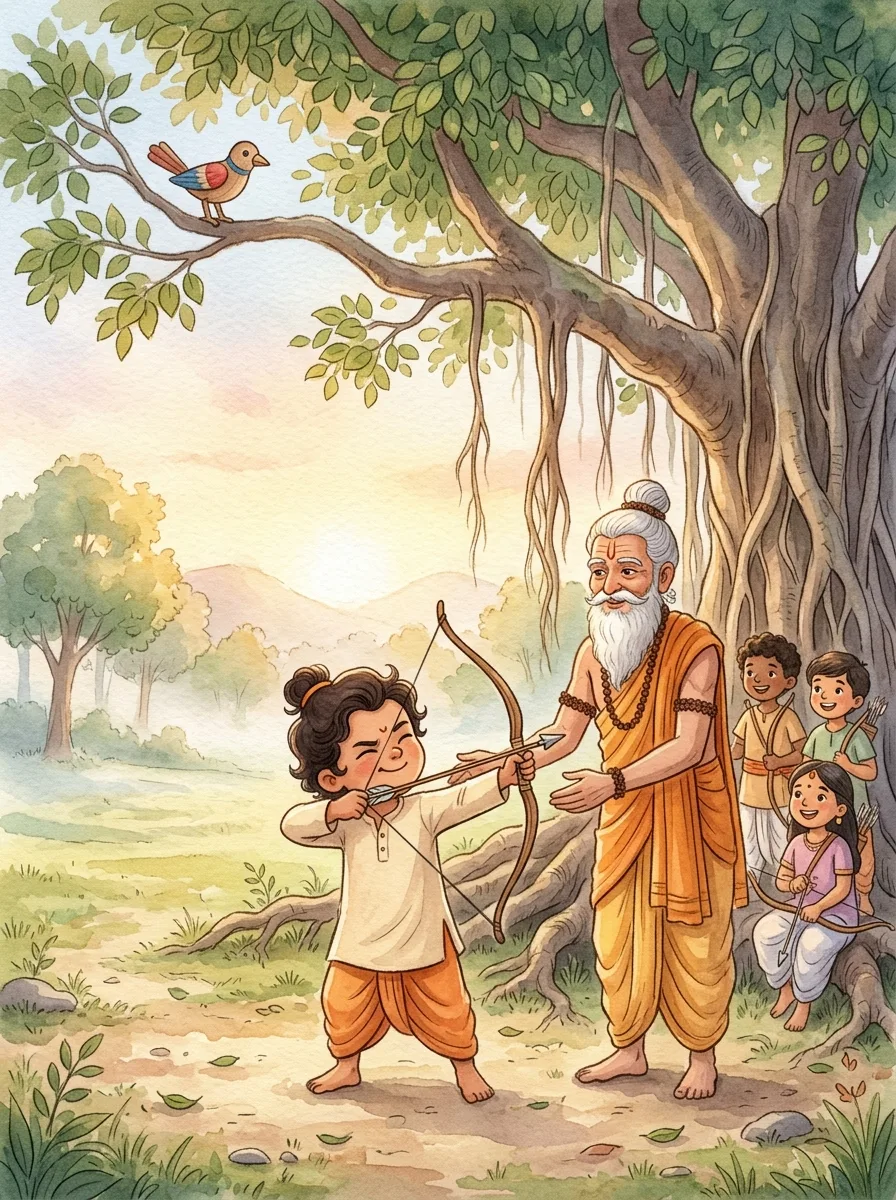
Your child and the Eye of the Bird
At Guru Drona's archery lesson, everyone is asked what they can see on the wooden bird in the tree. Some say the branches, some say the sky. Your child, standing beside Arjuna, sees only the bird's eye and says so. Drona nods: that is how an archer looks at the world. Your child's arrow does not hit the mark, but the next morning Your child is back at the tree, practising.
Lesson: Look only at your goal and the noise around it fades
Mahabharata
Your child and Bhima's Lunch
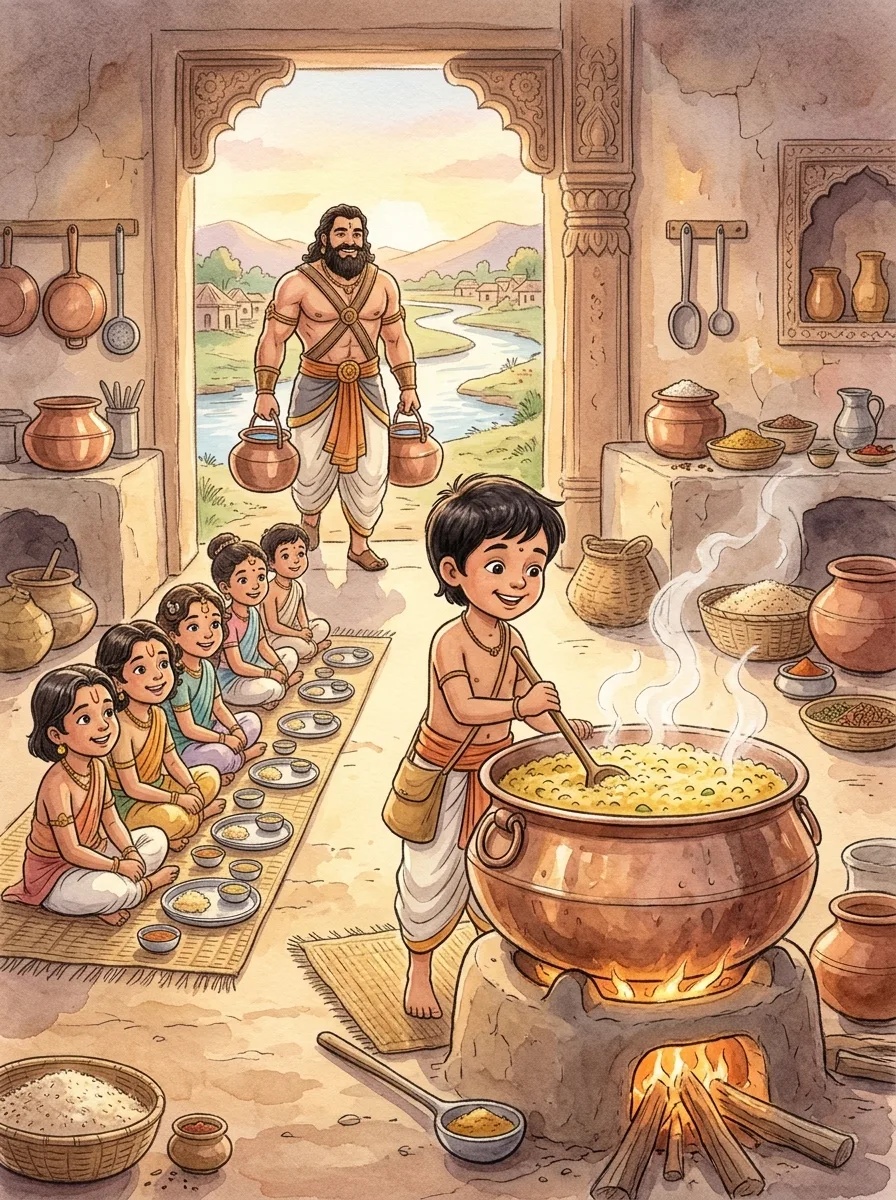
Your child and Bhima's Lunch
Bhima has eaten every laddoo in the kitchen again and the younger cousins have nothing left. Your child does not scold him; instead Your child asks Bhima to use his enormous strength to carry water from the river so they can cook a meal big enough for everyone. Bhima lifts the biggest pot ever seen, and the whole family eats together, laughing.
Lesson: Strength is at its best when it feeds more than one person
Mahabharata
Your child and the Chariot Wheel
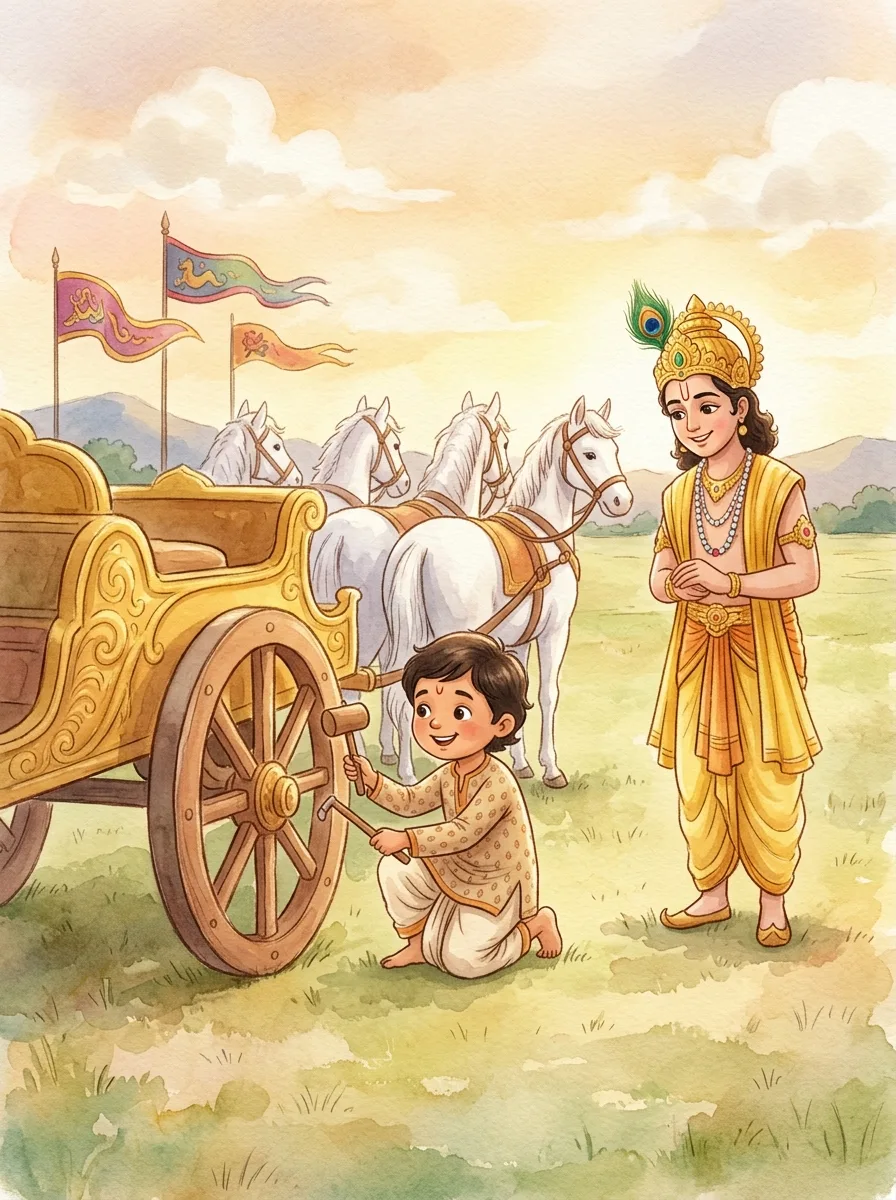
Your child and the Chariot Wheel
Before the great gathering at Kurukshetra, a chariot wheel comes loose and every grown-up is too busy to notice. Your child, who has spent the summer watching the wheelwright, fetches a wooden peg and a mallet and taps it back into place. Krishna, who sees everything, winks and says the smallest hands often keep the biggest journeys rolling.
Lesson: Pay attention to small things and you will be ready for big ones
Mahabharata
Your child and the House of Lac
Your child and the House of Lac
The Pandavas have been given a beautiful new palace, and Your child, the builder's child, notices that the walls smell of wax and oil and that the doors are fixed shut. Your child tells Vidura, the wise uncle, instead of keeping quiet. A tunnel is dug, and when the palace catches fire, everyone is already safe on the other side of the river.
Lesson: If something feels wrong, tell a trusted grown-up
Mahabharata
Your child and Draupadi's Swayamvar
Your child and Draupadi's Swayamvar
At the great swayamvar, princes must shoot a fish's eye while looking only at its reflection in water. Every prince has failed, and the bowl of water keeps rippling from the crowd's stamping. Your child, the water-bearer, quietly asks the crowd to be still. In the silence, Arjuna, dressed as a poor brahmin, takes aim and hits the mark. Draupadi chooses him, and thanks the child who made the water still.
Lesson: Sometimes the greatest help is to make things quiet
Mahabharata
Your child and the City of Indraprastha
Your child and the City of Indraprastha
The Pandavas are given a wilderness of thorns and told to make it a kingdom. Your child is one of the village children who come to help. While the grown-ups argue about where the palace should go, Your child plants a row of neem seeds along the path for shade someday. Years later, the road into shining Indraprastha is lined with tall neem trees, and everyone knows who planted them.
Lesson: Plant something today for people you may never meet
Mahabharata
Your child and the Game of Dice
Your child and the Game of Dice
In the great hall, Yudhishthira keeps losing at dice and keeps playing, and the grown-ups say nothing. Your child, serving water, sees the dice are loaded and speaks up in a small voice. Nobody listens that day, but Vidura hears. Years later, when Your child's friends want to bet marbles on a rigged game in the village, Your child knows exactly what to say, and says it loudly.
Lesson: Speak up when a game is unfair, even if nobody listens the first time
Mahabharata
Your child and the Forest Hut of the Pandavas
Your child and the Forest Hut of the Pandavas
The Pandavas are living in the forest, and Your child, from a nearby village, visits every day with a pot of milk. Draupadi's magic vessel feeds everyone, but Bhima is grumpy and homesick. Your child challenges him to a wrestling match, lets him win in two seconds, and laughs so hard that Bhima laughs too. The forest years feel a little shorter after that.
Lesson: Cheering up a friend is worth more than winning
Mahabharata
Your child and the Lake of Questions
Your child and the Lake of Questions
A voice from a forest lake says nobody may drink until they answer its questions. The four younger Pandavas ignore it, drink, and fall asleep. Your child, who came to fetch water, waits with Yudhishthira and listens as he answers every riddle patiently. When the voice asks Your child one small question, what is the fastest thing in the world, Your child says 'a thought', and the lake laughs and lets them all drink.
Lesson: Listen first, then answer; patience wins where hurry fails
Mahabharata
Your child and the Year in Disguise
Your child and the Year in Disguise
The Pandavas must spend a year hidden in the palace of Virata, each pretending to be someone else, and Your child is the kitchen helper who guesses who they are. Bhima the cook lifts pots with one finger; Arjuna the dance teacher moves like an archer. Your child keeps the secret for the whole year, even when the palace guards offer a bag of sweets for gossip.
Lesson: A secret you are trusted with is not yours to trade
Mahabharata
Your child and Arjuna's Doubt
Your child and Arjuna's Doubt
On the field of Kurukshetra, Arjuna has put down his bow because he cannot bear to face his cousins and teachers. Your child, the boy who holds the horses, hears Krishna speak gently about doing your duty without fear of the result. That evening Your child has to tell Papa about a broken window, and remembers the words: do the right thing, then let go.
Lesson: Do what is right and let go of what happens next
Mahabharata
Your child and Abhimanyu's Lesson
Your child and Abhimanyu's Lesson
Young Abhimanyu learned how to enter the chakravyuh formation while still in his mother's womb, but never how to get out. Your child hears the story and thinks about the tall tree in the village that everyone climbs up and nobody can climb down from. Before climbing, Your child asks Dadaji to show the way down first. From then on, Your child always learns the way back before setting out.
Lesson: Learn how to come back before you go in
Mahabharata
Your child and Karna's Gift
Your child and Karna's Gift
Karna gives away anything he is asked for, even the golden armour he was born with. Your child hears the story and, at the temple fair, a small girl asks for the new kite Your child just bought. It is hard. Your child gives it, then helps her fly it, and discovers that watching someone else's kite rise feels almost the same as flying your own.
Lesson: Giving is hardest and best when it costs you something
Mahabharata
Your child and the Five Brothers' Breakfast
Your child and the Five Brothers' Breakfast
Kunti tells her five sons to share everything equally, and this morning that means one mango between five brothers and Your child, their visiting friend. Bhima wants it whole. Your child suggests cutting it into six, and then quietly gives its own piece to the youngest, Sahadeva, who is smallest. Yudhishthira notices and says a guest who shares like that is already a brother.
Lesson: Fair shares, and a little more for the smallest
Mahabharata
Your child and Ekalavya's Bow
Your child and Ekalavya's Bow
Ekalavya learned archery on his own by practising before a clay statue of the teacher who refused him. Your child has been refused a place in the school cricket team for being too small. Remembering Ekalavya, Your child sets up a stump in the courtyard and bowls a hundred balls every evening for a month. At the next trial, the coach cannot believe the same child is bowling.
Lesson: Nobody can stop you from practising
Mahabharata
Arjuna’s Focus Arrow
In a peaceful practice field inspired by the Geeta, Your child learns that the arrow flies straight only when the mind is steady. With kind guidance, Your child practices focus, effort, and calm action without worrying about applause. The story should stay respectful and child-safe, using the epic or fable as inspiration rather than a heavy retelling. Your child faces a small choice connected to courage, dharma, wisdom, or friendship, then helps the scene resolve through kindness. The ending should carry the value clearly without sounding preachy.
Lesson: Focus on sincere effort, not only the reward.