Eid ul-Adha
Your child and the Three Parts of Bakrid
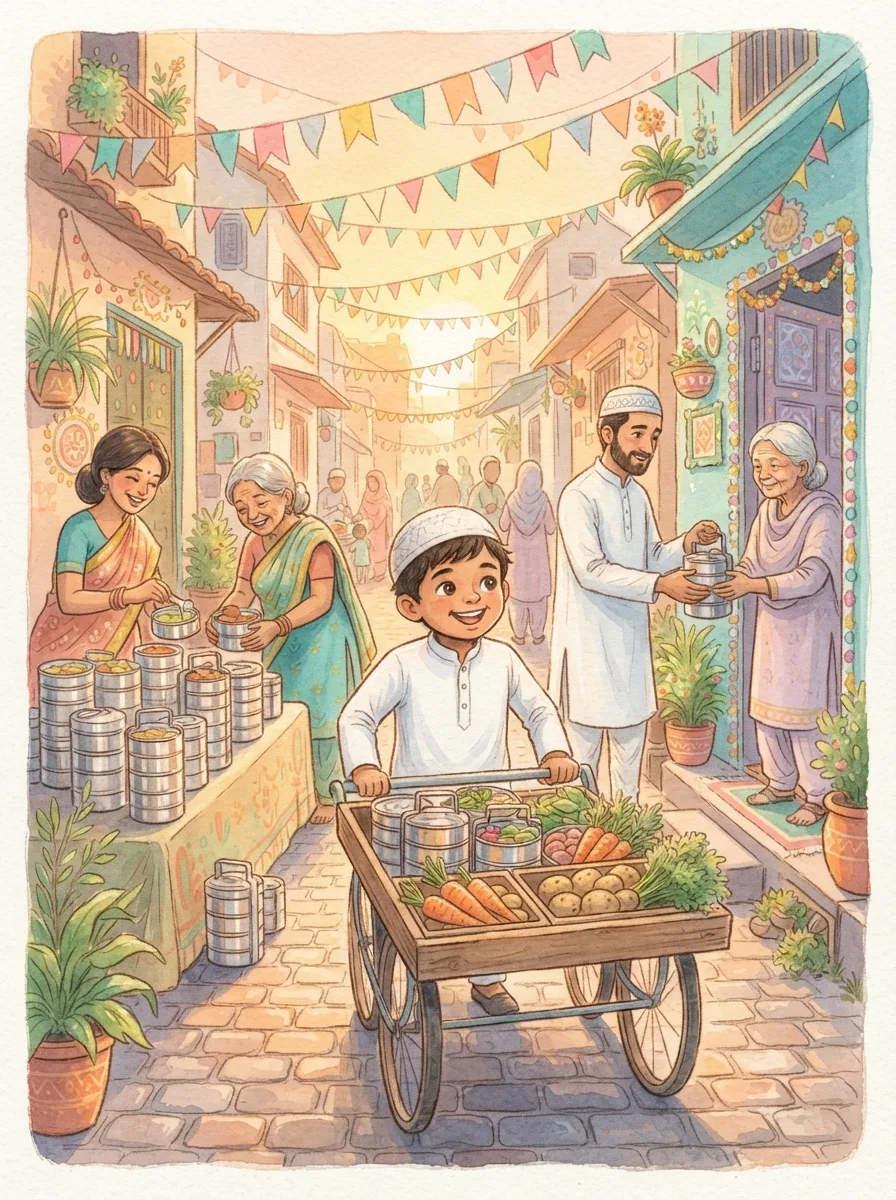
Your child and the Three Parts of Bakrid
On Bakrid, Abbu explains that the festival food is divided into three parts: one for the family, one for relatives and friends, and one for those who have less. Your child is given the job of packing the third part into steel tiffins. The tiffins are heavy and the lane is long. Your child borrows the vegetable cart from the corner and wheels them door to door, until every tiffin is empty and every doorstep has a smile.
Lesson: The share you give away is the one that matters most
Eid ul-Adha
Your child and the Namaz in New Clothes
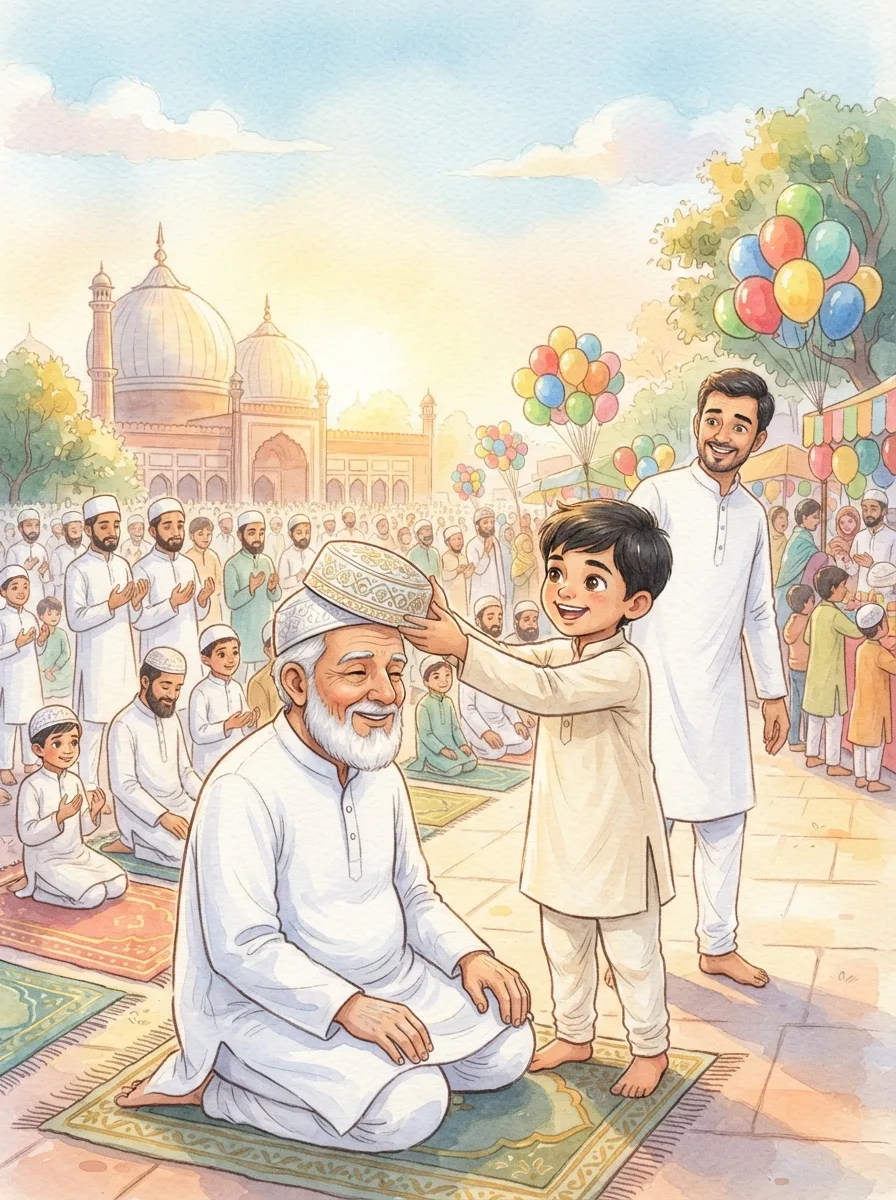
Your child and the Namaz in New Clothes
The Eid namaz at the Eidgah ground begins early, and Your child is proud of the new white kurta and embroidered cap. On the way, Your child sees an old man walking barefoot with a torn cap. Abbu is far ahead. Your child takes off the new cap and places it on the man's head. At the ground, Abbu asks where the cap went. Your child points to the old man standing tall in the front row, and Abbu says nothing, only hugs.
Lesson: New clothes look best when they make someone else stand tall
Eid ul-Adha
Your child and the Goat Named Chotu
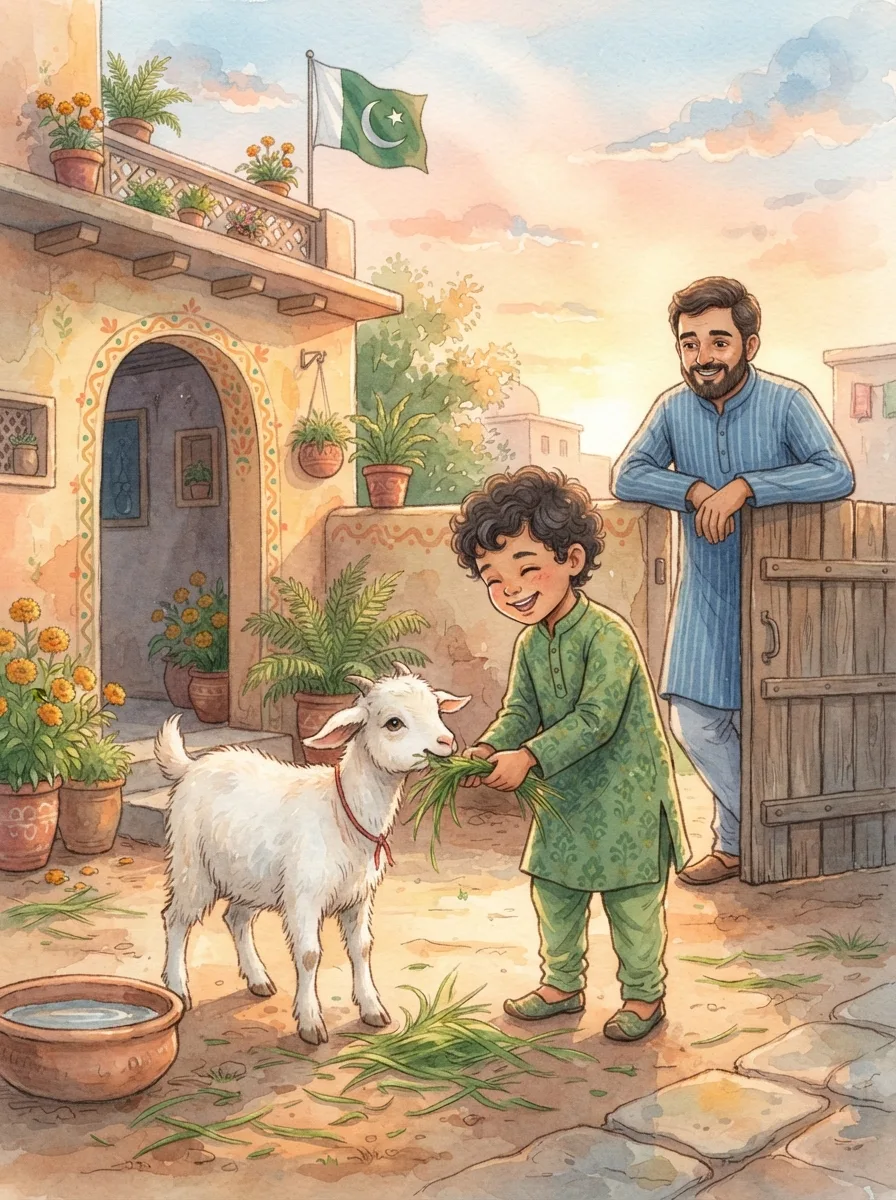
Your child and the Goat Named Chotu
Chacha brings a small white goat home for Bakrid, and Your child names him Chotu and looks after him for a week: fresh grass every morning, water in a clay bowl, a red thread round his neck. Chotu follows Your child to the gate every day. Ammi says caring for an animal gently is part of what the festival teaches. On Eid morning, Your child brushes Chotu one last time and says thank you into his soft ear.
Lesson: Gentleness to a creature in your care is a kind of prayer
Eid ul-Adha
Your child and the Sheer Khurma That Boiled Over
Your child and the Sheer Khurma That Boiled Over
Dadi is making sheer khurma for the Eid guests, with milk, vermicelli, dates and pistachios, and she steps out to greet the neighbours. The milk starts to rise. Your child remembers Dadi's trick, drops a steel spoon into the pot and lowers the flame, and the milk sinks back just in time. Dadi comes back, sees the spoon, and laughs so hard she adds double pistachios to Your child's bowl.
Lesson: Watching closely means you know what to do in the moment
Eid ul-Adha
Your child and the Story of the Father and the Son
Your child and the Story of the Father and the Son
On the night before Bakrid, Nani tells Your child why the festival is kept: long ago, a good man was ready to give up the thing he loved most because he trusted, and instead he was given a ram, and taught that what matters is a willing heart. Your child asks what a willing heart means. Nani says it means giving without being asked. The next morning Your child gives away the favourite toy car to the cousin who has none.
Lesson: A willing heart gives before it is asked
Eid ul-Adha
Your child and the Eidi in the Envelope
Your child and the Eidi in the Envelope
After namaz, every uncle and aunt presses Eidi into Your child's hand, crisp notes in small envelopes, until the pocket bulges. At the sweet shop, Your child sees the shop boy, no older than Your child, being scolded for a broken jar he cannot pay for. Your child quietly slides one envelope across the counter. The scolding stops. On the way home, the pocket is lighter and the heart is much fuller.
Lesson: Eidi is sweetest when it fixes someone's bad day
Eid ul-Adha
Your child and the Biryani for the Hindu Neighbours
Your child and the Biryani for the Hindu Neighbours
Ammi has made a huge deg of biryani, and Your child is sent with a covered plate to the Sharma family upstairs, who have been neighbours for twenty years. Mrs Sharma opens the door and, before Your child can speak, she hands over a box of her own besan laddoos to carry back. On the stairs Your child meets her son coming down with a plate too. They swap on the landing and both families eat two feasts that day.
Lesson: Good neighbours make every festival a festival for two
Eid ul-Adha
Your child and the Visit to Nani in the Village
Your child and the Visit to Nani in the Village
On the second day of Eid, the family takes the bus to Nani's village, and the road is jammed with everyone going to their relatives. Your child is bored and hot. Then the bus stops and a woman with a baby cannot find a seat. Your child jumps up, offers the seat, and stands for the rest of the way holding the rail. At Nani's, Nani hears the story and gives Your child the first bite of her mutton korma.
Lesson: Giving up your seat is a small thing that means a lot
Eid ul-Adha
Your child and the Mehndi That Went Wrong
Your child and the Mehndi That Went Wrong
The night before Eid, Baji is applying mehndi on everyone's hands, and Your child wants a peacock. Halfway through, the cone bursts and the peacock becomes a blob. Your child's eyes fill. Then, looking closely, Your child sees a moon shape in the blob and asks Baji to draw a star beside it. By morning the hand has a crescent and star, and every cousin wants the same design instead of a peacock.
Lesson: A mistake seen kindly can become a new design
Eid ul-Adha
Your child and the Lost Cap at the Mosque
Your child and the Lost Cap at the Mosque
After the Bakrid namaz at the big city mosque, hundreds of people pour out, and a small boy is crying by the shoe rack because he has lost his Abbu in the crowd. The grown-ups rush past. Your child takes the boy's hand, climbs the steps so both can be seen, and calls out his name over and over. A man in a green kurta comes running. He lifts the boy, then lifts Your child too, and buys them both an orange ice lolly.
Lesson: Stop for the one who is lost and the crowd becomes kind
Eid ul-Adha
Your child and the Sewing of the Eid Kurta
Your child and the Sewing of the Eid Kurta
Money is short this Eid, and Ammi is sewing Your child's kurta herself from a plain white cloth on the old machine. Your child wanted the shiny one from the market and sulks. Late at night, Your child wakes and sees Ammi still stitching, embroidering a tiny crescent on the pocket by lamplight. In the morning, Your child wears the kurta with the crescent facing out, and tells everyone at the Eidgah who made it.
Lesson: A stitch made with love is worth more than shine
Eid ul-Adha
Your child and the Share for the Ragpicker
Your child and the Share for the Ragpicker
All morning Your child has watched Abbu pack the third share of Bakrid food for the poor into bags. When they are all given out, a ragpicker boy comes to the gate with his sack, too shy to ask. Nothing is left. Your child runs inside, fills a plate from the family's own share, biryani, sheer khurma, two dates, and carries it out. Abbu watches from the window and says the family share just got its blessing.
Lesson: When the giving share is finished, give from your own
Eid ul-Adha
Your child and the Cousins' Cricket Match
Your child and the Cousins' Cricket Match
On Eid afternoon, all the cousins from three cities gather in Dadi's courtyard for the yearly cricket match, and there are eleven players for two teams. The older cousins want to leave the smallest one out. Your child says, 'I will be the umpire and Zoya bats for both sides.' The match is a riot of laughter, Zoya hits a four into the sheer khurma pot, and Dadi declares it the best Eid match ever played.
Lesson: A good game finds room for everyone
Eid ul-Adha
Your child and the Old Man Who Ate Alone
Your child and the Old Man Who Ate Alone
The Bakrid feast at home is loud and full, and Your child steps onto the balcony and sees old Rahim chacha across the lane eating alone at his window, his family far away in Dubai. Your child fills a plate with biryani, adds a bowl of sheer khurma, and asks Abbu to come along. They knock, and Rahim chacha's eyes shine. He tells stories of Eids fifty years ago until the moon is high, and nobody wants to leave.
Lesson: Nobody should eat alone on a festival day
Eid ul-Adha
Your child and the Last Date of Eid
Your child and the Last Date of Eid
The three days of Eid are over, the relatives have gone, and one date is left in the crystal bowl. Your child and cousin Faiz both reach for it. Instead of arguing, Your child breaks it in half, takes out the seed, and says, 'Half each, and we plant the seed.' They push the seed into a pot on the balcony with a little water. Dadi says that is exactly how a festival should end: shared, and with something growing.
Lesson: End a celebration by sharing and planting something new