Eid at Home
Your child and the Moon on the Terrace
Your child and the Moon on the Terrace
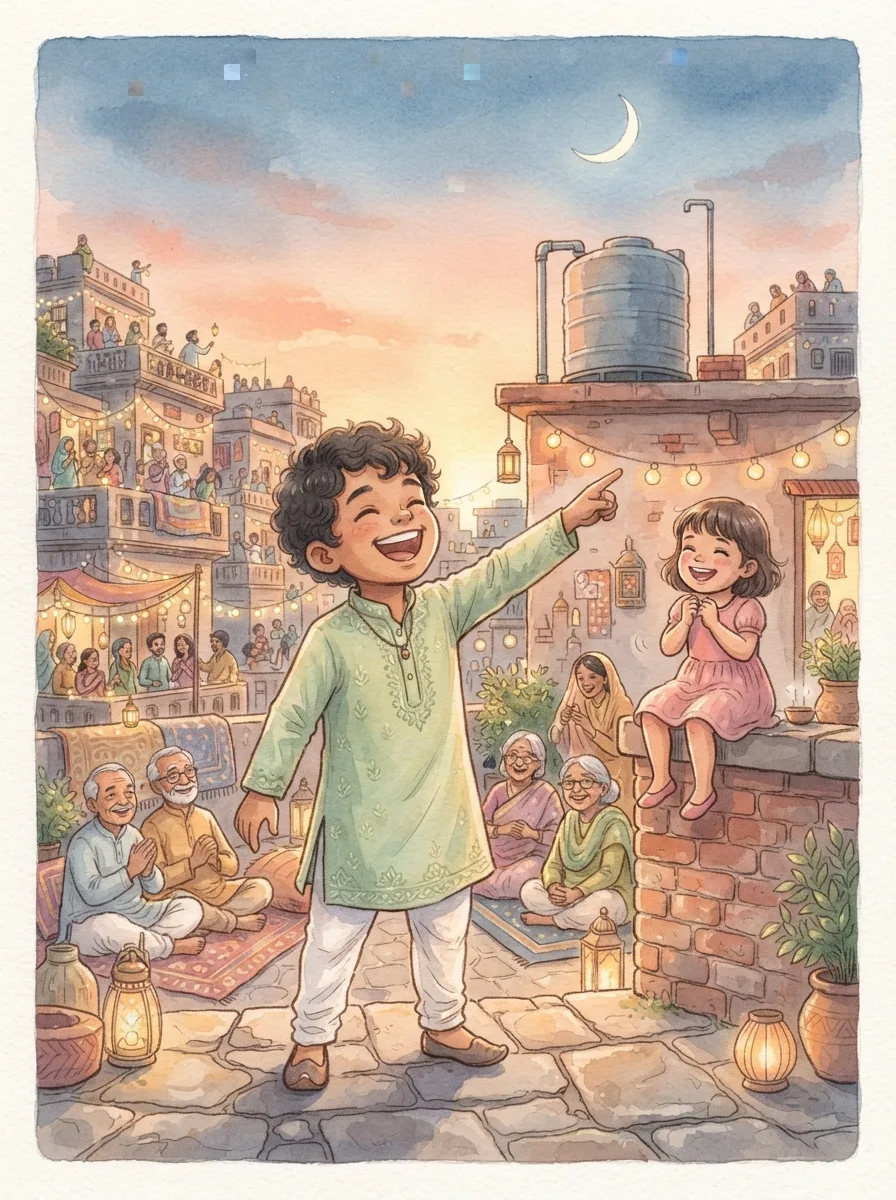
It is chaand raat and the whole mohalla is on its terraces, looking for the thin Eid moon. Your child spots it first, a silver thread above the water tank, but little cousin Zoya cannot see it and starts to cry. Your child lifts her onto the parapet, points along an outstretched arm, and waits. 'There!' Zoya squeals. The terraces cheer, and Eid begins.
Lesson: The best moment is the one you help someone else see
Eid at Home
Your child's New Kurta and the Torn Sleeve
Your child's New Kurta and the Torn Sleeve
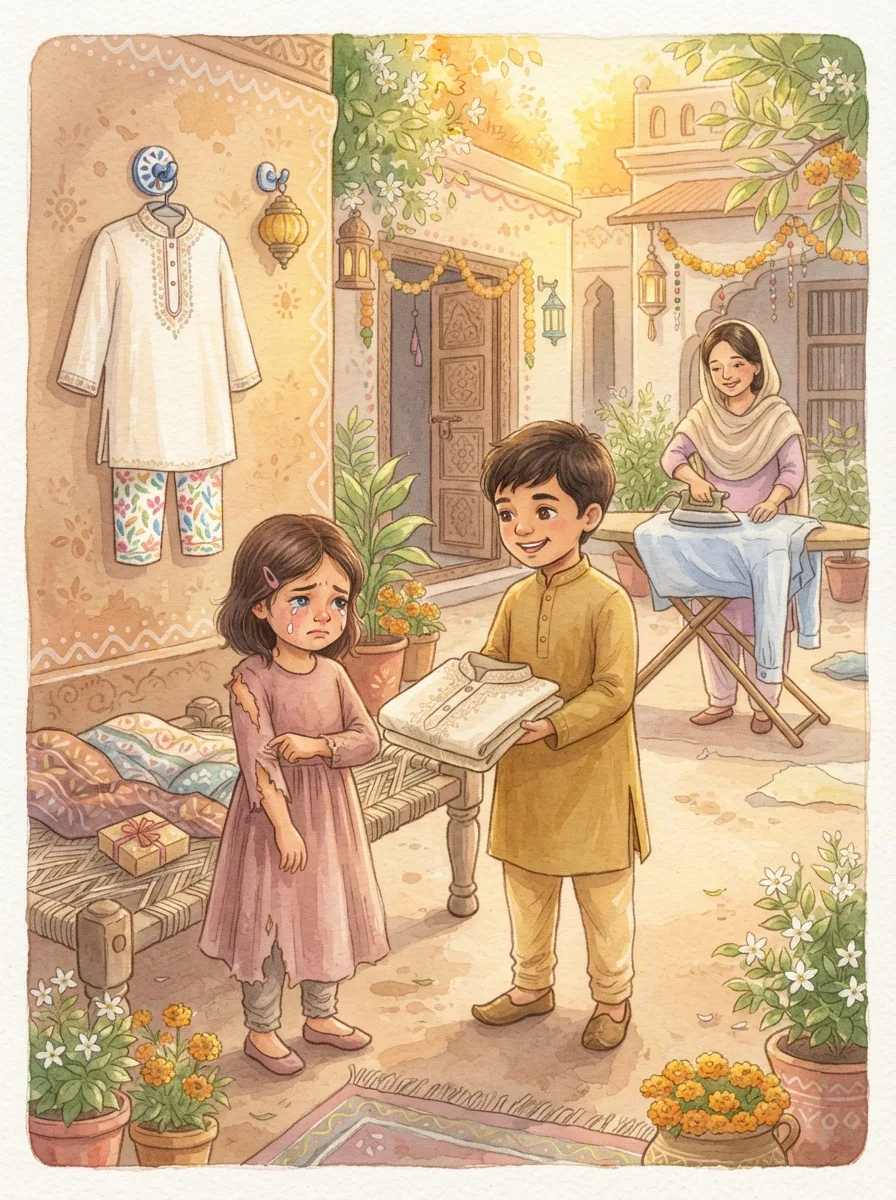
The new Eid kurta has been hanging on the hook for a week. On Eid morning, Your child finds that the sleeve of cousin Imran's kurta has torn, and Imran is close to tears in his old shirt. Your child looks at the crisp new kurta, then hands it over. 'You are the guest.' Ammi finds a fresh shirt for Your child, and both boys go to the courtyard smiling.
Lesson: A new kurta looks best on the one who needs it more
Eid at Home
Your child and the Sewaiyan That Nearly Burnt
Your child and the Sewaiyan That Nearly Burnt
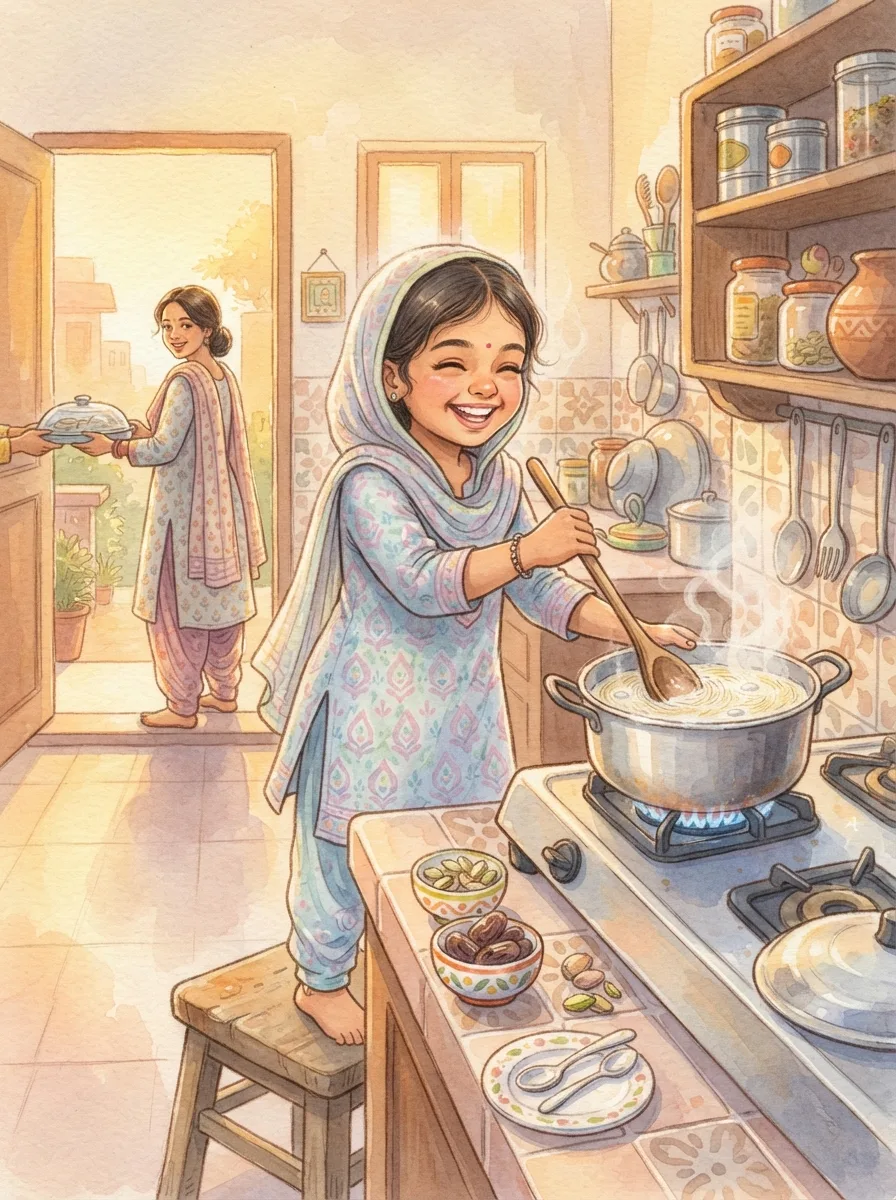
Ammi is making sheer khurma, and the doorbell keeps ringing with neighbours bringing plates. Your child is told to watch the pot. The milk begins to rise. Instead of shouting for Ammi, Your child stands on a stool, lowers the flame the way Ammi showed, and keeps stirring the sewaiyan with the long spoon. The sheer khurma is saved, and Your child gets the first bowl, with extra pistachios.
Lesson: Watch carefully and you can be trusted with important things
Eid at Home
Your child and the Eidi Envelope
Your child and the Eidi Envelope
Dadi calls all the children one by one and presses an Eidi envelope into each hand. Your child counts the notes twice, then sees that the housemaid's daughter, Rukhsar, is standing by the door with nothing. Your child walks over and folds half the Eidi into her hand. Dadi watches, says nothing, and later slips a second envelope under Your child's pillow.
Lesson: Eidi shared is Eidi doubled
Eid at Home
Your child's View of the Eid Namaz
Your child's View of the Eid Namaz
Abbu and Bhaijaan leave for Eid namaz in white kurtas and caps. Your child is too small to go and is sad. Then Nani opens the courtyard door: the men are praying in long rows on the road, all the way to the masjid. Your child spreads a small mat in the courtyard, stands quietly, and follows the rows, bowing when they bow. Abbu turns and smiles from far away.
Lesson: You can join from wherever you are standing
Eid at Home
Your child and the Loudspeaker at Dawn
Your child and the Loudspeaker at Dawn
During Ramzan, the masjid loudspeaker wakes the lane for sehri while it is still dark. Your child is not fasting yet, but gets up anyway and sits with Abbu at the table. Abbu looks tired, so Your child warms the parathas, pours the milk, and sets the dates in a bowl. 'You are my sehri helper,' says Abbu. Every morning after that, Your child is up before the loudspeaker.
Lesson: Helping quietly before dawn is a kind of fasting too
Eid at Home
Your child and the Iftar Plate for the Guard
Your child and the Iftar Plate for the Guard
It is the last iftar of Ramzan and the table is full: pakoras, fruit chaat, rose sharbat and dates. As the siren sounds, Your child remembers Shankar uncle, the building guard, who has been on duty all evening. Your child fills a plate, carries it down the stairs carefully, and sits with him on the gate bench while he eats. Shankar uncle says it is the tastiest chaat in the city.
Lesson: A feast tastes better when the whole building eats
Eid at Home
Your child and the Mehndi Cone
Your child and the Mehndi Cone
On chaand raat, Khala is putting mehndi on every girl's hands, and the line is long. Your child waits and waits, then sees Khala rubbing her tired wrist. Your child picks up a spare cone and practises on a paper plate: a flower, a leaf, a dot. By the time the cone is empty, Your child has done little Sana's palm, wobbly but pretty. Khala says it is the nicest flower of the night.
Lesson: Waiting your turn is easier when you find a way to help
Eid at Home
Your child and the Cousin from Hyderabad
Your child and the Cousin from Hyderabad
Cousin Faiz arrives on Eid morning from Hyderabad, and he speaks Dakhni in a way that makes Your child's friends giggle. Faiz goes quiet. Your child takes him to the terrace, learns the words Faiz uses for kite and pigeon, and then teaches the whole lane. By evening everyone is shouting 'kaiko' and 'hau' and Faiz is laughing loudest. The kites go up together.
Lesson: A new word is a new friend
Eid at Home
Your child and the Zakat Jar
Your child and the Zakat Jar
Every Ramzan, Abbu puts a jar on the shelf and drops coins in for zakat. This year Your child asks what it is for. Abbu explains that a part of what you have belongs to those who have less. Your child goes to the piggy bank, counts out ten rupees for every hundred, and drops them in. On Eid the jar goes to the family of the rickshaw driver whose wheel broke.
Lesson: A little of what is yours already belongs to someone else
Eid at Home
Your child and the Plates for the Neighbours
Your child and the Plates for the Neighbours
Ammi has made twelve plates of biryani and sewaiyan for the building, and Bhaijaan is busy with friends. Your child takes the first plate to Mrs Iyer, who returns it with payasam. The next comes back with modak from the Joshis. By the last plate, Your child has climbed six floors and the tray is heavier than it started, with the whole building's sweets on it.
Lesson: Give a plate away and it comes back fuller
Eid at Home
Your child's Quiet Bakra Eid
Your child's Quiet Bakra Eid
On Bakra Eid, Abbu tells Your child the old story of Ibrahim, who was ready to give up what he loved most, and how Allah asked only for a willing heart. Then Abbu packs the meat into three parcels: one for home, one for relatives, one for the poor. Your child insists on carrying the third parcel to the lane behind the masjid, and comes back without it, and with a very full heart.
Lesson: The gift that leaves your hands is the one that counts
Eid at Home
Your child and the Lost Eid Cap
Your child and the Lost Eid Cap
Dadaji's white crocheted Eid cap, the one he has worn for forty years, is missing on Eid morning. Everyone is rushing. Your child stops and thinks: Dadaji sat on the divan last night, reading. Under the cushion, there it is. Your child brushes it, carries it to Dadaji with both hands, and receives the biggest hug of the day and a new name: the finder.
Lesson: Stop and think and lost things come back
Eid at Home
Your child and the Sheer Khurma for Mrs D'Souza
Your child and the Sheer Khurma for Mrs D'Souza
Mrs D'Souza, the old lady across the landing, has no family visiting this Eid, or any other day. Your child notices her door stays shut while every other door is open. Your child fills a bowl of sheer khurma, knocks, and asks to come in. They eat together, and Mrs D'Souza shows photos of her Eid friends from long ago. Your child promises to come back at Christmas.
Lesson: No one should eat a festival alone
Eid at Home
Your child and the Eid After the First Fast
Your child and the Eid After the First Fast
This Ramzan, Your child kept one roza, a whole day without even a sip of water, with Ammi checking every hour. It was hard, and at four o'clock Your child nearly gave up. Now, on Eid morning, the family gathers, and Abbu announces the first roza to everyone. Your child receives claps, Eidi from every uncle, and the front seat on the way to Nani's house.
Lesson: Keep going through the hard hour and the morning is sweeter
Eid at Home
Eid Moon Surprise
The Eid moon is shy behind a silver cloud, so Your child gathers friends to prepare a surprise welcome. With lanterns, greetings, and shared treats, they learn that celebration is not only waiting for the moon, but making room for everyone under it. The story should grow into a warm celebration with one small problem that could leave someone out. Your child notices the problem, gathers family or friends, and uses kindness, patience, and courage to bring the celebration back together. The ending should feel joyful, inclusive, and full of shared light.
Lesson: Hospitality, patience, and sharing make every celebration feel like home.