Independence Day
Your child and the Flag at Dawn
Your child and the Flag at Dawn
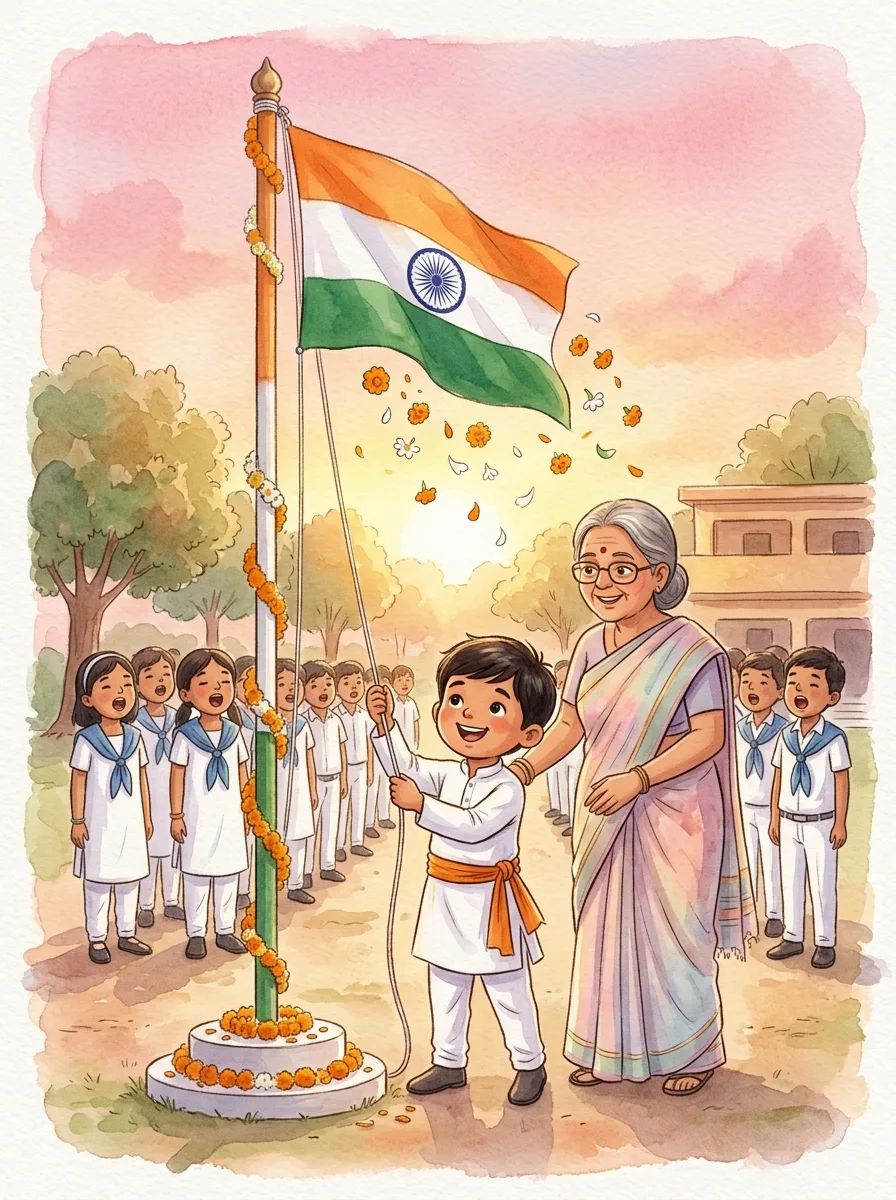
Your child has been chosen to help hoist the flag at the school on 15 August. All night the rope, the knot and the flower petals inside are practised. At dawn the tricolour rises, the petals fall, and a thousand voices sing Jana Gana Mana. Your child's hands are shaking, but the flag flies straight and proud, and that is what everyone remembers.
Lesson: Do your small part well and the whole country stands taller
Independence Day
Your child and the Tricolour Kite
Your child and the Tricolour Kite
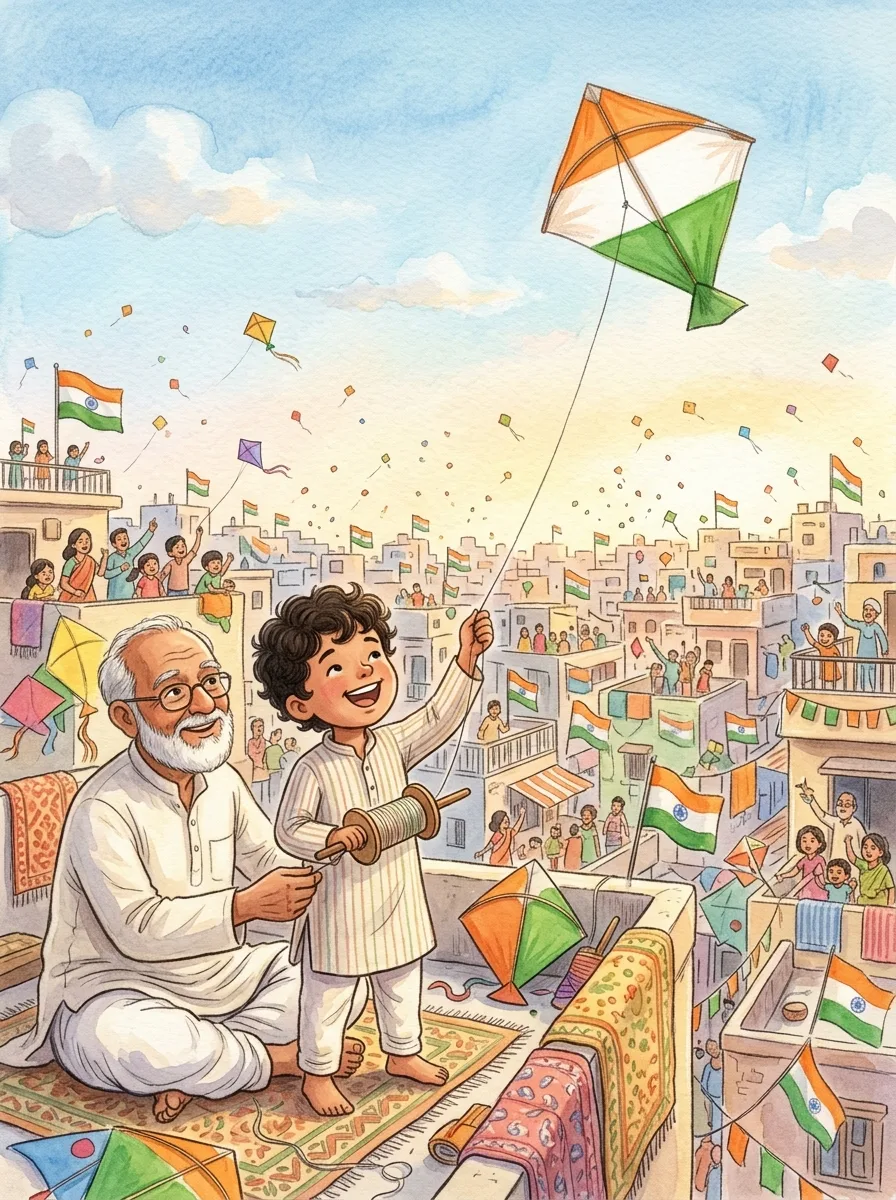
Every rooftop in the mohalla has a kite up on Independence Day, and Your child's kite is the only one made at home, from saffron, white and green paper and Dadaji's old bamboo. It is lopsided and everyone laughs, until a gust takes it higher than all the shop-bought ones. From the highest rooftop, the tricolour kite is the one every eye can see.
Lesson: What you make with your own hands flies the highest
Independence Day
Your child and Nani's Freedom Story
Your child and Nani's Freedom Story
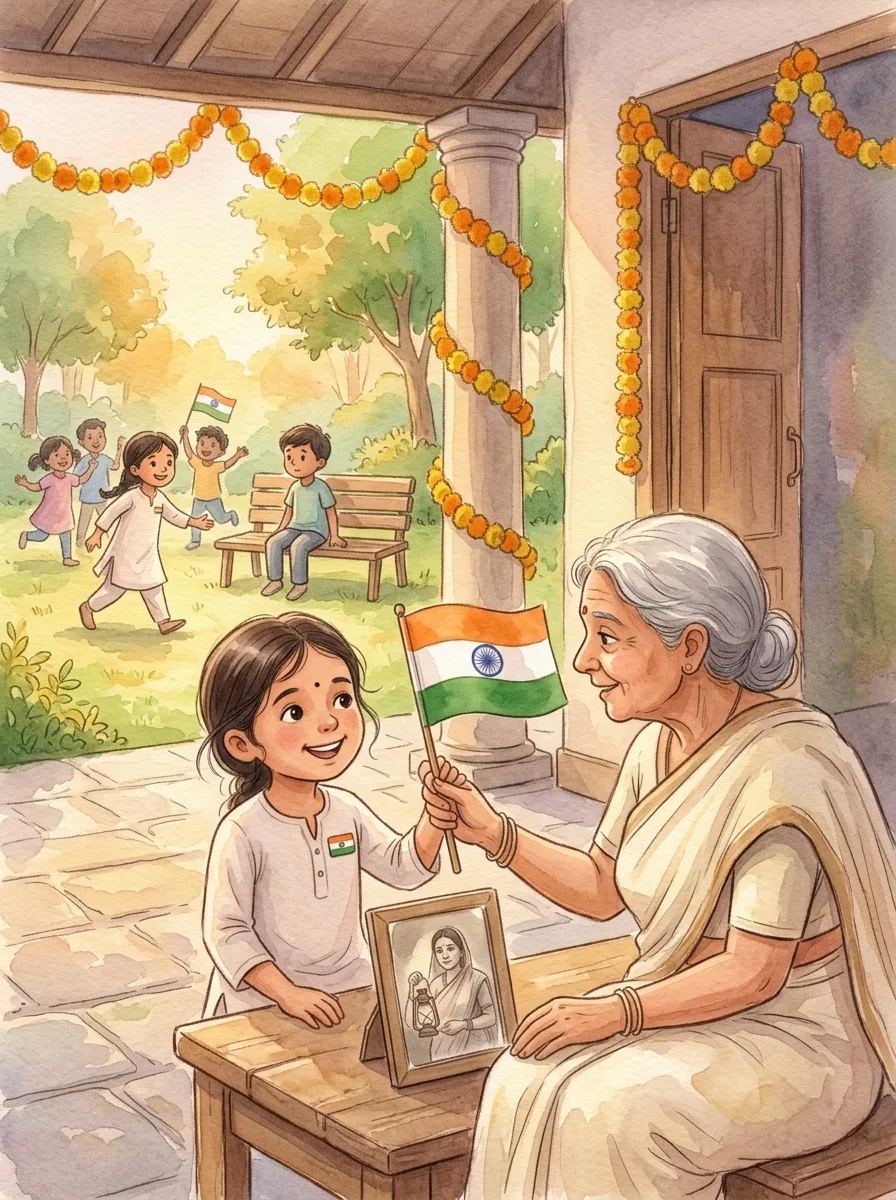
After the flag hoisting, Nani tells Your child about her own Nani, who marched with a lantern in 1942 and was scolded by the whole village. Your child listens, then asks what freedom means today. Nani says: helping the boy nobody plays with, speaking up when something is wrong. Your child takes the little paper flag to the park and does exactly that.
Lesson: Freedom is something you do, not just something you have
Independence Day
Your child and the Flag That Was Upside Down
Your child and the Flag That Was Upside Down
The building's Independence Day flag is ready to be hoisted, and Your child notices the green is at the top. Nobody else has looked. Saying something to the secretary uncle is scary, but Your child walks up and says it quietly. The uncle checks, goes red, and fixes it just before the rope is pulled. Saffron on top, the flag rises, and the uncle thanks Your child in front of everyone.
Lesson: If you see something wrong, say it politely before it is too late
Independence Day
Your child and the March Past
Your child and the March Past
Your child is in the school march past, and the boy in front keeps stepping with the wrong foot, throwing the whole line off. The teacher is cross. Your child does not complain; Your child whispers 'left, right' softly to him for the whole practice week, and on the day the line marches perfectly. The teacher praises the line. The boy says thank you with a tiny salute.
Lesson: Help the one who is out of step and the whole line wins
Independence Day
Your child and the Story of the Salt
Your child and the Story of the Salt
Dadaji tells Your child how Gandhiji walked to the sea to make salt because the rulers said Indians could not. At dinner that night, Your child is told that the small children cannot sit at the big table. Your child does not shout. Your child politely asks why, and when nobody has a good answer, the rule is changed. Dadaji winks and passes the salt.
Lesson: Ask 'why' politely when a rule makes no sense
Independence Day
Your child and the Tricolour Rangoli
Your child and the Tricolour Rangoli
The colony's Independence Day rangoli competition needs saffron, white and green powder, and the shop has run out. Your child refuses to give up: turmeric and red chilli for saffron, rice flour for white, crushed neem leaves for green. The rangoli smells like a kitchen and looks like a flag. The judges give it the prize for creativity, and every neighbour asks for the recipe.
Lesson: When the shop runs out, the kitchen is full of colours
Independence Day
Your child and the Freedom Fighter Next Door
Your child and the Freedom Fighter Next Door
The old man in the ground-floor flat, whom nobody visits, once carried messages for freedom fighters as a boy, Nani says. On Independence Day, Your child knocks on his door with a small paper flag and asks him to tell the story. He tells it for an hour, with his eyes shining. Your child invites him to the school assembly the next day, and the whole school stands up when he walks in.
Lesson: The people with the best stories are often the ones nobody asks
Independence Day
Your child and the Flag That Touched the Ground
Your child and the Flag That Touched the Ground
After the school parade, paper flags are scattered on the ground and children are stepping on them. Your child remembers Papa saying the flag must never touch the ground. Instead of scolding, Your child starts picking them up, one by one, and a friend joins, then another. By the time the bell rings, there are two hundred flags in a box, and the principal asks to keep them for next year.
Lesson: Respect is shown by what you pick up, not what you say
Independence Day
Your child and the National Anthem in the Lane
Your child and the National Anthem in the Lane
The colony's Independence Day gathering has a speaker that will not work, and the anthem cannot be played. People start to drift away. Your child climbs onto the low wall and starts singing the anthem alone, wobbly at first. By the second line, ten people join. By the last, the whole lane is singing, and the flag goes up to two hundred voices instead of one speaker.
Lesson: A brave first voice brings all the others
Independence Day
Your child and the Kite That Crossed the Road
Your child and the Kite That Crossed the Road
On Independence Day the rooftops are full of tricolour kites, and Your child's drifts across the road and lands on the roof of the house that nobody talks to, because of an old family quarrel. Your child goes to the door, asks politely, and the girl who answers climbs up to fetch it. She has a kite too. They fly both from the same roof, and by evening both families are on the terrace.
Lesson: A kite can cross a road that grown-ups will not
Independence Day
Your child and the Jalebi After the Flag
Your child and the Jalebi After the Flag
After the flag hoisting, jalebis are handed out and the queue is long. The old sweeper who cleaned the ground at dawn is standing at the very back. Your child gets a plate, walks past the whole queue, and gives it to him first. Some children mutter. Your child says he was here before anyone, and goes to the back of the queue. The second plate tastes just as good.
Lesson: The one who did the work should eat first
Independence Day
Your child and the Fifteen-August Diary
Your child and the Fifteen-August Diary
Nani says that on the first Independence Day, her father wrote a page in his diary about what freedom meant to him. The diary is lost. On this Independence Day, Your child starts a new one: what freedom means at eight years old. Playing outside, choosing books, asking questions. Nani reads it and says her father would have liked it. Your child promises to write a page every year.
Lesson: Write down what freedom means to you, and keep writing
Independence Day
Your child and the Flag for the Tea Stall
Your child and the Flag for the Tea Stall
Every building in the lane has a flag on Independence Day, except the little tea stall on the corner, where the chai uncle works from five in the morning. Your child makes a flag from paper and a stick and brings it to the stall. The chai uncle ties it to his kettle handle and says it is the first flag his stall has ever flown. Every customer that day salutes the kettle.
Lesson: Nobody should be left out of the flag
Independence Day
Your child and the Map of India on the Wall
Your child and the Map of India on the Wall
For Independence Day, Your child's class paints a huge map of India on the school wall, and everyone wants to paint their own state. Nobody wants the small ones in the north-east. Your child takes them, learns their names, their rivers and their festivals, and paints them with extra care. When the map is unveiled, the north-east corner is the brightest, and the new girl from Manipur cries a little.
Lesson: Every corner of the map deserves the same care