Bihu
Your child and the Cows in the River on Goru Bihu
Your child and the Cows in the River on Goru Bihu
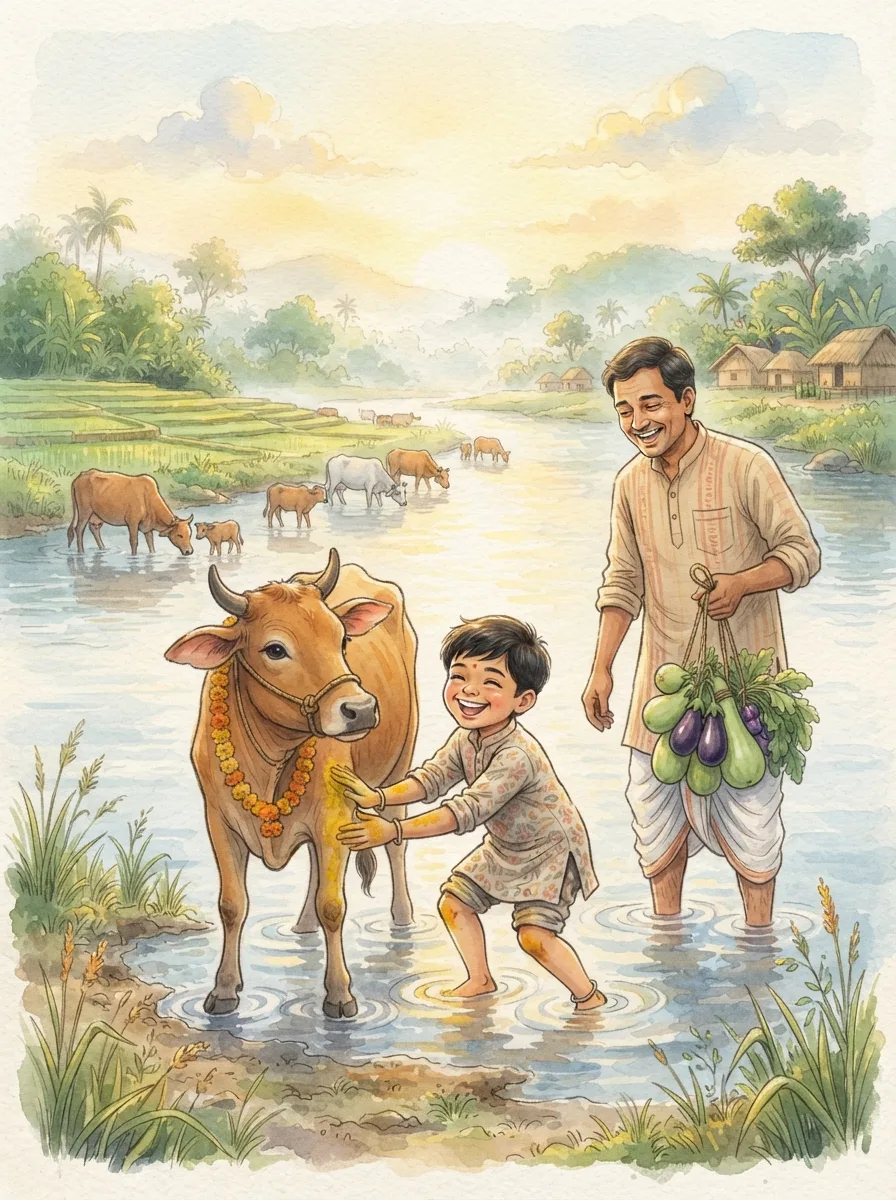
On Goru Bihu, the first day of the festival, the village cattle are led to the river and washed with turmeric and black gram paste. Your child's job is the old brown cow, Lakhimi, who refuses to step into the water. Pushing does nothing. Your child wades in first, splashes gently, and hums the Bihu tune Deuta sings. Lakhimi follows, step by step, and stands calm while Your child rubs turmeric on her back.
Lesson: Lead the way and the frightened will follow
Bihu
Your child and the Pepa That Would Not Sound
Your child and the Pepa That Would Not Sound
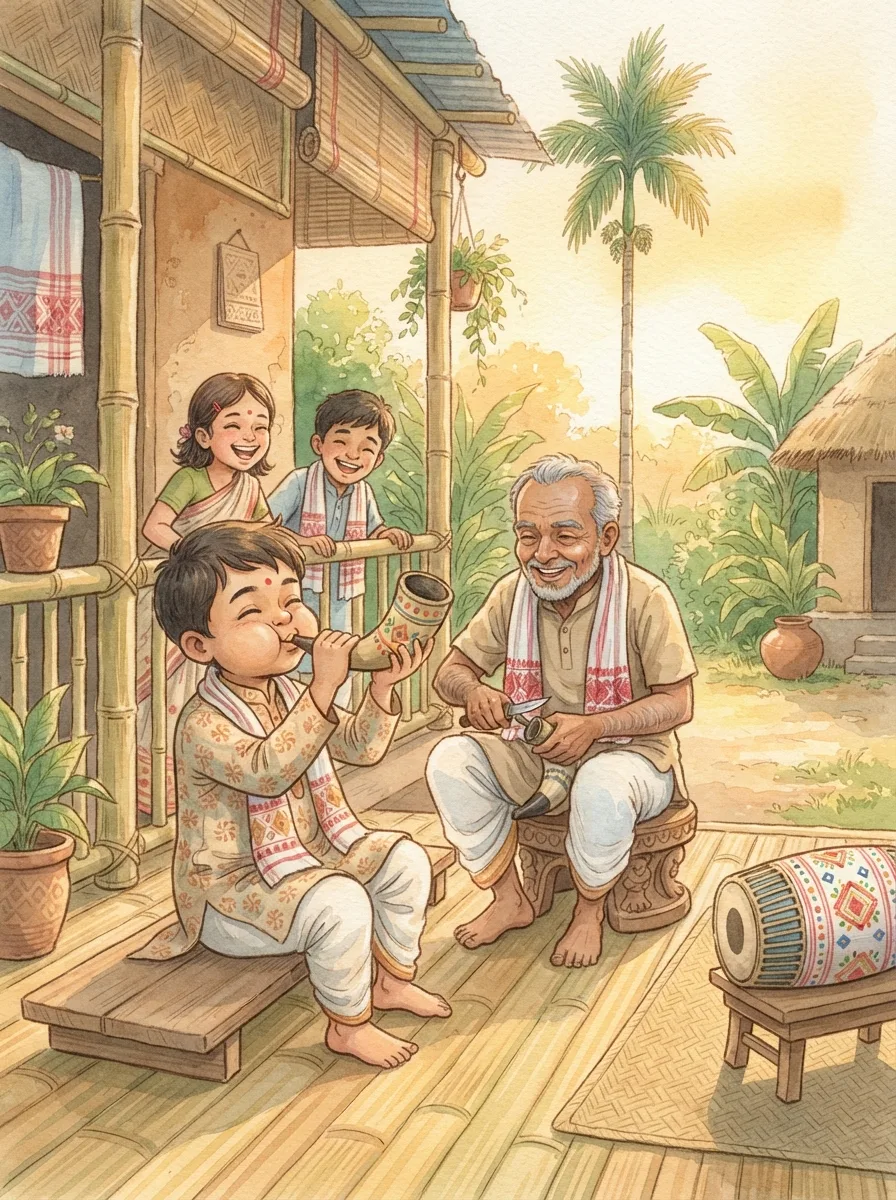
Koka has made Your child a pepa from a buffalo horn and a bamboo reed for the Bihu dance, but no matter how hard Your child blows, it only squeaks. The cousins laugh. Koka says, 'Not harder, softer.' Your child tries again, lips loose, breath long and slow, and a deep golden note rolls out across the courtyard. That evening Your child plays the first pepa call of the Bihu dance.
Lesson: Some things answer to gentleness, not force
Bihu
Your child and the Story of Bohag
Your child and the Story of Bohag
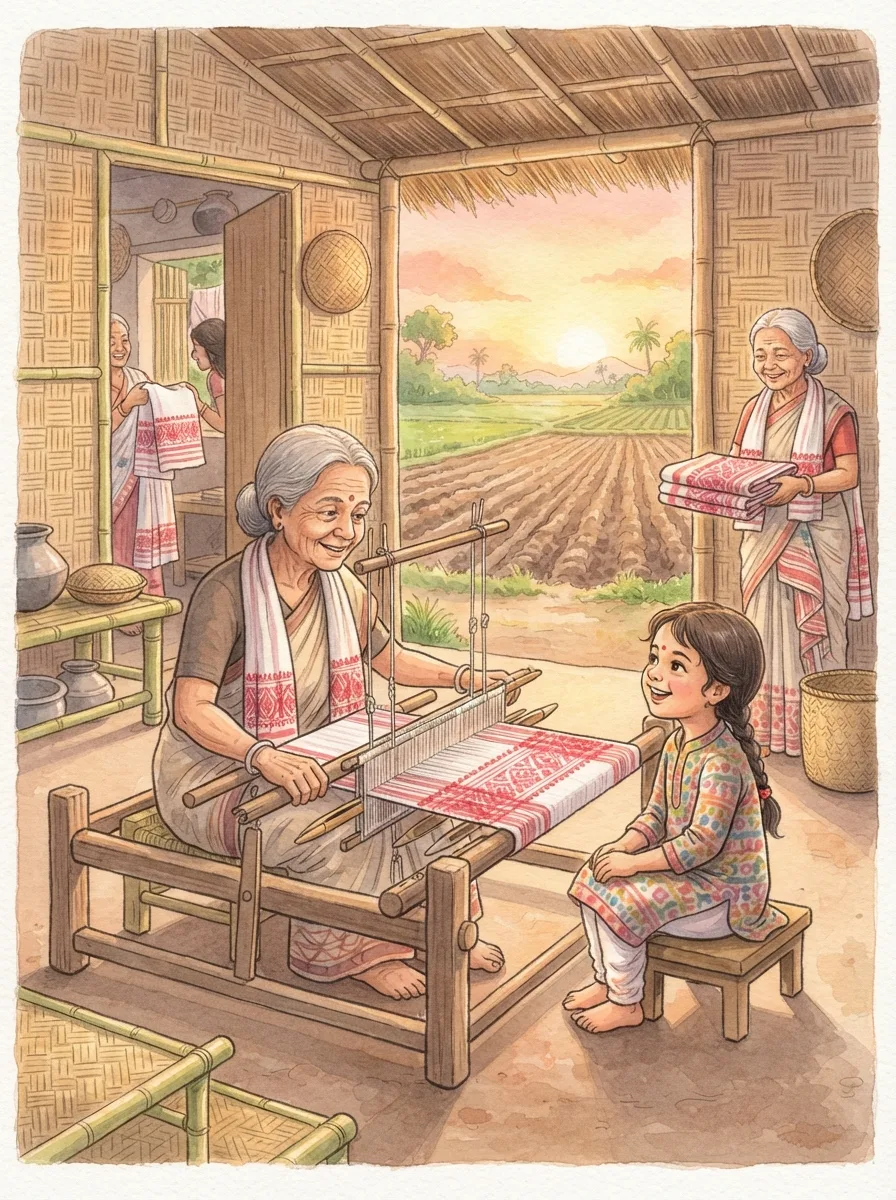
Aita sits Your child down beside the loom and explains that Bohag Bihu is the Assamese new year, when the fields are ploughed, the first seeds go in, and everyone thanks the cattle and the elders before the rains come. That is why the young touch the feet of elders and give a gamosa. Your child listens, then runs to the back room and gives the first gamosa, a little crooked, to the old cook who has fed the family for years.
Lesson: Thank the people who help you grow
Bihu
Your child and the Pitha on the Clay Stove
Your child and the Pitha on the Clay Stove
Ma is making til pitha for Bihu, spreading rice batter on the hot pan, filling it with sesame and jaggery, and rolling it in one quick move. Your child's pithas tear every time. Ma is called away to the guests. Instead of giving up, Your child makes the batter a little thicker, waits until the edge lifts, and rolls gently. The next pitha is perfect. By the time Ma returns, a plate of twenty is ready.
Lesson: Watch closely, adjust a little, and try again
Bihu
Your child and the Bihu Dance in the Field
Your child and the Bihu Dance in the Field
The village Bihu dance is in the paddy field under the bright moon, and the dhol beats fast. Your child has practised the steps but freezes when the circle opens. Then the dhol player, Bhaiti, misses a beat, and the dancers stumble. Your child stamps the beat loudly on the hard ground, one two, one two, and the dancers find it again. Soon Your child is in the middle of the circle, clapping the whole line back into rhythm.
Lesson: Find the beat for others and you find your own courage
Bihu
Your child and the Gamosa for the Bus Driver
Your child and the Gamosa for the Bus Driver
The family is taking the crowded bus from Guwahati to the village for Bihu, and Deuta has given Your child a stack of gamosas to give the elders. The driver has been driving since dawn with no one to wish him. At the last stop, Your child climbs to the front, places a gamosa round his neck and says, 'Happy Bihu.' The driver's tired face breaks into a grin and he honks the horn in a Bihu rhythm all the way to the gate.
Lesson: Wish the ones who carry you there
Bihu
Your child and the Laru Shared with the Tea Pickers
Your child and the Laru Shared with the Tea Pickers
Aita has made a big tin of coconut laru for Bihu, and Your child is walking through the tea garden to Mama's house with it. The tea pickers are working even on Bihu, baskets on their backs. Your child stops, opens the tin, and offers a laru to every one of them. The tin is half empty when it reaches Mama's, but Mama says a half tin that was shared is worth two full ones.
Lesson: A sweet halved is a joy doubled
Bihu
Your child and the New Year Clothes
Your child and the New Year Clothes
Everyone gets new clothes for Bohag Bihu, but this year the family has less money and Your child gets last year's dhoti, mended. At school the next day, the other children show off. Your child feels small, until Aita ties her own hand-woven gamosa round Your child's neck, one she wove on the loom over many evenings. In the school Bihu dance, the teacher says it is the most beautiful gamosa she has seen.
Lesson: What is made for you by hand cannot be bought
Bihu
Your child and the Lost Calf on Goru Bihu
Your child and the Lost Calf on Goru Bihu
After the cattle bath on Goru Bihu, a small calf is missing from the herd walking home. The uncles say it will find its way. Your child cannot rest, walks back along the riverbank, and hears a soft cry in the tall grass. The calf has its leg caught in a bamboo fence. Your child frees it carefully, wraps a gamosa round the scratched leg, and walks it home just as the lamps are being lit.
Lesson: Never leave the smallest one behind
Bihu
Your child and the City Bihu on the Rooftop
Your child and the City Bihu on the Rooftop
Far from the village, the family lives in a Guwahati flat and there is no field for the Bihu dance. Ma looks sad. Your child goes door to door in the building, finds two dhol players, one pepa and a dozen dancers from different floors. On the rooftop, with the Brahmaputra shining in the distance, they dance the Bihu under the city stars. Ma dances too, for the first time in years.
Lesson: Where there are people, there is a place to celebrate
Bihu
Your child and the Elders' Blessing
Your child and the Elders' Blessing
On the second day of Bihu, Manuh Bihu, everyone bathes early and gives gamosas to elders in return for a blessing. Your child visits every house in the village lane. At the last house, old Deka Koka lives alone and nobody has come to him. Your child gives him the last gamosa, touches his feet, and stays for tea and pitha. Deka Koka says the new year has finally begun for him.
Lesson: A blessing is a gift you give by asking for one
Bihu
Your child and the Dhol with the Wet Skin
Your child and the Dhol with the Wet Skin
A spring shower soaks the big Bihu dhol just before the evening dance, and the wet skin gives only a dull thud. The dhol player groans that the dance is finished. Your child remembers Koka drying fish over the fire, carries the dhol to the kitchen and holds it by the warm clay stove, turning it slowly. Ten minutes later the skin is tight and the dhol booms across the field. The dance begins only a little late.
Lesson: A useful memory can save the whole evening
Bihu
Your child and the Cuckoo of Bohag
Your child and the Cuckoo of Bohag
Aita says Bihu truly begins when the kuli, the cuckoo, sings in the mango tree, and every morning Your child runs out to listen. Nothing. The cousins say the cuckoo has left the village. Your child refuses to give up, sits quietly under the mango tree at dawn with a bowl of water for the birds, and waits. On the third morning, the kuli sings. Your child races in shouting that Bihu has begun.
Lesson: Patience hears what hurry misses
Bihu
Your child and the Hushori at the Doorstep
Your child and the Hushori at the Doorstep
On Bihu evenings, groups of singers called hushori go from house to house singing blessings at each doorstep. The group arrives at Your child's house, but the family has run out of laru and pitha to give them. Your child runs to the kitchen, fills a bowl with sweet curd and jaggery, and offers it with a gamosa. The singers say it is the finest gift of the night and sing an extra song for Your child.
Lesson: What you give matters less than the heart it comes with
Bihu
Your child and the First Seed of the New Year
Your child and the First Seed of the New Year
On the last day of Bihu, Deuta takes Your child to the newly ploughed field to plant the first seeds of the year. The soil is dark and wet, and Your child pushes each seed in with a thumb and covers it carefully. Deuta says every Bihu the family plants one seed for a wish. Your child plants one extra, for the whole village to have enough rice, and waters it from a small clay pot before walking home.
Lesson: A new year begins with a seed and a wish for others