Telling Time
Your child and the Clock Tower
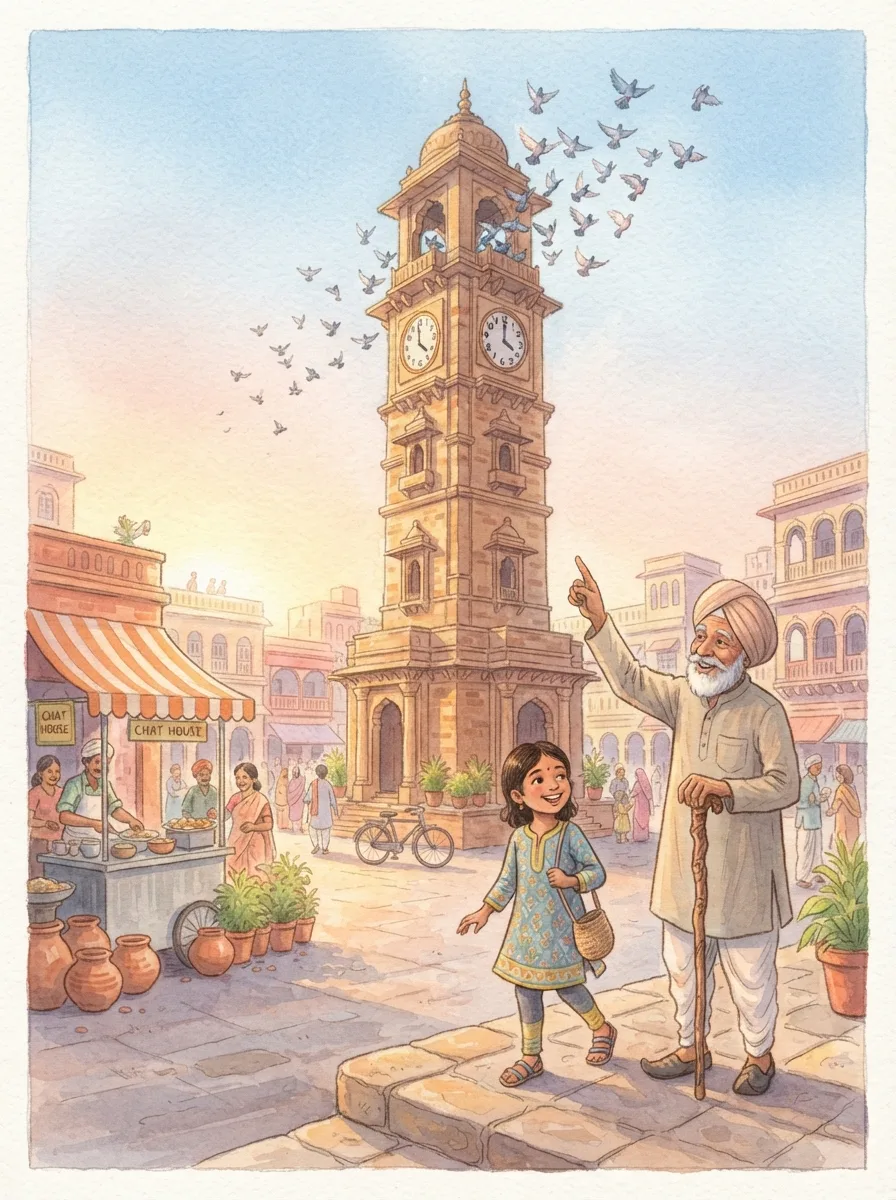
Your child and the Clock Tower
The old clock tower in the town square has four faces, and Dadaji says they all tell the same time. Your child walks around it to check. The short hand points to three on every face, the long hand straight up. 'Three o'clock,' says Dadaji, 'when the long hand is on twelve.' They wait, and when the long hand reaches six, the bell strikes for half past three and pigeons burst from the tower.
Lesson: The short hand tells the hour, the long hand tells the rest
Telling Time
Your child and the School Bell
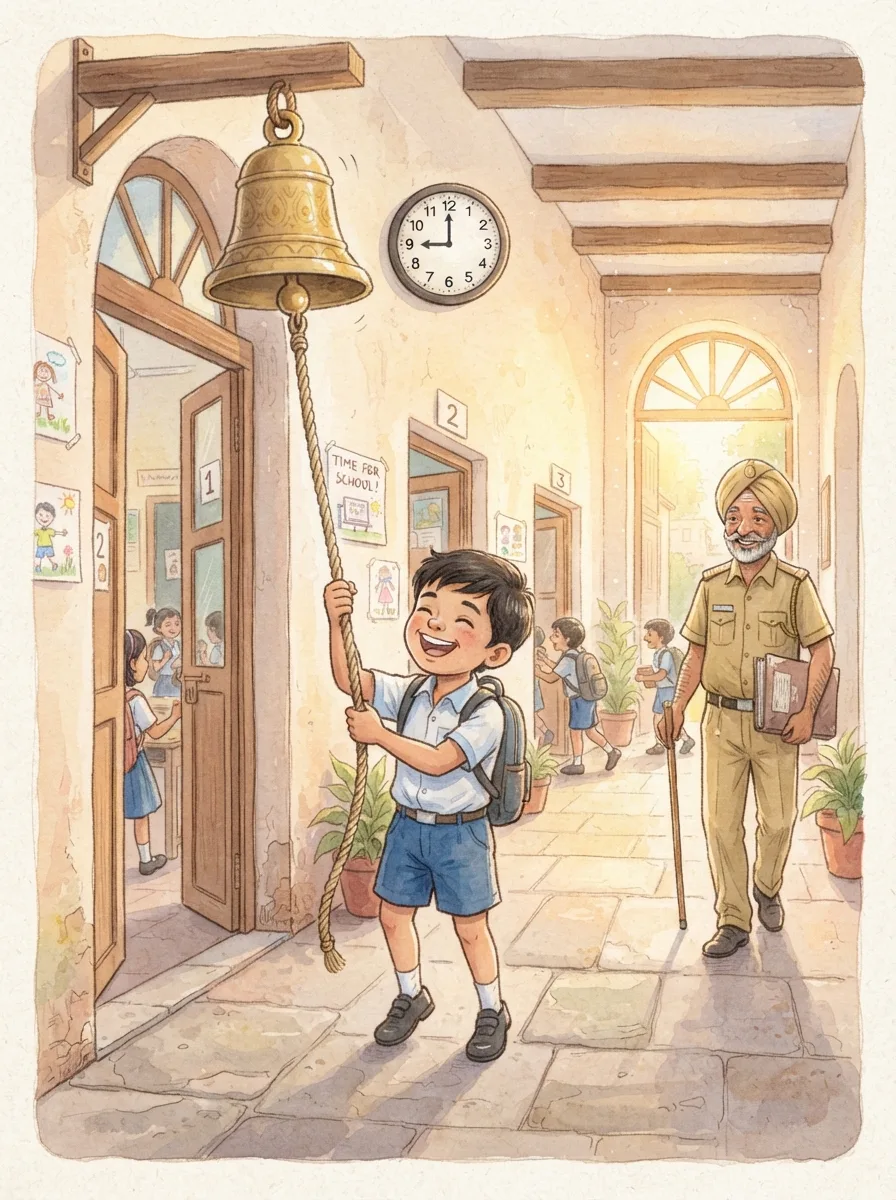
Your child and the School Bell
The peon rings the school bell by hand, and today he asks Your child to watch the clock for him while he fetches the register. The bell must ring at exactly nine. Your child watches the long hand climb past the ten, the eleven. It reaches the twelve, and Your child pulls the rope with both hands. Every class stands up at once. The peon says nobody has ever rung it so exactly on time.
Lesson: Watch the long hand and you will know the very moment
Telling Time
Your child and the Train Timetable
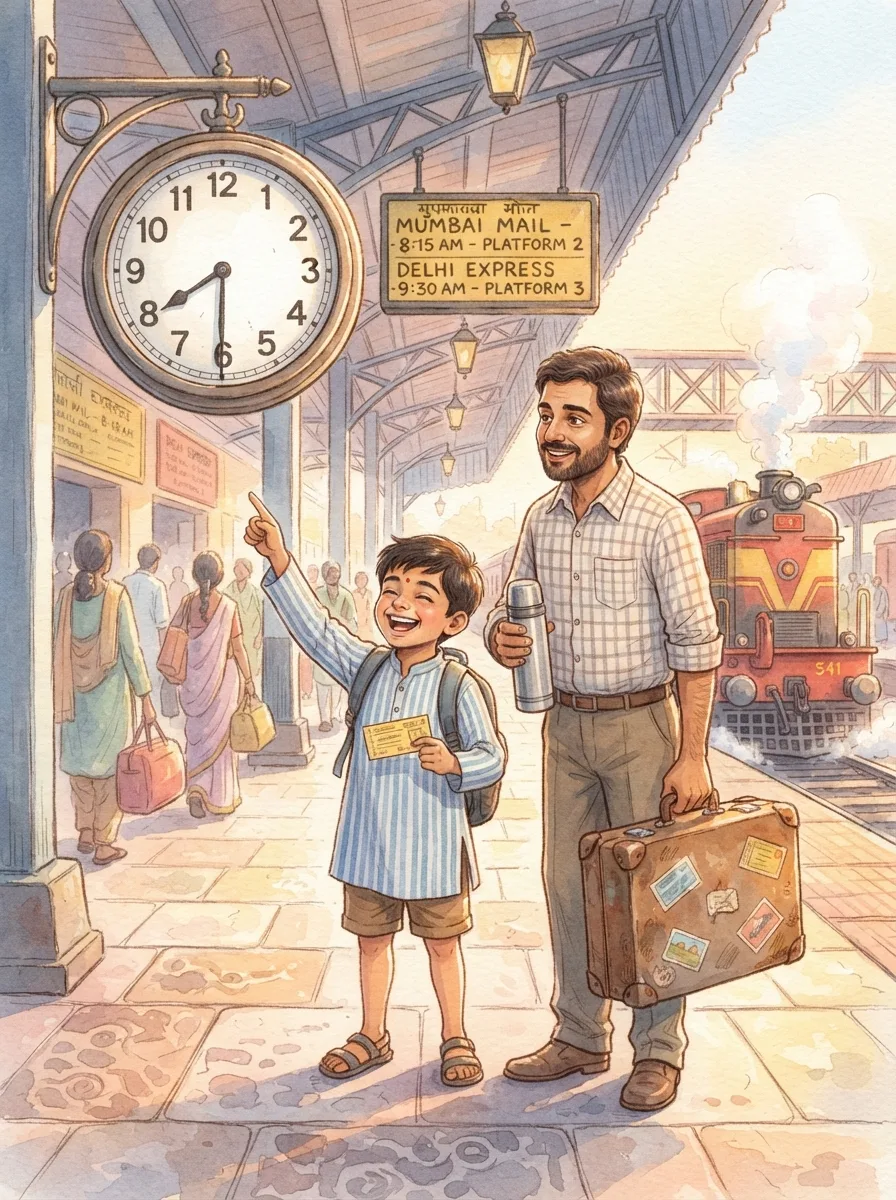
Your child and the Train Timetable
The train to Nani's town leaves at ten past seven, and Papa lets Your child be in charge of the time. On the platform clock the short hand is near seven and the long hand is on the two. 'That is ten past,' says Papa, 'two fives.' The board says the train is five minutes late. Your child works out that means the long hand will be on the three. It is, and the whistle blows just as Your child says so.
Lesson: Every number on the clock is worth five minutes
Telling Time
Your child and Five More Minutes
Your child and Five More Minutes
In the colony park Amma says it is time to go, and Your child asks for five more minutes. Amma points to her watch. 'The long hand is on the four. When it reaches the five, we go.' Your child swings, checks, swings, checks. The hand crawls. Then it lands on the five, and Your child jumps off without being asked. Amma says a child who keeps time gets five minutes again tomorrow.
Lesson: Five minutes is real when you watch it on the clock
Telling Time
Your child and the Sundial in the Garden
Your child and the Sundial in the Garden
Nana pushes a stick into the ground in the middle of the garden and says it is a clock. Your child does not believe him until they mark where the shadow falls at nine with a pebble, then at ten, then at eleven. The shadow moves like a slow hand. At noon it is the shortest of all. The next day Your child tells Nani it is exactly ten by the stick, and the kitchen clock agrees.
Lesson: The sun was telling time long before clocks did
Telling Time
Your child and the Morning to Night Chart
Your child and the Morning to Night Chart
Your child keeps being late for everything, so Papa and Your child make a chart. Seven o'clock, wake up, a drawing of the sun. Eight, school bus. One, lunch. Four, play. Eight at night, story. Your child draws a small clock next to each one with the hands in the right place. The chart goes on the fridge, and for a whole week Your child is early, even for bedtime, which surprises everyone.
Lesson: A day has a shape, and the clock shows you where you are in it
Telling Time
Your child and the Cuckoo Clock at Mausi's House
Your child and the Cuckoo Clock at Mausi's House
Mausi's wooden clock has a tiny bird that comes out and calls the hour. Your child waits with a notebook to catch it. At four it comes out four times. Your child writes that down. Then it is quiet for so long that Your child almost gives up, until Mausi says, 'Look at the long hand, it has only gone halfway.' At five the bird calls five times, and Your child has counted every one.
Lesson: An hour is a long time, and it is the same length every time
Telling Time
Your child and the Doctor's Appointment
Your child and the Doctor's Appointment
Dadi has a doctor's appointment at half past eleven, and she keeps asking if it is time to go. Your child takes charge. On the wall clock the short hand is between ten and eleven, the long hand on the twelve. 'Half past ten,' says Your child, 'we need one hour.' At eleven Your child fetches her chappals. At quarter past they leave. They arrive at half past exactly, and Dadi tells the doctor who got her there on time.
Lesson: Work out how long is left, then use it well
Telling Time
Your child and the Mandir Bell at Dawn
Your child and the Mandir Bell at Dawn
In the village, the mandir bell rings every morning before the sun is up, and Your child wants to know the time by it. Nani says the pujari rings it at five. Your child sets the small alarm clock beside the bed, hears the bell, checks: five. The next day, the bell and the clock again. On the third day Your child wakes just before the bell without any clock at all, and Nani calls it a village clock inside.
Lesson: Keep the same time every day and your body learns it too
Telling Time
Your child and the Cake in the Oven
Your child and the Cake in the Oven
Amma's cake needs forty minutes in the oven, and Your child is the timekeeper. The cake goes in at ten past four. Your child counts on from the two: three is fifteen, four is twenty, all the way to ten past plus forty. 'It comes out at ten to five.' Amma checks with her fingers and nods. Your child watches the long hand climb, and at ten to five the kitchen smells exactly right.
Lesson: Add minutes on the clock face and you will know when it is ready
Telling Time
Your child and the Bus That Comes at Quarter Past
Your child and the Bus That Comes at Quarter Past
The school bus comes at quarter past seven, and Your child has missed it twice. Bhaiya draws a clock on the slate and shades the top right piece. 'This is a quarter, like a quarter of a roti. Quarter past means the long hand is on the three.' The next morning Your child watches the hand reach the three, grabs the bag, and is at the gate as the bus turns the corner. The driver waves.
Lesson: A quarter of the clock is a quarter of the hour
Telling Time
Your child and the Shadow Race on the Terrace
Your child and the Shadow Race on the Terrace
On the terrace, Papa and Your child trace their shadows with chalk at nine in the morning. Long and thin. At noon they trace them again, and the shadows are short and stubby. At four they are long again, but on the other side. Your child writes the time next to each one. The next morning, Your child stands in the nine o'clock shadow and it fits, and knows the time without a clock.
Lesson: Morning, noon and evening each have a shadow of their own
Telling Time
Your child and the Kite Flying Hour
Your child and the Kite Flying Hour
Chacha says the wind on the terrace is best for one hour in the evening, from five to six. Your child takes the kite up at five sharp and watches the clock through the stair door. The kite climbs high. At half past five the wind is strongest. Your child checks the clock again, quarter to six, and starts winding in. At six the wind drops, just as Chacha said, and the kite lands safely in Your child's hands.
Lesson: Know how long you have and make every minute count
Telling Time
Your child and the Wristwatch From Nana
Your child and the Wristwatch From Nana
Nana gives Your child his old wristwatch with a leather strap that goes round twice. 'Now you are in charge of your own time,' he says. All day Your child reports it: eight o'clock, breakfast. Half past nine, brushing the dog. Twenty past twelve, lunch, which Your child reads slowly, counting the fives. At night Your child falls asleep with the watch on, ticking softly, and Nana says that is exactly how he used to sleep.
Lesson: A watch on your wrist is a promise to keep time
Telling Time
Your child and the New Year Countdown
Your child and the New Year Countdown
The whole family is on the terrace waiting for midnight, and Your child is allowed to stay up. Papa says midnight is when both hands point straight up at the twelve. Your child watches the long hand pass the nine, the ten, the eleven. Everyone starts counting down from ten. At twelve the hands meet, the colony cheers, and Your child shouts, 'It is twelve o'clock!' louder than anyone.
Lesson: When both hands point to twelve, a new day begins
Telling Time
Bedtime Routine
Every evening the gentle Sleepy Star Sprites flutter down to visit Your child, but their dream dust only sparkles once teeth are brushed and cozy pajamas are on. Racing playfully against the slowly setting moon, Your child completes each calming step one by one, discovering that a peaceful bedtime routine quietly unlocks the doorway to the softest, most wonderful dreamland adventures.
Lesson: Sleep helps bodies grow strong and minds stay sharp, bedtime routines make nights easier, peaceful thoughts lead to wonderful dreams, and nighttime is nothing to fear—it's magical.
Telling Time
Time Machine Adventure
While tinkering in the attic, Your child accidentally winds up Grandpa's dusty old clock, which whirs to life as a marvelous time machine! Zipping off to greet gentle dinosaurs, curious inventors, and a shimmering peek at the future, Your child sees how every moment quietly connects to the next. With wide-eyed wonder, Your child learns that the caring choices we make today help shape a kinder tomorrow for everyone.
Lesson: History helps us understand the present, people throughout time share common humanity, our actions today become tomorrow's history, and learning about the past creates wisdom for the future.
Telling Time
Bath Time Bubbles
Splish, splash! Your child discovers that shimmering bath bubbles are actually tiny, giggling bubble fairies who only appear for children who play happily in the water. Joining cheerful Captain Sudsy, Your child sails a bobbing rubber-duck ship across sparkling Bubble Bay on a merry little voyage. Between the suds and the songs, Your child learns that getting squeaky clean can be the joyful gateway to wonderful, magical water adventures.
Lesson: Taking care of our bodies through cleaning is important and can be fun, routines become adventures with imagination, and clean bodies help us stay healthy.
Telling Time
Fitness & Wellness Routine
Fitness & Wellness Routine
Your child decides it's time to feel strong, energized, and healthy. Building a routine of movement, good food, and restful sleep, Your child learns that wellness isn't about being perfect—it's about caring for your body a little every day. Through small wins and steady effort, Your child discovers that healthy habits build confidence that lasts a lifetime.
Lesson: Physical health and habit formation.
Telling Time
Screen Time Balance Quest
Screen Time Balance Quest
A tablet dragon keeps asking for one more minute, so Your child follows a balance map through play, rest, reading, and outdoor time. The dragon learns too: screens are most fun when they have healthy boundaries. The story should turn technology into a helpful tool that needs wise choices. Your child faces a playful digital problem, sets a boundary, and uses curiosity without losing kindness or balance. The ending should show that the smartest hero is not controlled by screens, gadgets, or shortcuts.
Lesson: Healthy boundaries help technology stay useful, fun, and balanced.
Telling Time
Time Telling Tower
The clock tower has mixed up morning, afternoon, and bedtime. Your child climbs from hour to hour, helping the town remember what happens when, and learns that time can be a friendly guide for the day. The story should turn numbers, shapes, time, or measurement into a mystery that needs careful thinking. Your child tests an idea, notices a pattern, and helps others solve the puzzle fairly. The ending should make logic feel useful, playful, and connected to everyday life.
Lesson: Understanding time helps children feel prepared and independent.
Telling Time
Nap Time Nest
A sleepy bird cannot find a cozy nest, and Your child helps gather quiet sounds, soft blankets, and one last story. Together they learn that rest is not missing out; it is how bodies get ready for more adventure. The story should make the routine feel safe, playful, and repeatable for a young child. Your child meets a silly obstacle, practices one small step, and feels proud without pressure. The ending should reassure children that growing up happens through tiny tries, comfort, and cheerful encouragement.
Lesson: Rest helps bodies and minds grow ready for the next adventure.