Money & Saving
Your child and the Clay Gullak
Your child and the Clay Gullak
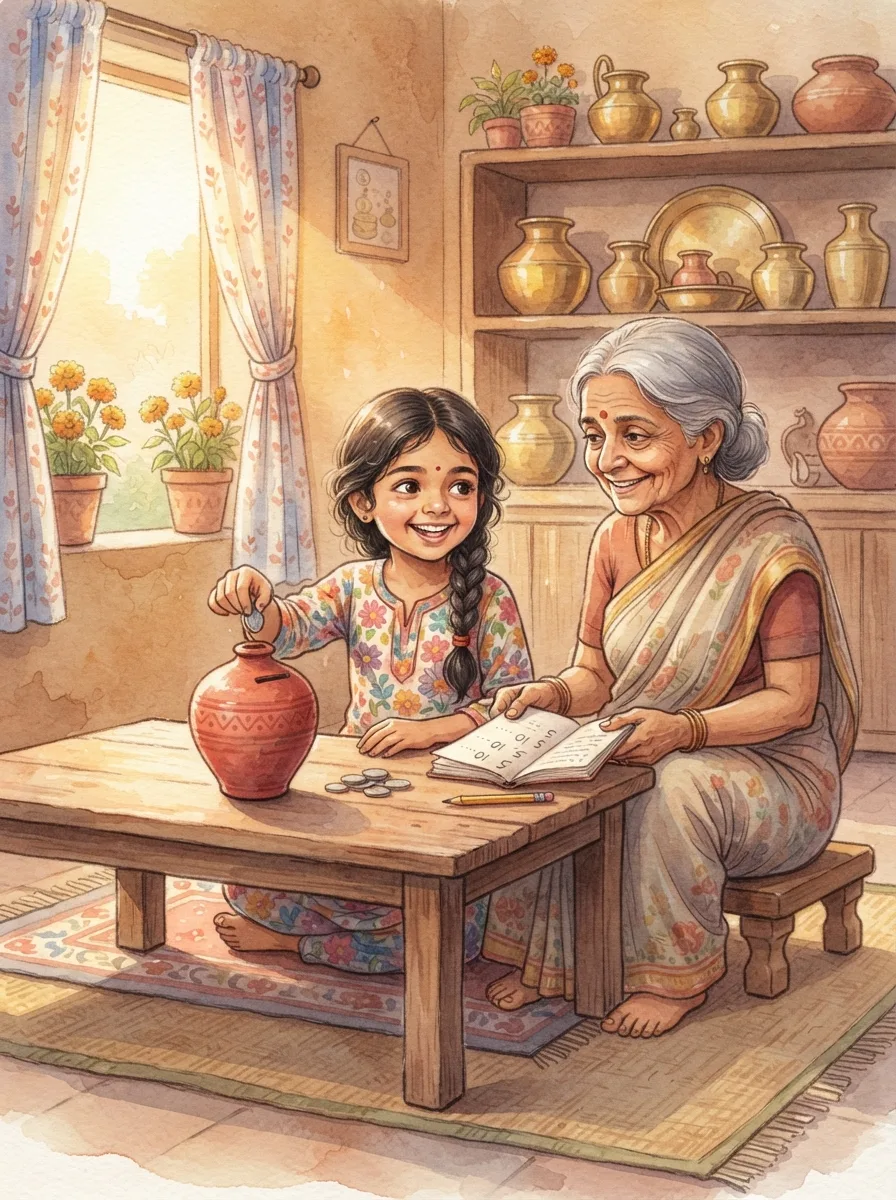
Dadi brings a clay gullak from the potter's lane, painted red with a slit on top. 'Every coin you do not spend, put in here,' she says. Your child drops in the first one-rupee coin and it goes clink. The next day a two-rupee coin, clink. Your child shakes it every night to hear how full it sounds. When Dadi asks how many are inside, Your child has kept count in a notebook: fourteen coins, twenty-one rupees.
Lesson: A coin saved is a coin that is still yours
Money & Saving
Your child Counts the Coins and Notes
Your child Counts the Coins and Notes
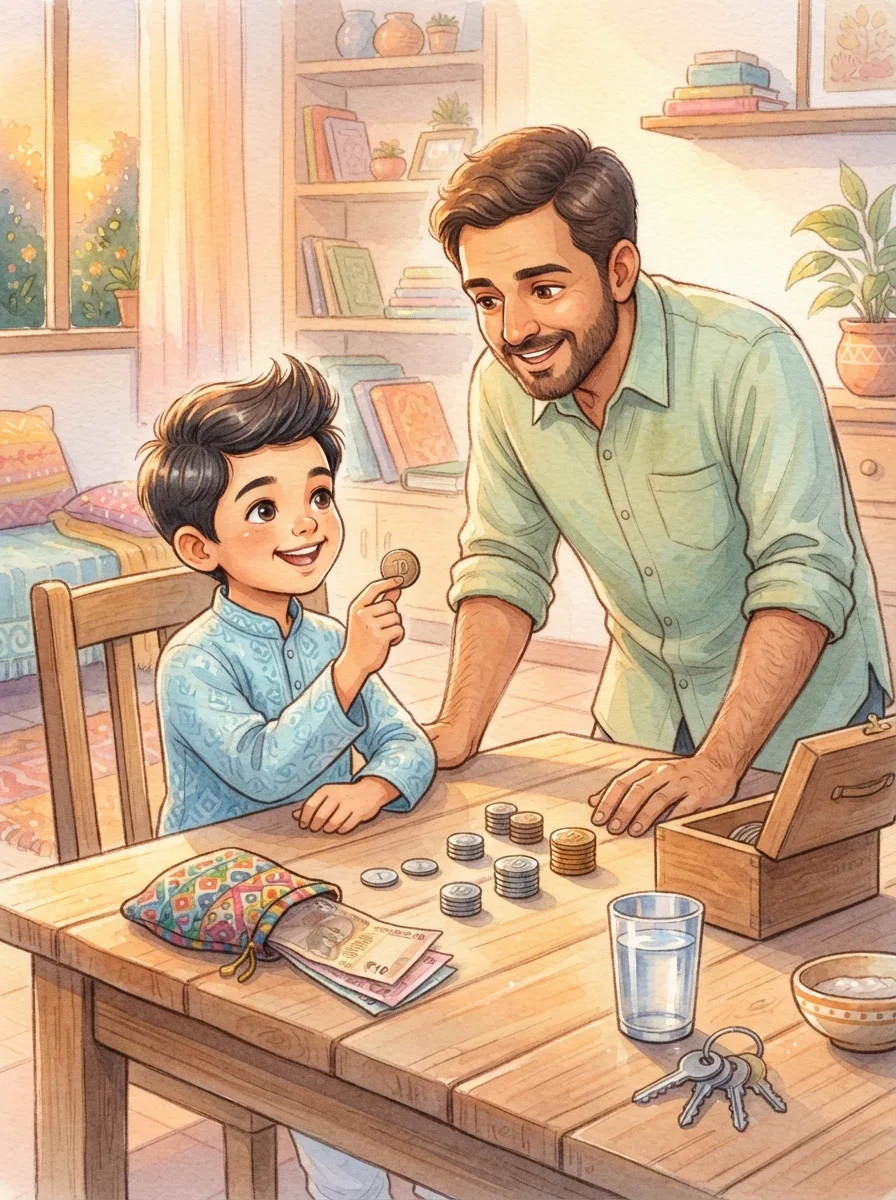
Papa empties his pocket onto the table and asks Your child to sort it. Coins in one pile: one, two, five, ten, with different pictures on each. Notes in another: ten, twenty, fifty. Your child learns that five two-rupee coins make one ten-rupee coin, and two fifties make one hundred. By the end Your child can say the total, one hundred and thirty-seven rupees, and Papa says that is more than he thought he had.
Lesson: Small coins add up to big notes
Money & Saving
Your child and the Change at the Sabziwala
Your child and the Change at the Sabziwala
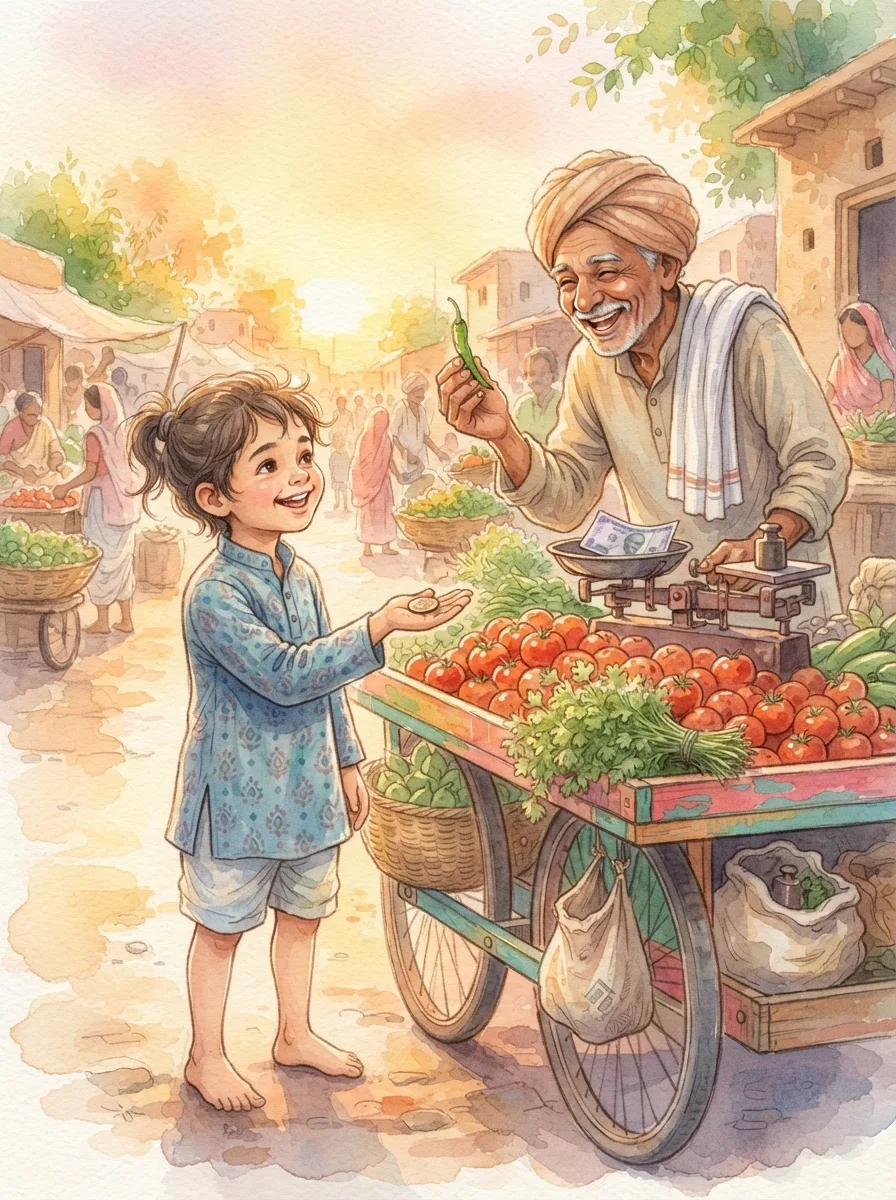
Amma sends Your child to the sabziwala with a fifty-rupee note for tomatoes and coriander. The tomatoes are thirty, the coriander is five. Your child works it out on the way: thirty-five, so fifteen back. The sabziwala hands over a ten-rupee coin and says, 'Done.' Your child looks at it and says politely, 'Five more, please.' He laughs, finds a five, and gives Your child a free green chilli for being sharp.
Lesson: Count your change before you walk away
Money & Saving
Your child Saves for the Cycle Bell
Your child Saves for the Cycle Bell
The bell on Your child's cycle is broken, and a new one at the cycle shop costs sixty rupees. Papa says the gullak is the way. Your child puts in the Sunday ten every week and writes it down. Forty. Then the ice cream cart comes, and Your child wants a cone. Ten rupees. Your child thinks, then walks past. Two weeks later the gullak has sixty, and the new bell rings all the way down the lane.
Lesson: Wait a little now, ring the bell later
Money & Saving
Your child and the Eidi Envelope
Your child and the Eidi Envelope
On Eid, every uncle and aunty presses an envelope into Your child's hand, and by evening there is a pile. Your child opens them at Ammi's table and counts: three hundred and forty rupees. 'Some to keep, some to spend, some to give,' says Ammi. Your child puts two hundred in the gullak, keeps one hundred for a book, and gives forty to the man who sweeps the lane, who says Eid Mubarak with a bow.
Lesson: Keep some, spend some, give some
Money & Saving
Your child and the Diwali Money
Your child and the Diwali Money
The Diwali shagun from Nana comes in a shiny envelope: five hundred rupees. Your child has never held so much. In the market the cracker stall glitters, the toy stall shouts, and the sweet stall smells of ghee. Your child walks past all three, then buys one packet of sparklers for fifty rupees and puts the rest in the gullak. On Diwali night the sparklers are just as bright, and the gullak is much heavier.
Lesson: Big money needs a small plan
Money & Saving
Your child and the Needs and Wants List
Your child and the Needs and Wants List
The school list has pencils, a notebook, an eraser. Your child's own list has a glitter pen, a sticker sheet and a fancy sharpener. At the stationery shop Amma draws two columns on the back of the list: need and want. Your child puts each thing where it belongs. The needs cost forty rupees. There are ten rupees left. Your child picks the sticker sheet from the wants, and leaves the rest for another day.
Lesson: Needs come first, then one want if there is enough
Money & Saving
Your child and the Lemonade Stand in the Colony
Your child and the Lemonade Stand in the Colony
It is too hot to play, so Your child and the neighbour Ravi set up a nimbu paani stand at the colony gate. Amma lends lemons and sugar, and Your child writes the price on a card: five rupees a glass. Guards, aunties and the postman all stop. By evening the tin has sixty rupees. Your child gives Amma twenty for the lemons, splits the rest with Ravi, and learns that a stand costs something before it earns.
Lesson: What you earn is what is left after what you spent
Money & Saving
Your child and the Village Haat
Your child and the Village Haat
At the weekly haat in Nani's village, everything is on the ground on cloths: bangles, jaggery, clay toys. Nani gives Your child twenty rupees. The clay horse is fifteen, the bangles ten, the jaggery five. Your child cannot have all three. After walking the whole haat twice, Your child buys the horse and the jaggery, exactly twenty, and Nani says that is the first time anyone has ever spent to the last rupee.
Lesson: Twenty rupees goes further when you walk the whole market first
Money & Saving
Your child and the Shop List for Dadi
Your child and the Shop List for Dadi
Dadi cannot walk to the kirana shop today, so Your child goes with her list and a hundred-rupee note. Milk, twenty-eight. Bread, thirty. Matches, five. The shopkeeper adds it up on his pad and says sixty-five. Your child adds it up too, on fingers, and gets sixty-three. They check together, and the shopkeeper had added the bread twice. He hands back thirty-seven rupees and a toffee, and Dadi says Your child can go every time.
Lesson: Add it up yourself, even when someone else already has
Money & Saving
Your child and the Bank With Papa
Your child and the Bank With Papa
The gullak is full, so Papa takes Your child to the bank. Inside it is cool and quiet, with counters and a token machine. The lady counts the coins on a tray: three hundred and twelve rupees. She opens a small account in Your child's name and stamps a passbook. 'Now the money is safe, and it grows a little by itself,' Papa says. Your child holds the passbook the whole way home and reads the number twice.
Lesson: Money in the bank is safe and grows while you sleep
Money & Saving
Your child and the Ten Rupees on the Train
Your child and the Ten Rupees on the Train
On the train to Mausi's house, Your child has ten rupees of own money. A boy comes through the coach selling small packets of roasted chana for ten rupees. Your child buys one and the money is gone. At the next station, a girl sells guavas for ten rupees too, and Your child wants one very much. Nothing left. Your child shares the chana with the cousin instead, and decides to think longer next time.
Lesson: Once it is spent, it is spent, so choose slowly
Money & Saving
Your child and the Cracked Gullak
Your child and the Cracked Gullak
The gullak falls off the shelf and cracks down the middle. Coins roll under the bed and behind the almirah. Your child does not cry, but gets a torch and a broom handle and finds every one. Dadaji helps count: one hundred and forty rupees. He brings a steel dabba with a slit cut in the lid, and Your child pours the coins in. It does not clink as sweetly, but it will never crack.
Lesson: The saving matters more than the jar
Money & Saving
Your child and the Book Fair Budget
Your child and the Book Fair Budget
The school book fair has tables of stories, and Amma gives Your child one hundred and fifty rupees for the whole fair. The dinosaur book is ninety. The joke book is sixty. The sticker book is eighty. Your child tries every pair: dinosaur and joke, one fifty exactly. Dinosaur and sticker, too much. Your child takes the first pair to the counter, hands over all the notes, and gets nothing back and everything wanted.
Lesson: A budget is a puzzle, and the right pair fits exactly
Money & Saving
Your child and the Sharing Jar
Your child and the Sharing Jar
Next to the gullak, Your child keeps a small jam jar with a label that says Sharing. One coin in ten goes there. When Ammi says the family at the end of the lane lost their roof in the storm, Your child empties the jar: forty-five rupees. It is not much. But with Papa's note and Bhaiya's savings, it buys a tarpaulin and rope. Your child helps carry it down the lane, and the little girl there waves.
Lesson: A little set aside for others is never little
Money & Saving
Mini Money Jar
Three jars appear on Your childs shelf: save, spend, and share. With each coin choice, the jars tell a tiny story, helping Your child learn that money is a tool for patience, joy, and kindness. The story should turn the everyday skill into a playful mission with a real choice to practice. Your child can make a mistake, try again, and discover a simple tool like counting, waiting, asking, or planning. The ending should celebrate progress, not perfection, so the lesson feels encouraging.
Lesson: Simple money choices can teach patience, planning, and generosity.