The Musical Donkey
Your child and the Cucumber Field
Your child and the Cucumber Field
A hungry donkey and his jackal friend sneak into a cucumber field every night, and Your child, sent to guard the crop, catches them mid-munch. Instead of shouting, Your child offers a deal: a basket of cucumbers each evening if the donkey will help carry water in the morning. The donkey brays with joy, and the jackal wonders what all that noise is about.
Lesson: A fair deal is better than a stolen snack
The Musical Donkey
Your child and the Midnight Song
Your child and the Midnight Song
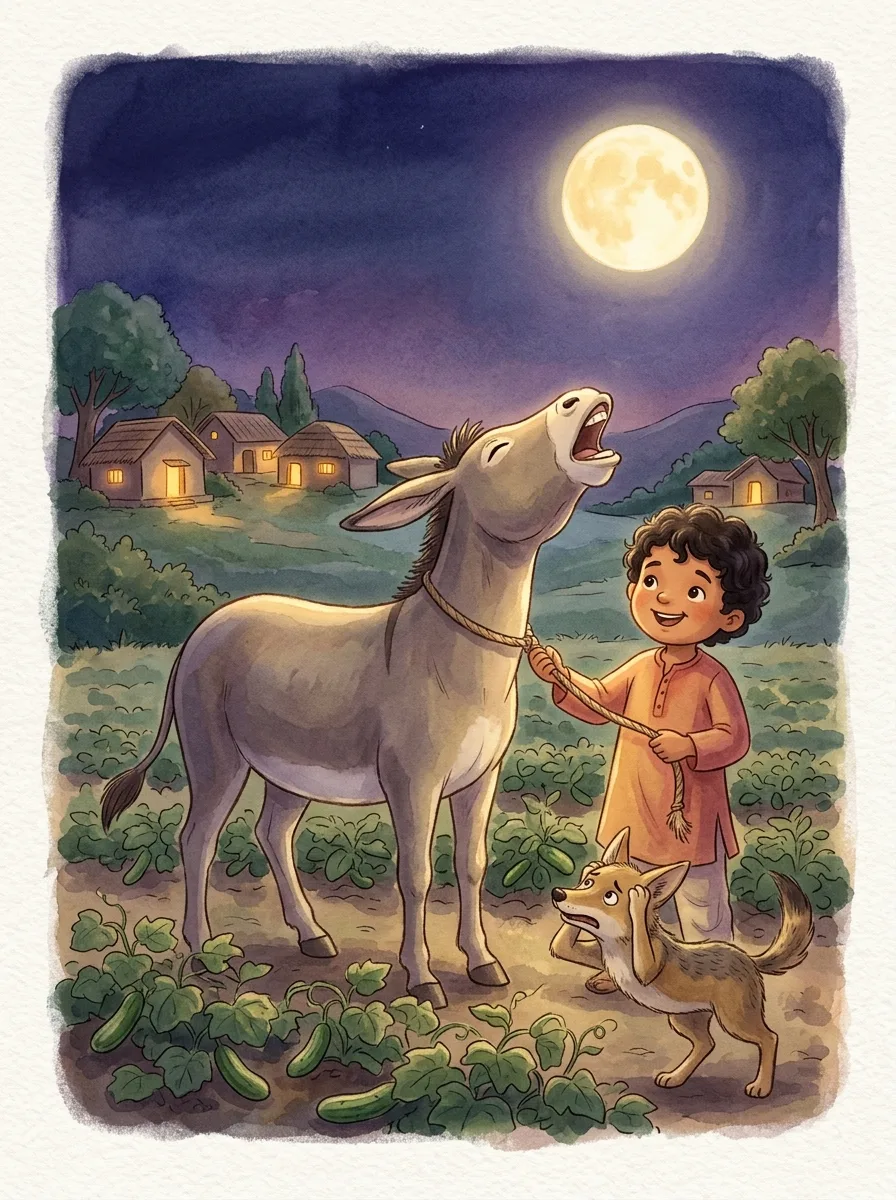
The donkey announces that the moon is so lovely he simply must sing. The jackal begs him not to, and Your child explains that the farmers are asleep and a song now will wake the whole village. The donkey cannot help it and lets out a tremendous bray. Lamps flicker on in every hut, and Your child has to hurry the red-faced donkey out of the field before anyone sees.
Lesson: There is a right time and a right place for everything
The Musical Donkey
Your child and the Village Concert
Your child and the Village Concert
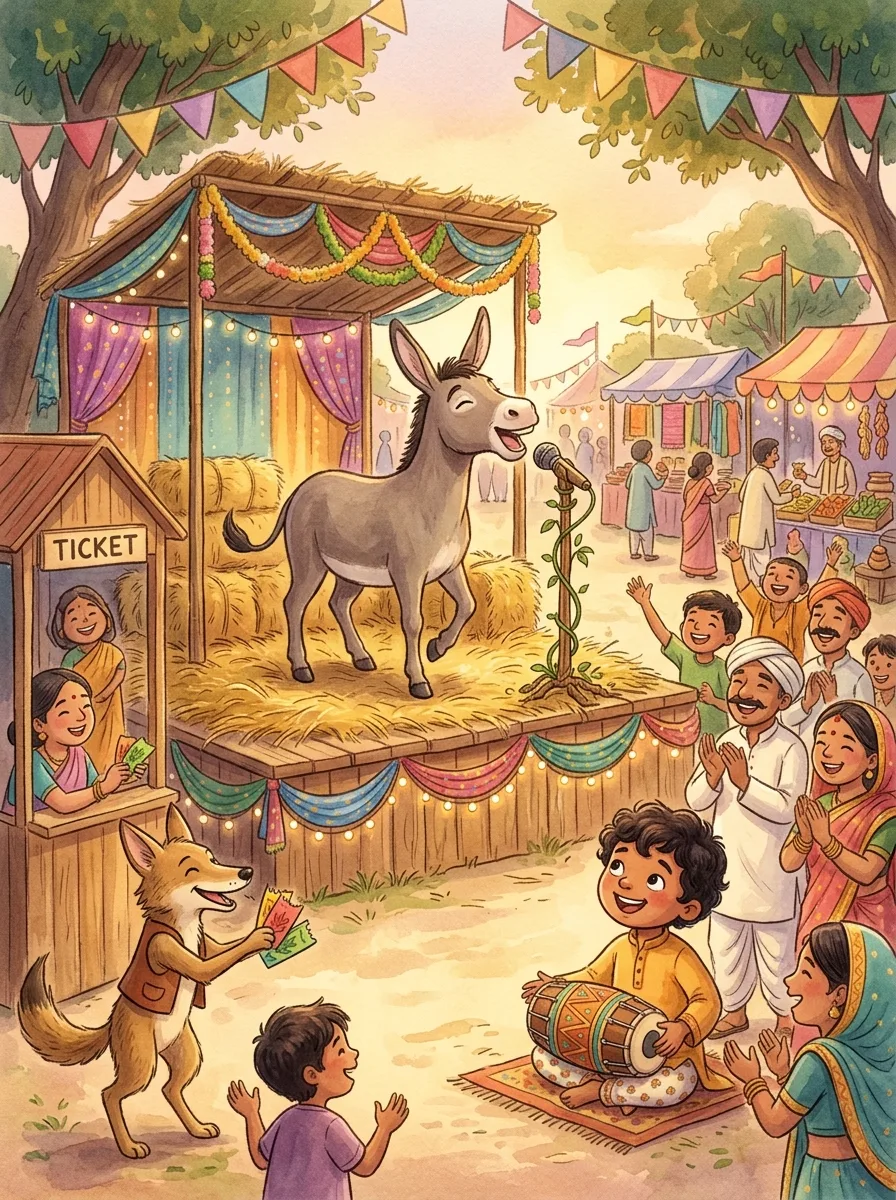
The donkey is sad that nobody wants to hear him sing. Your child has an idea: a proper concert at the harvest fair, in the daytime, where loud is allowed. The donkey practises with Your child on a small drum, the jackal sells tickets made of leaves, and when the big bray finally comes, the whole village claps and the children bray right back.
Lesson: Every voice has a place where it belongs
The Musical Donkey
Your child and the Donkey Who Loved to Sing
Your child and the Donkey Who Loved to Sing
The washerman's donkey, Uddhata, works hard all day carrying bundles of clothes, and at night he dreams of singing. Your child, who helps the washerman fold sheets, is the only one who ever listens to his braying. One evening Your child tells him honestly that the notes are loud but the feeling is real, and that every singer starts somewhere. The donkey brays with joy, and the washerman covers his ears.
Lesson: Be honest and kind at the same time
The Musical Donkey
Your child and the Jackal's Plan
Your child and the Jackal's Plan
The donkey and his friend the jackal sneak into the cucumber fields at night, and the donkey, full and happy, decides to sing. The jackal warns him the farmers will wake. Your child, sleeping in the field hut with Nana to guard the crop, hears the whispered argument and creeps closer. Before the first note, Your child steps out and says softly, 'Not here. Sing by the river, where nobody sleeps.'
Lesson: The right song in the wrong place is still trouble
The Musical Donkey
Your child and the Farmers' Sticks
Your child and the Farmers' Sticks
The donkey does not listen and sings anyway, and the farmers come running with sticks. The jackal has already slipped away. Your child runs in front of the donkey with arms spread and says, 'He is only a singer with bad timing, not a thief.' The farmers lower their sticks, grumbling. The donkey gets a scolding instead of a beating, and Your child gets a very grateful nuzzle.
Lesson: Stand between anger and someone who made an honest mistake
The Musical Donkey
Your child and the Song by the River
Your child and the Song by the River
The donkey has promised not to sing in the fields, but he still needs somewhere to sing. Your child takes him to the wide bend of the river, far from every house, where the noise floats away over the water. Every evening they go together: the donkey brays to the sky, the frogs join in, and Your child keeps time on a tin can. It is the worst music in the village and the happiest hour of the day.
Lesson: There is a right time and place for everything, even a loud song
The Musical Donkey
Your child and the Jackal Who Ran
Your child and the Jackal Who Ran
The jackal comes back the next day as if nothing happened, and the donkey is hurt that his friend left him to the farmers. Your child listens to both sides. The jackal says he warned the donkey; the donkey says a friend stays anyway. Your child suggests that a real friend does both: warns you, and then stays if you do not listen. The jackal is quiet, and the next night, he stays.
Lesson: A true friend warns you, and stays with you anyway
The Musical Donkey
Your child and the Cousin Who Would Not Wait
Your child and the Cousin Who Would Not Wait
Your child's little cousin has learned a song and wants to sing it in the middle of Nani's afternoon nap, then during the neighbour's prayers, then at the doctor's. Your child tells her the story of the singing donkey. She thinks about it and asks, 'When is the right time?' Your child says after dinner, on the terrace, with everyone listening. The song, sung at the right time, gets a standing ovation.
Lesson: Even a lovely song needs the right moment
The Musical Donkey
Your child and the Village Fair Stage
Your child and the Village Fair Stage
The village fair has a talent contest and the donkey wants to enter. Everyone laughs. Your child enters him anyway, as a comedy act, and teaches him to bray on cue after each of Your child's jokes. The crowd howls with laughter, the judges give a special prize, and the donkey, who never understood the difference between laughing with and laughing at, is the happiest performer on the stage.
Lesson: Find the stage where your talent fits
The Musical Donkey
Your child and the Real Cucumber Thief
Your child and the Real Cucumber Thief
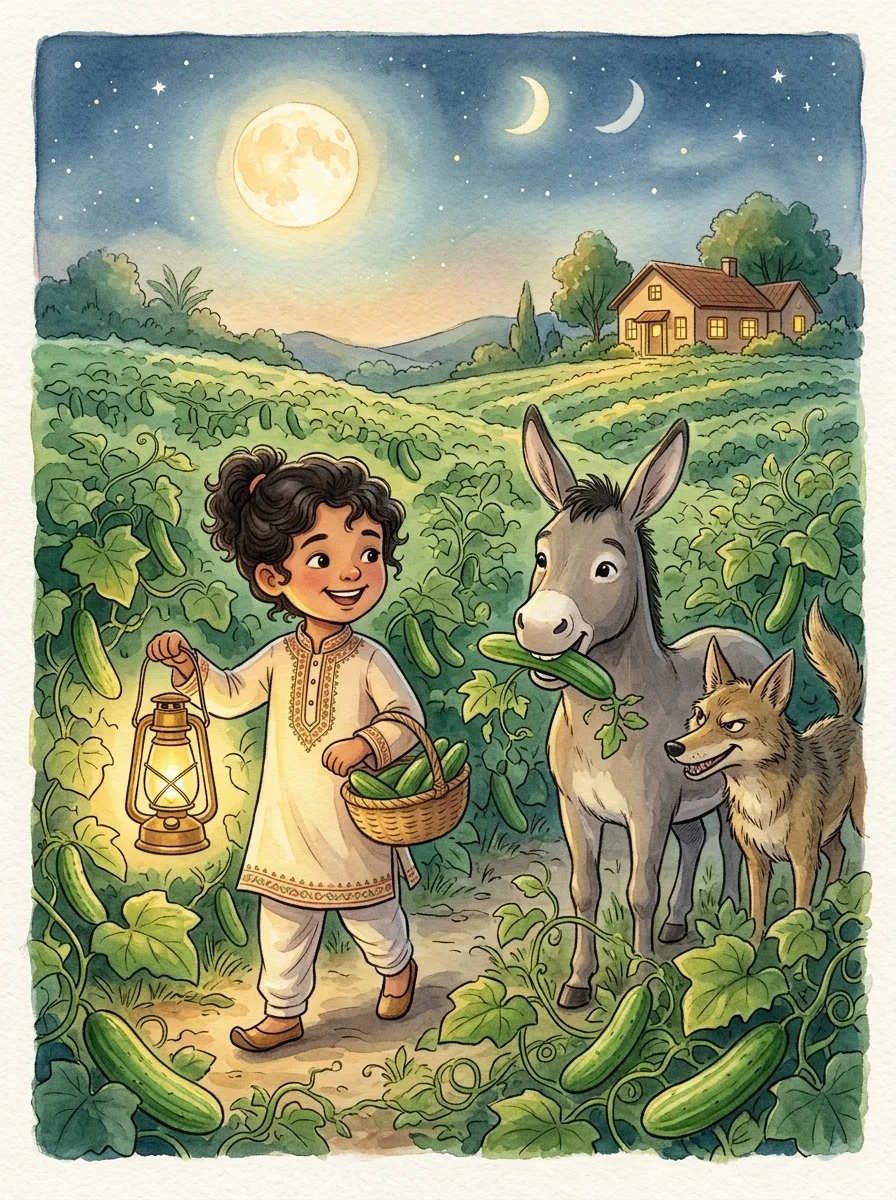
Cucumbers keep disappearing from the fields, and the farmers blame the donkey, who has been at the river every night with Your child. Your child decides to prove it and keeps watch from the hut with a lantern. At midnight, a fat porcupine waddles through the vines. Your child shows the farmers the quill marks, and the donkey's name is cleared with an apology and a cucumber.
Lesson: Do not blame the one who got in trouble last time
The Musical Donkey
Your child and the Washerman's Heavy Load
Your child and the Washerman's Heavy Load
The washerman piles more and more bundles on the donkey until his legs shake. Your child notices and does not just complain. Your child borrows the bullock cart's old wheels and builds a little trolley the donkey can pull instead of carry. The washerman grumbles, tries it, and finds he can take twice the washing. The donkey walks tall again and sings the whole way, softly, by the river.
Lesson: If a friend is struggling, build them something that helps
The Musical Donkey
Your child and the Singing Lesson
Your child and the Singing Lesson
The donkey wants to sing properly, so Your child takes him to the old music teacher who plays the harmonium at the temple. She laughs, then listens, then says that even a bray has notes in it. She teaches him to bray low, then high, then hold one note. He cannot become a koel, but by the festival he can bray in tune with the harmonium, and the temple children love it.
Lesson: Everyone can improve with a patient teacher
The Musical Donkey
Your child and the Night the Village Needed Noise
Your child and the Night the Village Needed Noise
A leopard is prowling near the goat pens, and the village needs to make a great noise to scare it away, but the drums are locked in the temple. Your child runs to the washerman's shed and wakes the donkey. 'Tonight,' says Your child, 'sing as loud as you have ever sung.' The donkey brays like thunder, the leopard flees to the hills, and for once the whole village thanks him for his song.
Lesson: The thing people complain about may one day save them
The Musical Donkey
Your child and the Donkey's Day Off
Your child and the Donkey's Day Off
The donkey works every day of the year and has never had a holiday. Your child asks the washerman for one day, promises to do the folding double the next day, and takes the donkey to the river to do nothing at all. They roll in the sand, eat sweet grass, and the donkey sings only when Your child asks. At sunset the donkey says it was the best day of his life, and Your child agrees.
Lesson: Everyone who works hard deserves a day to rest
The Musical Donkey
The Clever Crow’s Pitcher
The Clever Crow’s Pitcher
In a Panchatantra-style village, a thirsty crow cannot reach the water at the bottom of a pitcher. Your child helps gather pebbles one by one, learning that patience and clever thinking can solve problems strength cannot. The story should stay respectful and child-safe, using the epic or fable as inspiration rather than a heavy retelling. Your child faces a small choice connected to courage, dharma, wisdom, or friendship, then helps the scene resolve through kindness. The ending should carry the value clearly without sounding preachy.
Lesson: Small smart steps can solve big problems.
The Musical Donkey
The Lion and the Tiny Mouse
The Lion and the Tiny Mouse
A proud lion laughs when a tiny mouse offers help, until a net teaches both of them a lesson. With Your childs kindness, the mouse proves that no friend is too small to make a big difference. The story should stay respectful and child-safe, using the epic or fable as inspiration rather than a heavy retelling. Your child faces a small choice connected to courage, dharma, wisdom, or friendship, then helps the scene resolve through kindness. The ending should carry the value clearly without sounding preachy.
Lesson: Kindness to the small can return in big ways.
The Musical Donkey
The Monkey and the Mango Bridge
The Monkey and the Mango Bridge
A playful monkey wants every mango first, but the branch bridge shakes whenever anyone grabs too much. Your child helps the animals share fairly, learning that greed can wobble a bridge while fairness keeps it strong. The story should stay respectful and child-safe, using the epic or fable as inspiration rather than a heavy retelling. Your child faces a small choice connected to courage, dharma, wisdom, or friendship, then helps the scene resolve through kindness. The ending should carry the value clearly without sounding preachy.
Lesson: Fair sharing keeps friendships strong.
The Musical Donkey
The Wise Tortoise’s Quiet Plan
The Wise Tortoise’s Quiet Plan
When noisy animals rush toward a muddy shortcut, a wise tortoise asks Your child to wait and watch. The patient path turns out safer, teaching everyone that slow thinking can sometimes be the fastest way home. The story should stay respectful and child-safe, using the epic or fable as inspiration rather than a heavy retelling. Your child faces a small choice connected to courage, dharma, wisdom, or friendship, then helps the scene resolve through kindness. The ending should carry the value clearly without sounding preachy.
Lesson: Patience and observation can prevent avoidable mistakes.
The Musical Donkey
The Jackal’s Honest Echo
A clever jackal discovers a cave that echoes every untruth louder than thunder. With Your childs help, the animals learn that cleverness is best when it walks beside honesty. The story should stay respectful and child-safe, using the epic or fable as inspiration rather than a heavy retelling. Your child faces a small choice connected to courage, dharma, wisdom, or friendship, then helps the scene resolve through kindness. The ending should carry the value clearly without sounding preachy.
Lesson: Cleverness should be guided by honesty and care.
The Musical Donkey
The Blue Jackal Learns Humility
The Blue Jackal Learns Humility
In a Panchatantra-style forest, a jackal painted blue pretends to be greater than everyone else. Your child helps the animals uncover the truth kindly, learning that pretending feels heavy but honesty feels free. The story should stay respectful and child-safe, using the epic or fable as inspiration rather than a heavy retelling. Your child faces a small choice connected to courage, dharma, wisdom, or friendship, then helps the scene resolve through kindness. The ending should carry the value clearly without sounding preachy.
Lesson: Honesty and humility build better friendships than pretending.
The Musical Donkey
The Talkative Turtle’s Promise
The Talkative Turtle’s Promise
A turtle promises two swans to stay quiet while flying across the sky, but words keep tickling the tongue. Your child helps the turtle practice listening, learning that some promises are kept by pausing first. The story should stay respectful and child-safe, using the epic or fable as inspiration rather than a heavy retelling. Your child faces a small choice connected to courage, dharma, wisdom, or friendship, then helps the scene resolve through kindness. The ending should carry the value clearly without sounding preachy.
Lesson: Listening and self-control help us keep promises.
The Musical Donkey
The Four Friends of the Forest
The Four Friends of the Forest
A deer, crow, mouse, and turtle each has one small talent. When trouble arrives, Your child helps them combine their strengths and learns that friendship works best when everyone brings what they can. The story should stay respectful and child-safe, using the epic or fable as inspiration rather than a heavy retelling. Your child faces a small choice connected to courage, dharma, wisdom, or friendship, then helps the scene resolve through kindness. The ending should carry the value clearly without sounding preachy.
Lesson: Friends become stronger when they value each other’s different gifts.
The Musical Donkey
The Wise Rabbit and the Moon Pond
The Wise Rabbit and the Moon Pond
A small rabbit must protect the pond from a boastful elephant herd without fighting. With Your childs clever plan and moonlit reflection, the animals learn that wisdom can be stronger than size. The story should stay respectful and child-safe, using the epic or fable as inspiration rather than a heavy retelling. Your child faces a small choice connected to courage, dharma, wisdom, or friendship, then helps the scene resolve through kindness. The ending should carry the value clearly without sounding preachy.
Lesson: Wisdom and calm thinking can solve problems without force.