Saying Sorry
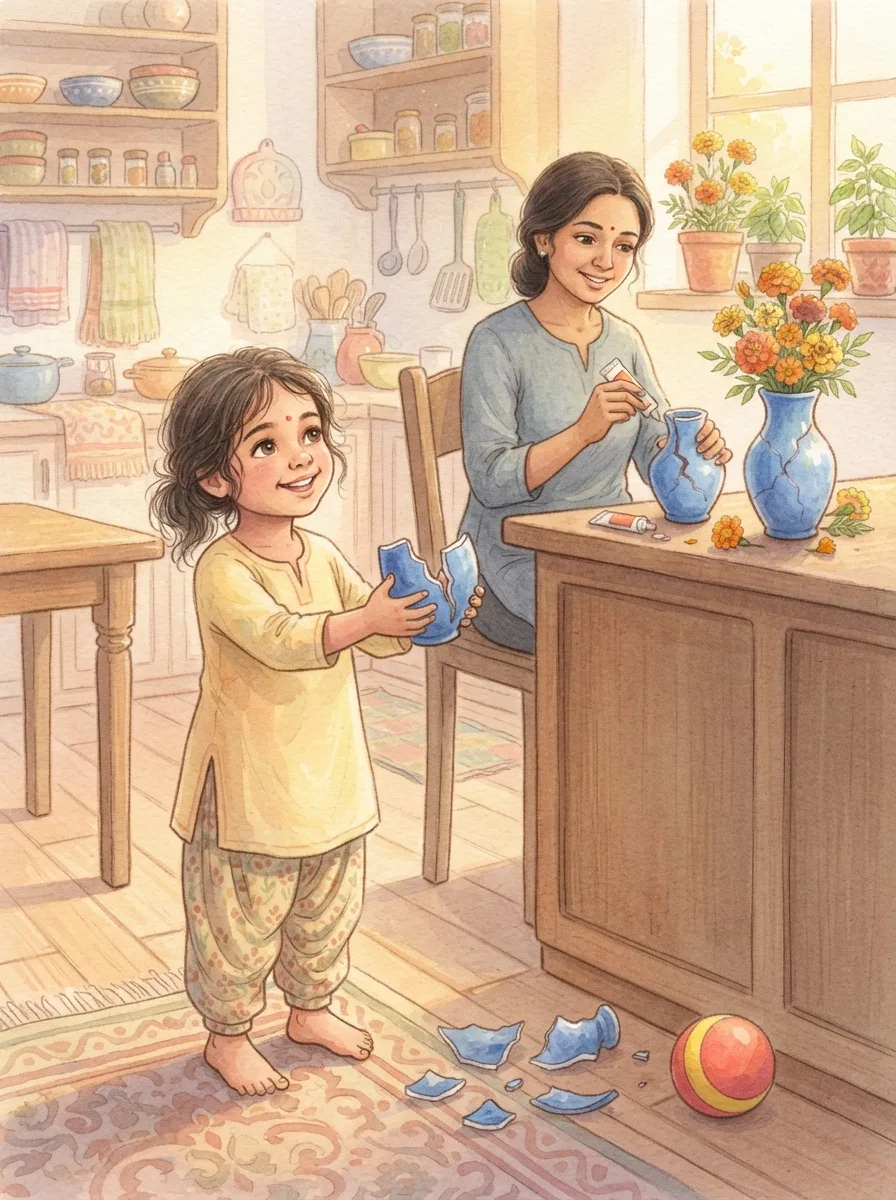
Your child and the Vase in Pieces
Your child and the Vase in Pieces
The blue vase from Nani was on the shelf, and Your child's ball was not supposed to be inside. Now the vase is in five pieces on the floor and nobody saw. Your child could push the pieces behind the curtain. Instead Your child picks them up, goes to Amma in the kitchen, holds them out and says, 'I did this. I was playing inside. I am sorry.' Amma is quiet, then gets the glue. The vase has a crack now, and Nani says it looks loved.
Lesson: The pieces behind the curtain always come out
Saying Sorry
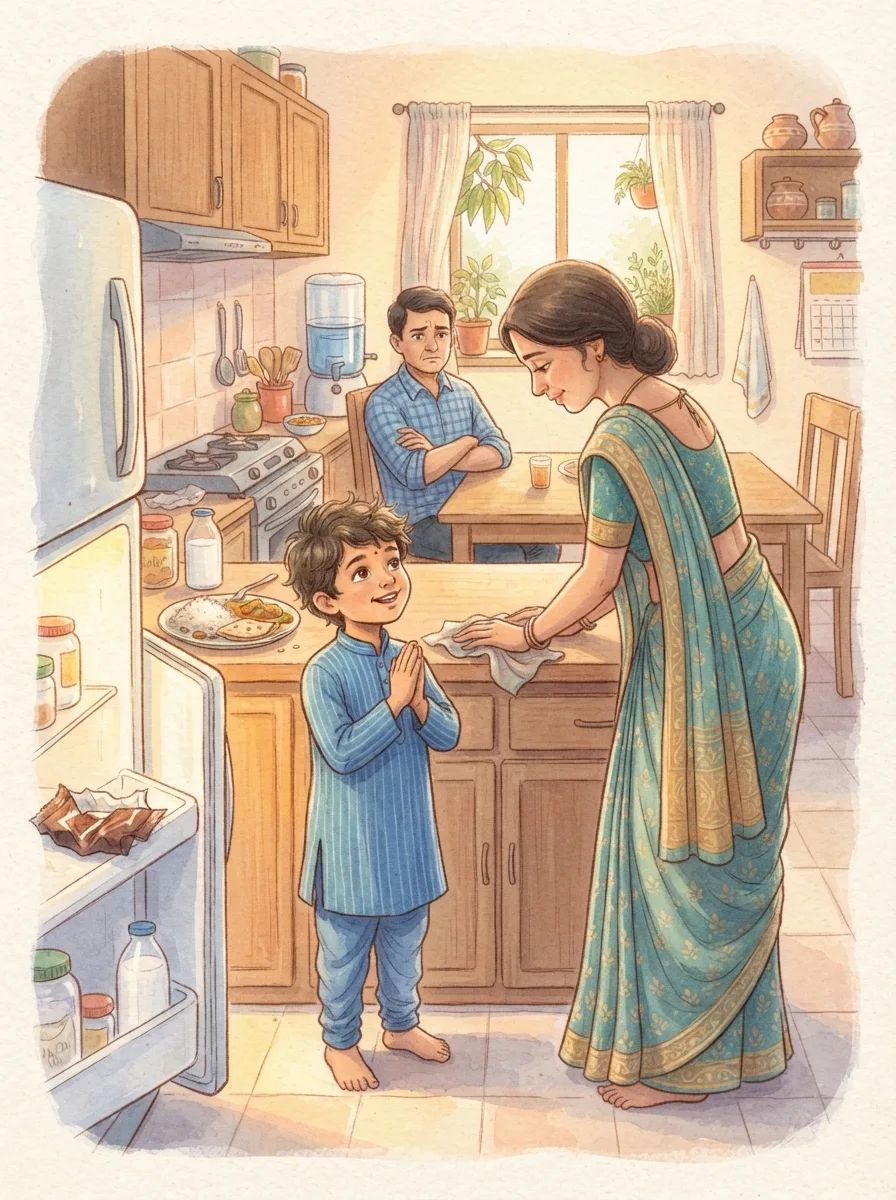
Your child and the Missing Chocolates
Your child and the Missing Chocolates
Six chocolates go missing from the fridge and when Papa asks, Your child says, 'Maybe Sunita Didi.' Papa frowns. Sunita Didi is not asked, but she is looked at differently all evening, and she notices. Your child cannot eat dinner. Before bed Your child goes to Papa and says, 'It was me. I said Didi's name because I was scared.' In the morning Your child says it to Didi too, in front of everyone. Didi says nothing for a moment, then squeezes Your child's hand.
Lesson: A wrong blame must be taken back in front of the same people
Saying Sorry
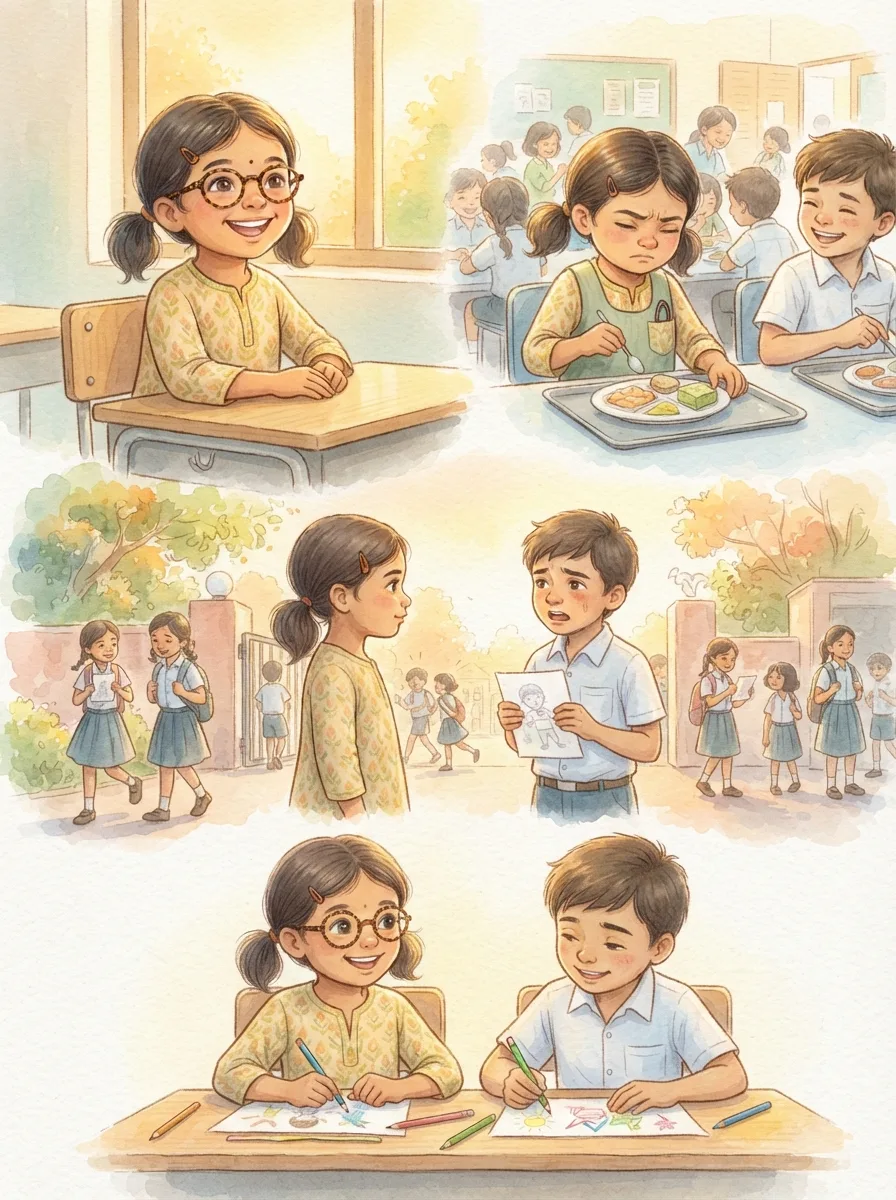
Your child and the Joke About the Glasses
Your child and the Joke About the Glasses
Tanvi comes to school with new thick glasses and Your child says, 'Now you look like an owl,' and half the class laughs. Tanvi laughs too, but at lunch she is not wearing them and keeps bumping into desks. Your child feels the joke sitting like a stone. After the last bell Your child finds Tanvi at the gate. 'That was a mean joke. I am sorry. Please wear them, you need them.' The next day Tanvi wears them, and Your child says they look smart.
Lesson: A joke that makes someone hide is not a joke
Saying Sorry
Your child and the Borrowed Pen
Your child and the Borrowed Pen
Arjun lends Your child his good ink pen for the exam and Your child loses it somewhere between the exam hall and the bus. For three days Your child avoids Arjun and says, 'Tomorrow.' On the fourth day Your child walks up to him before assembly. 'I lost your pen. I should have told you the first day. Here is mine, and I will save up for a new one.' Arjun is annoyed for a minute, then says, 'Just tell me next time.'
Lesson: Sorry gets heavier every day you carry it
Saying Sorry
Your child and the Tomato Plants
Your child and the Tomato Plants
Your child's straight drive goes over the wall into Verma Uncle's garden and flattens three tomato plants he has watered every evening since March. The other boys scatter. Your child stands there, then rings the bell. Verma Uncle opens the door with his stick. 'It was my shot, Uncle. I am sorry. Can I help fix them?' Uncle grumbles, then hands over a trowel. They stake the plants back up together. In June, Uncle brings over a bowl of the first tomatoes.
Lesson: Ring the bell yourself before someone rings it for you
Saying Sorry
Your child and the Push at the Party
Your child and the Push at the Party
At cousin Kabir's birthday, the musical chairs get wild and Your child pushes little Riya off the last chair to win. Riya sits on the floor and cries. Your child gets the prize, a whistle, and it feels awful. Your child walks back through the crowd, kneels beside Riya and says, 'I pushed you. That was wrong. This is yours.' Riya takes the whistle and blows it right in Your child's ear. Everyone laughs, Your child loudest of all.
Lesson: A prize you pushed for is not a prize
Saying Sorry
Your child and the Homework That Was Not Done
Your child and the Homework That Was Not Done
Amma asks if the Hindi homework is done and Your child says yes, because the cartoon is at the good part. The next morning the notebook is empty and Miss writes a note. Your child could hide the note. Instead Your child gives it to Amma at breakfast and says, 'I lied last night. I am sorry. I will do it now and skip cartoons today.' Amma signs the note without a word. Then she puts one extra paratha on the plate.
Lesson: Own the lie yourself, before the note does it for you
Saying Sorry
Your child and the Shout at Dadi
Your child and the Shout at Dadi
In the village, Dadi calls Your child in from the fields for the third time and Your child shouts, 'Leave me alone!' loud enough for the neighbours. Dadi goes inside quietly. The cousins go very still. Your child plays for five more minutes and none of it is fun. Inside, Dadi is sitting on the cot with her back turned. Your child sits next to her, touches her feet, and says, 'I should not have shouted. I am sorry, Dadi.' Dadi pulls Your child's ear, gently.
Lesson: Touch the feet you shouted at
Saying Sorry
Your child and the Game Neha Was Left Out Of
Your child and the Game Neha Was Left Out Of
In the colony park, Your child picks teams for kho-kho and leaves Neha out because she is slow, and says so out loud. Neha goes and sits on the swing alone. The game is good but Your child keeps seeing the swing. At the end Your child walks over. 'I said a mean thing and I left you out. I am sorry. Tomorrow you are on my team, first pick.' Neha shrugs, then says, 'I am good at chain, actually.' She is.
Lesson: Leaving someone out is a mistake you can fix tomorrow
Saying Sorry
Your child and the Rude Word on the Bus
Your child and the Rude Word on the Bus
The city bus is packed and the conductor asks Your child to move back for the fourth time. Your child mutters a rude word. The conductor hears it and his face changes, but he says nothing and goes on punching tickets. Papa did not hear. Your child's face is hot for six stops. At the stop, Your child tugs the conductor's sleeve. 'Uncle, I said a bad word to you. Sorry.' The conductor stares, then laughs and taps Your child's head with the ticket punch.
Lesson: A sorry said out loud fixes a word said under your breath
Saying Sorry
Your child and the Chaiwala's Tray
Your child and the Chaiwala's Tray
Running through the market to catch up with Amma, Your child knocks straight into the chaiwala's tray and six glasses of chai crash to the ground. The chaiwala shouts. Your child wants to keep running. Instead Your child stops, turns, and says, 'I was running and I did not look. I am sorry, Bhaiya.' Then Your child helps pick up the unbroken glasses. Amma pays for the chai. The chaiwala, calmer now, gives Your child a biscuit and says, 'Slowly next time, hero.'
Lesson: Stop and turn around, even when you could run
Saying Sorry
Your child and the Sorry That Was Not a Sorry
Your child and the Sorry That Was Not a Sorry
Your child scribbles on Dev's drawing and says, 'Sorry, but you started it.' Dev walks off angrier. Miss Rao hears and asks Your child to sit. 'A sorry with a but is not a sorry. What did you do?' Your child thinks. Then goes to Dev at the next break and tries again. 'I ruined your drawing. No but. I am sorry. Can I help you make another?' Dev hands over a pencil. The new drawing has two signatures at the bottom.
Lesson: A sorry with a but in it is only half a sorry
Saying Sorry
Your child and the Broken Promise
Your child and the Broken Promise
Your child promised little brother Aryan a game of carrom at five, then went to Rohit's house and forgot. At seven, Aryan is still sitting by the carrom board with the striker in his hand. He does not even complain, which is worse. Your child sits down opposite. 'I promised and I forgot. That was not fair to you. I am sorry. Best of three, right now, and you can have first strike.' Aryan pockets the queen in his first shot and grins.
Lesson: A promise to a little brother counts as much as any other
Saying Sorry
Your child and the Torn Library Book
Your child and the Torn Library Book
The library book about volcanoes goes home in Your child's bag, and comes back with page forty torn clean out, because Your child wanted the volcano picture on the wall. The librarian, Mr Das, does not notice at return. Your child almost walks away. Then Your child turns back, takes the folded page out of a pocket and says, 'I tore this. I am sorry. Can I tape it back?' Mr Das gets the tape. Now the volcano book has a wrinkle, and Your child borrows it every month.
Lesson: Say sorry even when nobody has noticed yet
Saying Sorry
Your child and Aarav's Idea
Your child and Aarav's Idea
In the group project, Aarav says the model should have a real working water wheel. When Miss asks whose idea it was, Your child says, 'Mine,' and gets the praise. Aarav says nothing, but stops helping. At home the praise feels like a borrowed shirt. Next day Your child puts a hand up before class begins. 'Miss, the water wheel was Aarav's idea. I said it was mine. Sorry, Aarav.' Miss writes both names on the board. Aarav starts helping again, and the wheel turns.
Lesson: Praise you did not earn never fits
Saying Sorry
The Brave Apology Bridge
After accidentally breaking a friend’s toy, Your child wants to hide. A small bridge appears between sorry and repair, and Your child learns that a brave apology includes truth, care, and helping make things better. The story should place Your child inside a real moral choice, where the easy path and the kind path are not the same. Through a small mistake, a helpful pause, and a brave decision, Your child learns the value by doing it. The ending should feel honest, warm, and earned.
Lesson: Apologizing bravely helps repair trust after mistakes.