Empathy
Your child and the New Boy at Lunch
Your child and the New Boy at Lunch
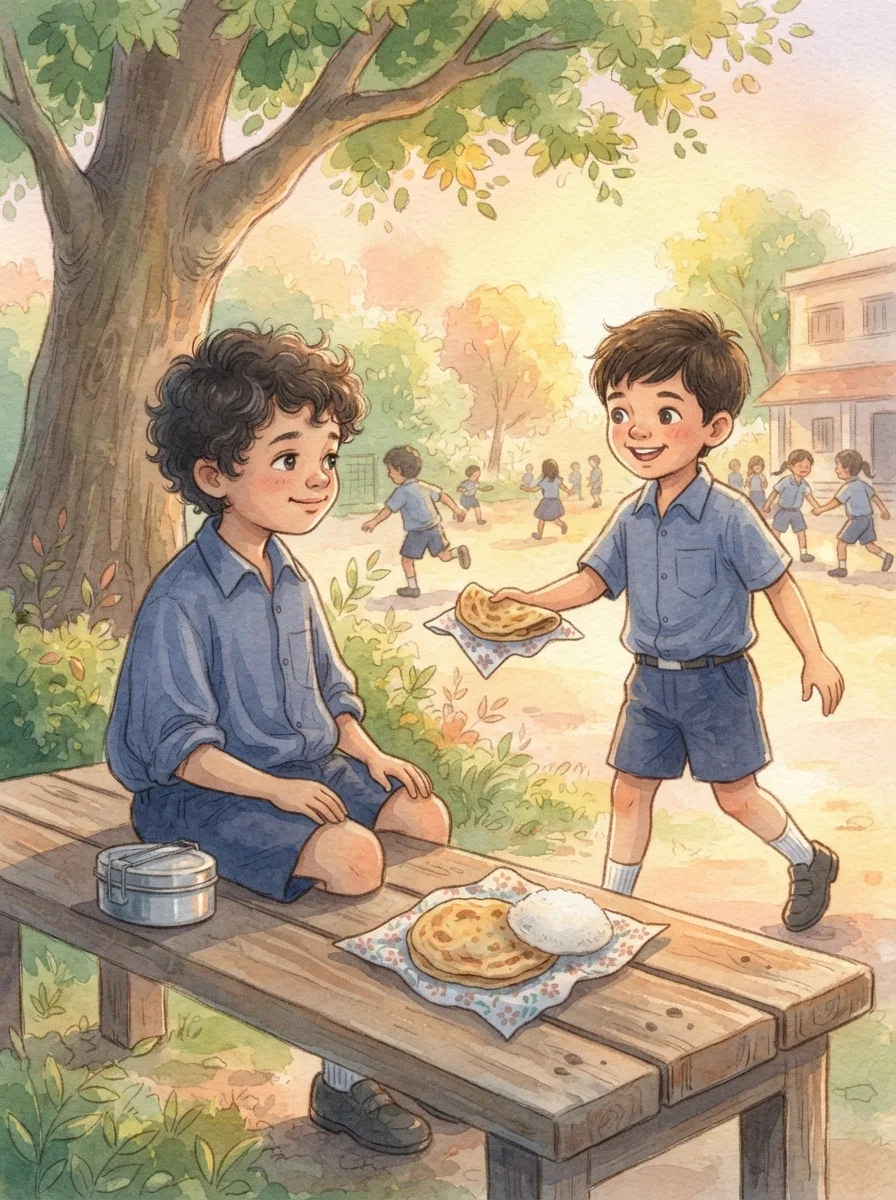
A new boy, Ishaan, joins Class 3 in the middle of the year and sits alone at lunch with his tiffin closed. Everyone else has their groups already. Your child remembers the first day at this school, the too-big uniform and the stomach ache. Your child picks up the tiffin and walks over. 'What did your Amma pack?' Ishaan opens it slowly. Idli. Your child trades one paratha for one idli, and by the bell they are arguing about cricket.
Lesson: Remember your own first day and someone else's becomes easier
Empathy
Your child and Sunita Didi's Tired Day
Your child and Sunita Didi's Tired Day
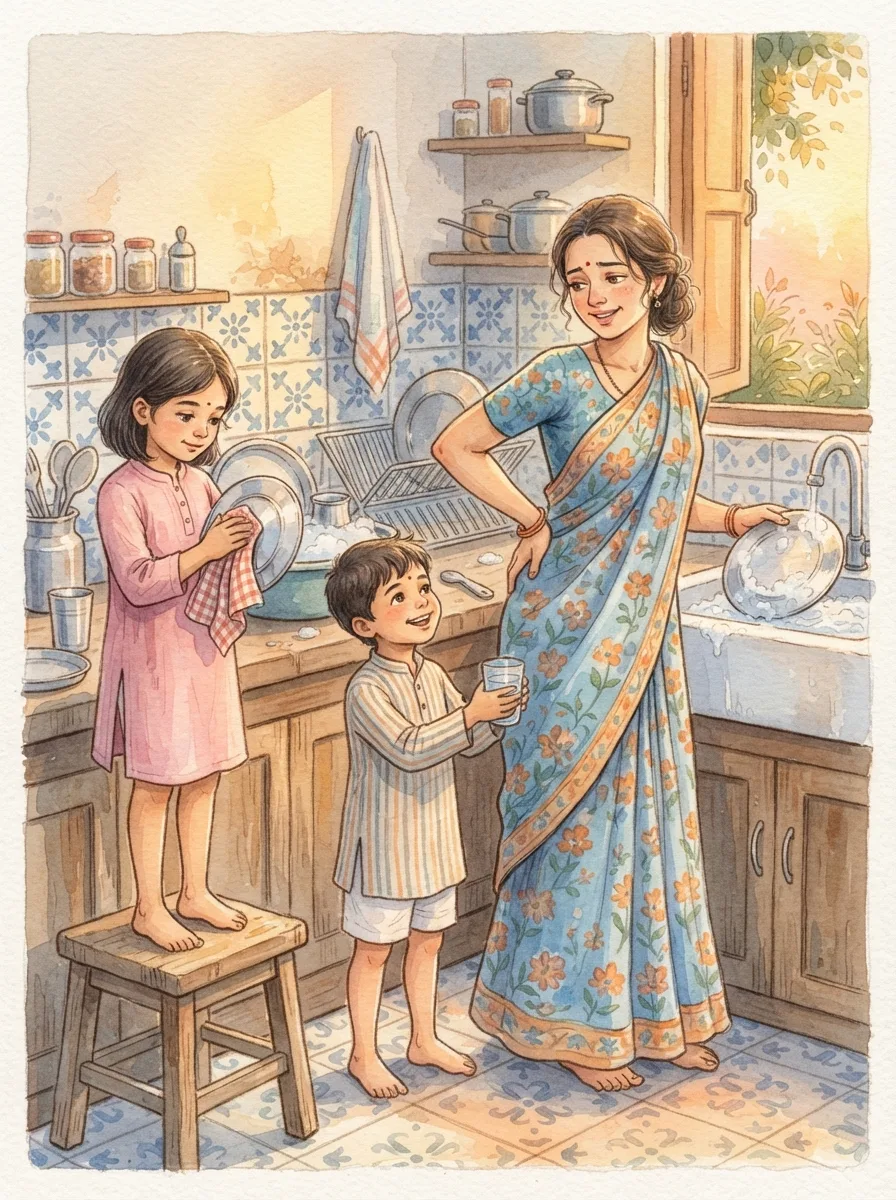
Sunita Didi comes to wash the dishes every evening, and today she is slower, rubbing her back, and does not hum. Your child is about to ask her to find the lost crayon box, then stops. Instead Your child pulls a stool beside the sink and says, 'Sit for a minute, Didi. I will bring water.' Didi laughs and sits. She tells Your child her little boy was up all night with fever. Your child dries the plates so she can go home early.
Lesson: Look at a tired face before you ask for one more thing
Empathy
Your child and Gudiya's Lost Bunny
Your child and Gudiya's Lost Bunny
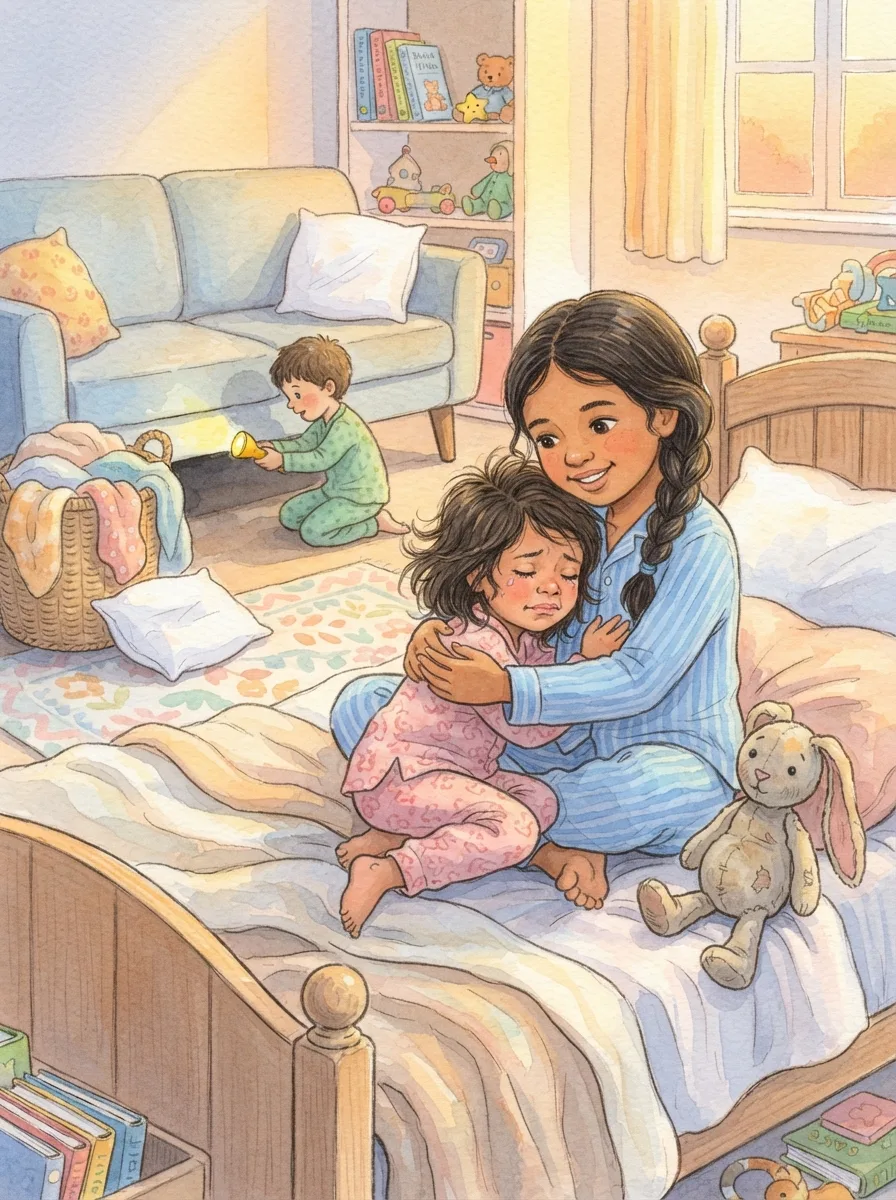
Little Gudiya cannot find her cloth bunny at bedtime and is crying so hard she cannot say the word bunny. Papa says it is just a toy. Your child knows it is not just a toy, because Your child once lost a blue car and cried for two days. Your child searches under the sofa, behind the washing machine and finally in the laundry basket, where the bunny is hiding in a pillowcase. Gudiya stops crying mid-sob. Your child tucks them both in.
Lesson: Small things are not small to the one who lost them
Empathy
Your child and the Watchman in the Rain
Your child and the Watchman in the Rain
The monsoon breaks at four o'clock and Bahadur Uncle, the colony watchman, is still at the gate in his plastic cap, water running off his nose. Everyone runs past him into their dry flats. Your child watches from the balcony, then goes in and tells Amma. Together they carry down a steel glass of hot chai and Papa's old umbrella. Bahadur Uncle holds the chai with both hands. 'Beta,' he says, 'nobody has ever brought me chai in the rain.'
Lesson: Someone standing in the rain for you deserves a cup of chai
Empathy
Your child and Mrs Iyer's Quiet Flat
Your child and Mrs Iyer's Quiet Flat
Mrs Iyer in flat 302 lives alone since Uncle passed away, and Your child notices her door is always half open, as if waiting. One afternoon Your child knocks with the maths homework and asks, 'Aunty, can you check this?' She can, because she was a teacher for thirty years. She checks it slowly and tells a story about every sum. Now Your child goes every Tuesday. Amma says the homework does not need checking. Your child says, 'I know.'
Lesson: A half-open door is asking for someone to knock
Empathy
Your child and the Word That Would Not Come
Your child and the Word That Would Not Come
Faiz has to read the paragraph aloud and gets stuck on the first word, his mouth opening and closing. Someone at the back giggles. Your child sees Faiz's fingers shaking on the page and remembers how it feels when the whole class waits. So Your child does not look at Faiz, only at the book, and waits without a single sigh. The word comes. Then the next. After class Your child says, 'You read the hard paragraph. I got the easy one.'
Lesson: Waiting quietly is a kind of helping
Empathy
Your child and the Dog Under the Bench
Your child and the Dog Under the Bench
There is a brown dog that always lies under the bench in the colony park, and today it is shivering though the sun is out. The other children throw a ball near it and laugh when it flinches. Your child sits on the ground a little way off, not too close, and speaks softly. Then Your child runs home for a bowl of water and an old towel. The dog drinks. By evening it is sleeping on the towel, and its tail thumps when Your child passes.
Lesson: Even a frightened dog can feel that someone is gentle
Empathy
Your child and the Boy on the Bus
Your child and the Boy on the Bus
On the school bus, a small boy from Class 1 is crying quietly with his face to the window. Nobody notices because everyone is shouting about the match. Your child moves to the empty seat beside him. 'First week?' The boy nods. He does not know which stop is his. Your child asks the conductor Uncle, finds it, and sits with the boy until the bus reaches it. The next morning the small boy saves the seat beside him and waves.
Lesson: Crying is quiet, so you have to look
Empathy
Your child and the Market Seller's Daughter
Your child and the Market Seller's Daughter
At the Sunday sabzi market, a girl Your child's age sits behind a basket of tomatoes doing homework on her knee while her mother sells. Her pencil is a stub. Your child is here with Papa to buy vegetables and has three new pencils in the bag for Monday. Your child thinks about it for exactly one tomato and then walks over. 'This one writes very dark.' The girl looks at her mother, who nods. They both look at the sum together. Papa buys extra tomatoes.
Lesson: Notice who is working while you are shopping
Empathy
Your child and Dadi's Slow Steps
Your child and Dadi's Slow Steps
At the village house, Dadi walks to the temple every morning, and this summer she walks slower, stopping at every third step. Your child wants to run ahead with the cousins. Instead Your child notices Dadi's hand searching for the wall and slips into it. They walk at Dadi's speed, past the well, past the buffalo, and Dadi tells the name of every tree. It takes twenty minutes. At the temple Dadi says, 'Today I did not feel old.'
Lesson: Walk at someone's speed and you will hear their stories
Empathy
Your child and the Birthday With No Gift
Your child and the Birthday With No Gift
At Meera's birthday party everyone puts a wrapped gift on the table, and Ravi comes with nothing, hands in his pockets, standing at the edge. Your child sees him looking at the pile. Your child quietly tears the wrapping off the gift, a box of colour pencils, and takes out half. 'Come, we will give it together.' They write both names on the card. Meera hugs them both. Ravi eats two pieces of cake and does not stand at the edge again.
Lesson: A gift shared is two gifts
Empathy
Your child and Mummy's Quiet Morning
Your child and Mummy's Quiet Morning
Mummy is quiet this morning, buttering toast without looking, and her eyes are red. Your child almost asks where the sports shoes are. Then Your child remembers that Nani in Patna has been unwell, and that Mummy was on the phone late last night. Your child finds the shoes alone, packs the bag alone, and puts a drawing of Nani on the fridge with a big sun over it. Mummy sees it, sits down, and hugs Your child for a long time.
Lesson: When a grown-up goes quiet, find your own shoes
Empathy
Your child and the Girl Who Came Last
Your child and the Girl Who Came Last
On sports day Priya trips ten steps before the finish and comes last in the hundred metres, with everyone watching. Your child has just won the sack race and is holding a ribbon. Priya sits behind the water table with her knees up. Your child walks over with two glasses of nimbu pani and sits down, saying nothing about the race. After a minute Priya says, 'I was winning.' Your child says, 'I saw. You were fast.' Priya smiles a very small smile.
Lesson: Bring water before you bring advice
Empathy
Your child and the Shy Cousin at the Wedding
Your child and the Shy Cousin at the Wedding
At Mausi's wedding there are three hundred people, loud music and a cousin from Kerala, Anju, who does not know anyone and stands behind a pillar. Your child is having fun on the dance floor. Then Your child spots Anju's face, the same face Your child made at the big school function. Your child goes over and holds out a hand. 'Come, I will show you where the ice cream is.' By the time the baraat arrives, Anju is teaching Your child a Malayalam song.
Lesson: In a crowd of three hundred, find the one behind the pillar
Empathy
Your child and Kamla Didi's Lane
Your child and Kamla Didi's Lane
Every morning Kamla Didi sweeps the colony lane, and every morning the chips packets come back, thrown from balconies. Your child watches her bend to pick up the same packet for the third day and feels it in the chest. Your child draws a poster with a broom and a big please, and sticks it in the lift. Then Your child carries a bag down and picks up packets alongside her. Kamla Didi says, 'Aaj kam hai.' There is less today. The next morning there is even less.
Lesson: When you see someone's work, you stop making it harder
Your child discovers a magical kindness counter that quietly keeps track of good deeds, but it only ticks when nobody is watching. Excited by the secret, Your child slips helpful surprises to classmates, neighbors, and strangers without ever asking for thanks. As the counter softly glows, Your child learns a warm truth: quiet, unnoticed kindness can feel even happier and brighter inside than being praised out loud.
Lesson: Small acts of kindness have big impacts, kindness spreads from person to person like ripples, everyone deserves compassion even if they seem grumpy, and being kind makes the world brighter for everyone.
Empathy
Christmas Kindness Workshop
Christmas Kindness Workshop
At a tiny winter workshop, Your child discovers that the best gifts cannot be wrapped. Helping shy elves make notes, songs, and helpful surprises, Your child learns that kindness is a present that keeps getting bigger each time it is shared. The story should grow into a warm celebration with one small problem that could leave someone out. Your child notices the problem, gathers family or friends, and uses kindness, patience, and courage to bring the celebration back together. The ending should feel joyful, inclusive, and full of shared light.
Lesson: Thoughtful kindness matters more than expensive gifts.
Empathy
The Lotus of Equal Kindness
The Lotus of Equal Kindness
A lotus pond blooms differently for every creature, yet the water holds them all. Your child learns a Geeta-inspired lesson: treat friends, strangers, and even difficult people with steady kindness. The story should stay respectful and child-safe, using the epic or fable as inspiration rather than a heavy retelling. Your child faces a small choice connected to courage, dharma, wisdom, or friendship, then helps the scene resolve through kindness. The ending should carry the value clearly without sounding preachy.
Lesson: Steady kindness means respecting everyone, not only people who are easy to like.
Empathy
The Kindness Captain
A playground ship needs a captain, but everyone wants to steer first. Your child listens to each friend, shares turns, and learns that kind leaders do not grab the wheel; they help everyone sail together. The story should place Your child inside a real moral choice, where the easy path and the kind path are not the same. Through a small mistake, a helpful pause, and a brave decision, Your child learns the value by doing it. The ending should feel honest, warm, and earned.
Lesson: Leadership means helping everyone feel included.