Caring for Nature
Your child and the Dripping Tap
Your child and the Dripping Tap
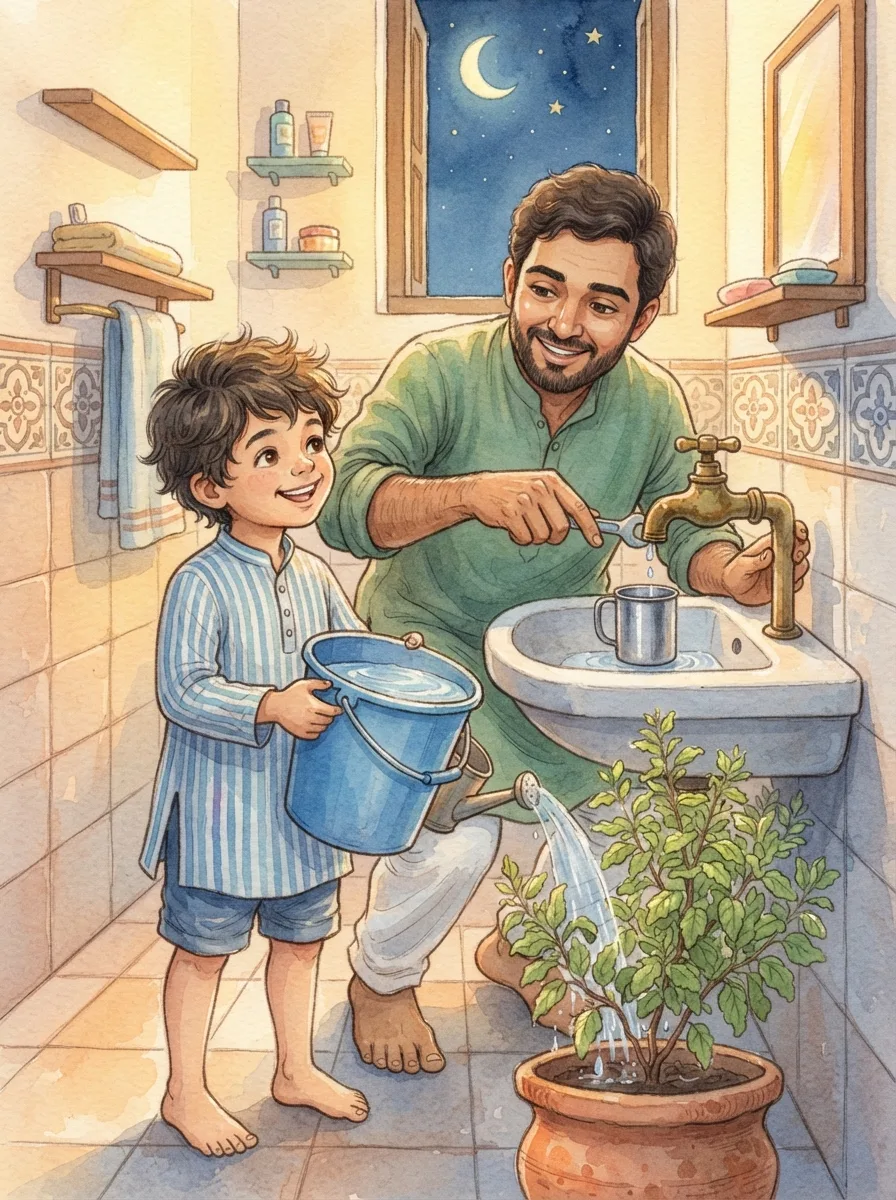
The bathroom tap has been dripping for a week, drop, drop, all night, and everyone says it is just a drip. Your child puts a mug under it before school. By evening the mug is full, and by the next morning the bucket is half full. Your child carries the bucket to Papa. 'This is one day of drip.' Papa looks at the bucket for a long moment, then gets the spanner. The tap is fixed by dinner, and the bucket waters the tulsi.
Lesson: Count the drops and the grown-ups will find the spanner
Caring for Nature
Your child and the Balcony Garden
Your child and the Balcony Garden
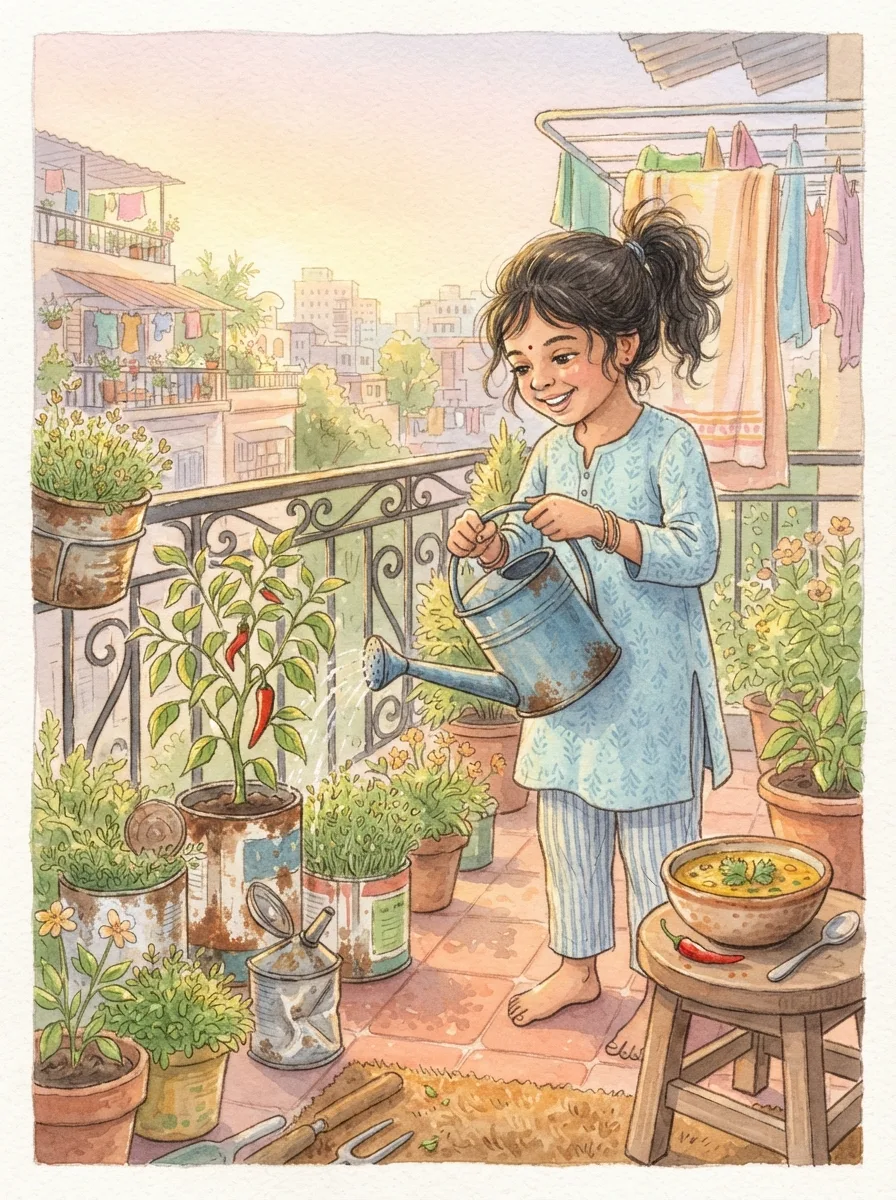
The balcony has nothing on it except the drying rack, and Your child wants green. Amma says there is no space. Your child finds three old paint tins, a cracked bucket and an empty oil can, and Dadi gives methi seeds and a chilli plant. Every morning Your child waters them before school. The methi comes up in a week, thin and bright. In a month the chilli has one red chilli. Amma puts it in the dal and says it is the spiciest chilli she has ever eaten.
Lesson: There is always room for green if you look at old tins differently
Caring for Nature
Your child and the Plastic-Free Tiffin
Your child and the Plastic-Free Tiffin
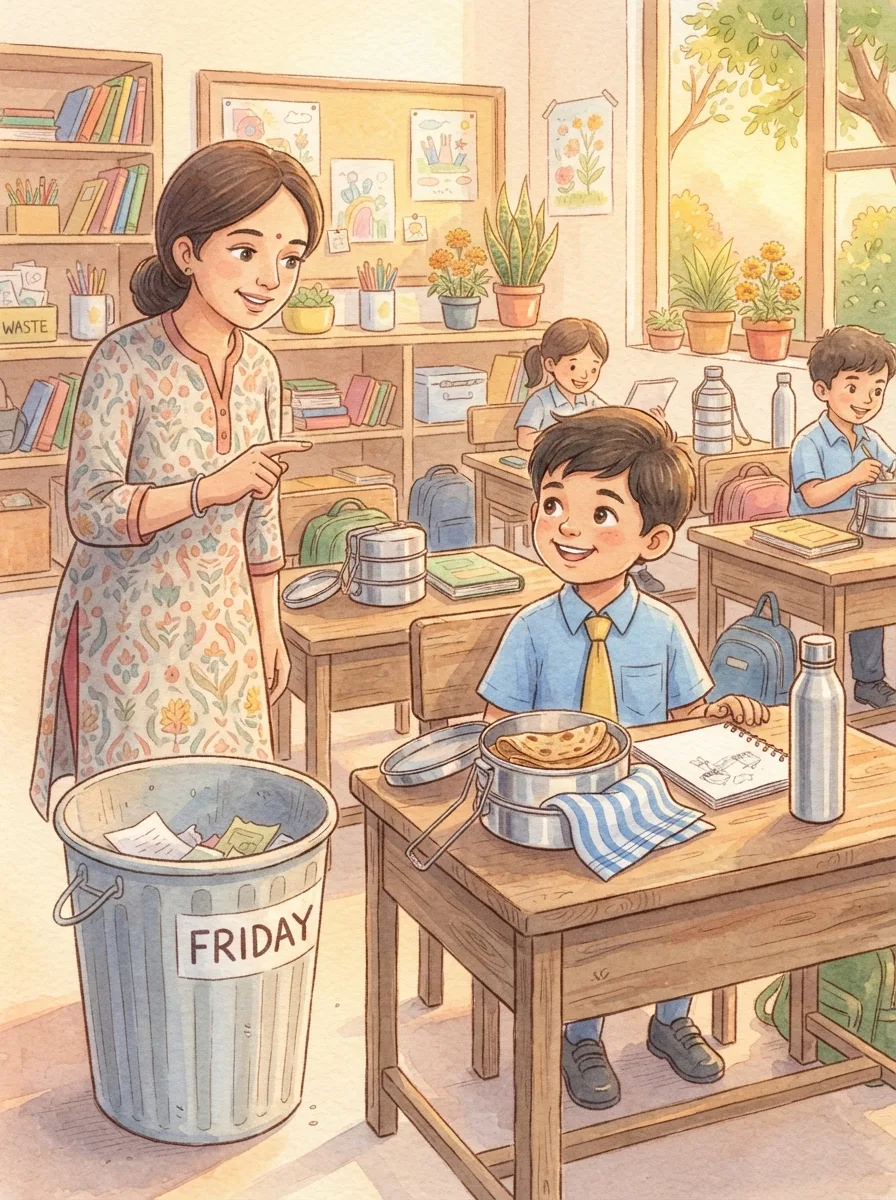
Miss Sharma asks the class to look at the dustbin after lunch. It is full of foil, plastic wrappers and juice boxes. Your child looks at the sandwich wrapper in hand. That night Your child asks Amma for the old steel tiffin from the cupboard and a steel bottle. Amma packs parathas in it, and a cloth napkin. The next day the wrapper is not in the bin because there is no wrapper. By Friday, five friends have steel tiffins too, and the bin is only half full.
Lesson: The bin gets lighter one tiffin at a time
Caring for Nature
Your child and the Sparrow's Water Bowl
Your child and the Sparrow's Water Bowl
It is forty-four degrees in May and Your child sees a sparrow pecking at the dry drain outside the window. Its beak opens and closes. Your child fills a clay bowl with water and puts it on the balcony ledge in the shade, with a stone inside so nothing slips. Nothing comes for a day. Then one sparrow, then six, then a squirrel with its tail up. Your child refills the bowl every morning before it is hot, and the balcony sounds like a tree.
Lesson: In summer, a bowl of water is a whole tree for a bird
Caring for Nature
Your child and the Colony Clean-up
Your child and the Colony Clean-up
The colony park is full of chips packets and the swing seat has a wrapper stuck to it. Everyone complains and nobody moves. On Sunday morning Your child takes two garbage bags and a pair of Papa's gardening gloves and starts alone by the slide. Golu from B block joins. Then his sister. Then the watchman brings a broom. By eleven o'clock there are five full bags, twelve tired children and a park that looks brand new. The next week there is a new dustbin.
Lesson: Start alone by the slide and the colony will come
Caring for Nature
Your child and the Sapling by the Road
Your child and the Sapling by the Road
On the way to school, a small gulmohar sapling is lying by the road, torn out by the roadworks with its roots drying in the sun. Everyone steps around it. Your child wraps the roots in the tiffin napkin and carries it, dirt and all, into class. Miss lets it sit in a cup of water till afternoon. At home Papa helps plant it beside the gate. In three years, Papa says, it will have red flowers. Your child waters it every evening, and counts.
Lesson: A sapling nobody stops for is still alive
Caring for Nature
Your child and the Monsoon Planting
Your child and the Monsoon Planting
In the village, the first monsoon rain turns the field soft, and Dadaji says this is the week to plant. He gives Your child ten neem saplings and a stick to make holes. The cousins want to play in the puddles instead. Your child plants all ten along the field edge, muddy to the knees, with Dadaji naming each one. At the end Your child jumps in the puddle anyway. Next summer, Dadaji sends a photo: ten small neem trees standing in a row like schoolchildren.
Lesson: Plant when the rain comes, and the shade comes later
Caring for Nature
Your child and the Two Dustbins
Your child and the Two Dustbins
The colony gives every flat two dustbins, green for kitchen waste and blue for dry, and in Your child's house everything goes in whichever is nearest. Your child sticks a drawing on each lid, a banana peel on the green and a bottle on the blue. Then every evening Your child checks. Papa gets it wrong twice. Bhaiya gets it wrong five times. By the end of the month the sweeper Didi says the family's bins are the only ones she never has to sort, and Your child draws her a gold star.
Lesson: Sorting the bins at home saves someone else's hands
Caring for Nature
Your child and the Diwali Without Smoke
Your child and the Diwali Without Smoke
Every Diwali the colony fills with cracker smoke until Your child's little sister coughs and the street dog hides under the car for two days. This year Your child has a box of crackers from Mama, and a choice. Your child returns the box for a box of sparklers and diyas, and the money left buys ladoos for the watchman. On Diwali night the balcony glows with fifty diyas, the sparklers make the sister squeal, and the street dog sits at the gate, watching the lights.
Lesson: Light that does not make anyone cough is still Diwali
Caring for Nature
Your child and the Holi With One Bucket
Your child and the Holi With One Bucket
On Holi the colony taps run all morning and the lane becomes a river of coloured water. This year the notice board says the water tank is low. Your child fills one bucket and tells the gang, 'This is our whole Holi.' There is groaning. Then Your child brings out dry gulal and a pichkari with a small squirt. They play for two hours with one bucket and ten packets of colour, and everyone is pink to the ears. In the afternoon the taps still work for the bath.
Lesson: One bucket and lots of colour is enough for a whole Holi
Caring for Nature
Your child and the Cloth Bag at the Market
Your child and the Cloth Bag at the Market
At the sabzi market every seller hands over a thin plastic bag, and Amma's basket ends up full of them. Your child has made a cloth bag in craft class, with a lopsided sun on it. At the tomato stall Your child holds it open and says, 'No polythene, bhaiya, put them here.' The seller grins. At the next stall, the same. By the end, the cloth bag is heavy and there is not one plastic bag. Amma says the sun is the best thing in the market.
Lesson: Hold the cloth bag open before the plastic comes out
Caring for Nature
Your child and the Return Gift Seeds
Your child and the Return Gift Seeds
For Your child's birthday, Amma has bought twenty plastic whistles as return gifts. Your child thinks about last year's whistles, which broke by evening and went in the bin. 'Can we give something that grows?' They fill twenty paper packets with marigold seeds and a small clay pot each. At the party some children look puzzled. A month later, three photos come on Amma's phone: marigolds on three balconies. Then two more. By Diwali, the whole colony has orange flowers from one birthday.
Lesson: The best return gift is one that is still here next year
Caring for Nature
Your child and the Wrapper on the Bus
Your child and the Wrapper on the Bus
On the school bus, the boy in front finishes his chips and flicks the packet out of the window into the hedge. Your child has a toffee wrapper in hand and the window is open. It would be easy. Your child folds the wrapper and puts it in the shirt pocket instead. The boy in front sees. 'Why?' Your child says, 'The hedge did not eat the toffee.' The boy laughs, then at the next stop he gets off and picks up his packet, and keeps it.
Lesson: The hedge did not eat the toffee, so it should not keep the wrapper
Caring for Nature
Your child and the Switch-off Walk
Your child and the Switch-off Walk
The electricity bill comes and Papa sighs. That night Your child walks through the flat and counts: the bathroom light, the balcony light, the fan in the empty room, the television talking to nobody. Seven things on for nobody. Your child switches them all off, then does the same walk every night before bed, calling it the switch-off walk. Bhaiya laughs and then joins. Next month Papa reads the bill twice, and says the switch-off walk has earned an ice cream.
Lesson: Lights on for nobody are a river running for nobody
Caring for Nature
Your child and the Old Peepal Tree
Your child and the Old Peepal Tree
A notice on the colony board says the old peepal by the gate will be cut for a new parking space. Your child has spent every summer in its shade with the koel calling. Your child writes a letter to the colony committee, with a drawing of the tree full of birds, and asks the neighbours to sign. Thirty do. At the meeting Your child reads the letter, voice shaking. The committee decides to put the parking on the other side. The koel does not know how close it came.
Lesson: A shaking voice can still save a tree
Caring for Nature
Sustainability Mission
The planet needs helpers, and Your child is ready to answer the call. From planting gardens to cutting waste and inspiring neighbors to join in, Your child leads a mission to protect the world we share. Along the way, Your child learns that big change begins with small, steady actions, and one caring person can spark a whole community.
Lesson: Individual actions aggregate into collective impact, despair is transformed through strategic action, environmental and social justice are inseparable, and hope is a choice made real through effort.