Teej
Your child and the Swing in the Mango Tree
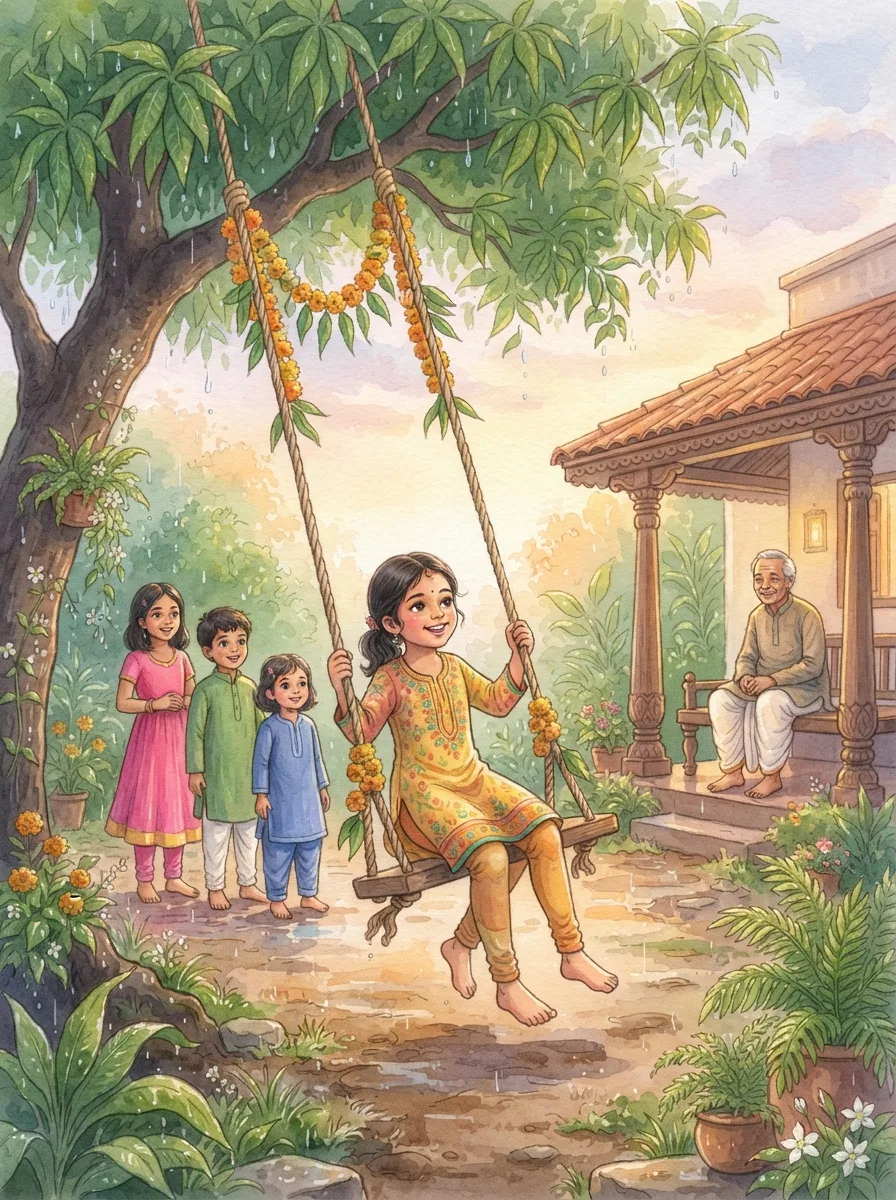
Your child and the Swing in the Mango Tree
It is Hariyali Teej and Dadaji has hung a new rope swing from the old mango tree behind the house. All the cousins want the first turn and the shouting grows louder than the rain. Your child climbs down from the seat and says, 'Youngest first, then everyone gets ten pushes.' The little ones squeal into the wet green leaves, and when Your child's turn finally comes, every cousin lines up to push.
Lesson: The first turn feels best when you give it away
Teej
Your child's First Mehndi Cone
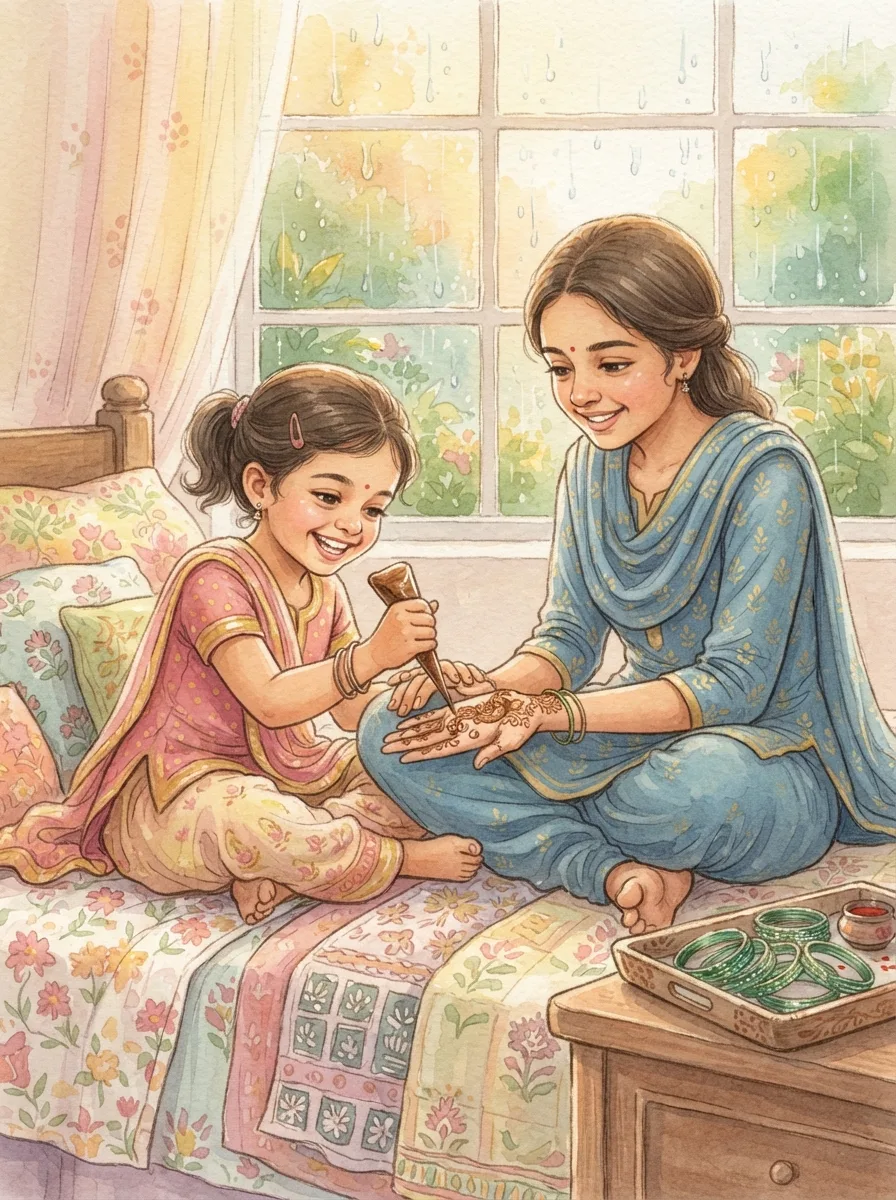
Your child's First Mehndi Cone
The mehndi wali has gone home and Didi's left palm is still empty, with the Teej songs starting next door. Your child picks up the leftover cone, hands trembling. The first leaf comes out fat and wobbly. Didi does not laugh; she says, 'Slow, like the rain on the window.' Your child breathes out and draws a peacock feather, a swing and a tiny sun, and Didi wears the lopsided palm proudly all evening.
Lesson: A wobbly start becomes a pattern if you keep your hand steady
Teej
Your child and the Ghewar for the Whole Lane
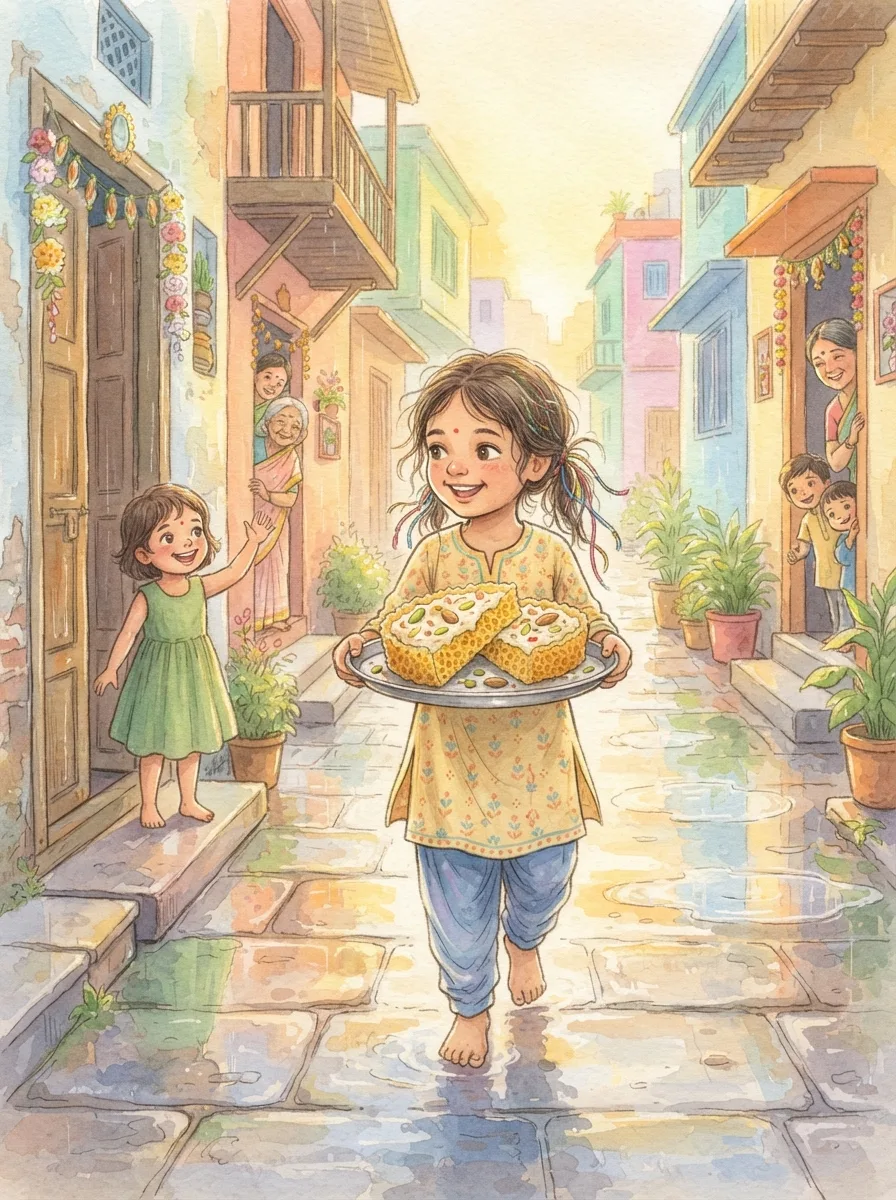
Your child and the Ghewar for the Whole Lane
Amma has bought one big round ghewar dripping with syrup and malai, and Your child wants to eat every crunchy hole of it. Then Your child remembers the watchman's little daughter, who was staring at the sweet shop window this morning. Your child cuts the ghewar into slices like a wheel, keeps one, and carries the plate down the lane, handing out crisp golden pieces until the plate is empty and every hand is sticky.
Lesson: A sweet shared down the whole lane is sweeter than one eaten alone
Teej
Your child and the Green Bangles That Broke
Your child and the Green Bangles That Broke
Nani's box of glass Teej bangles slips out of Your child's hands and three green bangles crack on the floor. Nobody saw. Your child could push the pieces under the bed. Instead, Your child carries the broken bangles to Nani and says, 'I was running with the box.' Nani sweeps them up, then takes Your child to the bangle seller under the peepal tree, and they pick the new set together, one shade greener than before.
Lesson: Owning up turns a broken thing into a new beginning
Teej
Your child at the Jaipur Teej Procession
Your child at the Jaipur Teej Procession
The Teej procession is winding past the Tripolia Gate with camels, elephants, dancers and a golden palanquin carrying the idol of Parvati. In the crowd, Your child loses hold of Papa's hand. Instead of running, Your child does what Papa said: stands still beside a policeman in white gloves and waves the green Teej dupatta high. Papa finds Your child before the last dhol passes, and they watch the palanquin together from his shoulders.
Lesson: When you are lost, standing still is the fastest way home
Teej
Your child and Nani's Fasting Day
Your child and Nani's Fasting Day
On Teej, Nani keeps a fast and still wants to cook the whole feast for the family. Your child notices her sit down twice and rub her knees. Without being asked, Your child washes the coriander, peels the ginger, lays the plates and fans Nani with a folded newspaper when the kitchen grows hot. At sunset, when Nani finally sips water and eats a piece of ghewar, she says Your child cooked half the Teej dinner.
Lesson: Noticing tiredness is the first step of helping
Teej
Your child and the Lehariya Sari Song
Your child and the Lehariya Sari Song
The mohalla women sit on a charpai under a tarpaulin, wearing wave-patterned lehariya saris and singing Teej songs about Parvati waiting patiently through many rains. Your child does not know the words and feels silly. Then Chachi hands Your child the small dholak and says, 'You keep the beat.' Thump by thump, the words come. By the last song, Your child is singing about the swing and the green fields louder than anyone.
Lesson: Join in with what you can and the rest will follow
Teej
Your child and the Story Parvati Told the Rain
Your child and the Story Parvati Told the Rain
Rain drums on the tin roof, and Dadi tells how Parvati prayed through many, many monsoons until she and Shiva were finally together, which is why Teej is a day of patience. Your child has been begging for a puppy for weeks and stamping when the answer is 'not yet'. The next morning, Your child stops stamping and instead fills a bowl of water for the street dogs every day. By the end of the monsoon, one small wet puppy is following Your child home.
Lesson: Patience shown quietly is answered in its own time
Teej
Your child and the Flooded School Swing
Your child and the Flooded School Swing
The school is holding a Teej mela, but the playground swing is standing in ankle-deep rainwater and the teachers are about to cancel the jhoola competition. Your child fetches the sweeper's broom, ropes in three friends, and they push the water towards the drain, then spread dry sand from the long-jump pit. When the swings begin, the smallest children in class one go first, and Your child does the pushing.
Lesson: Fixing the problem is more fun than complaining about it
Teej
Your child and the Shy Bride Next Door
Your child and the Shy Bride Next Door
A new bhabhi has moved in next door and it is her first Teej away from her mother's house. She sits alone on the balcony while the songs go on below. Your child climbs the stairs with a plate of ghewar, a spare green bangle and a rope for the swing. 'Come,' says Your child, 'Amma says you have to push me.' The bhabhi laughs for the first time that day and pushes Your child so high the mango leaves tickle.
Lesson: Someone far from home only needs one person to say come
Teej
Your child and the Green That Came Back
Your child and the Green That Came Back
Dadaji says Hariyali Teej celebrates the earth turning green after the first rains. On the way to the village well, Your child sees that the tulsi and marigold seedlings by the panchayat wall have been trampled by goats. Your child spends the afternoon before the swings building a small fence of sticks and replanting each seedling in the wet mud. A week later Dadaji points at the wall, greener than the fields.
Lesson: The green comes back for those who plant it
Teej
Your child's Teej on the Rajdhani Train
Your child's Teej on the Rajdhani Train
Teej falls while the family is on the overnight train to Jaipur, and there is no swing, no songs, no ghewar. Your child refuses to let the festival pass. A dupatta tied between two upper berths becomes a jhoola for the toddler across the aisle, Amma opens the tiffin of ghewar for the whole compartment, and an old aunty in a green sari teaches everyone a Teej song. The ticket checker claps along.
Lesson: A festival is wherever you decide to celebrate it
Teej
Your child and the Rusty Old Swing
Your child and the Rusty Old Swing
The iron swing in the temple courtyard has been rusting since last Teej, and the pujari says it is too old to use. Your child does not agree. With Bhaiya's help, Your child scrubs the rust with a coconut husk, oils the chains, and ties fresh marigold and mango-leaf garlands on the bars. On Teej evening the pujari swings on it first, laughing, and then every child in the mohalla lines up.
Lesson: Old things shine again when someone cares enough to try
Teej
Your child and the Mehndi That Ran in the Rain
Your child and the Mehndi That Ran in the Rain
Amma's Teej mehndi is drying beautifully when a sudden burst of rain sweeps in through the open door. Half of it smudges. Amma's face falls; she has waited all year. Your child runs for the cone and says, 'I will fix the sad half.' The new half is full of clouds, raindrops and a tiny umbrella. At the Teej gathering, every aunty asks for the same rain design.
Lesson: What goes wrong can be drawn into something new
Teej
Your child and the Highest Swing in the Village
Your child and the Highest Swing in the Village
The Teej swing hung from the giant banyan goes higher than any Your child has seen, and the older boys are daring everyone to swing over the branch. Your child climbs on, feels the rope, and sees it is frayed near the knot. It would be easy to swing a little and look brave. Instead, Your child climbs down and tells Kaka, who replaces the rope. That evening, Your child swings higher than anyone, safely.
Lesson: Speaking up about danger is braver than showing off