Makar Sankranti
Your child and the Kite That Would Not Fly
Your child and the Kite That Would Not Fly
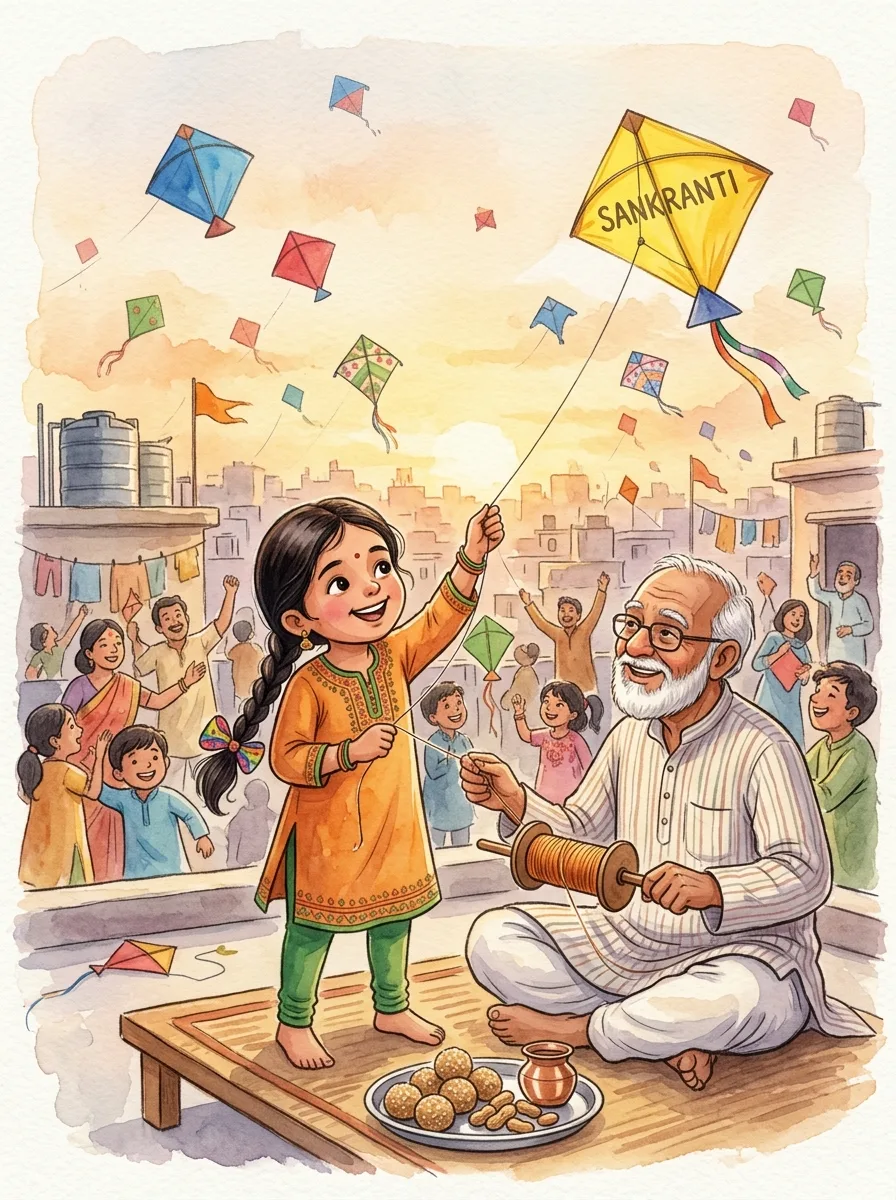
On Makar Sankranti morning every rooftop has a kite in the air except Your child's, which keeps nose-diving into the water tank. Dadaji shows how to loosen the string and wait for the wind instead of tugging. On the third try the yellow kite lifts, wobbles and soars, and Your child whoops loud enough for the whole colony to hear.
Lesson: Patience lets the wind do the lifting
Makar Sankranti
Your child and the Til Laddoo Promise
Your child and the Til Laddoo Promise
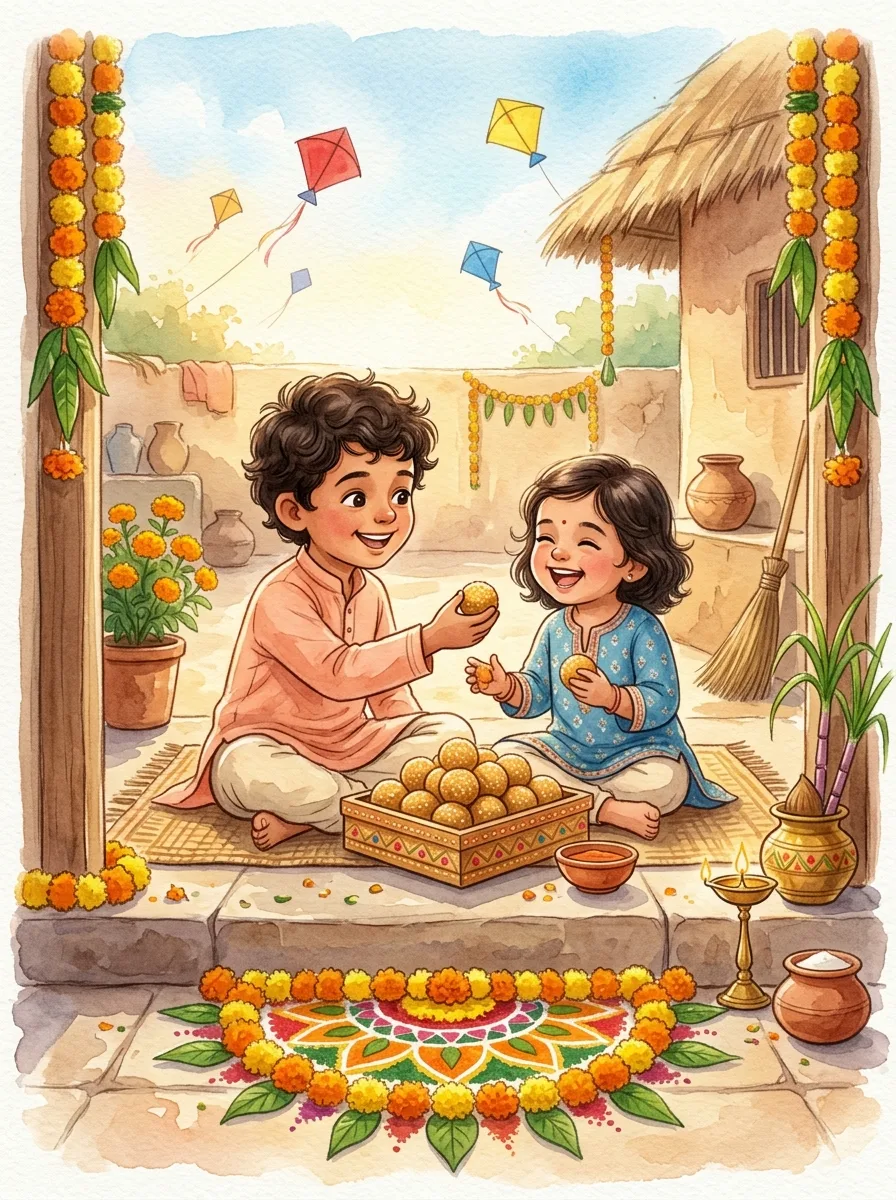
In Maharashtra, Sankranti sweets come with a promise: "tilgul ghya, god god bola", take the sweet and speak sweetly. Your child has been cross with a friend all week. Carrying a box of sesame laddoos next door feels hard, but the friend takes one, smiles, and the quarrel melts like jaggery in the sun.
Lesson: Sweet words mend what a quarrel broke
Makar Sankranti
Your child and the Pongal Pot
Your child and the Pongal Pot
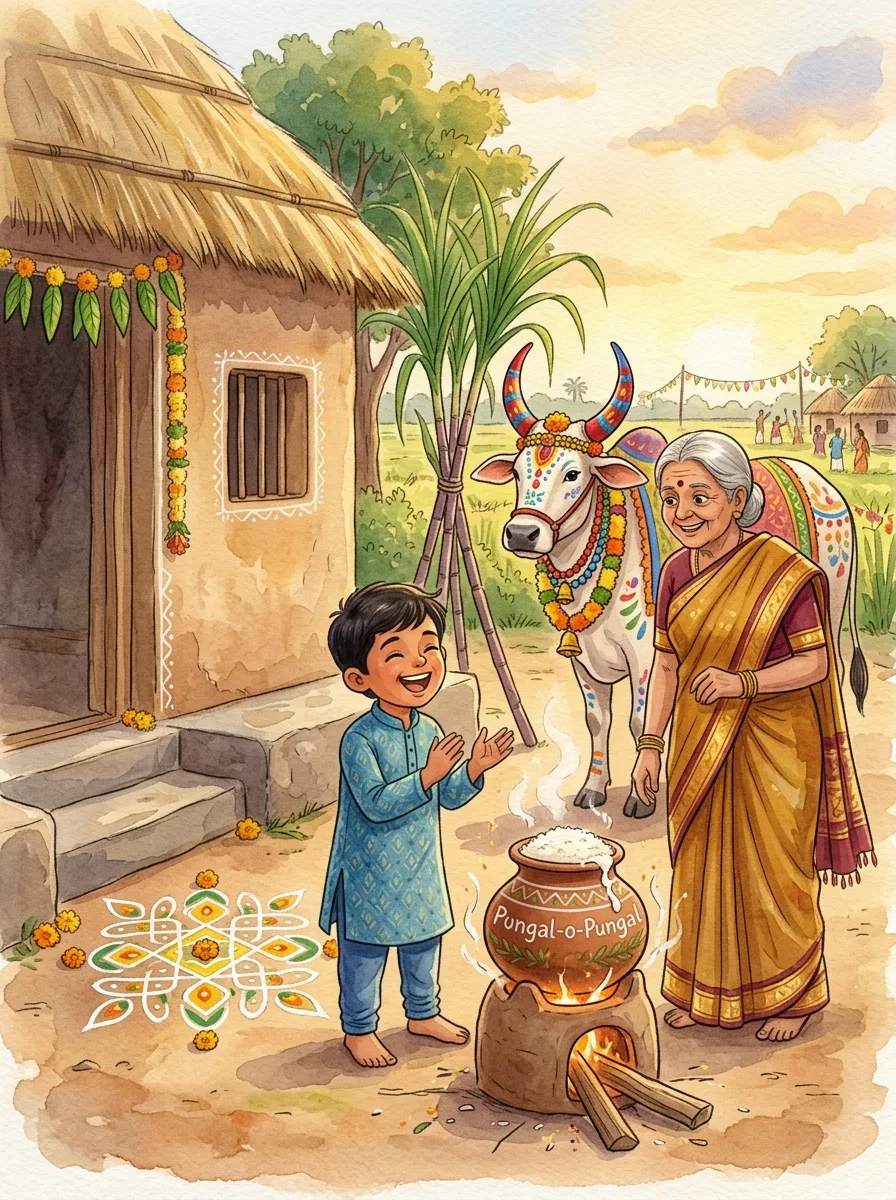
At Paati's house in Tamil Nadu, Sankranti is called Pongal, and the new rice is boiling in a clay pot decorated with turmeric leaves. Everyone waits for the milk to bubble over, because that means the year will overflow with good things. Your child watches so carefully that the shout "Pongalo Pongal!" bursts out of Your child first, and the whole family cheers.
Lesson: Good things come to those who watch and wait
Makar Sankranti
Your child and the Rooftop Kite Battle
Your child and the Rooftop Kite Battle
Every rooftop in the mohalla is shouting 'Kai po che!' as kites dive and cut each other from the winter sky. Your child has the smallest kite of all and keeps losing. Instead of giving up, Your child watches how the wind curls around the water tank and flies low along it. One by one the big kites drift away, and the little paper kite is the last one flying.
Lesson: Watch carefully and even the smallest kite can stay up longest
Makar Sankranti
Your child and the Kite in the Neem Tree
Your child and the Kite in the Neem Tree
A beautiful purple kite has crashed into the neem tree outside Dadaji's house, and a small boy from the next lane is crying below it. Your child knows the rule: a cut kite belongs to whoever catches it. But Your child climbs up carefully, untangles the string from the twigs, and hands the kite straight back to its owner. The two spend the rest of Sankranti flying it together.
Lesson: The fairest rule is the one you would want used on you
Makar Sankranti
Your child and the Bird with the Tangled Wing
Your child and the Bird with the Tangled Wing
On the terrace, Your child finds a pigeon with kite string wound tightly around its wing, too frightened to move. All the cousins are busy with their kites, so Your child fetches Nani's small scissors and a bowl of water and sits very still until the bird stops trembling. Snip by snip the string comes free. When the pigeon flies off, Your child promises to use only plain cotton thread from now on.
Lesson: Kindness means noticing who the celebration might be hurting
Makar Sankranti
Your child and the Bonfire of Lohri
Your child and the Bonfire of Lohri
The night before Sankranti, the whole lane gathers around a Lohri bonfire, tossing in popcorn, peanuts and rewri while the dhol beats. Your child is given the job of walking the circle with the basket. When a shy new neighbour hangs back in the shadows, Your child walks over, hands her the basket and pulls her into the dance. By the last song, she is singing loudest of all.
Lesson: A celebration is only complete when everyone is inside the circle
Makar Sankranti
Your child and the Kolam of a Hundred Dots
Your child and the Kolam of a Hundred Dots
Before dawn on Pongal morning, Amma is drawing a kolam of a hundred rice-flour dots outside the door, and Your child wants to help. The first lines wobble and the dots do not join. Amma does not fix them; she shows Your child how to breathe out slowly as the flour runs between the fingers. By sunrise there is a sun, a pot and a lopsided sugarcane in white powder, and Your child made most of it.
Lesson: Steady hands come from a steady breath, not from hurrying
Makar Sankranti
Your child and the Cow with the Painted Horns
Your child and the Cow with the Painted Horns
On Mattu Pongal, the village cows are washed, garlanded and have their horns painted in bright colours. Your child is given a pot of blue paint and the oldest, gentlest cow, Lakshmi. She keeps swinging her head away. Instead of grabbing her, Your child sings the song Thatha sings at milking time, and Lakshmi goes still. Her horns end up blue with yellow stars, the finest in the village parade.
Lesson: Gentleness gets more done than force
Makar Sankranti
Your child and the First Sugarcane
Your child and the First Sugarcane
The harvest is in and the sugarcane stalks are taller than Your child. Thatha says the first stalk of the year must be shared before anyone eats. Your child carries the long cane through the village, snapping off a piece for the postman, the washerwoman, the temple priest and the stray dog who follows everyone. By the time Your child gets home there is only one small piece left, and it is the sweetest one.
Lesson: What you give away first tastes sweetest in the end
Makar Sankranti
Your child and the Dip in the River at Dawn
Your child and the Dip in the River at Dawn
On Makar Sankranti, Nana takes Your child to the river for the holy dip before sunrise. The water is icy and the steps are crowded, and Your child wants to run straight back to the warm blanket. Then Your child sees Nana wading in slowly, holding his breath and laughing. One deep breath, one brave step, and the cold turns into a bright, tingling joy as the sun rises over the water.
Lesson: The bravest step is usually the first cold one
Makar Sankranti
Your child and the Chikki That Would Not Set
Your child and the Chikki That Would Not Set
Nani is making peanut chikki for the whole building and the jaggery keeps going soft instead of crisp. Your child, who has watched three batches fail, remembers the cold steel plate on the balcony. Nani pours the next batch onto it, Your child rolls it flat, and it snaps perfectly. Together they cut squares for every flat on every floor, and the lift smells of jaggery all day.
Lesson: Watching closely is its own kind of helping
Makar Sankranti
Your child and the Bihu Drum
Your child and the Bihu Drum
In Assam it is Magh Bihu, and the village is building a straw meji house to burn at dawn while everyone feasts. Your child is asked to keep the beat on the dhol while the elders stack the straw, but the rhythm keeps racing ahead. An old drummer places Your child's palm on the drumskin and says: listen to the people carrying, not to your own hurry. The straw rises in time, and so does the sun.
Lesson: A good rhythm follows the people who need it
Makar Sankranti
Your child and Nani's Sesame Seeds
Your child and Nani's Sesame Seeds
Nani hands Your child a laddoo and says 'Til gul ghya, god god bola,' which means eat sweet and speak sweet. Your child has been quarrelling with a cousin all week. Instead of eating the laddoo, Your child walks across the courtyard, offers it with both hands, and says the words. The cousin breaks it in half. By afternoon they are flying one kite between them.
Lesson: A sweet word offered first can end a long quarrel
Makar Sankranti
Your child and the Lost Spool of Thread
Your child and the Lost Spool of Thread
The big kite is ready but the spool of thread has vanished, and Papa is sure it was on the parapet a minute ago. Everyone blames the wind. Your child follows a thin white line across the terrace, over the wall and down to where a puppy has wound it happily around three flowerpots. Instead of scolding, Your child winds it back slowly, and the puppy becomes the family's kite-flying mascot.
Lesson: Follow the thread patiently and most mysteries unravel