Baisakhi
Your child and the Golden Wheat Field
Your child and the Golden Wheat Field
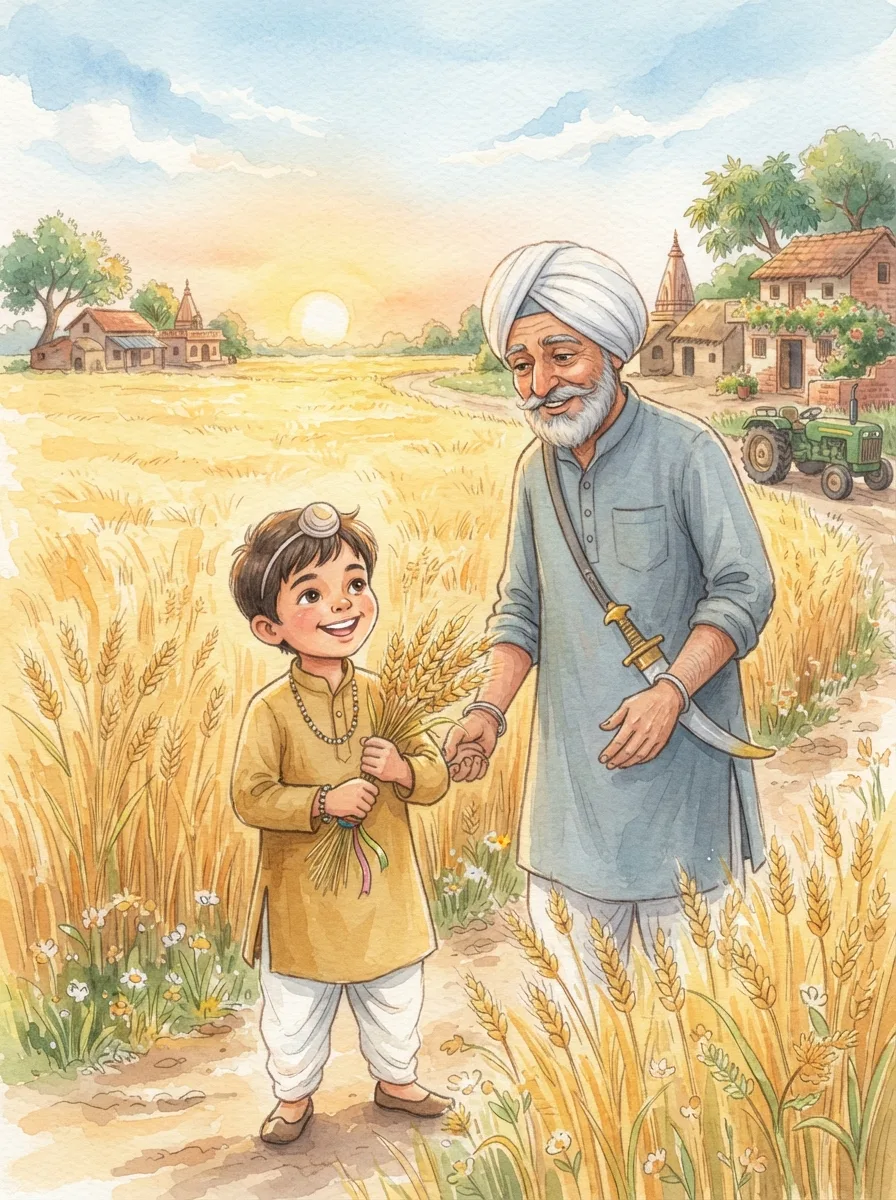
The wheat around Dadaji's village has turned the colour of honey, and on Baisakhi morning everyone goes out to cut the first sheaf. Your child is given a small sickle and a corner of the field. The stalks are stubborn and the sun is hot, but Your child keeps going until a tidy little bundle is tied with string. Dadaji lifts it high and says, 'The first sheaf of the year!'
Lesson: Work with patience and the field will give back
Baisakhi
Your child and the Langar Ladle
Your child and the Langar Ladle
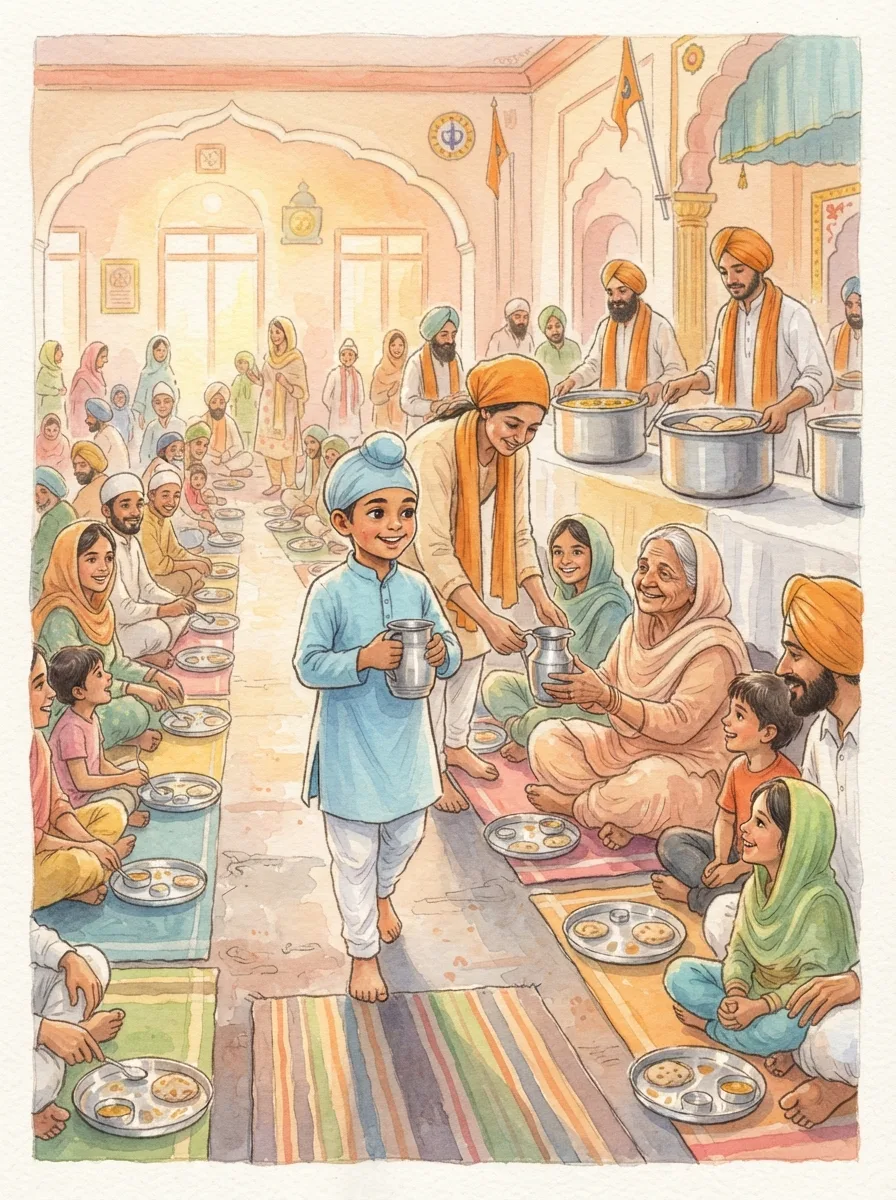
The gurdwara langar on Baisakhi feeds thousands, and Your child wants to help but is told the ladles are too heavy. So Your child finds another job: walking down the long rows with a jug of water, filling every steel glass. When an old lady cannot reach hers, Your child kneels down and holds it for her. She pats Your child's head and calls it the sweetest water she has tasted.
Lesson: There is always a way to serve if you look for one
Baisakhi
Your child's First Dhol Beat
Your child's First Dhol Beat
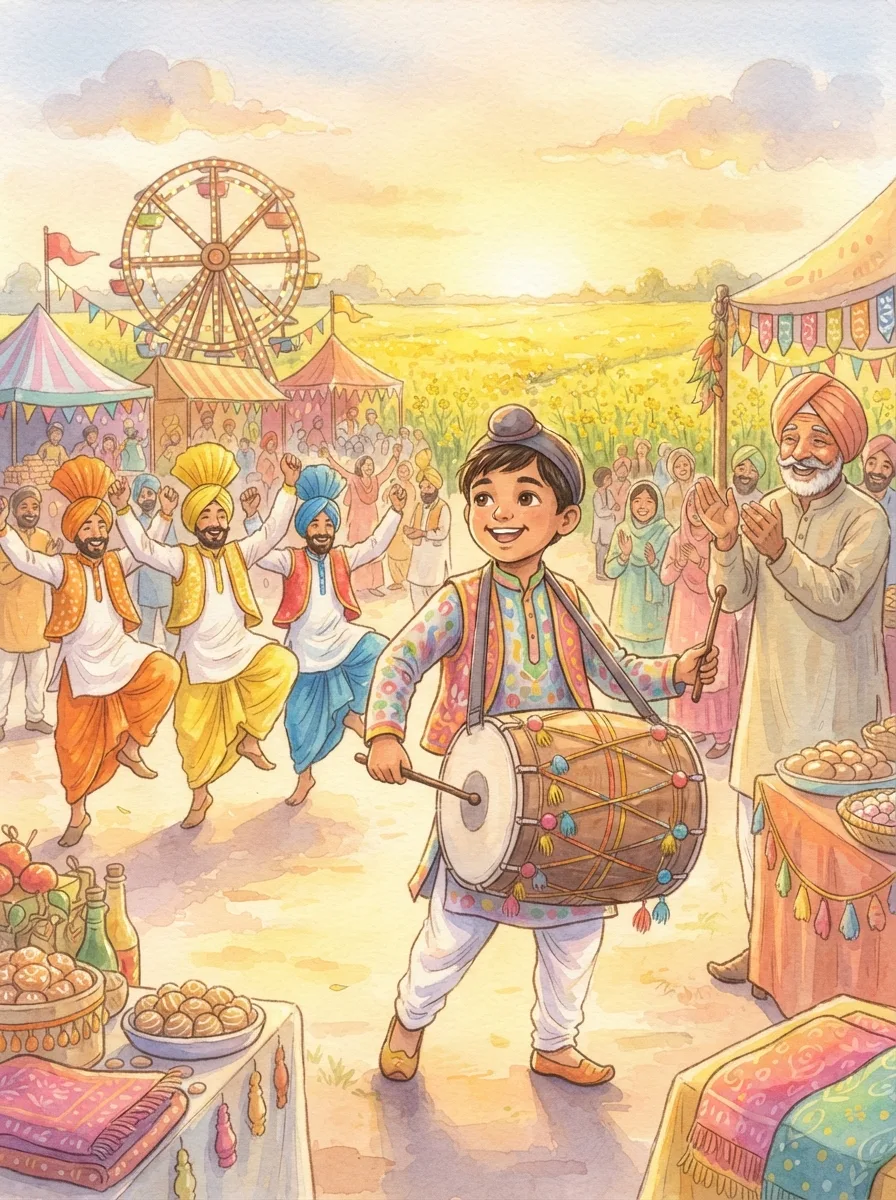
Mamaji plays the dhol at every Baisakhi mela, and this year he hands Your child the sticks. The first thumps are all wrong, and the bhangra dancers stumble and laugh. Your child's cheeks burn, but Mamaji says, 'Listen to your heart, it already knows the beat.' Your child closes both eyes, listens and plays again. This time the dancers leap up shouting 'Balle balle!'
Lesson: Listen before you play and the rhythm will come
Baisakhi
Your child and the Nagar Kirtan Flag
Your child and the Nagar Kirtan Flag
The Nagar Kirtan procession winds through the mohalla with singing, sweepers washing the road and the Panj Pyare walking ahead. Your child is holding a little saffron flag when a gust snatches it and drops it in a puddle. A small girl nearby has lost hers too. Your child rinses the flag, wrings it out, and holds it high so both of them can carry it together.
Lesson: A flag held by two hands flies just as proud
Baisakhi
Your child and the Kada Prasad Bowl
Your child and the Kada Prasad Bowl
Warm kada prasad is placed in Your child's cupped hands at the gurdwara, sweet and glistening with ghee. Outside, Your child's cousin is sulking because he arrived too late and the line is closed. Your child looks at the prasad, then walks over and shares exactly half. The cousin's frown melts. 'Prasad tastes best when it is halved,' says Nani, watching from the steps.
Lesson: What is given to you is meant to be passed on
Baisakhi
Your child and the Phulkari Dupatta
Your child and the Phulkari Dupatta
Nani's old phulkari dupatta, embroidered with a garden of orange and pink flowers, is to be worn at the Baisakhi gathering. But one corner has torn. Nani's eyes are weak now, so Your child threads the needle, matches the colours and stitches a small new flower over the tear. At the mela, everyone asks who embroidered the brightest flower, and Nani points at Your child.
Lesson: Old things stay beautiful when young hands care for them
Baisakhi
Your child and the Giddha Circle
Your child and the Giddha Circle
The women and girls of the village form a giddha circle, clapping and singing bolis while one dancer after another steps into the middle. Your child's Didi is too shy to go in, though she has practised for weeks. Your child takes her hand, steps into the circle first and begins the clapping. Didi follows, spins, and the circle roars with 'Shava shava!'
Lesson: Sometimes courage means going first so a friend can follow
Baisakhi
Your child and the Story of the Five Brave Ones
Your child and the Story of the Five Brave Ones
On Baisakhi night Dadaji tells Your child how, long ago, Guru Gobind Singh asked for the brave and five ordinary people stood up one by one, becoming the first Khalsa. The next day at school, a bigger boy is teasing a quiet new classmate. Nobody moves. Your child remembers the five who stood up, walks over and says, 'Come, sit with us.'
Lesson: One person standing up gives others the courage to stand too
Baisakhi
Your child and the Kite over the Mustard Fields
Your child and the Kite over the Mustard Fields
In Papa's hometown, Baisakhi means kites. Your child has a bright blue kite and the sky is full of rivals. When the string of a little cousin's kite snaps and it floats down into the yellow mustard field, Your child winds in the blue kite, wades through the flowers to find the lost one, and comes back with pollen-dusted hair and two kites.
Lesson: Winning the sky matters less than bringing a friend's kite home
Baisakhi
Your child and the City Baisakhi
Your child and the City Baisakhi
Living in a tall Mumbai building, Your child misses the fields of Punjab that Dadi describes. So Your child convinces the neighbours to hold a Baisakhi evening on the terrace: a pot of wheat sprouts in the corner, a small dhol borrowed from the watchman, and everyone bringing one dish. When Dadi hears the first drumbeat above the traffic, her eyes fill with happy tears.
Lesson: Home is wherever you bring the festival with you
Baisakhi
Your child and the Tractor Parade
Your child and the Tractor Parade
The village tractors are decorated with marigolds and ribbons for the Baisakhi parade, and Your child gets to ride on the very first one. Halfway down the road, Your child spots a puppy trembling in the path. 'Stop!' shouts Your child, and the whole parade halts while the puppy is lifted to safety. It rides the rest of the way in Your child's lap.
Lesson: Never be too busy celebrating to notice the small and scared
Baisakhi
Your child and the Lassi Stall
Your child and the Lassi Stall
At the Baisakhi mela, Bua runs a lassi stall and the line is long. Your child helps by churning the curd until arms ache. A boy at the back of the line has only two rupees, not enough for a glass. Your child quietly pours a small glass, tops it with a dollop of malai and passes it over. Bua sees, and pours Your child one too.
Lesson: Kindness poured out always comes back full
Baisakhi
Your child and the Grain for the Birds
Your child and the Grain for the Birds
After the harvest, Dadaji fills a sack with wheat to sell in the mandi. Your child notices the sparrows and pigeons pecking hopelessly at the empty stubble. Instead of asking for sweets, Your child asks Dadaji for one small bowl of grain from the sack and scatters it on the flat roof every morning of the festival week. Soon the roof is alive with birdsong.
Lesson: A good harvest is one that leaves something for everyone
Baisakhi
Your child and the Forgotten Shoes
Your child and the Forgotten Shoes
Outside the gurdwara on Baisakhi, hundreds of shoes are lined up in the joda ghar. Your child is asked to help hand them back and gets a pair mixed up, and a grandfather leaves wearing the wrong chappals. Your child could say nothing. Instead Your child runs after him down the crowded lane, apologises, and swaps them. He laughs and gifts Your child a warm jalebi.
Lesson: Owning a mistake quickly turns it into a small one
Baisakhi
Your child and the Bhangra at the School Fair
Your child and the Bhangra at the School Fair
The school Baisakhi fair has a bhangra contest, and Your child's team has practised for weeks. At the last moment their lead dancer twists an ankle and cries. Your child gives up the centre spot, sits beside her with an ice pack and cheers so loudly the rest of the team dances better than ever. They win second place, and Your child hands the medal to the injured friend.
Lesson: A true team member shines from the side too