Guru Nanak
Your child and the True Bargain
Your child and the True Bargain
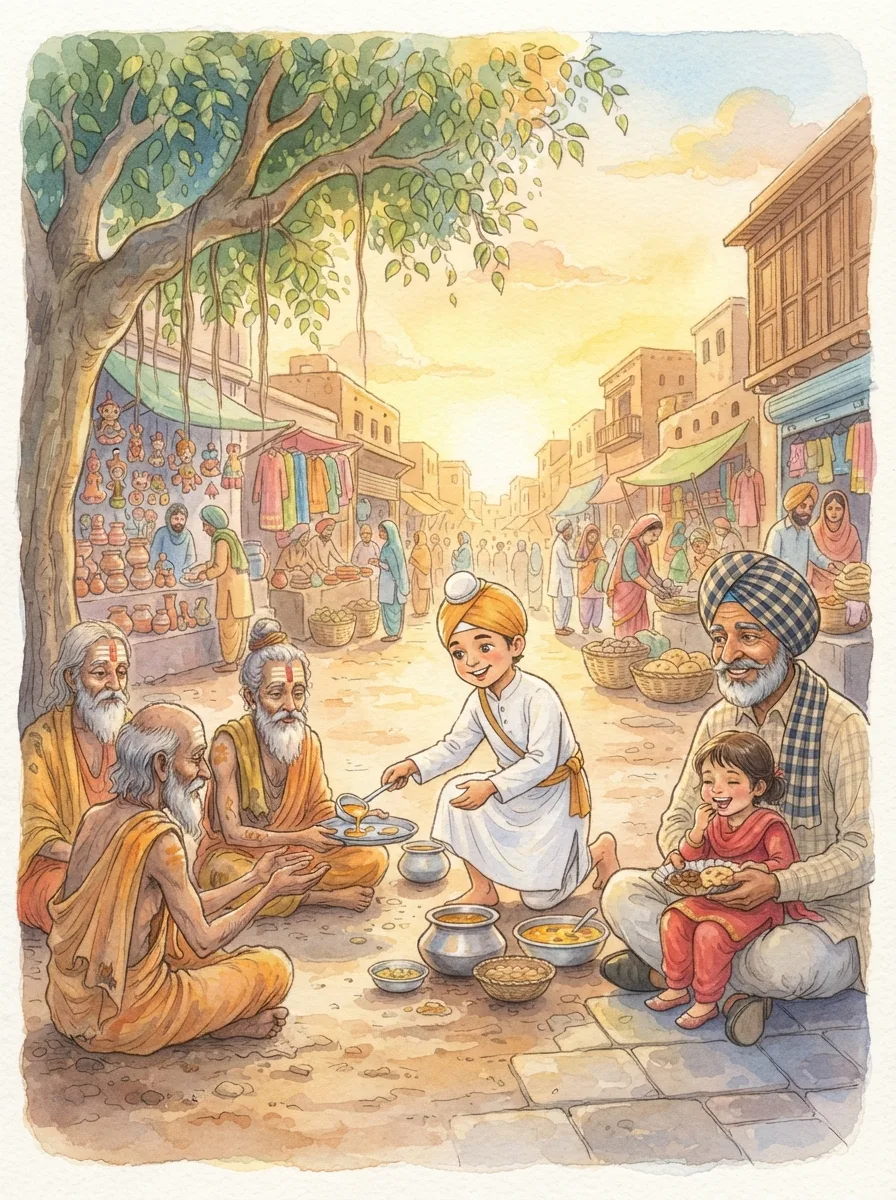
Young Nanak is given twenty rupees to trade and spends them all feeding hungry sadhus, calling it the sacha sauda, the true bargain. Dadaji tells Your child this on the way to the market with fifty rupees for a toy. At the gate an old man is selling nothing and eating nothing. Your child buys him a plate of chhole kulche and comes home without a toy but with a bargain Dadaji calls the best of the year.
Lesson: The truest bargain is the one that fills another's plate
Guru Nanak
Your child and Bhai Lalo's Honest Bread
Your child and Bhai Lalo's Honest Bread
Guru Nanak refuses the rich Malik Bhago's feast and eats at the carpenter Bhai Lalo's home, because honest work makes honest bread. Your child hears the sakhi at the gurdwara. On Sunday two birthday parties fall on the same day: one with a bouncy castle at a big hotel, and one at the watchman's room with jalebis. Your child chooses the watchman's daughter's party, and the jalebis taste like Bhai Lalo's roti.
Lesson: Honest bread from a humble kitchen is the sweetest
Guru Nanak
Your child and the Cobra Shade in the Field
Your child and the Cobra Shade in the Field
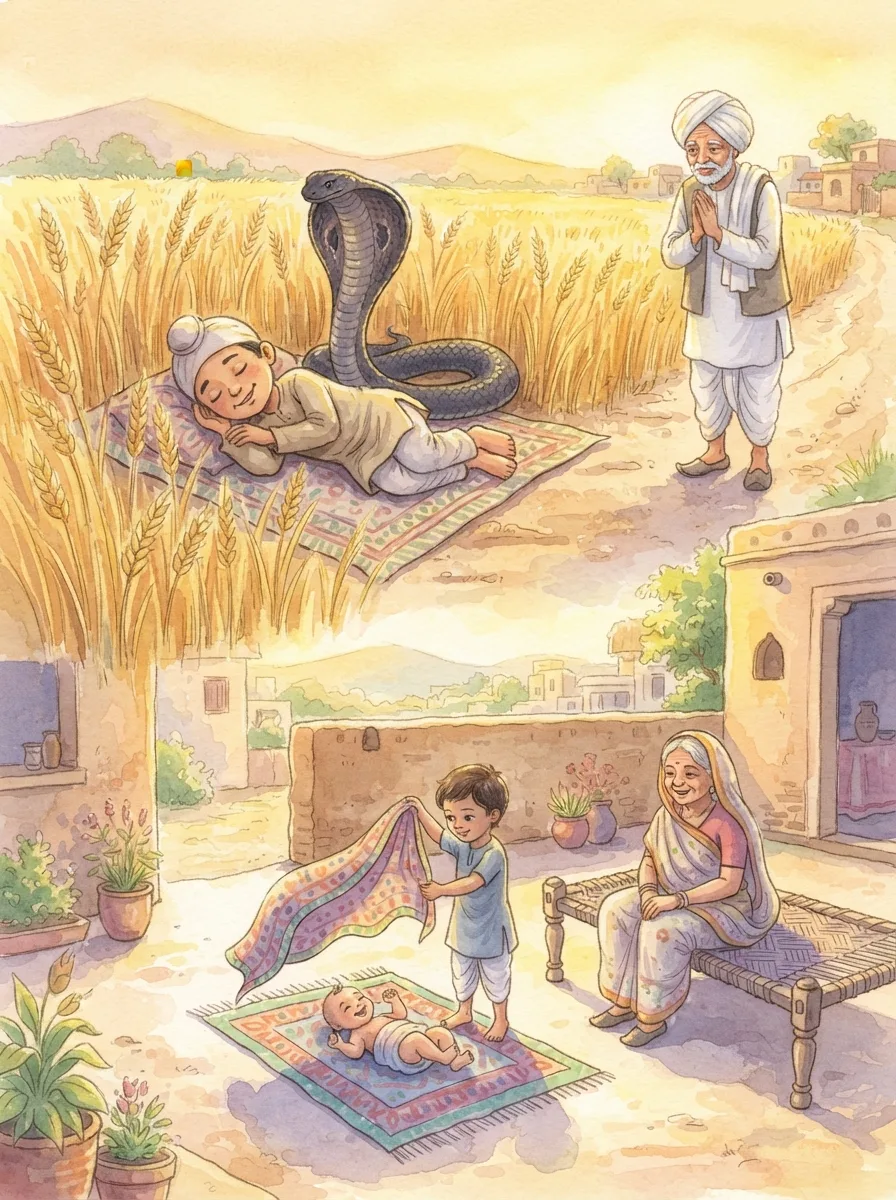
Young Nanak fell asleep in the field and a cobra spread its hood to shade his face from the sun, and the village headman saw and knew the boy was special. Your child hears this from Nani while the cousins nap in the courtyard. When the sun creeps onto baby Simran's face, Your child stands with a dupatta stretched out like a hood until Amma returns, and Nani says the cobra has a helper now.
Lesson: Be the shade for someone who is sleeping
Guru Nanak
Your child and the Boulder at the Spring
Your child and the Boulder at the Spring
Wali Kandhari refuses water to thirsty Mardana from his hilltop spring, and when Guru Nanak lifts a stone and a new spring flows below, the angry man rolls a boulder down; the Guru stops it with his palm, and the mark remains at Panja Sahib. Your child hears this and thinks of the school water cooler, which the big boys crowd around so the small ones cannot reach. Your child makes a queue with the little ones first, and the crowd melts.
Lesson: Water belongs to everyone, so make sure the smallest drink first
Guru Nanak
Your child and Mardana's Rabab
Your child and Mardana's Rabab
Wherever Guru Nanak walked, his friend Mardana played the rabab and the Guru sang, and people of every faith stopped to listen. Your child hears this at kirtan, where the old ragi's rabab string snaps mid-shabad. Your child runs to the storeroom, finds the spare string box, and holds the instrument steady while he restrings it. The shabad continues, and the ragi lets Your child pluck the last note.
Lesson: Keep the music going and everyone will keep listening
Guru Nanak
Your child and the River That Gave Him Back
Your child and the River That Gave Him Back
At Sultanpur, Nanak went into the river Bein to bathe and did not come back for three days; everyone feared the worst, but he returned quiet and shining, saying, 'There is no Hindu, no Muslim, only one.' Dadaji tells Your child this at the ghat. Later, when the class divides itself into groups by religion for a picnic, Your child puts all the names into one bowl and draws mixed teams, and the picnic is the best one yet.
Lesson: There is no this side and that side, only one
Guru Nanak
Your child's Ek Onkar Drawing
Your child's Ek Onkar Drawing
Ek Onkar, the first words of the Guru's teaching, mean there is one creator of everyone. Your child paints the symbol for the school assembly and Bhaiya says it is only for Sikhs. Your child asks Dadi, who explains that one means everyone, so nothing is only for anyone. Your child adds a mosque, a temple, a church and a gurdwara around the symbol, all the same size, and the principal keeps the painting on her wall.
Lesson: One means everyone, so nothing is only for some
Guru Nanak
Your child in the Langar Line
Your child in the Langar Line
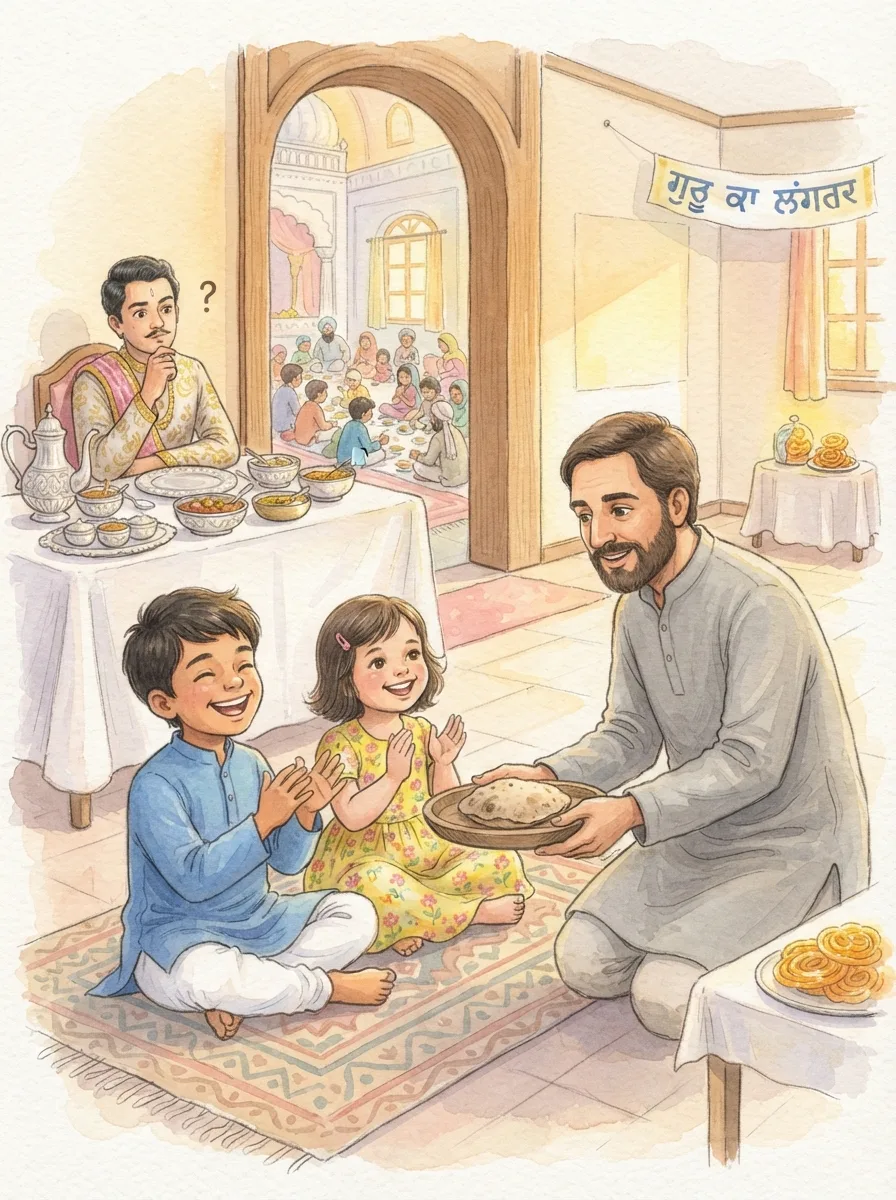
In the langar everyone sits in a row on the floor, rich and poor, and eats the same dal and roti, because the Guru said nobody should sit higher than anyone else. Your child is serving roti for the first time. A man in a torn shirt hesitates at the door, unsure he may enter. Your child walks over, folds hands, and leads him to a seat right next to the doctor from the colony. Both ask for seconds.
Lesson: In the same row, on the same floor, everyone is equal
Guru Nanak
Your child and the Shoes at the Door
Your child and the Shoes at the Door
Sewa means service, and the humblest sewa at a gurdwara is cleaning the shoes at the door. Your child wants to do the important job of serving kheer, but Papa puts Your child on shoe duty. Your child is grumpy at first, then notices an old man struggling to find his slippers and helps him, then another, then a child. By the end Your child knows every pair, and the kheer tastes better for the work.
Lesson: The humblest sewa is where you learn the most
Guru Nanak
Your child and the Fields That Were Not Eaten
Your child and the Fields That Were Not Eaten
Young Nanak was sent to watch the buffaloes, but he sat lost in thought while they grazed the neighbour's field; when the angry farmer came, the field stood whole and green. Nani tells Your child this before asking Your child to mind the goats at the village. Your child does not daydream; Your child watches carefully and steers the goats away from the neighbour's brinjal patch, and the farmer sends over a basket of brinjals as thanks.
Lesson: Mind what you are given to mind and the neighbour will thank you
Guru Nanak
Your child and the Feet That Pointed at God
Your child and the Feet That Pointed at God
In Mecca, Guru Nanak slept with his feet toward the holy place and was scolded; he asked the man to turn his feet toward where God was not, and the man found there was no such place. Dadaji tells Your child this when Your child mocks a classmate for praying differently. Your child thinks about it all evening, apologises to Ayesha the next day, and asks her to teach the words of her prayer.
Lesson: There is no direction where God is not, so respect every prayer
Guru Nanak
Your child's Gurpurab Prabhat Pheri
Your child's Gurpurab Prabhat Pheri
Before dawn on Gurpurab the prabhat pheri walks through the mohalla singing shabads, and Your child is allowed to carry the lantern for the first time. Halfway, Your child sees Mrs Iyer, who is not Sikh, standing at her gate wishing she could join but shy. Your child holds out the lantern and says, 'Everyone walks.' Mrs Iyer walks the whole route humming, and brings pongal for the langar that afternoon.
Lesson: Hold out the lantern and everyone can walk
Guru Nanak
Your child and the One Who Shared the Quilt
Your child and the One Who Shared the Quilt
Guru Nanak's three teachings are naam japo, kirat karo, vand chhako: remember, work honestly, share what you have. Your child learns them at the gurdwara school in winter. That night, sleeping over at a cousin's house, there is only one thick quilt for three children. Your child spreads it across all three and tucks the edges, and the three sleep warm together till morning.
Lesson: Vand chhako: whatever you have, spread it so all are warm
Guru Nanak
Your child and the Lost Buffalo at Talwandi
Your child and the Lost Buffalo at Talwandi
A sakhi says young Nanak once spent a whole day searching for a neighbour's lost buffalo before he would eat, because someone's worry was more important than his own hunger. Your child hears this from the school bus driver, Sardar Uncle. That afternoon, when a classmate's puppy goes missing near the school, Your child skips the canteen and searches every corner of the playground until the puppy is found under the slide.
Lesson: Another's worry comes before your own hunger
Guru Nanak
Your child and the Honest Scale of Sultanpur
Your child and the Honest Scale of Sultanpur
At the Sultanpur storehouse, Nanak weighed grain for the poor, and when he reached the number thirteen, tera, he kept saying 'tera, tera,' meaning 'yours, yours,' and gave and gave. Your child hears this while helping Amma run the Diwali stall. A little boy's coins are two rupees short for a diya. Your child says 'tera' softly, and gives it to him anyway, and Amma adds two rupees from her own purse without a word.
Lesson: Weigh honestly, and when you can, say tera and give