Republic Day
Your child and the Flag That Would Not Open
Your child and the Flag That Would Not Open
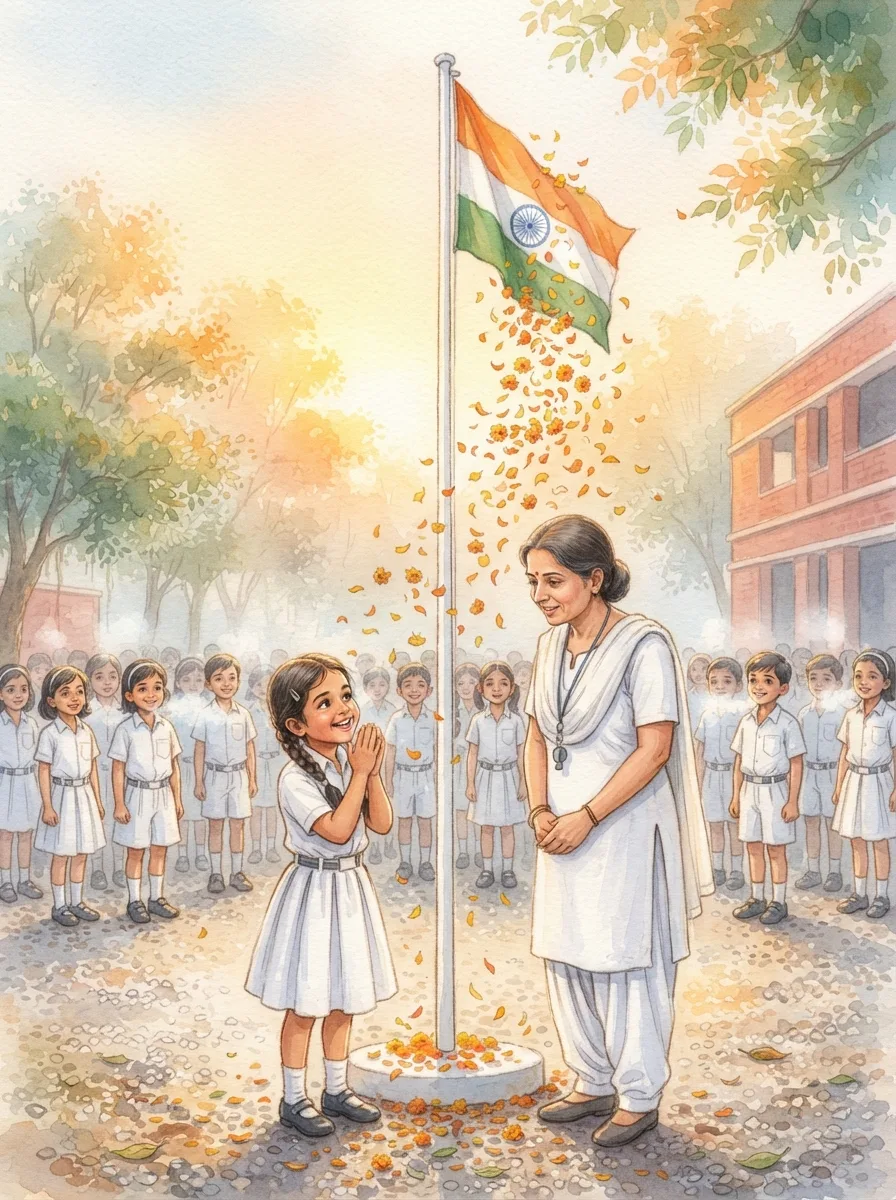
On the school ground at eight in the morning, everyone's breath comes out white. The principal pulls the rope, the tricolour rises to the top of the pole, and stays in a tight bundle. Nobody moves. Your child, standing in the front row, remembers Papa saying the flag opens when the rope is tugged sideways. Your child whispers it to the PT sir. One sideways tug, and petals fall out with the flag as it unfurls over the whole school.
Lesson: Speak up when you know something that helps
Republic Day
Your child's Tricolour from Three Dupattas
Your child's Tricolour from Three Dupattas
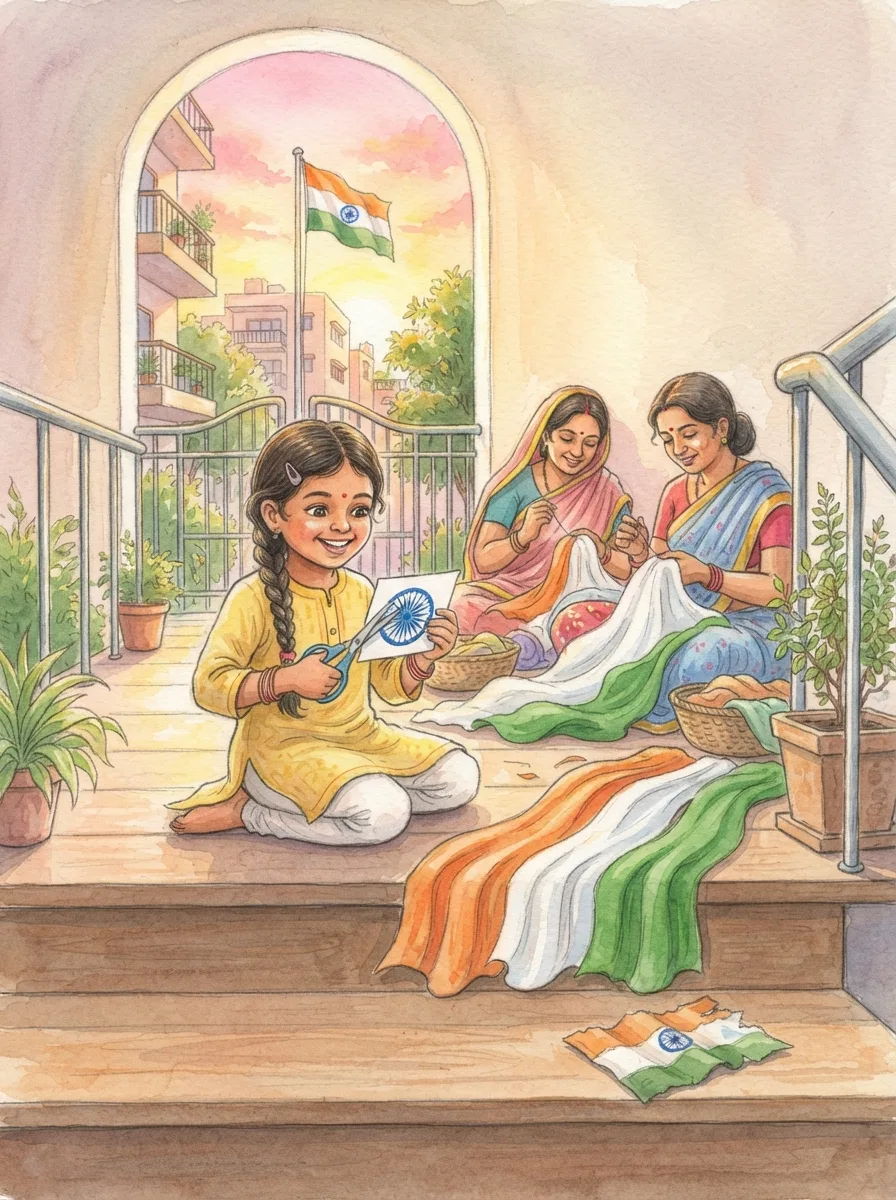
The colony flag has torn in the wind the night before Republic Day and every shop is shut. Your child runs upstairs and comes back with Mumma's saffron dupatta, Dadi's white one and Chachi's green one. The ladies of the building stitch them together on the landing while Your child cuts a chakra from blue chart paper. At sunrise the cloth flag rises over the gate, and the wind makes it look like it is dancing.
Lesson: What you need is often already at home
Republic Day
Your child and Dadaji's Big Book
Your child and Dadaji's Big Book
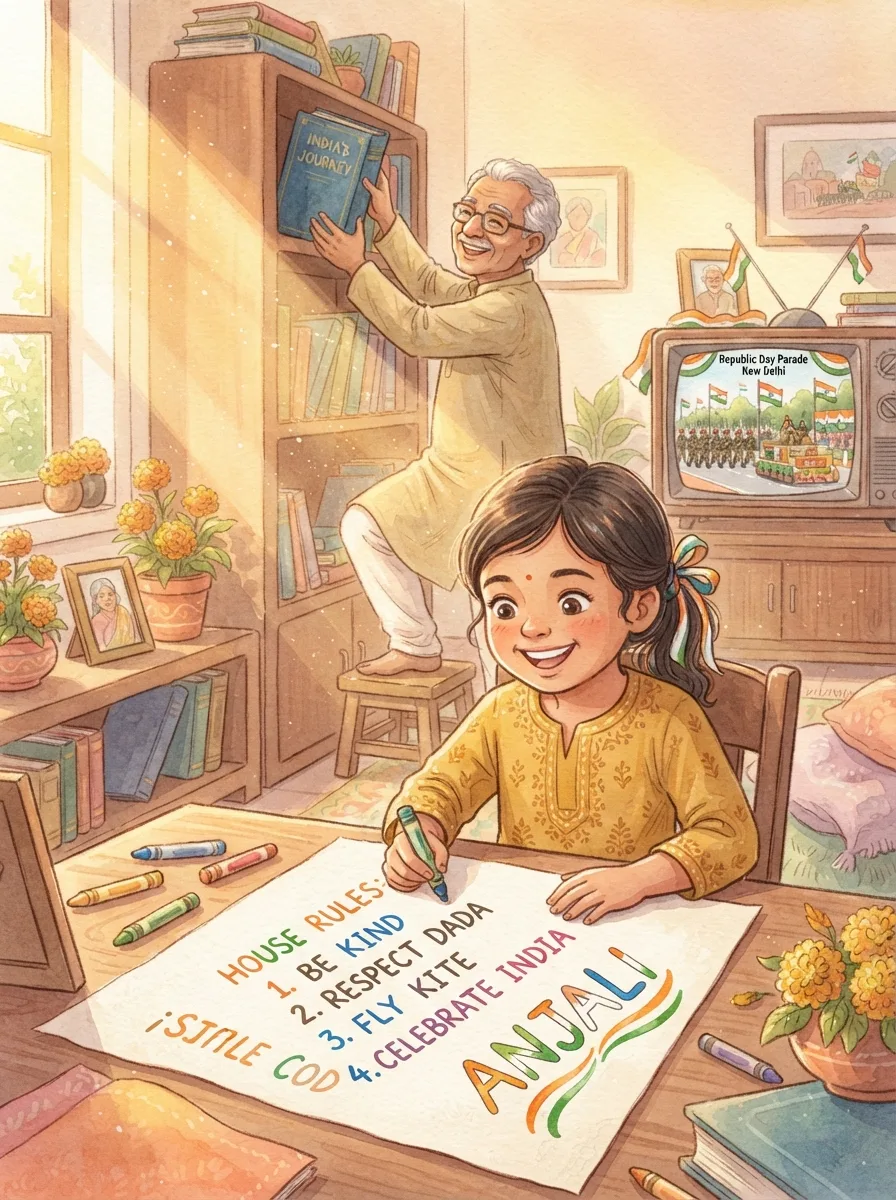
The TV keeps saying the word Constitution and Your child wants to know what it is. Dadaji brings down a thick book from the top shelf and blows off the dust. He explains it as the rule book that every person in India agreed to, like the rules of a game that everyone plays fairly. Together they make a small Constitution for the house: no shouting, share the last laddoo, everyone gets a turn on the swing. Your child signs it first.
Lesson: Fair rules that everyone agrees to keep everyone safe
Republic Day
Your child and the Parade on the Old TV
Your child and the Parade on the Old TV
In Nana's village house the old TV shows the parade only in stripes of colour. Your child bangs the side of it, the way Nana does, and the picture clears just as the camels come marching in a line. The whole family crowds in front of the screen. Nana names every state as its tableau rolls past, and Your child fetches the atlas and finds each one on the map, from Kerala's boats to Assam's tea gardens.
Lesson: A country is made of many places and every one belongs
Republic Day
Your child and the Jalebi for the Guard
Your child and the Jalebi for the Guard
After the colony flag hoisting, everyone gets a cone of hot jalebi from the big kadhai at the gate. Your child gets a cone and notices that Ramu kaka, the guard who tied the flag to the pole before anyone woke up, has none, because he is still standing at his post. Your child walks over with the paper cone and holds it up. Ramu kaka salutes, then takes one jalebi, then two. They eat the rest together at the gate.
Lesson: Look for the one who did the work and was forgotten
Republic Day
Your child and the Bicycle with a Flag
Your child and the Bicycle with a Flag
Bhaiya says the children of the lane should have their own parade. Your child ties a small paper flag to the bicycle handlebar, then a second one to the carrier, and rings the bell in time with the band music from the TV. Six cycles follow, one with a drum tied to it. They ride from the temple to the well and back while the aunties clap from their doorways. The cycles go slow, because a parade is not a race.
Lesson: The smallest parade is still a parade if you do it with heart
Republic Day
Your child's Paper Cap for the Whole Class
Your child's Paper Cap for the Whole Class
The class is told to come in white for Republic Day, but half the children have no white clothes. Your child learns from Didi how to fold a paper cap, and by the night before has made thirty from old newspapers, painting a saffron stripe on top and a green stripe below. In the morning every child in the class wears one. From the flag stage the principal says the class looks like a row of little flags.
Lesson: Make one for everyone and nobody is left out
Republic Day
Your child and the Anthem Sung Alone
Your child and the Anthem Sung Alone
The school speaker system breaks just as the flag is up, and the national anthem cannot play. The teachers look at each other. Your child, who sings it every night in the bath, starts, small and shaky at first. By the second line the whole front row joins, by the third the entire school. At the end there is a long quiet, then the loudest clapping the ground has heard.
Lesson: Start singing and the others will find their voice
Republic Day
Your child and the Flag That Touched the Ground
Your child and the Flag That Touched the Ground
After the colony function, small plastic flags lie everywhere, in the mud, near the drain, under a scooter. Papa told Your child that a flag should never touch the ground. So Your child gets a cloth bag and goes round the lane collecting every one, wiping the dirty ones clean. Papa helps put the flags in a box for next year. Only Your child's own flag stays out, in the pen stand on the study table.
Lesson: Respect is what you do after the crowd has gone
Republic Day
Your child and the Kerala Tableau
Your child and the Kerala Tableau
The school has a tableau competition and Your child's group draws Kerala, a place none of them has seen. Mumma calls her friend Leela aunty in Kochi, who tells Your child about snake boats and coconut trees over a video call. The group builds a long boat from cardboard with twelve paper paddles and a green sari for the backwater. It does not win. But Leela aunty gets the photo and says it looks just like home.
Lesson: Learn about a place from someone who loves it
Republic Day
Your child and the Cold Morning Drill
Your child and the Cold Morning Drill
Your child is chosen for the school march past, which means practising at seven every morning for two weeks in the fog. On the fourth day it is so cold that Your child wants to quit. Dadi wakes early, makes a thermos of haldi doodh, and walks to the ground with a shawl. She stands at the edge of the field every single morning. On the day, Your child marches past her without turning, chin up, as taught.
Lesson: Show up in the cold and the day will be warm
Republic Day
Your child and the Rangoli of Three Colours
Your child and the Rangoli of Three Colours
The society has a Republic Day rangoli contest and Your child's family is in a rush. Chachi is at work, Mumma has a fever, and there is only one packet each of saffron, white and green powder. Your child draws the design first with chalk, a chakra in the middle with twenty-four spokes counted carefully, then fills it alone, kneeling on the cold floor for an hour. The neighbours stop to photograph it before the judges even arrive.
Lesson: Plan first, then work slowly and it will be beautiful
Republic Day
Your child and the Soldier at the Gate
Your child and the Soldier at the Gate
On Republic Day a real soldier in uniform comes to the colony function, Mrs Kaur's son, home on leave. All the children want to touch his medals. Your child instead asks him what he does when he is scared. He crouches down and says he thinks of his mother's parathas and does his job. Later Your child gives him a drawing of a paratha with a medal on it. He puts it in his pocket, over his heart.
Lesson: Courage is doing the job even when you are scared
Republic Day
Your child and the Late Flag at Nani's Town
Your child and the Late Flag at Nani's Town
In Nani's small town the flag is hoisted at the panchayat office, but this year the sarpanch is stuck on a bad road and the crowd is drifting home. Your child tugs Nani's hand and says the flag should not wait for one person. Nani speaks to the old schoolmaster, who agrees, and asks the youngest child there to pull the rope. Your child pulls. When the sarpanch arrives, he claps loudest of all.
Lesson: Some things are bigger than any one person
Republic Day
Your child and the Badge for Every Helper
Your child and the Badge for Every Helper
The Republic Day speech at school is about the people who keep the country running. Your child goes home and thinks of the sweeper aunty, the milkman, the bus driver and the postman. With Didi's help, Your child cuts out fifteen paper badges in three colours and writes thank you on each. The next morning they are pinned on every helper who passes the gate. The bus driver wears his all week.
Lesson: A country runs on the people we forget to thank
Republic Day
Cleanup Toy Parade
When playtime ends, the toys do not want to return home until Your child leads a cleanup parade. Blocks march to boxes, bears wave from shelves, and Your child learns that tidying can be a cheerful finish to fun. The story should make the routine feel safe, playful, and repeatable for a young child. Your child meets a silly obstacle, practices one small step, and feels proud without pressure. The ending should reassure children that growing up happens through tiny tries, comfort, and cheerful encouragement.
Lesson: Cleanup feels easier when it is predictable, playful, and shared.