Ganesha
Your child and the Boy Made of Turmeric
Your child and the Boy Made of Turmeric
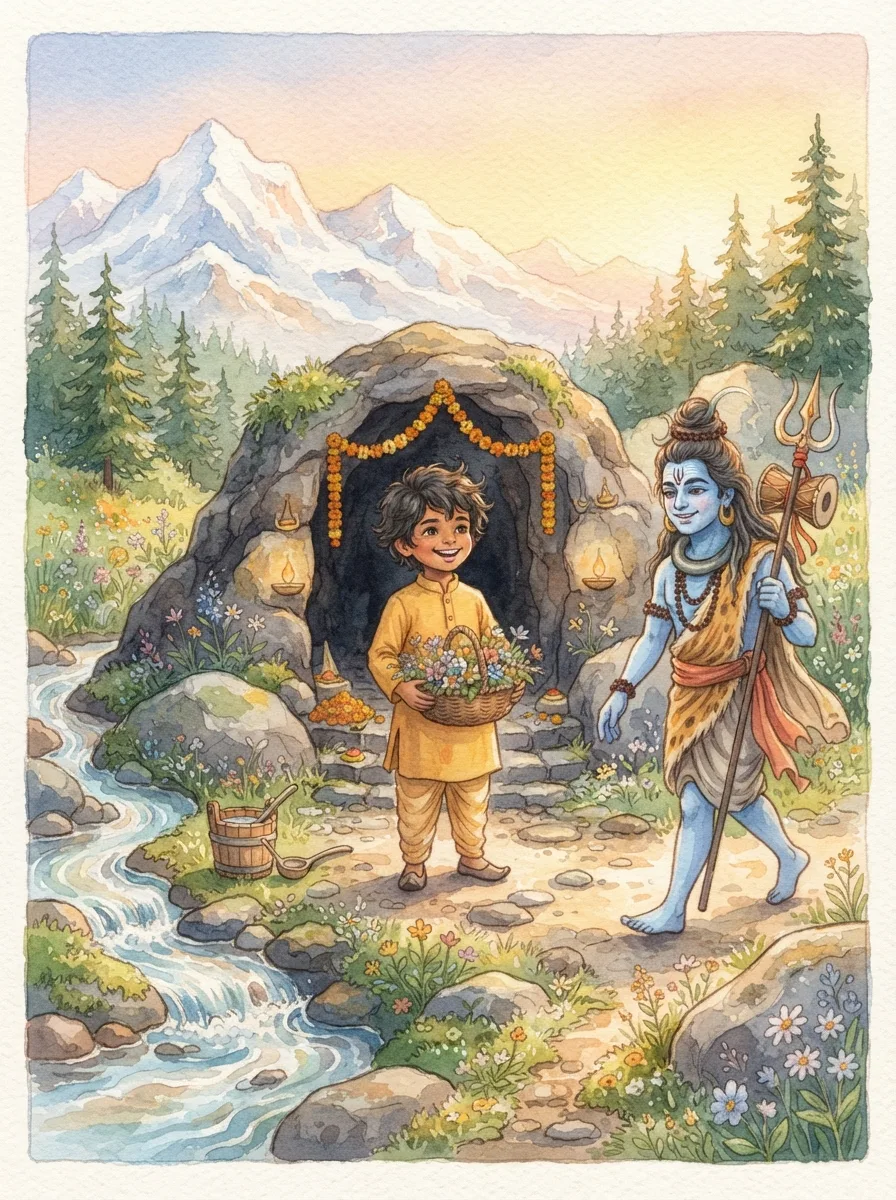
Parvati shapes a boy from turmeric paste and asks him to guard her door while she bathes. Your child, gathering flowers nearby on Kailash, is asked by the new boy how one guards a door. Your child shows him how to stand tall, be polite and never leave the post. When Shiva arrives, the boy stands firm just as taught, and Your child learns that even a guard can be gentle.
Lesson: Stand firm, but stand kindly
Ganesha
Your child and the Elephant Head
Your child and the Elephant Head
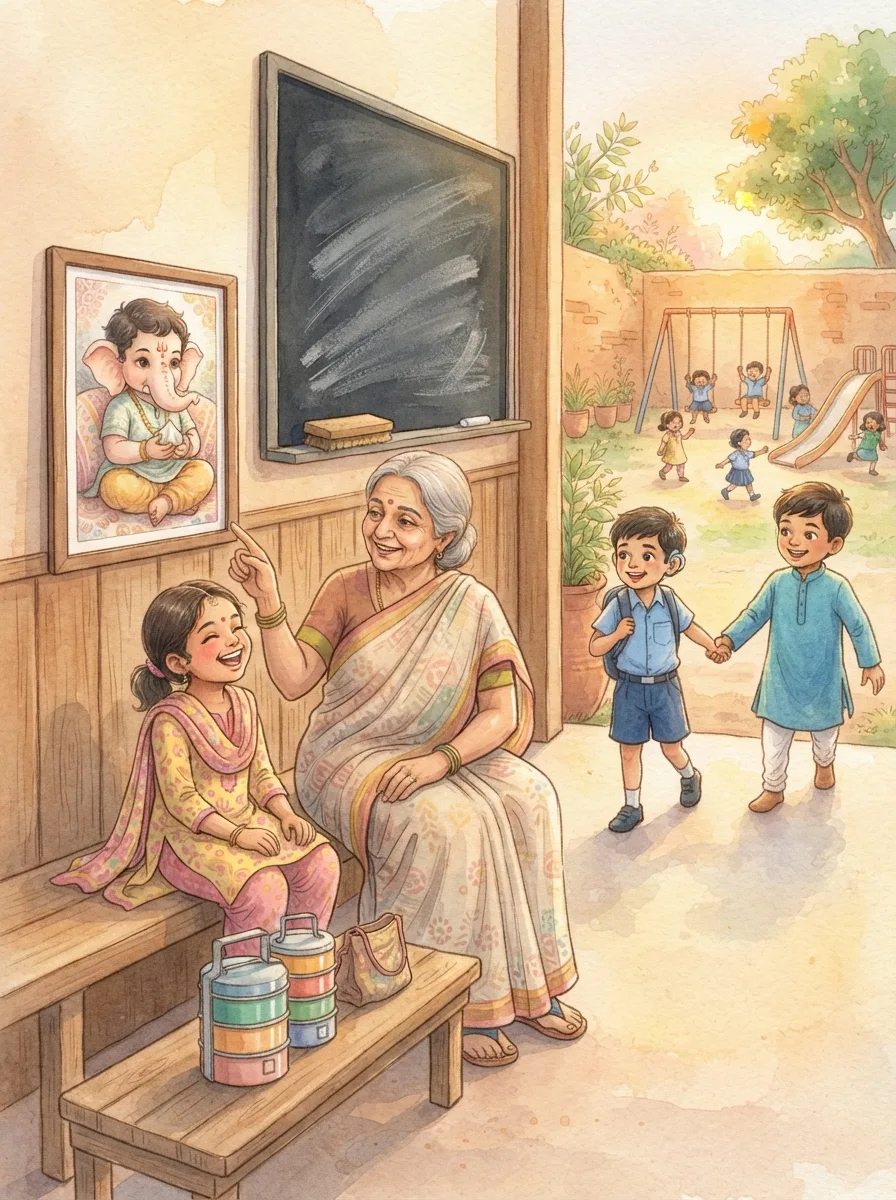
Nani tells Your child how Shiva gave Ganesha an elephant's head and made him the first to be worshipped, so he would never feel different again. At school the next day, new boy Farhan is teased for his hearing aid. Your child remembers the story, sits beside Farhan at lunch, and asks him to be captain of the team. By the end of the week everyone wants Farhan on their side.
Lesson: What makes someone different can be what makes them first
Ganesha
Your child and the Race Around the Parents
Your child and the Race Around the Parents
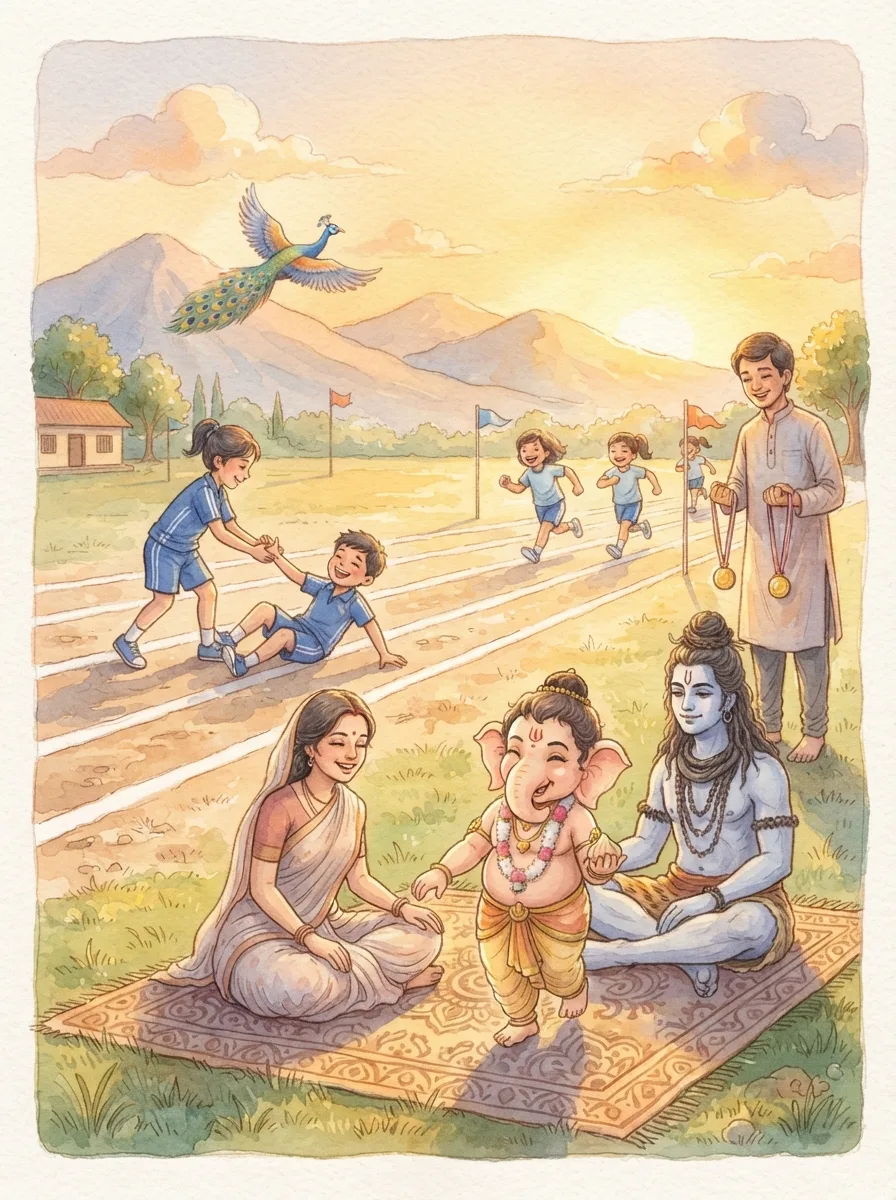
Kartikeya flies off on his peacock to circle the world, while Ganesha simply walks around Shiva and Parvati and says, 'You are my whole world.' Dadaji tells Your child this before the school sports day. Your child is not the fastest runner, but when a classmate falls, Your child stops, helps him up, and they finish together. The teacher gives them both the sportsmanship medal.
Lesson: The wisest way round is not always the fastest
Ganesha
Your child's Plate at Kubera's Feast
Your child's Plate at Kubera's Feast
Proud Kubera invites Ganesha to show off his riches, and Ganesha eats every dish, every plate, and asks for more, until Kubera learns that pride cannot fill a belly. Your child hears this at a wedding buffet where a cousin is piling food only to throw it away. Your child takes a small helping, finishes it, and goes back for seconds, and the cousin quietly does the same.
Lesson: Take what you will finish and go back if you are hungry
Ganesha
Your child and the Broken Tusk Pen
Your child and the Broken Tusk Pen
When Vyasa needs a scribe for the Mahabharata and the pen breaks, Ganesha snaps off his own tusk and keeps writing. Amma tells Your child this during exam week when Your child's pen runs dry halfway through a story. Your child does not give up; Your child borrows a pencil, keeps writing, and later shares a spare pen with the girl at the next desk whose pen has failed too.
Lesson: Finish what you started, whatever the pen
Ganesha
Your child and the Mouse Who Carried a God
Your child and the Mouse Who Carried a God
Ganesha's vehicle is a tiny mouse called Mushak, small enough to slip into any corner. At the Ganpati pandal, a real mouse runs across the floor and the aunties shriek. Your child does not stamp or shout; Your child opens the side door and guides the little creature out with a broom of leaves. The pandit smiles and says Ganpati's friend just came to say hello.
Lesson: Even the smallest creature deserves a gentle way out
Ganesha
Your child and the Moon's Laugh
Your child and the Moon's Laugh
The moon laughs when Ganesha slips after eating too many modaks, and learns that mocking someone is not funny at all. Your child is the one Ganesha turns to, asking if the fall really looked so silly. Your child says 'yes, a little,' then helps Ganesha up and rubs his knee. The moon, watching, feels ashamed and hides his face, and from that day he must wax and wane.
Lesson: Help them up before you laugh, or do not laugh at all
Ganesha
Your child's Modak for the Late Guest
Your child's Modak for the Late Guest
Aaji makes twenty-one steamed modaks for Ganesh Chaturthi, and Your child helps pinch every pleat. Everyone gets one, and just as Your child lifts the last modak, the watchman's little daughter appears at the door. Your child looks at the modak, then at her, and breaks it in two so they each get half. Aaji says Ganpati Bappa likes the half-modak best.
Lesson: Half a sweet shared tastes sweeter than a whole one alone
Ganesha
Your child and the Eleven-Day Guest
Your child and the Eleven-Day Guest
Ganpati comes home for eleven days, and Your child is given the job of morning aarti. On the fourth day the family sleeps in, and everyone forgets. Your child wakes early, lights the lamp alone, and rings the bell softly so nobody is startled. Papa wakes to the sound and says that looking after a guest when nobody is watching is the truest kind of welcome.
Lesson: Look after your guest even when nobody is watching
Ganesha
Your child and the Visarjan by the Lake
Your child and the Visarjan by the Lake
On the last day the idol goes to the lake, and Your child is sad to say goodbye. Papa explains that Ganpati Bappa returns every year, like a friend who visits. Your child notices the family next door has bought a plaster idol with chemical paint and worries about the fish. Your child gently suggests the clay tank set up by the municipal corporation, and both families immerse together in clean water.
Lesson: Say goodbye in a way that keeps the lake clean for next year
Ganesha
Your child and the First Page of the Notebook
Your child and the First Page of the Notebook
Every new notebook in Your child's house starts with 'Shri Ganeshaya Namah' on the first page. Bhaiya laughs and says it is just a habit. Your child asks Dadi why, and she explains that beginning with a good thought clears the path ahead, the way Ganesha clears obstacles. So Your child writes it neatly, then adds a second line: 'I will try my best,' and keeps that promise all year.
Lesson: Begin with a good thought and the path gets easier
Ganesha
Your child and the Obstacle on the Road
Your child and the Obstacle on the Road
Ganesha is called Vighnaharta, remover of obstacles. On the way to school, Your child's bus is stopped by a fallen branch in the lane, and the driver honks and grumbles. Your child gets down, and soon the driver, two aunties and a cycle-wallah are all pulling together. The branch slides aside and the bus rolls on, and Your child thinks maybe obstacles are removed by many hands.
Lesson: Obstacles move fastest when many hands push together
Ganesha
Your child's Single-Tusk Drawing
Your child's Single-Tusk Drawing
In art class Your child draws Ganesha with one tusk, and a classmate says it is a mistake because elephants have two. Your child almost rubs it out, then remembers the story of the tusk given up to finish a great book. Your child keeps the drawing and explains it to the class, and the teacher pins it on the board with the title 'Ekadanta, the one who gives.'
Lesson: Know the story behind what you draw and stand by it
Ganesha
Your child and the Lost Dhol on Chaturthi
Your child and the Lost Dhol on Chaturthi
The colony's Ganesh procession is about to start, but the dhol-wallah's drum strap has snapped and he is close to tears. Your child runs home, fetches Amma's old dupatta and Papa's belt, and helps him knot a new strap. The dhol booms again, the idol sways forward on its cart, and the dhol-wallah lets Your child give the very first beat.
Lesson: Fix the small thing and the big celebration goes on
Ganesha
Your child Listens with Big Ears
Your child Listens with Big Ears
Dadi says Ganesha's big ears mean he listens more than he speaks. At the family dinner, everyone talks over little cousin Meera, who is trying to tell about her lost kitten. Your child puts a hand up, asks everyone to pause, and listens to Meera's whole story. Then Your child organises a search of the stairwell, and the kitten is found asleep in a shoe rack.
Lesson: Big ears and a quiet mouth find what is lost
Ganesha
Ganesha's Playful Riddle
In a cozy temple garden, wise and gentle Ganesha, the elephant-headed friend of beginnings, invites Your child to solve a playful riddle. Instead of rushing, they pause, listen, and think cleverly, choosing patience over hurry. A friendly little mouse squeaks helpful hints while sweet modaks wait as treats. Ganesha smiles, teaching Your child that thoughtful minds and calm patience can gently untangle any puzzle.
Lesson: Patience and clever thinking can solve any problem.
It is Ganesh Chaturthi, and Your child is right in the middle of the celebration. The home pandal glows with marigolds and brass lamps, a plate of freshly folded modaks waits on a banana leaf, and a tiny grey mouse seems to follow Your child everywhere. As the dhol drums begin and neighbours arrive, Your child finds a small but important way to help, and on the last evening walks with the whole street to the water to say goodbye until next year.
Lesson: Patience, kindness and new beginnings make every obstacle smaller.