Buddha
Your child and the Swan in the Palace Garden
Your child and the Swan in the Palace Garden
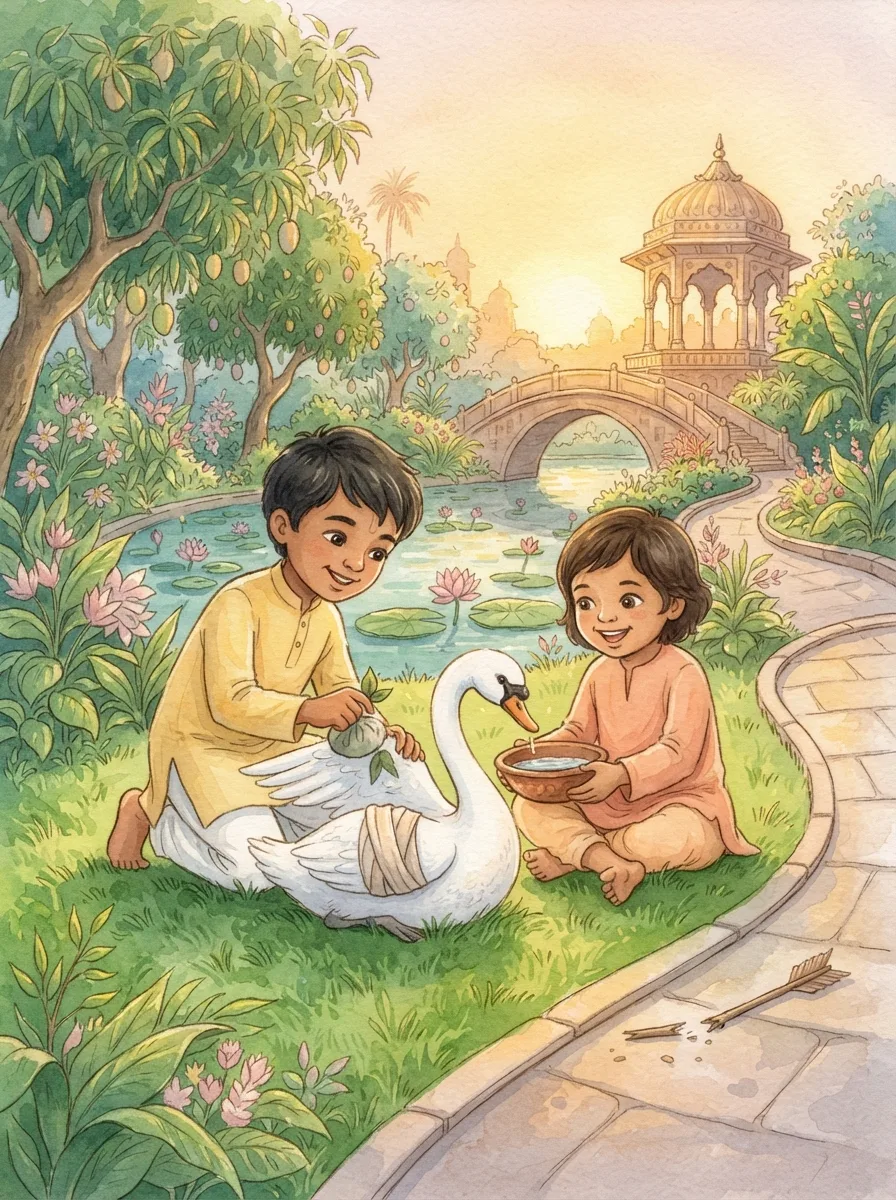
In the palace garden a white swan falls with an arrow in its wing, shot by Prince Siddhartha's cousin. Siddhartha pulls out the arrow and refuses to give the bird up. Your child, the gardener's child, brings a bowl of water and helps hold the wing while the prince binds it with a strip of his own silk. When the elders decide the bird belongs to the one who saved it, Your child cheers the loudest.
Lesson: A life belongs to the one who cares for it
Buddha
Your child and the Four Sights at the Gate
Your child and the Four Sights at the Gate
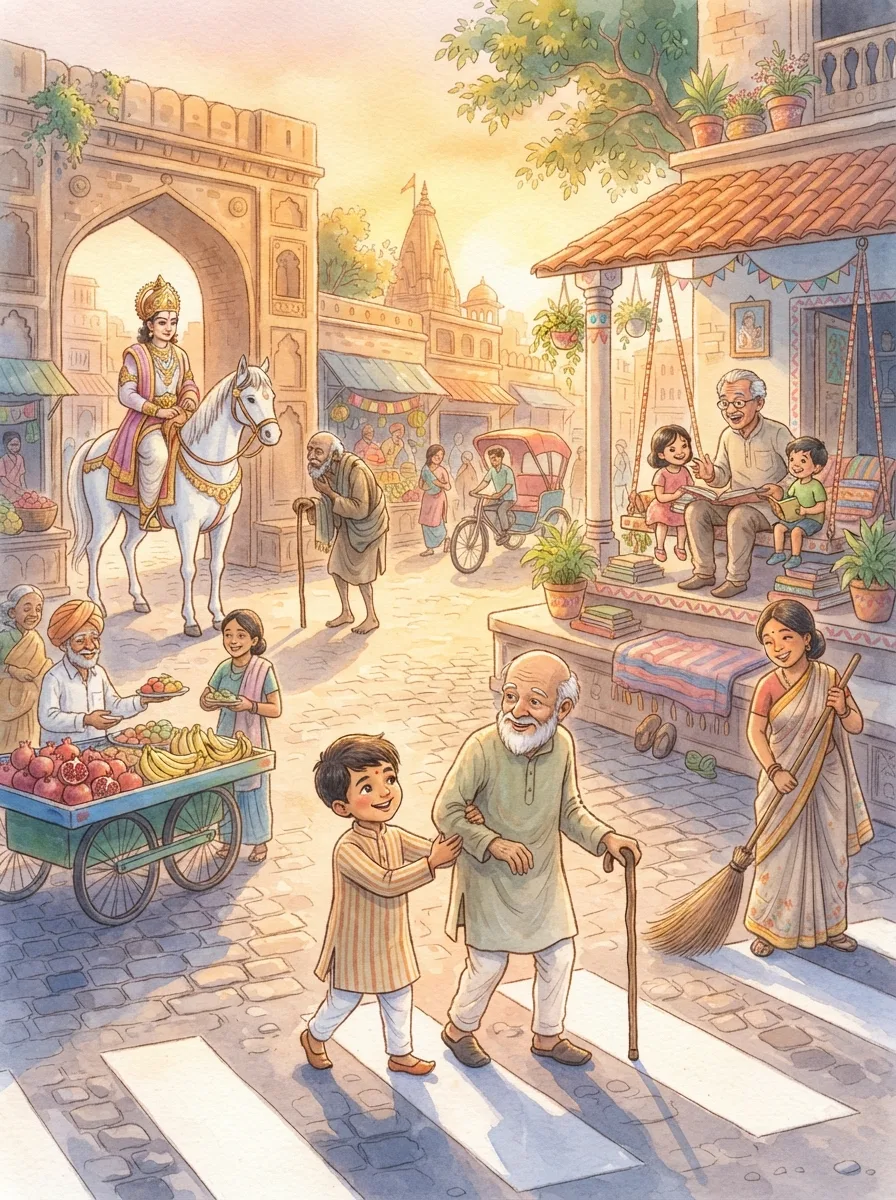
Dadaji tells Your child how the prince rode out of the palace and saw four things his father had hidden from him: an old man, a sick man, a funeral, and a calm monk. The next day, walking to the bus stop, Your child notices the old fruit seller's shaking hands, the coughing boy, the sad family in white, and the smiling sweeper. Your child buys the fruit and offers a hand across the road.
Lesson: Once you truly see, you cannot walk past
Buddha
Your child and the Night the Prince Left
Your child and the Night the Prince Left
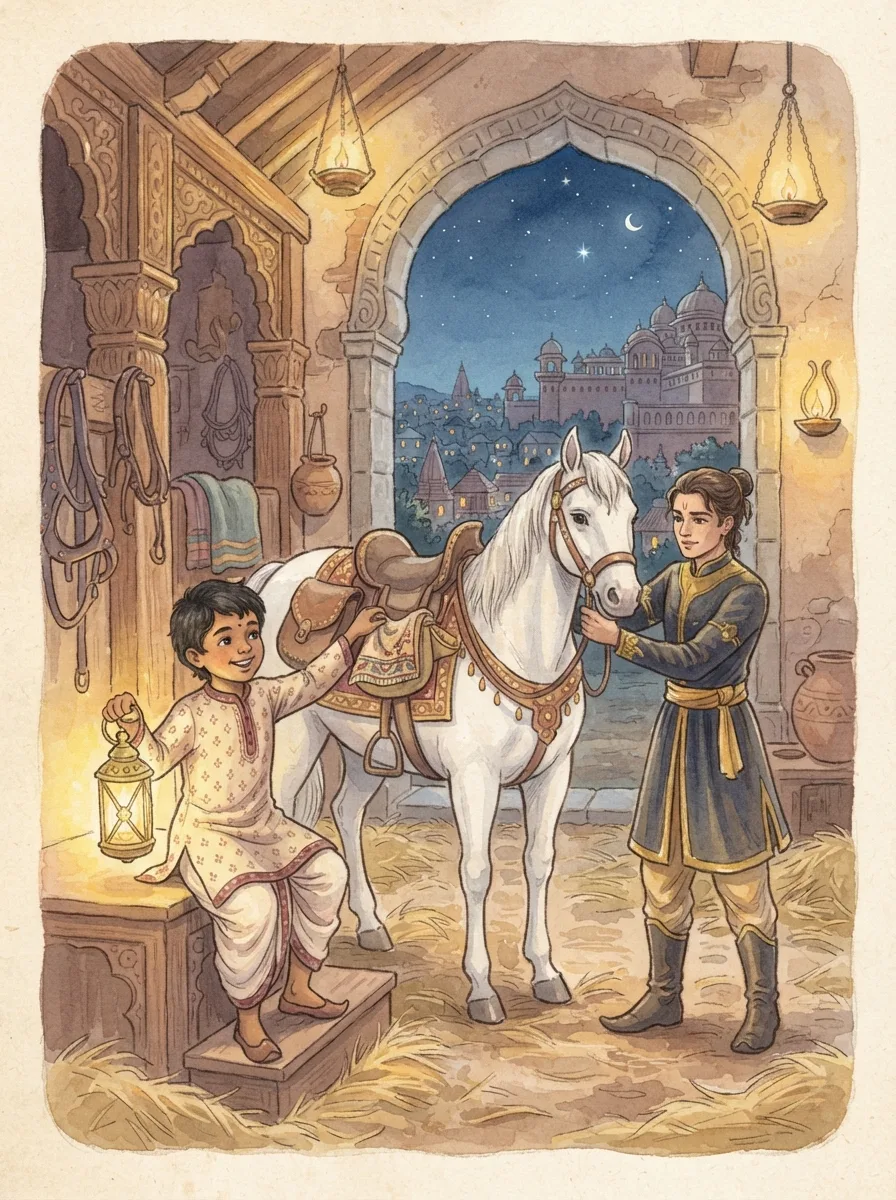
Inside the story, Your child is the stable child who holds the lantern while Siddhartha saddles his horse Kanthaka on the night he leaves. Your child asks why he is going when the palace has everything. The prince says he is going to find something for everyone, not just himself. Your child tucks a small bag of dates into the saddle so the searcher will not go hungry.
Lesson: The biggest journeys begin with a question, not a map
Buddha
Your child and the Bowl of Rice from Sujata
Your child and the Bowl of Rice from Sujata
The prince has starved himself thin under a tree, believing that suffering will bring answers, and is too weak to stand. Your child, walking with the village girl Sujata, carries the bowl of sweet milk rice she has made. When Siddhartha eats, colour comes back to his cheeks. He tells the children that a string too tight snaps and one too loose will not sing, and Your child never forgets it.
Lesson: Not too tight, not too loose, and the string will sing
Buddha
Your child and the Night Under the Peepal Tree
Your child and the Night Under the Peepal Tree
Amma tells Your child how Siddhartha sat under a peepal tree and vowed not to rise until he understood why hearts hurt, and how by dawn he had become the Buddha, the one who woke up. Inside the story, Your child keeps watch nearby all night, sweeping fallen leaves quietly, chasing away a curious monkey, and, when the morning star rises, being the first to see the new peace on his face.
Lesson: Keep watch for someone and you share in their dawn
Buddha
Your child and the Mustard Seed for Kisa Gotami
Your child and the Mustard Seed for Kisa Gotami
Kisa Gotami is heartbroken and the Buddha asks her to bring a mustard seed from a house that has never known sadness. Inside the story, Your child walks with her from door to door. Every house has a seed and a sorrow. By evening Your child sees her tears change from angry to soft, and she says, 'Everyone carries something.' Your child holds her hand all the way back to the tree.
Lesson: Every house has a sorrow, so no one grieves alone
Buddha
Your child and the Bandit Who Became Gentle
Your child and the Bandit Who Became Gentle
Nani tells of Angulimala, a fierce bandit everyone feared, who chased the Buddha through the forest but could not catch a man walking calmly. When the bandit shouted, 'Stop!' the Buddha said, 'I have stopped; it is you who has not.' The bandit dropped everything and became a monk. Your child thinks of the angry boy at school who chases everyone, and tomorrow, instead of running, sits down and offers half an orange.
Lesson: Stop running and even the fierce may stop chasing
Buddha
Your child and the Breath Counting Game
Your child and the Breath Counting Game
Papa cannot sleep, and Your child cannot either. So they play the breathing game the Buddha taught his monks: breathe in and count one, breathe out and count two, up to ten, then start again. Whenever a thought about work or homework arrives, they let it float by like a leaf on the Yamuna. By the fourth round Papa is snoring gently, and Your child smiles and starts a fifth round alone.
Lesson: Count your breaths and let the leaves float by
Buddha
Your child and the Lesson of the Raft
Your child and the Lesson of the Raft
Dadaji tells the Buddha's story of a traveller who builds a raft to cross a river, then carries the heavy thing on his head for the rest of the journey because it once helped him. Your child laughs, then looks at the old broken kite kept for three years and the bag of pebbles from a beach. That weekend Your child gives the pebbles to the little cousin and lets the kite go with a thank you.
Lesson: Thank the raft and set it down
Buddha
Your child and the Full Bowl at the Monastery Door
Your child and the Full Bowl at the Monastery Door
Inside the story, Your child follows the monks on their morning walk with begging bowls, carrying a small bowl too. A poor woman has only one roti and gives half. A rich man gives a heap but does not look up. Back at the monastery the Buddha says the half roti weighed more. Your child eats it slowly, thinking of how Amma always gives the last ladle to whoever comes late.
Lesson: The gift given with a look is the one that fills the bowl
Buddha
Your child and the Elephant in the Market
Your child and the Elephant in the Market
Amma tells how a frightened elephant was once let loose in the market to harm the Buddha, and how it slowed and knelt before his calm as if before a friend. In the story, Your child is the sweet seller's child hiding under a cart, and sees the great animal's ears go soft as the Buddha places a hand on its trunk. Your child creeps out and offers the elephant a jaggery ball, and it takes it gently.
Lesson: Calm is louder than fear, even to an elephant
Buddha
Your child and the Buddha Purnima Lanterns
Your child and the Buddha Purnima Lanterns
On Buddha Purnima the family visits the old vihara, and Your child is given one paper lantern to float on the pond. The little cousin drops hers in a puddle and howls. Your child tears the lantern paper in two, folds two smaller ones with the monk's help, and they float them side by side. The monk says two small lights make more of the pond visible than one big one.
Lesson: A light shared is a light doubled
Buddha
Your child and the Middle of the Seesaw
Your child and the Middle of the Seesaw
Dadi says the Buddha taught the middle path, not too much feasting and not too much fasting, not too much play and not too much work. In the park, Your child watches the little cousins stuck at either end of a seesaw, one high, one low, both shouting. Your child stands on the middle bar, gently rocks it level, and gets the two of them laughing and taking turns. Dadi calls it the middle path in action.
Lesson: Stand in the middle and both sides find their balance
Buddha
Your child and the Mynah Who Copied Everything
Your child and the Mynah Who Copied Everything
Papa tells the Buddha's advice to his son Rahula: look at your words before you speak, the way you look at your face in a mirror. That week a mynah starts repeating everything shouted in the lane, including Your child's grumpy words to the little sister. Hearing them echoed from the tree, Your child goes red, apologises properly, and from then on tries out words in the mirror first.
Lesson: Look at your words in the mirror before you send them out
Buddha
Your child and the Last Lesson Under the Sal Trees
Your child and the Last Lesson Under the Sal Trees
Nani says that when the Buddha grew old he lay down between two sal trees and told his monks the last thing they needed: be a lamp unto yourselves, and keep going with care. Inside the story, Your child stands at the edge of the grove holding a small lamp, not sad but quiet. The Buddha smiles at the lamp and nods, and Your child promises to carry it home and keep it lit.
Lesson: Be your own lamp and keep going with care