Dussehra
Your child and the Ramlila Stage
Your child and the Ramlila Stage
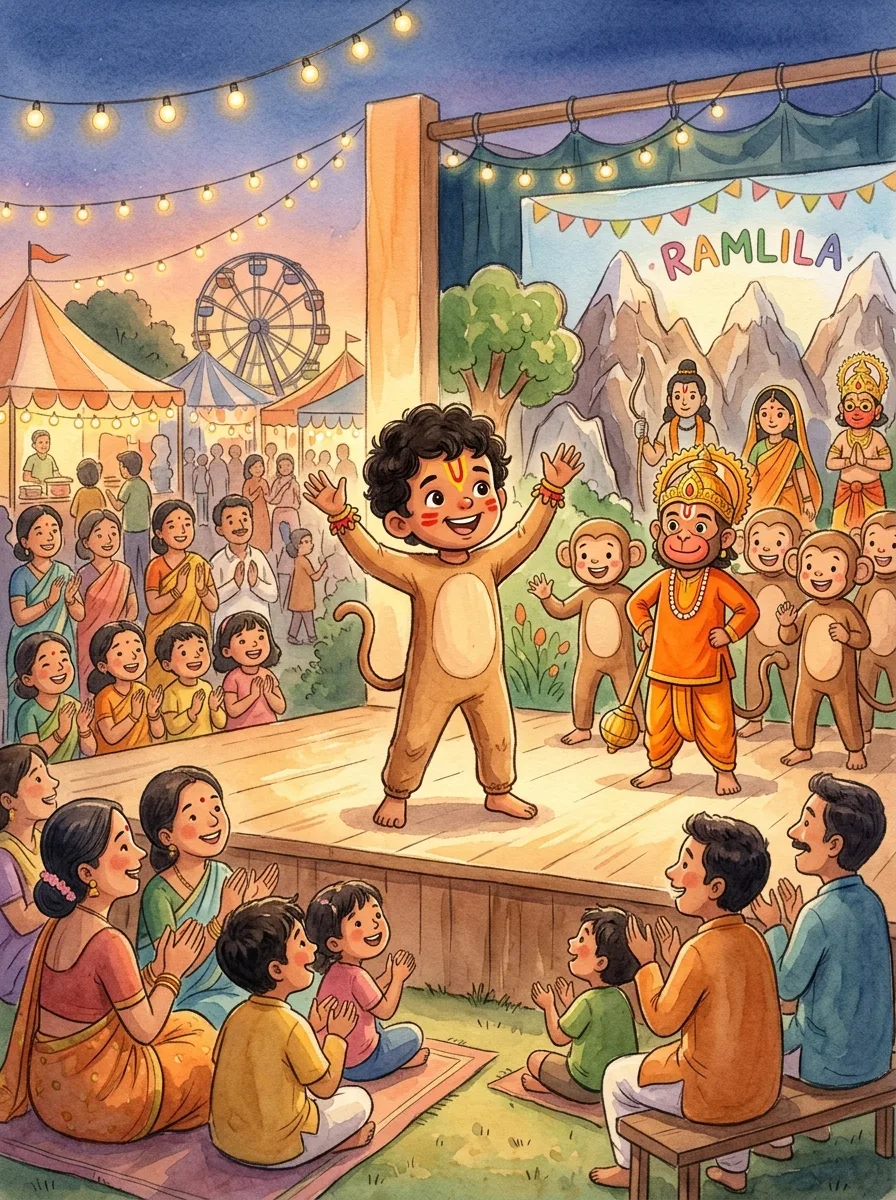
For Dussehra Your child gets a part in the school Ramlila as a monkey soldier, and is disappointed not to be Rama. On stage, the boy playing Hanuman forgets his line. Your child whispers it from behind, then leaps forward and shouts "Jai Shri Ram!" to cover the pause. The audience roars, and the teacher says the play was saved by a monkey.
Lesson: Every role matters when you play it with heart
Dussehra
Your child and the Ravana of Ten Heads
Your child and the Ravana of Ten Heads
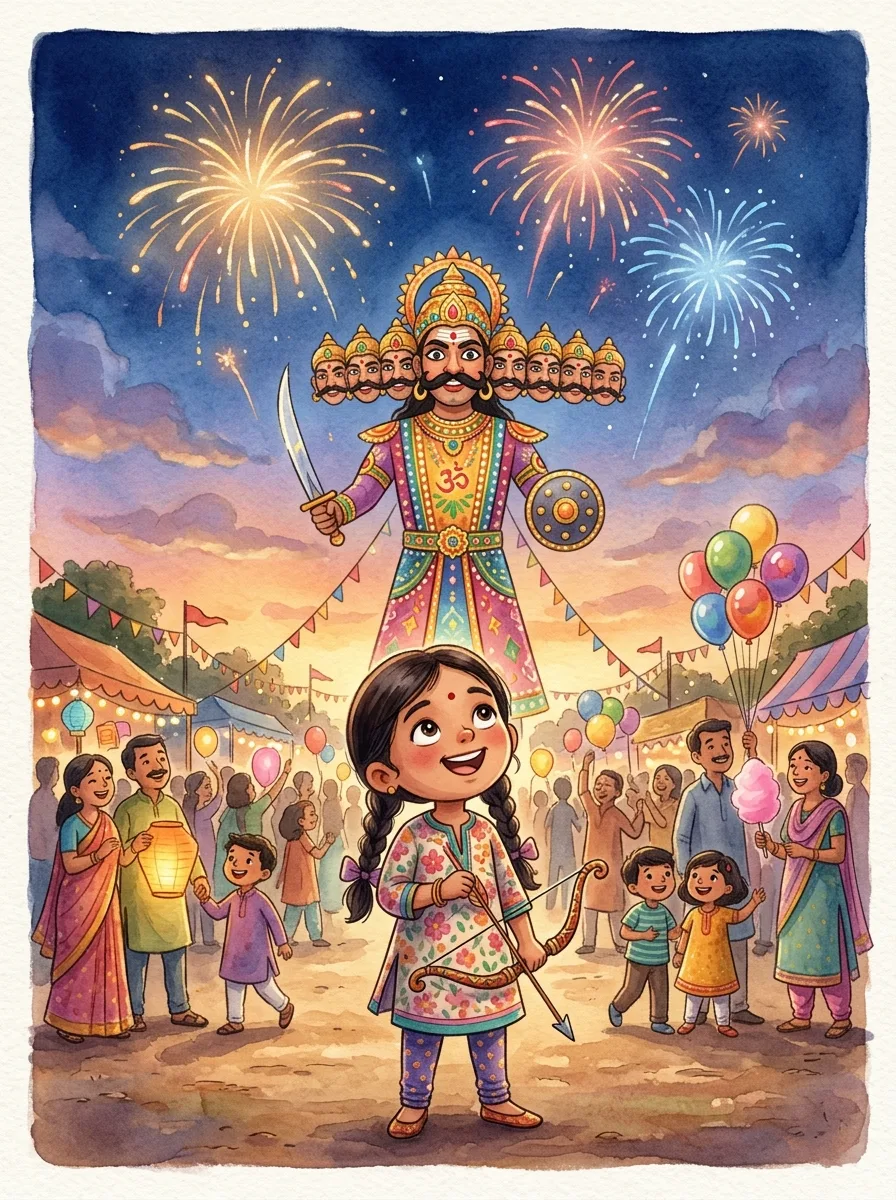
The giant Dussehra Ravana effigy in the field has ten painted heads, and Papa says each one is something inside us: anger, greed, jealousy and more. Your child thinks about the sulk that ruined yesterday. When the effigy crackles and the fireworks burst, Your child pretends to throw the sulk into the flames, and skips home lighter than a sparkler.
Lesson: Let go of the things that make you unkind
Dussehra
Your child and the Shami Leaves
Your child and the Shami Leaves
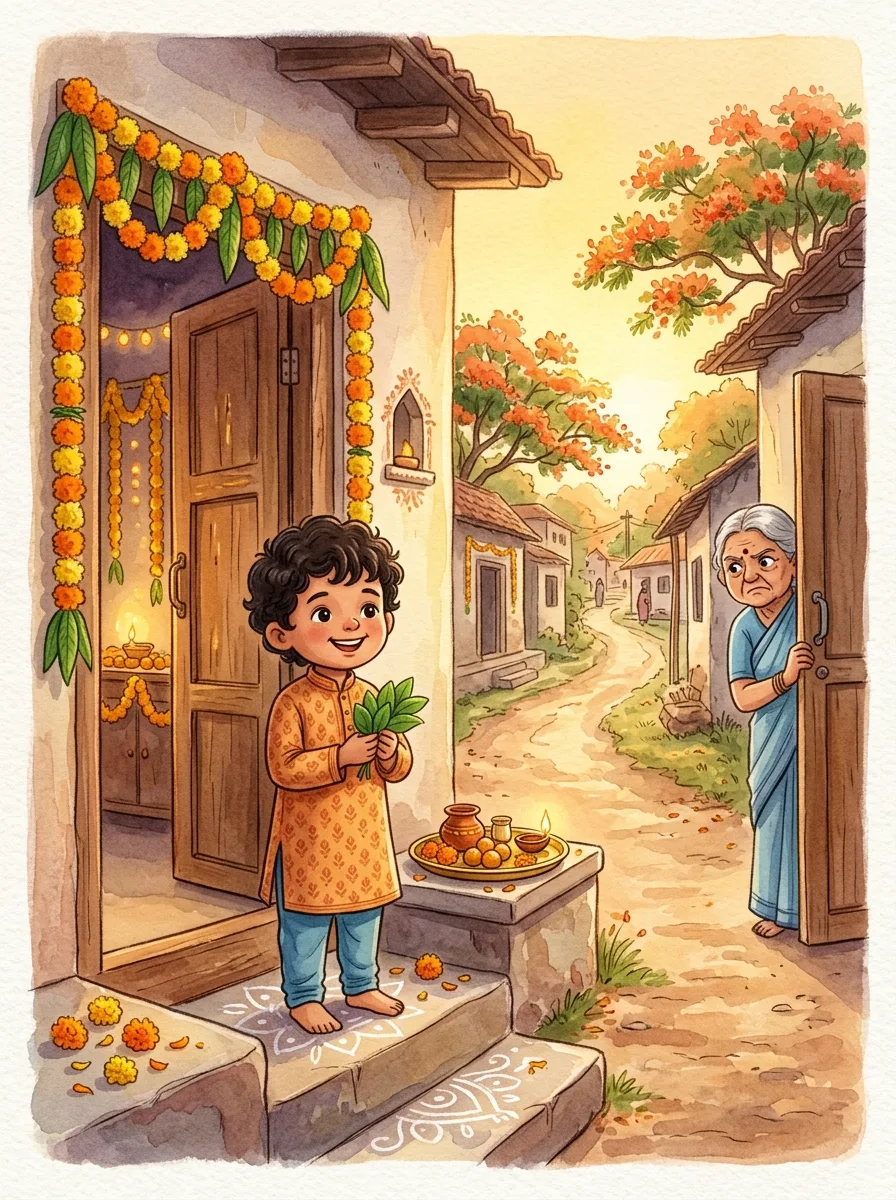
In Your child's Maharashtrian family, Dussehra means exchanging shami leaves as "gold" and wishing each other well. Your child fills a pocket with leaves and goes door to door, but the grumpy neighbour never opens up. Your child slips a leaf under the door anyway. The next morning there is a leaf under Your child's door, and a smile at the gate.
Lesson: Kindness offered freely finds its way back
Dussehra
Your child and the Effigy Builders
Your child and the Effigy Builders
The mohalla's Ravana effigy is forty feet tall and the artisans are racing to finish the ten heads before evening. Your child is handed the job of gluing on the paper moustaches. Nine go on straight; the tenth keeps curling off in the wind. Your child refuses to leave it and holds it in place until the glue sets. That evening, all ten moustaches are still on when the crowd cheers.
Lesson: Finish the last small piece as carefully as the first
Dussehra
Your child and the Boy Who Played Ravana
Your child and the Boy Who Played Ravana
In the school Ramlila, Your child is cast as Ravana and the other children start calling Your child the villain at lunch. It hurts. Nana explains that Ravana was very learned and very proud, and that playing him well teaches everyone what pride does. Your child practises the great laugh until it shakes the hall, and after the play the same children ask for an autograph.
Lesson: Understanding a villain is a lesson, not a stain
Dussehra
Your child and the Lost Arrow of Ramlila
Your child and the Lost Arrow of Ramlila
It is the final scene of the Ramlila and the special golden arrow that Rama must fire is missing from the props box. The actors are panicking behind the curtain. Your child, helping with costumes, remembers seeing it fall behind the drum. There is no time to reach it, so Your child snaps a stick from the marigold garland, wraps it in gold foil from a sweet box, and hands it over just as the curtain rises.
Lesson: When the plan breaks, make something new with what is near
Dussehra
Your child and the Ten Bad Habits
Your child and the Ten Bad Habits
Dadi says Ravana's ten heads stand for ten things that grow too big inside us, like anger and greed. She asks Your child to write one bad habit on a slip of paper for each head. Your child writes 'grabbing the remote', 'saying not me', 'teasing Chintu' and more. At the burning, Your child tucks the slips into the effigy's pocket, and works on the first one the very next morning.
Lesson: Name your bad habits and they become smaller
Dussehra
Your child and the Jatayu Rescue
Your child and the Jatayu Rescue
In the Ramlila, brave Jatayu the vulture tried to stop Ravana's chariot even though he was old. On Dussehra afternoon Your child finds an injured kite bird by the maidan, one wing hanging. The big boys say leave it. Your child fetches a shoebox and Papa's old towel, and they cycle to the bird hospital together. The vet says the wing will heal, and names the bird Jatayu.
Lesson: Be brave for those who cannot fly right now
Dussehra
Your child and the Fair at the Maidan
Your child and the Fair at the Maidan
The Dussehra mela has a giant wheel, balloon shooting and a sugar-candy stall, and Your child has twenty rupees. Then a little girl loses her balloon money in the dust and starts to cry. Your child looks at the giant wheel, looks at the girl, and buys her a balloon. The wheel will be there next year. The balloon floats above the crowd all evening, and so does Your child.
Lesson: Choosing someone else's smile is never a waste
Dussehra
Your child and the Ayudha Puja Tools
Your child and the Ayudha Puja Tools
On Ayudha Puja, Appa cleans and decorates every tool in the house, from the scooter to the kitchen knife, to say thank you for the work they do. Your child decides the school bag, the pencils and the cricket bat deserve thanks too. Each one is wiped, garlanded with a single flower and given a dot of kumkum. The bat, Your child insists, has worked hardest of all.
Lesson: Thank the things that help you every day
Dussehra
Your child and the Bommai Golu Visit
Your child and the Bommai Golu Visit
During Dussehra in Tamil Nadu, families visit each other's Golu doll displays and the children sing a song at each house. Your child is too shy to sing at the first house and the second. At the third, an old lady says nobody has visited her Golu all week. Your child takes a deep breath and sings the whole song, wobbly and loud. The old lady claps until her bangles ring.
Lesson: Your shy voice may be the one someone was waiting for
Dussehra
Your child and the Shami Tree Secret
Your child and the Shami Tree Secret
Dadaji says the Pandavas hid their weapons in a shami tree for a whole year and found them safe on Dussehra. Your child is asked to hide the birthday gifts for a cousin's surprise. Everyone keeps asking where they are. Your child keeps the secret for a whole week, even when tickled by two aunties. At the party, the gifts appear from under the shami tree in the garden.
Lesson: A secret kept faithfully is a gift in itself
Dussehra
Your child and the Mysore Torchlight Parade
Your child and the Mysore Torchlight Parade
At the Mysore Dasara torchlight parade, horses and riders pass under fireworks, and Your child is squeezed at the front of the stands. A younger boy behind cannot see and is about to cry. Your child swaps places without being asked and watches the rest from behind his shoulder. It turns out the view of the fireworks is even better from a step higher up.
Lesson: Giving up the best seat often finds you a better one
Dussehra
Your child and the First Firecracker
Your child and the First Firecracker
When the Ravana effigy burns, the crackers inside it explode in every colour, and Your child's little cousin claps her hands over her ears in terror. Your child wants to watch, but instead walks her to the tea stall at the edge of the maidan, buys two biscuits, and describes every colour so she can enjoy it from afar. Next year, she asks to stand a little closer.
Lesson: Courage grows a step at a time when someone waits with you
Dussehra
Your child and the Return of Rama
Your child and the Return of Rama
After the effigy burns, Dadi says the real festival is Rama coming home. Your child thinks about Nana in the hospital, who has missed Dussehra for the first time. Next morning Your child draws Rama's homecoming on a big sheet, with Nana's chair drawn in the palace, and asks Papa to take it to the ward. Nana keeps it above his bed until the day he comes home himself.
Lesson: A homecoming can be drawn before it happens