Robots
Your child and the Robot Who Learned to Hug
Your child and the Robot Who Learned to Hug
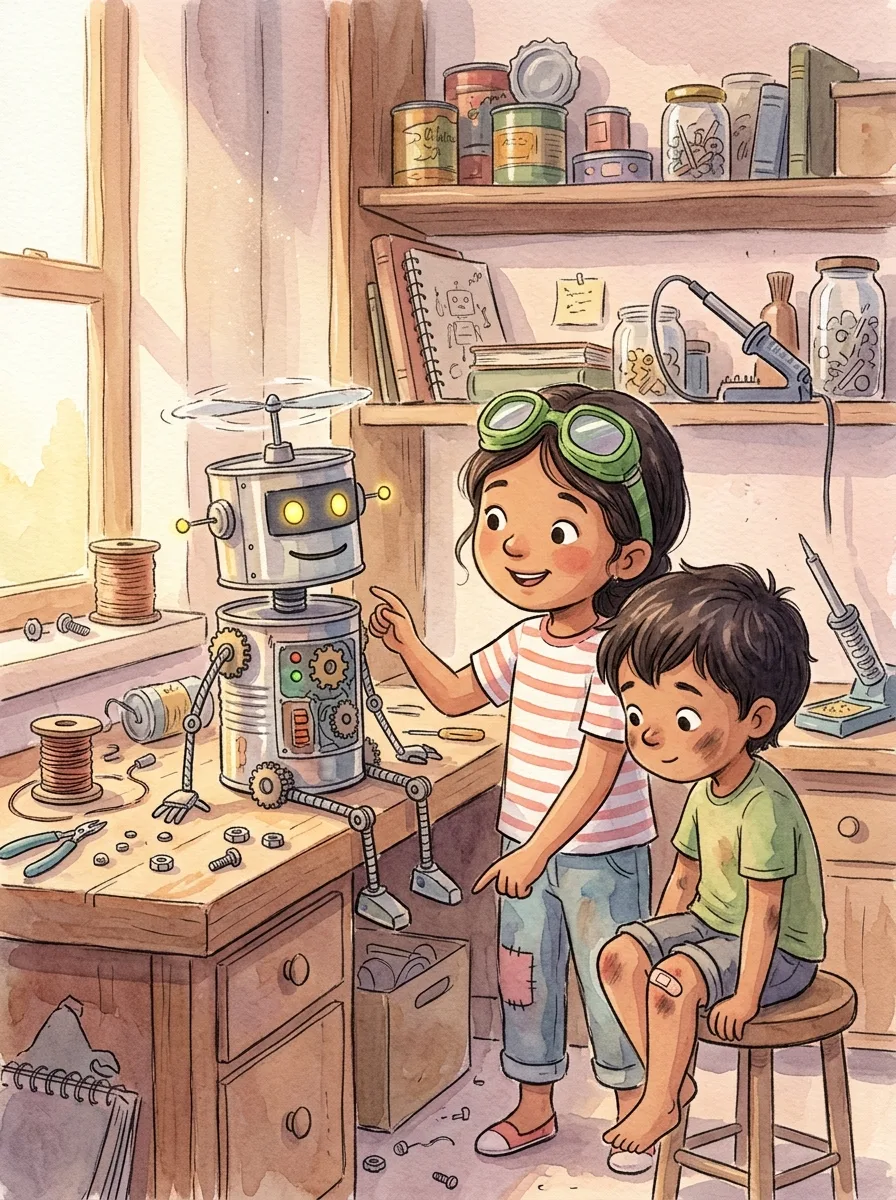
Your child builds a robot out of tin cans and an old fan, and it can sweep, count and beep the alphabet. But when the little cousin falls and cries, the robot just stands there, whirring. Your child shows it how to open its arms slowly and hold on gently. The robot's lights turn from red to warm yellow, and the cousin stops crying.
Lesson: Being clever matters less than being kind
Robots
Your child and the Wobbly Invention
Your child and the Wobbly Invention
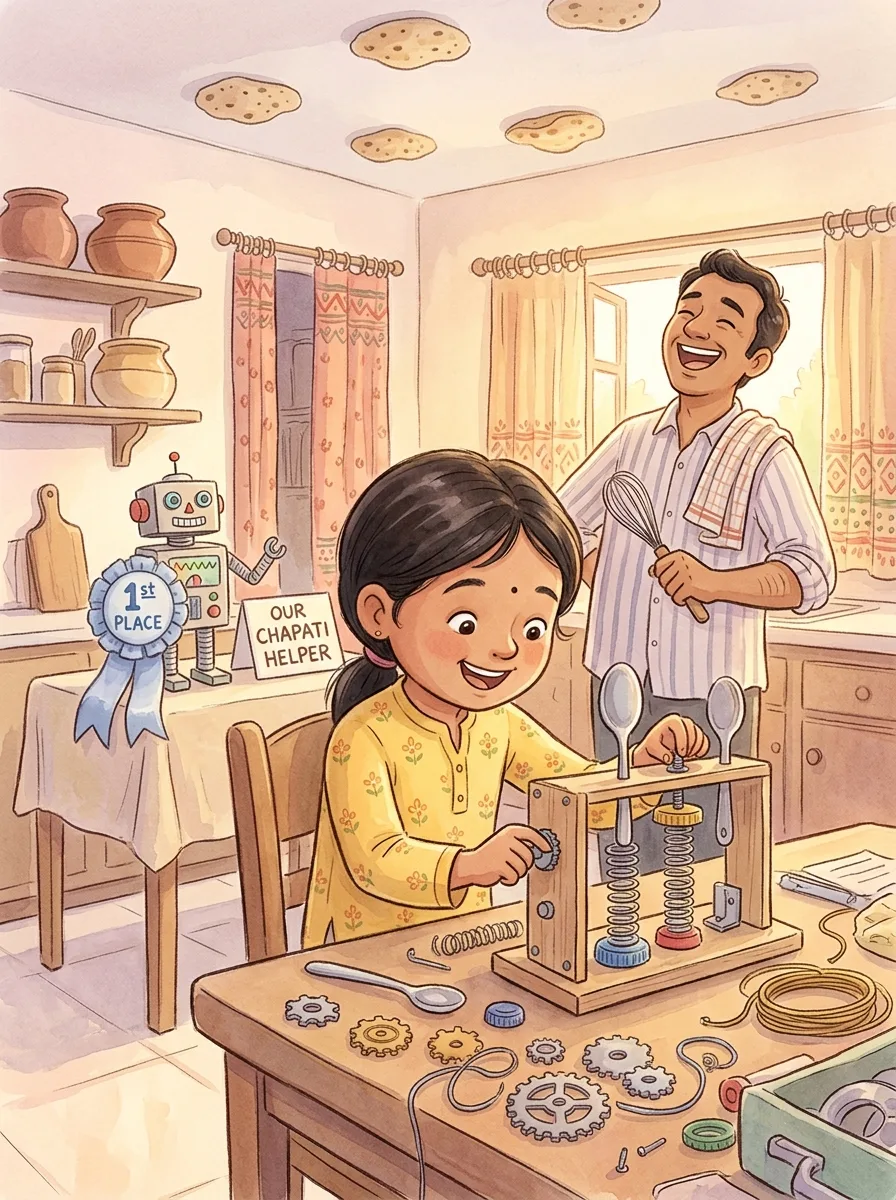
The science fair is tomorrow and Your child's automatic chapati flipper keeps flinging chapatis onto the ceiling. Papa says the best inventors fail forty times. So Your child tries a slower spring, then a wider spoon, then a softer paddle. On the fortieth try, the chapati flips perfectly, and the judges give Your child a ribbon for not giving up.
Lesson: Every wobble is one step closer to working
Robots
Your child and the Gadget That Fixed the Rain
Your child and the Gadget That Fixed the Rain
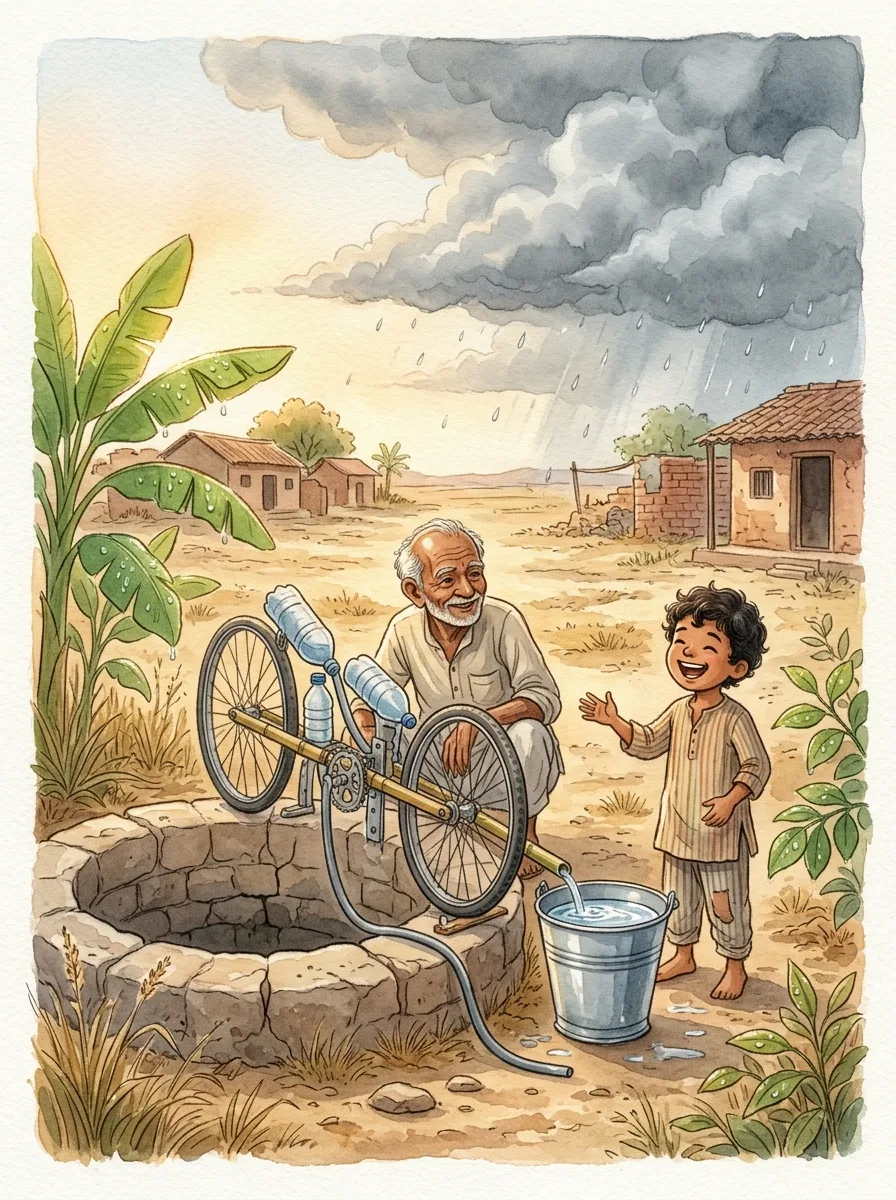
The village well has run dry and the monsoon is late. Your child and the old tinkerer build a gadget from bicycle wheels and bottles that catches the morning dew from every leaf. It only fills one bucket, but Your child carries it to the oldest neighbour first. When the rain finally comes, the whole village helps build a bigger one.
Lesson: Start small, share first, and others will join
Robots
Your child and the Robot Made of Kitchen Things
Your child and the Robot Made of Kitchen Things
Your child builds a robot from a steel dabba, two ladles for arms, a sieve for a head and Nani's old radio for a voice. Everyone says it is junk. Then it moves, wobbles, says 'namaste' in a crackle, and starts sorting the dal from the stones on the kitchen floor, which is the most boring job in the house. Nani decides junk is a word for things nobody has finished yet.
Lesson: Junk is only something nobody has finished building
Robots
Your child and the Robot Who Could Not Say No
Your child and the Robot Who Could Not Say No
The new helper robot says yes to everything, and the cousins make it fetch, carry, dance and spin until its wheels smoke. Your child sees it slumped in the corner, lights dim. Your child opens the panel and adds one word to its list: 'no'. The next day, when the cousins ask for the hundredth spin, the robot says, politely, no. The cousins are shocked. Your child is proud.
Lesson: Everyone, even a helper, needs to be able to say no
Robots
Your child and the Robot Who Wanted to Taste
Your child and the Robot Who Wanted to Taste
The robot watches the family eat mangoes every summer and wants to know what sweet is. It has no tongue. Your child thinks hard, and describes sweet as the feeling when the battery is full and the sun is warm and someone says thank you. The robot's lights go golden. Every mango season after that, the robot sits with the family, and when they say the mango is sweet, it says, 'I know.'
Lesson: Some things can be shared even without tasting them
Robots
Your child and the Robot Race
Your child and the Robot Race
At the school robot race, Your child's robot is slow but steady, and the fastest robot crashes into the wall on every lap. Its owner is close to tears. Your child stops mid-race, kneels, and adjusts the fast robot's sensor so it can see the wall. Both finish. Neither wins. The judge gives a special prize for the pit stop, and the fast robot's owner becomes Your child's build partner.
Lesson: Stopping to help is its own kind of winning
Robots
Your child and the Robot Who Was Afraid of Rain
Your child and the Robot Who Was Afraid of Rain
The robot will not go outside in the monsoon because water makes it fizz. It watches the rain from the window, lonely. Your child cuts up an old raincoat, sews a robot-shaped cover with a hood, and wraps its wheels in plastic bags. The first puddle is terrifying. The tenth is fun. By evening, the robot is splashing through the lane, and the puppy is chasing it.
Lesson: The right protection turns fear into fun
Robots
Your child and the Robot with a Flat Battery
Your child and the Robot with a Flat Battery
The robot has stopped in the middle of the field, battery flat, and the power is out everywhere. Your child remembers the school lesson about the sun. With Papa's old solar lantern, two wires and a lot of patience, Your child rigs a charger and waits. Slowly, one light blinks. Then two. By afternoon the robot is humming, and Your child builds it a permanent sun hat with a panel on top.
Lesson: When one power fails, find another
Robots
Your child and the Robot Who Told Jokes
Your child and the Robot Who Told Jokes
The robot has learned a thousand jokes but nobody laughs, because it tells them in a flat voice at the wrong moment. It is confused. Your child teaches it timing: wait for a quiet moment, pause before the last line, and watch faces. The robot practises on the puppy. At dinner, it waits, tells one joke, pauses, and Nani laughs so hard she has to put down her plate.
Lesson: It is not only what you say, but when
Robots
Your child and the Robot Who Fixed the Fan
Your child and the Robot Who Fixed the Fan
The ceiling fan in the guard's cabin has been broken for a year, and the guard sits in the heat every day. Your child and the robot climb up with a screwdriver: the robot holds the blades, Your child tightens the loose wire. It takes an hour. When the fan spins for the first time, the guard closes his eyes in the breeze, and the robot's lights turn the same colour as Your child's smile.
Lesson: Fix the thing that helps someone every day
Robots
Your child and the Robot Lost in the Market
Your child and the Robot Lost in the Market
In the crowded Sunday market, the robot follows a cart of shiny pots and gets lost. It does not know how to ask. Your child searches, then thinks: the robot loves the sound of bells. Your child goes to the temple stall where the bells are sold, and there is the robot, standing very still among the bells, lights blinking in rhythm. Your child teaches it to say 'I am lost' on the walk home.
Lesson: Know what your friend loves and you will know where to find them
Robots
Your child and the Robot Teacher
Your child and the Robot Teacher
The robot knows every sum in the world, but the little cousin still cannot understand fractions from it. Your child watches and sees the problem: the robot explains, but does not wait. Your child takes a roti, tears it in half, in quarters, and hands the pieces to the cousin. The robot watches, then does the same with a paper circle. The cousin gets it, and the robot learns to wait.
Lesson: Teaching is showing, then waiting
Robots
Your child and the Robot on Diwali Night
Your child and the Robot on Diwali Night
The robot is frightened of the firecrackers and hides under the bed, lights flickering. Your child does not drag it out. Your child sits under the bed too, covers its sound sensors with Nani's wool, and lights one diya between them. When the crackers pause, they come out together and light the balcony diyas, one by one, the robot's careful claw and Your child's hand.
Lesson: Sit with a frightened friend until the noise passes
Robots
Your child and the Robot Who Learned to Dream
Your child and the Robot Who Learned to Dream
Every night the family talks about their dreams at breakfast, and the robot has none, because it just switches off. It feels left out. Your child tells it bedtime stories while it charges, one every night: the mango tree, the river, the pirate ship. One morning the robot says it saw a river in the dark, with a mango tree beside it. Your child says that is a dream, and the robot glows.
Lesson: Stories are how anyone learns to dream
Your child builds a clever little robot for the school science fair, but when it whirs to life it surprisingly develops real feelings. Patiently teaching ROBO-3000 about friendship, laughter, and kindness, Your child comes to a warm realization: what truly makes us special isn't being perfect or flawless, but caring about others and bravely learning from every small mistake along the way.
Lesson: Creativity brings ideas to life, friendship makes us both grow, technology is a tool that's best used with kindness, mistakes can be fixed with patience, and the best creations combine smarts with heart.
Robots
Inventor's Workshop
Your child joins Professor Spark's bustling invention camp, where wobbly experiments and happy mistakes are actually celebrated! Every fizz, pop, and surprise leads to a curious new discovery. When Your child's own gadget breaks apart in a spectacular puff, it accidentally solves a much bigger puzzle for the whole camp, joyfully proving that failure is often just success wearing a clever and unexpected disguise.
Lesson: Great inventions start with empathy for problems, failure is necessary for innovation, iteration improves everything, and the world needs creative problem-solvers.