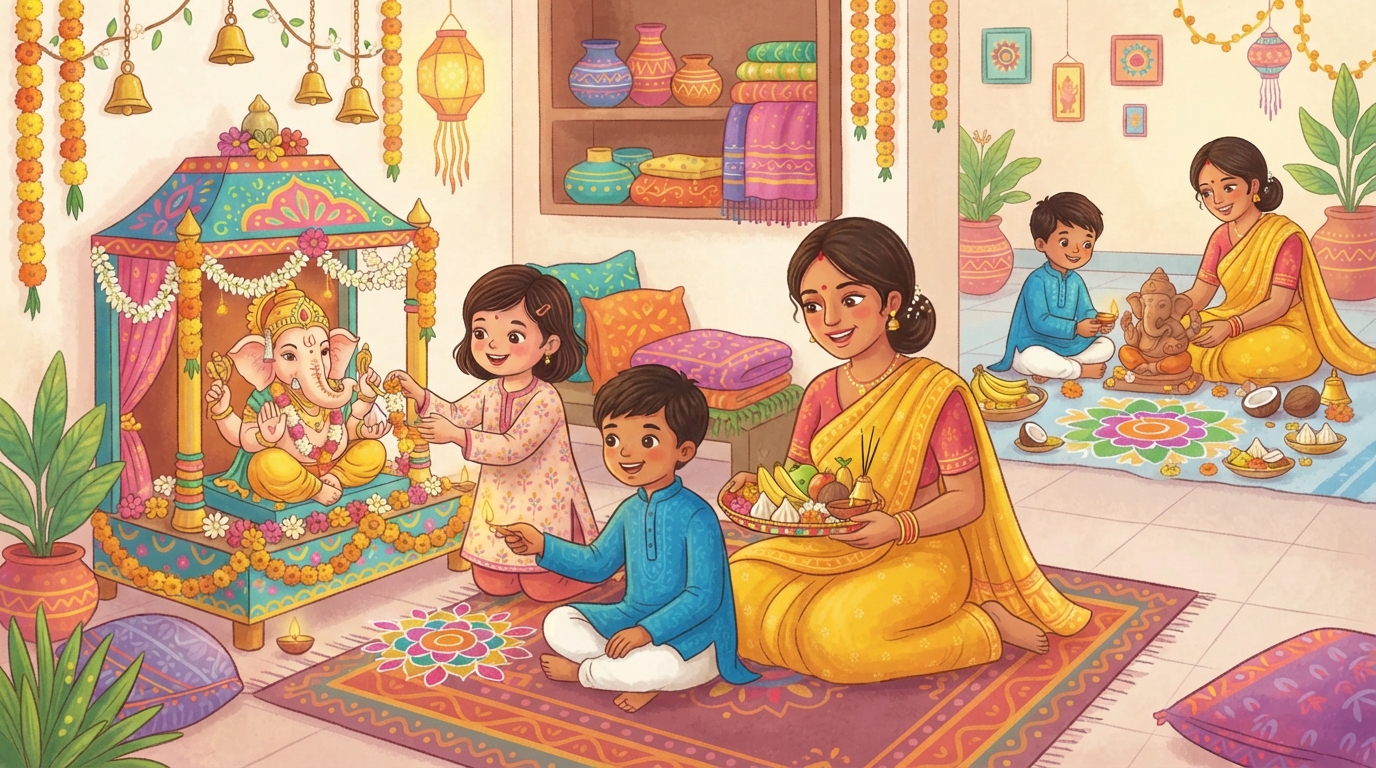
Ganesha stories are made for bedtime. They are short, they are kind, and almost every one of them ends with a sweet. Here are four you can tell in the ten days of Ganesh Chaturthi, retold for children between three and ten, with a gentle lesson tucked inside each.
1. The Race Around the World
One day the sage Narada brought a magical fruit to Kailash and said it could only be given to one of Shiva and Parvati's two sons. To decide, they held a race. Whoever went around the whole world first would win.
Kartikeya jumped onto his peacock and flew off over mountains, oceans and forests. Ganesha looked at his tiny mouse, looked at the enormous world, and thought.
Then he walked slowly around his mother and father, folded his hands and sat down. "My parents are my whole world," he said. "I have gone around it."
When Kartikeya came back, tired and dusty, the fruit was already in Ganesha's hands.
Lesson: the people who love you are your whole world.
2. The Broken Tusk
The sage Vyasa wanted to write the longest story ever told, the Mahabharata, but he needed someone who could write as fast as he could speak. Ganesha agreed on one condition: Vyasa must never pause. Vyasa agreed on his own condition: Ganesha must understand every line before writing it.
They began. Day and night the story poured out, and Ganesha's pen flew. Then, in the middle of a sentence, the pen snapped.
Ganesha did not stop. He broke off one of his own tusks, dipped it in ink and kept writing until the very last word. That is why, in every picture, Ganesha has one whole tusk and one short one.
Lesson: finish what you start, even when things break.
3. The Moon Who Laughed
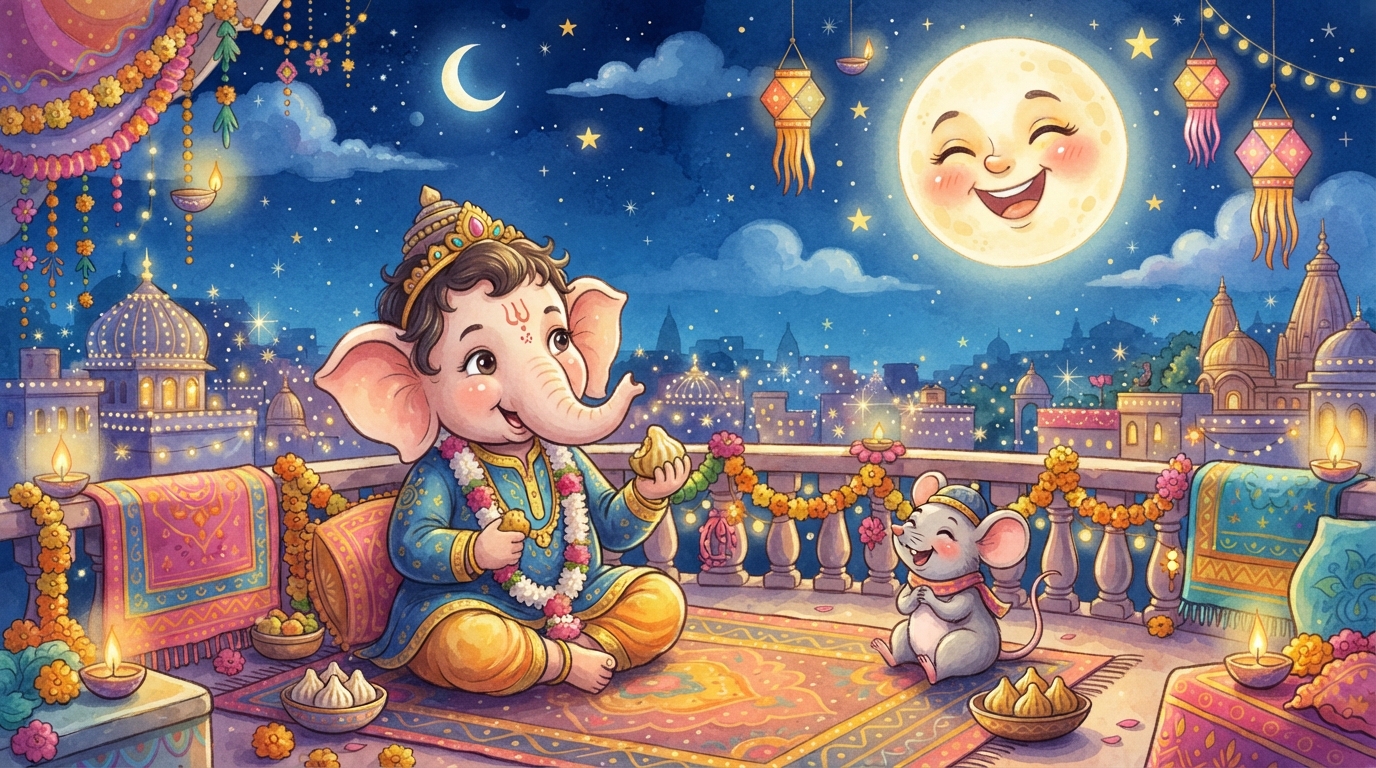
One evening Ganesha had eaten so many modaks that his tummy was round as a pot. Riding home on his little mouse, he wobbled, slipped and tumbled onto the ground. Up in the sky the Moon burst out laughing.
Ganesha was hurt, not by the fall but by the laugh. "Whoever looks at you tonight will have bad luck," he said. The Moon stopped laughing at once and said sorry, again and again. Ganesha softened. "Then only on this one night," he said. And that is why some families do not look at the moon on Ganesh Chaturthi.
Lesson: never laugh at someone who has fallen. Help them up.
4. The Mouse Who Carried a God
Mushak was the smallest creature on the mountain. Everyone else had a lion, a bull or a peacock to ride. Mushak had nothing but whiskers.
When Ganesha needed a ride, he looked past the lion and the bull and chose the mouse. "But I am tiny," squeaked Mushak. "Then we will go slowly," said Ganesha, "and we will see everything on the way."
Together they went everywhere, into the smallest corners and the tightest spaces where no lion could fit. Ganesha never once asked for a bigger ride.
Lesson: even the smallest helper matters.
How to Tell These Stories
Keep them slow. Stop for the funny bits, the tummy-wobble and the whiskers. Ask your child what they would have done in Ganesha's place. And end each one with a modak, real or imaginary.
Put Your Child Inside the Story
On Nanhe Kissey you can turn any of these into a personalised picture book where your child rides beside Mushak, finishes the drawing with a broken crayon, or says sorry to the Moon. Choose a story idea below, add your child's name and photo, and read it together tonight.
Ganpati Bappa Morya.